

If you are relocating from California to the Texas Hill Country, the first question I hear from almost every buyer is about property taxes. The headlines are unavoidable: Texas has some of the highest effective property tax rates in the country, while California, under Proposition 13, has some of the lowest for long-term homeowners. But the headline is not the full picture. The actual financial comparison requires adding state income tax, homeowners insurance, and the Texas homestead exemption into the model. When you run all the numbers together, the result is often surprising, and it rarely matches the simple property-tax comparison that dominates the discussion.
Here is the data-driven analysis, built around real scenarios for a household earning $150,000 per year moving from coastal California to the Texas Hill Country.
What the headlines miss: the full tax burden
The standard comparison looks only at property tax rates. California's average effective property tax rate is approximately 0.71 percent of assessed value. Texas's average effective rate is roughly 1.57 percent, more than double [1][2]. On a $500,000 home, that difference alone looks stark: roughly $3,550 per year in California versus $7,850 in Texas.
But that comparison omits two critical facts. First, California has a progressive state income tax that ranges from 1 percent to 12.3 percent, with a top marginal rate of 13.3 percent including the mental health surtax on income over $1 million [3]. Texas has no state income tax. Second, California's Proposition 13 caps annual assessment increases at 2 percent, but it does not protect new buyers, who are assessed at the full purchase price [4]. A family buying a $500,000 home in California in 2026 pays property taxes based on that full purchase price, not the previous owner's 1970s basis.
For a California household with $150,000 in annual income, the state income tax liability is approximately $8,300 to $9,800 per year depending on deductions and filing status [3]. Texas collects zero state income tax. That $8,300 to $9,800 annual savings more than offsets the difference in property taxes between the two states, before accounting for any other factors.
Annual Tax Burden Comparison: $150K Household Income, $500K Home
| Tax Category | California (est.) | Texas (est.) | Difference |
|---|---|---|---|
| State Income Tax | $8,300 - $9,800 | $0 | Texas saves $8,300 - $9,800 |
| Property Tax (no exemptions) | $3,550 | $7,850 | CA saves $4,300 |
| Homestead Exemption Savings | $0 (no state program) | -$2,600 | Texas saves $2,600 |
| Net Property Tax (with homestead) | $3,550 | $5,250 | CA saves $1,700 |
| Total State Tax Burden | $11,850 - $13,350 | $5,250 | Texas saves $6,600 - $8,100/year |
Sources: California FTB tax brackets (2025-26); NerdWallet California state tax rates; Ownwell Kendall County property tax data; Texas Comptroller homestead exemption (2025). Homestead exemption reflects the $140,000 school district reduction approved in 2025. California property tax uses 0.71% effective rate for new buyers [1][3][5][6]. Actual amounts depend on specific location, income, deductions, and filing status in both states.
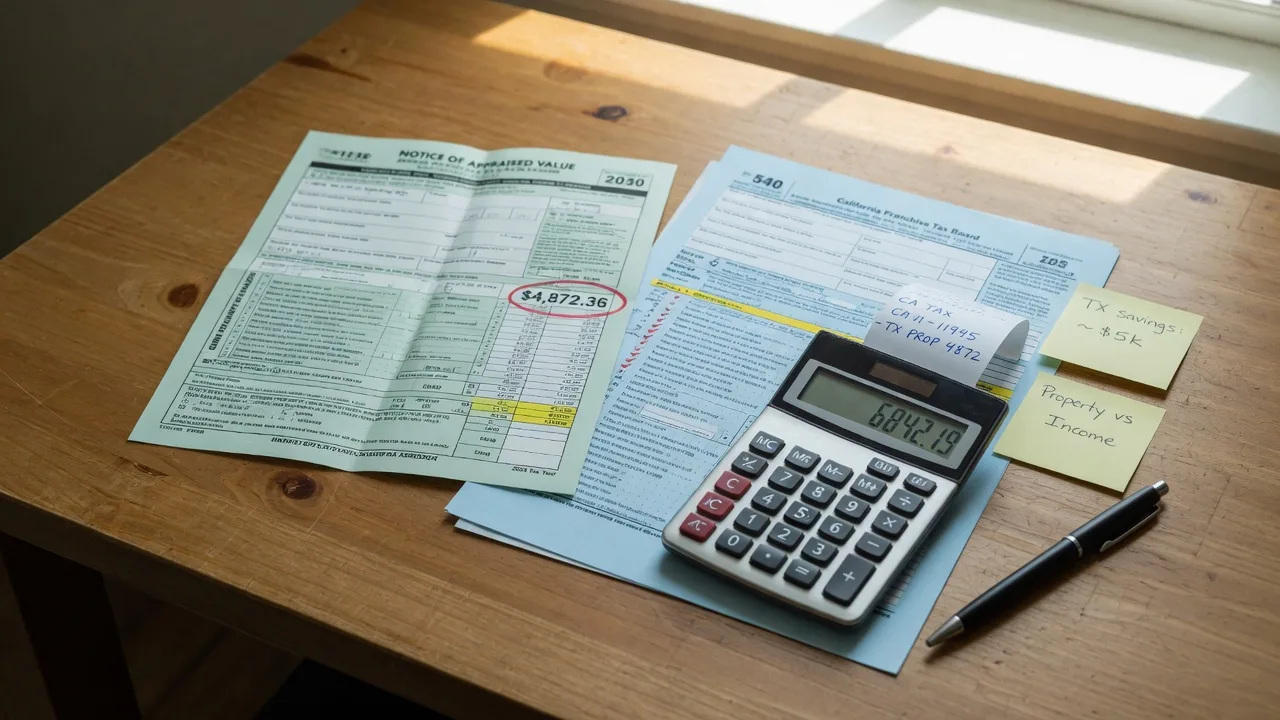
Scenario 1: The $600,000 Hill Country homebuyer
Let me build this out with a specific scenario that I see regularly: a California family earning $150,000 per year, purchasing a $600,000 home in Kendall County near Boerne. They are selling a California home and moving their equity to Texas, the classic relocating family profile.
In California, their property tax on a $600,000 purchase would be approximately $4,260 per year at the 0.71 percent effective rate, assuming no special assessments or Mello-Roos bonds [1]. But in many California communities, Mello-Roos and parcel taxes add $1,000 to $3,000 per year on top of the base rate, particularly in newer developments [4]. Their California state income tax at $150,000 household income would run approximately $8,800 per year [3]. Their California homeowners insurance would be approximately $2,525 per year for $500,000 in dwelling coverage [7].
In Texas, their property tax on a $600,000 home in Kendall County, at an effective rate of approximately 1.86 percent, would be approximately $11,160 before exemptions [2]. After the $140,000 homestead exemption for school district taxes, the taxable value drops to $460,000 for school purposes, reducing the total bill to approximately $8,600 per year [5]. Their Texas homeowners insurance would be approximately $4,500 to $6,500 per year for the same coverage, reflecting the Hill Country's higher exposure to hail, wind, and wildfire risk [8]. Their state income tax: zero.
Scenario 1: $150K Income, $600K Home, Kendall County
| Annual Cost | Coastal California | Kendall County TX | Difference |
|---|---|---|---|
| State Income Tax | $8,800 | $0 | -$8,800 |
| Property Tax (net of homestead) | $4,260 - $5,760 | ~$8,600 | +$2,840 to +$4,340 |
| Homeowners Insurance | $2,525 | $4,500 - $6,500 | +$1,975 to +$3,975 |
| Sales Tax (est. on $60K spend) | ~$4,500 | ~$4,800 | +$300 |
| Total Annual Difference | Texas saves ~$3,685 - $5,185/yr |
Sources: California FTB; Ownwell; NerdWallet; TWFG Broker; Texas Comptroller. Sales tax estimates assume $60,000 annual taxable spending. California property tax range reflects potential Mello-Roos up to $1,500/yr. Insurance range for Texas reflects Hill Country risk premiums [3][5][7][8].
Scenario 2: The higher-income buyer
For buyers earning $250,000 or more per year, the gap widens significantly. California's progressive tax system means a $250,000 household pays approximately $17,600 in state income tax [3]. Texas collects zero. That $17,600 annual savings covers the entire property tax difference between the two states on a $750,000 home, with over $5,000 left over.
This is the reality that the simple property-tax-rate comparison never captures. For higher-income households, the absence of state income tax in Texas is the single largest financial advantage of relocation, and it is not close.
The homestead exemption: the most underappreciated Texas benefit
Texas voters approved a significant homestead exemption increase in 2025, raising the school district exemption to $140,000 of assessed value [5]. This is the single most important property tax relief mechanism for Texas homeowners, and it is often the one California buyers do not know about.
On a $600,000 home in Kendall County, the $140,000 homestead exemption reduces the taxable value for school district taxes from $600,000 to $460,000. School district taxes typically account for 50 to 60 percent of the total property tax bill in Texas. The $140,000 exemption reduces the annual tax bill by approximately $2,600 per year on a typical Hill Country property [5].
The homestead exemption stacks with other exemptions, including the over-65 exemption, the disabled person exemption, and the disabled veteran exemption. For veterans with a 100 percent VA disability rating, the total exemption can reach 100 percent of property taxes [9].
The critical detail: the homestead exemption is not automatic. You must file Texas Comptroller Form 50-114 with your county appraisal district between January 1 and April 30 of the year following your purchase, or within one year of the delinquency date if you miss the window [5][6]. If you buy in August, you will not receive the exemption for that tax year, but you can file by April 30 of the following year and receive it going forward. I see buyers leave hundreds of dollars per month on the table simply because they did not know the form existed.
For a deeper look at how the homestead exemption works, our Boerne property tax guide provides a county-specific breakdown for Kendall County homeowners.
What the year-two appraisal does to your bill
There is one piece of the Texas property tax system that catches most California buyers off guard, and it is worth discussing honestly. In California, Proposition 13 caps the annual assessment increase at 2 percent, providing predictability [4]. Texas has no such cap. When you buy a home, the county appraisal district reassesses the property to its full market value. If you paid $600,000 for a home that was previously assessed at $350,000, the taxable value jumps immediately to $600,000, and your first-year tax bill reflects that full value.
What happens in year two depends on the market. If home values in your area increase by 5 to 10 percent, your appraisal may increase accordingly. Texas does have a 10 percent annual cap on homestead appraisal increases, enacted through Proposition 50 in 2023, but this cap applies only to homesteaded properties, and it limits the increase to 10 percent per year, not 2 percent [10]. Over a decade at 10 percent annual increases, the assessed value could roughly double. In practice, most Texas counties have seen more moderate increases, but the risk of significant year-over-year jumps is real, and it is the most common source of post-purchase frustration for California transplants.
The solution is straightforward: file your homestead exemption every year (most counties send renewal notices), monitor your appraisal notice each spring, and be prepared to protest if the increase exceeds market conditions. The protest process in Kendall County is straightforward and does not require an attorney. Our guide to protesting your appraisal walks through the process step by step.
Insurance: the hidden variable
One cost that does increase meaningfully when moving from California to the Texas Hill Country is homeowners insurance. Texas has the highest average homeowners insurance premiums in the United States, driven by catastrophic weather events, hail damage, windstorms, and freeze claims [8]. In the Hill Country specifically, properties face hail risk from spring storms, wildfire exposure in dry years, and freeze damage following events like Winter Storm Uri in 2021 [8].
For a $500,000 to $600,000 Hill Country home, annual premiums typically range from $4,500 to $6,500. California premiums for equivalent coverage run approximately $2,525 per year [7]. The difference of $2,000 to $4,000 per year is material, though it is still substantially smaller than the state income tax savings for most relocating households.
What the model says for the typical relocating family
When I walk through this analysis with clients, a clear pattern emerges. For a family earning $150,000 per year buying a $600,000 home in the Hill Country, the move from California produces annual savings of roughly $3,700 to $5,200 per year, after accounting for higher property taxes and insurance. For a family earning $250,000 per year, the savings grow to $12,000 to $15,000 per year [3][5][7][8].
The savings are real, but they are not automatic, and they depend on two things the homeowner controls: filing the homestead exemption on time and monitoring the annual appraisal for errors. The family that files the exemption and protests an inflated appraisal will save thousands more per year than the family that lets both slide.
Thinking through the tax math for your move?
I run this analysis with every California relocating client before we start looking at properties, using the actual tax rates for the specific county and school district they are considering. No scripts, no generic comparisons, just the numbers that apply to your income, your home price range, and the community you are targeting.
Schedule a Consultation | Relocation ResourcesFrequently asked questions
Are Texas property taxes really higher than California?
The effective property tax rate is higher in Texas, roughly 1.57 percent versus California's 0.71 percent for new buyers. On a $500,000 home, that difference is approximately $4,300 per year. However, when you add California's state income tax (approximately $8,800 per year at $150K income), Texas's total state tax burden is significantly lower. The property tax headline is true but incomplete [1][3].
Does Proposition 13 protect California buyers who move to Texas?
No. Proposition 13 limits annual assessment increases for California homeowners, but that protection does not follow you to Texas. When you buy a home in Texas, the county appraisal district assesses it at the purchase price. In subsequent years, Texas's 10 percent appraisal cap (Proposition 50) limits increases on homesteaded properties, but this is a higher cap than California's 2 percent limit [4][10].
How much does the Texas homestead exemption actually save?
The $140,000 school district exemption, approved by voters in 2025, reduces the taxable value for school district taxes by $140,000. On a typical Hill Country property with an effective rate of 1.86 percent, this saves approximately $2,600 per year. The exemption must be filed with Form 50-114 through your county appraisal district [5].
Is homeowners insurance really more expensive in Texas?
Yes. Texas has the highest average homeowners insurance premiums in the country. In the Hill Country specifically, annual premiums for a $500,000 to $600,000 home typically run $4,500 to $6,500, compared to approximately $2,525 in California for equivalent coverage. The difference of $2,000 to $4,000 per year is driven by hail, wind, and freeze risk [7][8].
How do I file the homestead exemption in Kendall County?
File Texas Comptroller Form 50-114 with the Kendall County Appraisal District between January 1 and April 30 of the year following your purchase. You can also file late within one year of the tax delinquency date (typically February 1 of the following year) to receive a refund. The form requires your name, property address, and evidence of occupancy, typically a Texas driver's license matching the property address [5][6].
Will my property taxes jump in year two?
They can, if the county appraisal increases. Texas law limits homestead appraisal increases to 10 percent per year (Proposition 50), but that is a cap, not a guarantee of stability. If home values in your area increase, your appraisal can rise up to that cap. Monitoring your annual appraisal notice and protesting if the increase exceeds market conditions is standard practice for Texas homeowners [10].
Do I save more on taxes if I earn more?
Yes, because Texas has no state income tax and California's tax is progressive. A household earning $250,000 per year saves approximately $17,600 per year in state income tax by moving to Texas, compared to $8,800 for a $150,000 household. For high-income earners, the absence of state income tax is the single largest financial advantage of relocating to the Hill Country [3].
Sources
- Property Tax by State 2026, California Effective Rate. California average effective property tax rate of 0.71%. propertytaxbystate.com
- Ownwell, Kendall County Property Tax Data (2026). Median effective rate of 1.57% in Kendall County; median home value of $484,320; median tax bill of $4,630. ownwell.com
- NerdWallet, California State Income Tax Rates & Brackets (2025-2026). Progressive brackets from 1% to 12.3%; 13.3% top rate including mental health surtax. nerdwallet.com
- Ballotpedia, California Proposition 13 Overview. Assessment cap, Mello-Roos districts, and impact on new buyers. ballotpedia.org
- Texas Comptroller, Homestead Exemption (2025). $140,000 school district homestead exemption approved by voters; Form 50-114 filing requirements. comptroller.texas.gov
- Kendall County Appraisal District, Homestead Exemption Application. Filing deadlines, forms, and instructions for Kendall County homeowners. kendallcad.org
- NerdWallet, Average Homeowners Insurance Cost in California (2026). Average annual premium of $2,525 for $500K dwelling coverage. nerdwallet.com
- TWFG Broker, How Much Does Homeowners Insurance Cost in Texas in 2026. Texas average premiums; Hill Country risk factors including hail, wind, and freeze. twfgbroker.com
- Texas Comptroller, 100% Disabled Veteran and Surviving Spouse Exemption FAQ. Full property tax exemption for qualifying disabled veterans. comptroller.texas.gov
- Texas Proposition 50 (2023), Texas Tax Code Sec. 23.23. 10% annual cap on homestead appraisal increases. statutes.capitol.texas.gov
This article provides general information about tax comparisons between California and Texas for relocating homebuyers. Tax laws, rates, and exemptions change. Verify current information with a qualified tax professional before making financial decisions based on this analysis.
Last verified: October 6, 2026
Published: August 19, 2026
Updated August 19, 2026