
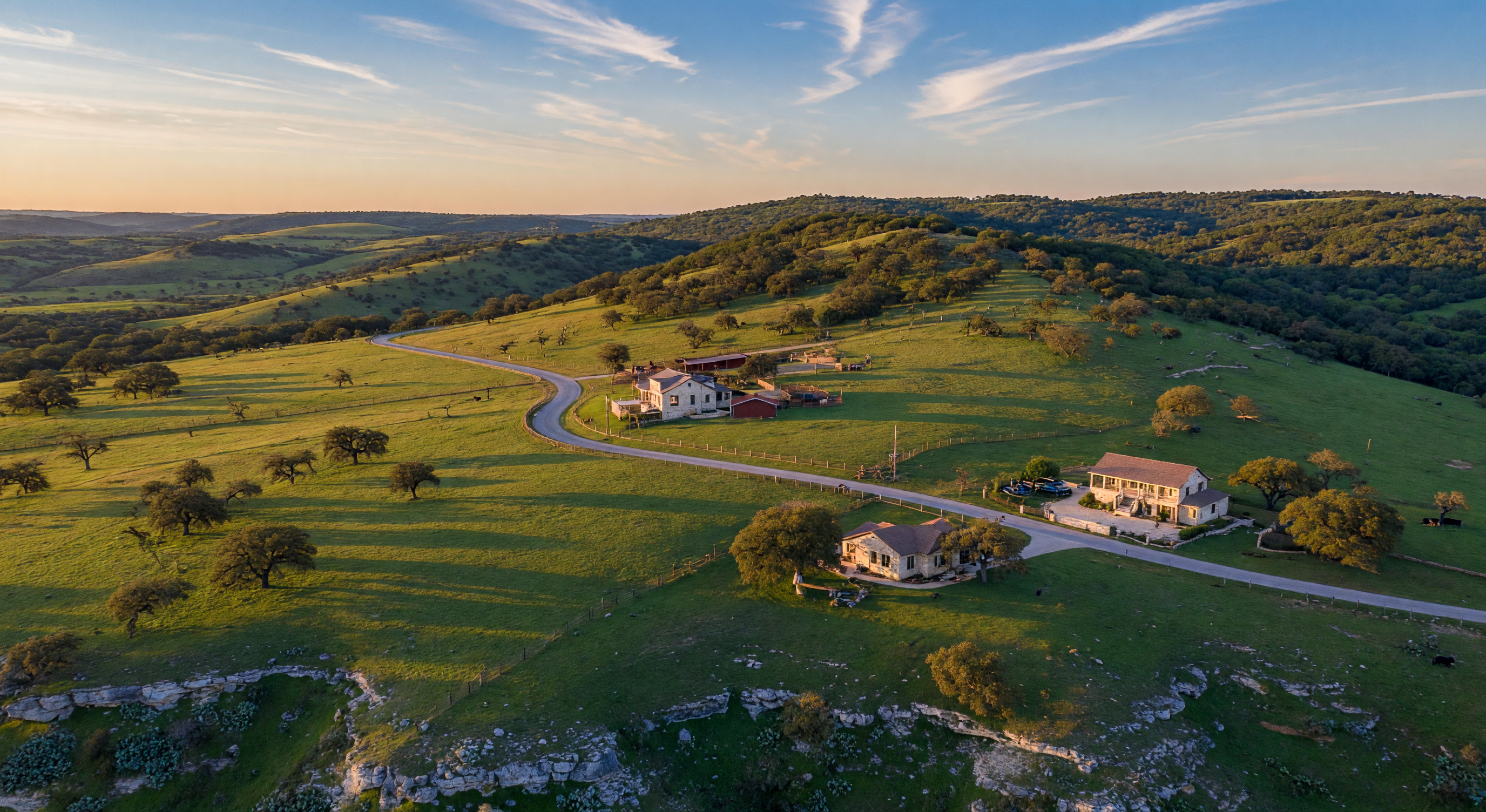
Hill Country Property Types
What You're Actually Buying
Every property type in the Texas Hill Country carries specific infrastructure, maintenance, tax, and lifestyle implications that most listing agents do not explain. This guide covers what each type actually means for the person who owns it.
The Texas Hill Country is not one real estate market. It is a collection of fundamentally different property types — each with its own infrastructure requirements, maintenance costs, tax implications, and lifestyle tradeoffs. An acreage property with a private well operates on completely different assumptions than a home in a gated community with municipal water. A ranch with an agricultural tax valuation follows rules that a standard residential buyer will never encounter.
Most listing agents describe these properties by square footage and bedroom count. That misses the point. What matters — what actually determines whether the property works for you — is the operational reality underneath. Water supply, septic systems, lot maintenance, HOA restrictions, limestone terrain, tax exemptions, development costs. These are the details that separate a good purchase from an expensive lesson.
This page walks through each major property type in the Hill Country with the specific considerations that most agents gloss over. It is designed for buyers who want to understand what they are buying — not just what it looks like.
Acreage: 1 to 10+ Acres
Acreage properties are the signature Hill Country purchase — typically 1 to 10 acres with rolling terrain, mature oaks, and a sense of space that suburban lots cannot replicate. But land comes with operational responsibilities that a half-acre suburban lot does not. Here is what owning acreage actually involves.
Water Supply: Well vs. Municipal
Water Supply: Well vs. Municipal
The majority of Hill Country acreage properties rely on a private well rather than municipal water. This means your water supply depends on the well's depth, the aquifer it draws from, and geological conditions that can vary dramatically from one parcel to the next.
Typical well depths near Boerne and Kendall County range from 200 to 800 feet. A well on one side of a property may hit productive fractures at 400 feet, while the adjacent parcel may need 800 feet for comparable yield. Well drilling is quoted as "to water plus 50 feet" because the exact depth cannot be predicted in advance.
What this means for buyers: Always request a well yield test during the option period. A minimum of 3 gallons per minute (GPM) is the threshold for a functional household well; 5–10 GPM is preferred. Pump replacement costs range from $2,000 to $5,000+ depending on depth. Annual well maintenance costs (testing, treatment, electricity) typically run $300 to $900.
Some properties straddle municipal service boundaries and may have the option to connect to city water. Connection fees typically range from $1,500 to $5,000+, but the infrastructure cost of running a water line from the nearest municipal main can be substantially more. For most acreage properties outside city limits, well water is the practical reality.
Septic Systems: The Maintenance Most Owners Forget
Septic Systems: The Maintenance Most Owners Forget
Acreage properties on well water almost always use a septic system. In the Hill Country, the predominant type is the aerobic septic system — which uses electricity, mechanical aerators, and regular maintenance. This is not a passive system you can ignore.
- Maintenance requirements: System-specific and jurisdiction-specific. Consult the local authorized agent and verify the current permit and maintenance record for the specific system on the property.
- Chlorine tablets: Many aerobic systems use chlorine for final disinfection. Regular replacement is required.
- Tank pumping: Required when sludge and scum layers exceed regulatory limits. Typically every 3–5 years.
- System replacement: $15,000–$30,000+ for a complete new installation, with Hill Country limestone terrain adding $2,000–$5,000 to drain field work compared to standard soil.
Lenders (FHA, VA, conventional) all require a functional septic system at closing. A non-functional system can prevent financing from closing.
Fencing: What You Are Responsible For
Fencing: What You Are Responsible For
On acreage, fencing is your responsibility — and it is more complex than most buyers expect. Texas fence law places specific obligations on landowners:
- Boundary fencing: In most cases, adjacent landowners share the cost of boundary fencing under Texas Property Code Chapter 203. If a boundary fence does not exist, either neighbor can build one and recover half the cost from the adjoining owner.
- Livestock fencing: If your property borders open range (common in parts of Bandera and Kendall Counties), you may need to fence to keep livestock out rather than fencing to keep things in.
- Replacement cost: A quality pipe or cable fence runs $8–$20 per linear foot installed. For a 5-acre property with 660 feet of perimeter, that is $5,300–$13,200 for a full fence. Rural barbed wire runs $3–$8 per linear foot but is not appropriate for all settings.
- Maintenance: Hill Country terrain — limestone, slopes, and mature trees — makes fence maintenance ongoing. Posts heave, wire sags, and gate hardware requires regular attention.
Agricultural and Wildlife Management Tax Exemptions
Agricultural and Wildlife Management Tax Exemptions
Acreage properties in the Hill Country often carry an agricultural valuation (1-d-1 Open-Space) that significantly reduces property taxes. This is not a "tax break" — it is a different method of appraising land based on its productive capacity rather than market value. The difference can be substantial.
- Traditional ag use: Livestock, hay production, or other agricultural activity. Most Hill Country counties require 10+ acres for livestock qualification. The property must have been in agricultural use for at least 5 of the preceding 7 years to qualify.[1]
- Wildlife management valuation: An alternative to traditional ag use that preserves the same tax benefits. The property must already hold an active agricultural valuation. Owners must submit a wildlife management plan to the county appraisal district and perform at least 3 of 7 recognized management practices annually (habitat management, census surveys, predator control, etc.).[2]
- Rollback risk: If the qualifying activity is discontinued — whether you sell the cows, stop hay production, or abandon the wildlife plan — the county may assess rollback taxes. These are calculated as the difference between the ag-tax savings and the market-value taxes for up to the previous five years. On a property with significant market appreciation, this can be a five-figure liability.[3]
For buyers, the critical question is: does this property have an active ag exemption, and am I prepared to maintain the qualifying activity? If you are buying a property with wildlife management, you need to understand the plan requirements before closing. If you are buying acreage that has been taxed at market value and want to establish an ag exemption, the timeline to qualification can be several years.
Wildfire Considerations
Wildfire Considerations
Wildfire risk is a real operational concern for acreage properties in the Hill Country — particularly those with tall grass, brush, and steep terrain. The risk is not theoretical. Extended drought periods create conditions where fast-moving grass fires are common across the region.
- Defensible space: The area immediately around your structure should be cleared of dense vegetation and fine fuels. Most Hill Country fire authorities and insurance companies now require or recommend defensible space assessments.
- Mowing and brush management: Tall grass and accumulated leaf litter are the primary carriers of wildfire across Hill Country terrain. Regular mowing and brush clearing are not cosmetic — they are fire prevention.
- Insurance implications: Some insurers are increasing premiums or reducing coverage in high wildfire-risk areas of the Hill Country. Confirm wildfire coverage specifics before closing.
- Topography matters: Fire moves faster uphill. Properties on slopes or canyon rims face elevated risk compared to flat terrain.
A well-maintained property with regular mowing, controlled brush lines, and defensible space around structures is significantly less fire-prone than an overgrown one. This is an ongoing commitment, not a one-time improvement.
Acreage At a Glance
- Water: Private well (200–800 ft) or limited municipal
- Wastewater: Aerobic septic, $200–$400/yr maintenance
- Fencing: $8–$20/ft pipe; $3–$8/ft barbed wire
- Ag exemption: 10+ acres typically required
- Wildfire: Ongoing brush management required
Gated Communities
Gated communities in the Hill Country — particularly in Fair Oaks Ranch and newer Boerne-area developments — offer security, maintained common areas, and a defined neighborhood character. They also come with recurring costs and behavioral restrictions that every buyer should evaluate before writing an offer.
What HOA Fees Actually Cover
What HOA Fees Actually Cover
HOA fees in Hill Country gated communities vary significantly — from under $500 per year in modest developments to over $1,500 annually in resort-style or amenity-rich communities. Understanding exactly what your dues cover is critical to evaluating the real cost of the property.
- Gate and entrance maintenance: Electronic gate systems, keypads, and common entry infrastructure. These systems require ongoing maintenance and eventual replacement — often funded through special assessments.
- Common area landscaping: Medians, entry features, greenbelts, and shared open spaces. This is typically the largest portion of the HOA budget.
- Community amenities: Pools, clubhouses, fitness centers, tennis courts, and playgrounds. The more amenities, the higher the dues. Amenities that are underutilized still cost the same to maintain.
- Road maintenance: In some communities, HOA dues cover private road maintenance including chip seal, striping, and drainage. This is a significant cost that most buyers do not think to ask about.
- Management and administration: Professional HOA management companies, insurance, accounting, and legal costs.
What dues do not cover: Country club memberships (often separate and additional), property taxes, personal insurance, individual property maintenance, and any special assessments levied for major repairs or capital improvements.
Rules and Restrictions to Watch For
Rules and Restrictions to Watch For
Every HOA operates under Covenants, Conditions, and Restrictions (CC&Rs) — a legally binding set of rules that govern what you can and cannot do with your property. These documents are typically 30 to 80+ pages. Buyers frequently sign without reading them. Here is what to look for:
- Architectural review committees (ACC): Most gated communities require ACC approval before any exterior modification — paint colors, fence styles, roof materials, outbuildings, solar panels, satellite dishes. Approval timelines vary from 2 weeks to 90 days. Denied modifications may require redesign at the owner's cost.
- Vehicle and parking restrictions: Some communities restrict RV, boat, and commercial vehicle storage. Others limit the number or type of vehicles in driveways. These rules are more common than buyers expect.
- Pet restrictions: Breed, size, and number limits. Leash requirements for common areas. Some communities prohibit certain breeds entirely.
- Landscaping requirements: Mandatory maintenance standards, prohibited plant species, and restrictions on natural or xeriscaping approaches. Some communities require a minimum percentage of irrigated lawn.
- Noise and activity restrictions: Generators, outdoor music, construction hours, and holiday decoration timelines.
Bill's advice: Request and read the full CC&Rs and financial statements before making an offer. If the community has a history of special assessments, that is a financial signal worth understanding.
What You Gain — and What You Give Up
What You Gain — and What You Give Up
Gated communities offer tangible benefits, but they also trade autonomy for amenity. Understanding both sides of that exchange matters.
What You Gain
- Controlled access and enhanced security
- Maintained common areas and infrastructure
- Consistent neighborhood standards
- Community amenities (pool, gym, trails)
- Generally stronger resale stability
What You Give Up
- Autonomy over exterior modifications
- Recurring HOA dues ($500–$1,500+/yr)
- Potential special assessments
- Vehicle, pet, and landscaping restrictions
- Approval processes for any exterior work
Gated Community Costs
- HOA dues: $500–$1,500+/year
- Country club: Separate membership, often $2,000–$10,000+/yr
- Special assessments: Variable, sometimes $1,000–$10,000+
- ACC approval: Required for exterior changes
- Review period: 2–90 days depending on community
Ranch Properties
Ranch properties in the Hill Country range from small 5-acre hobby tracts to multi-thousand-acre working operations. The difference between a working ranch and a recreational ranch is not just philosophical — it affects your taxes, your maintenance obligations, and the daily reality of ownership.
Working Ranches vs. Recreational Ranches
Working Ranches vs. Recreational Ranches
These two categories represent fundamentally different ownership models:
- Working ranches operate as commercial agricultural enterprises — cattle, hay production, or livestock operations that generate revenue. The land is appraised for taxes based on its productive capacity (1-d-1 Open-Space valuation), not its market value. On a $1.5 million ranch, this can mean property taxes of $3,000–$6,000/year instead of $15,000–$25,000 at market valuation. The tradeoff: you must actively manage the operation — hiring ranch hands, maintaining fences, managing herds, and meeting county appraisal district requirements annually.
- Recreational ranches are purchased for lifestyle — hunting, wildlife viewing, family gatherings, and privacy. Many recreational ranch owners convert their agricultural valuation to wildlife management, which preserves the tax benefits while aligning the land use with actual activities. The requirement: implement an approved wildlife management plan and perform at least 3 of 7 recognized management practices annually.[2]
The practical distinction: a working ranch generates income and requires daily operational management. A recreational ranch generates no income and requires periodic (but legally required) land management. Both qualify for significant tax benefits — but the obligations are different.
Land Management Realities
Land Management Realities
Hill Country ranch land requires active management regardless of whether it is a working or recreational operation. The terrain, climate, and ecology create specific maintenance requirements:
- Brush management: Ashe juniper (cedar) and other woody species encroach on open grassland without active management. Selective clearing maintains grassland habitat and reduces wildfire risk. Full clearing is rarely necessary or advisable.
- Erosion control: Hill Country terrain is highly erodible when vegetation is removed. Any clearing, road building, or ground disturbance requires erosion control planning — particularly near creek beds, limestone outcrops, and slopes.
- Water infrastructure: Stock tanks, windmills, pipelines, and livestock water systems require maintenance. Drought conditions can render surface water sources unreliable, requiring backup well systems.
- Wildlife management: Under a wildlife management plan, recognized practices include habitat management, census surveys, predator management, supplemental feeding, fencing, and water supply maintenance. Each practice must be documented and available for appraisal district review.
Tax Benefits and Rollback Risk
Tax Benefits and Rollback Risk
The 1-d-1 Open-Space agricultural valuation is the primary tax benefit for ranch properties. Here is how it works in practice:
- How it works: The county appraises the land based on its productive capacity (e.g., carrying capacity for cattle, tons of hay per acre) rather than its market value. On Hill Country land valued at $8,000–$15,000+ per acre, the ag valuation can reduce the taxable value by 80–95%.[3]
- Rollback taxes: If the qualifying activity stops — whether you sell livestock, abandon the wildlife plan, or subdivide the property — the county may reassess and charge rollback taxes. These cover the difference between the ag-tax savings and market-value taxes for up to 5 years. On a large ranch with significant appreciation, rollback liability can reach six figures.[3]
- Qualification timeline: To establish a new ag exemption, the property must have been in qualifying agricultural use for 5 of the preceding 7 years. If you are buying unimproved ranch land without an existing exemption, plan for a multi-year qualification period at market-value tax rates.
Ranch Cost Factors
- Land cost: $5K–$15K+/acre in Hill Country
- Ag valuation savings: 80–95% reduction vs. market
- Rollback risk: Up to 5 years of tax difference
- Wildlife plan: 3 of 7 practices required annually
- Brush management: Ongoing, not one-time
New Construction Neighborhoods
New construction in the Hill Country is booming — particularly in the corridors between Boerne, Fair Oaks Ranch, and New Braunfels. But building on Hill Country terrain is fundamentally different from building on a standard suburban lot. The geology creates challenges that every buyer of new construction should understand.
Builder Differences in the Hill Country
Builder Differences in the Hill Country
The Hill Country market includes national production builders, regional builders, and custom builders — each with different approaches to Hill Country terrain:
- National production builders bring standardized designs and volume pricing. The concern: their standard foundation and drainage designs are often calibrated for flat, deep-soil lots — not Hill Country limestone with shallow bedrock and variable drainage. Ask specifically how they adapt their standard engineering to the lot's geology.
- Regional builders with Hill Country experience typically have site-specific engineering approaches. They understand the terrain because they have built on it repeatedly. Ask for their Hill Country portfolio and references from completed projects on similar terrain.
- Custom builders offer the most terrain-adaptive approach but also require the most buyer involvement. If you are building on your own lot, the foundation engineering, site preparation, and drainage design are your responsibility to commission and fund.
Limestone, Drainage, and Foundation Considerations
Limestone, Drainage, and Foundation Considerations
Hill Country terrain creates three interconnected construction challenges that directly affect the quality and longevity of a new home:
- Limestone bedrock: Much of the Hill Country sits on shallow limestone. Foundation engineering must account for the actual rock profile of the specific lot — not generalized soil assumptions. Limestone depth can vary dramatically even within a single development. Excavation through rock requires specialized equipment (hydraulic breakers, rock saws) and can add $5,000–$15,000+ to site preparation costs.[4]
- Drainage: Limestone does not absorb water. Rainfall runs across the surface in channels determined by rock contours. Improper grading can direct water toward foundations, causing structural issues. Effective drainage design for Hill Country lots requires positive grading, swales, and sometimes French drains to manage surface water.[4]
- Foundation type: Hill Country homes typically use post-tension slabs (engineered for the specific lot's rock profile) or pier-and-beam foundations adapted to the terrain. The wrong foundation type for the site creates long-term settlement and structural risk. Ask the builder for the geotechnical report and foundation engineering plan for your specific lot.
Buyer action item: Request the site-specific geotechnical report and foundation engineering plans before closing. These documents show what the builder found beneath the slab and how they engineered for it. If the builder cannot produce these documents, that is a significant red flag.
Questions to Ask Before Buying New Construction
Questions to Ask Before Buying New Construction
New construction in the Hill Country is not a "trust the builder" situation. The following questions should be asked of every builder before committing to a purchase:
- Foundation: What foundation type is specified for this lot? Where is the geotechnical report? What was the limestone depth at the test borings?
- Drainage: How is the lot graded? Where does stormwater go? Has a drainage engineer reviewed the site plan?
- Water and septic: Is this property on a well or municipal water? If on a well, what is the expected depth? If on septic, what system type and who is the maintenance contractor?
- Warranty: What structural warranty is provided? What is covered and for how long? Is there a separate manufacturer warranty on mechanical systems?
- HOA and CC&Rs: Is the neighborhood under HOA control? What are the architectural restrictions? What are the current and projected dues?
- Completion timeline: What is the realistic construction timeline? What happens if the builder encounters unexpected rock or soil conditions?
New Build Red Flags
- No geotech report: Builder cannot provide lot-specific soil data
- Standard foundation: Same design for every lot regardless of terrain
- No drainage plan: Lot grading not engineered for limestone
- Vague warranty: Structural coverage undefined or limited
- Pressure to close fast: Before independent inspections
Hill Country Land (Unimproved)
Buying raw land in the Hill Country is the most complex and highest-risk property type for uninformed buyers. Unlike purchasing an existing home, raw land comes with no guaranteed water, no sewer system, no utilities, and no structure. The cost of development is often the largest surprise in the transaction.
Utilities: What Does and Does Not Exist
Utilities: What Does and Does Not Exist
Raw Hill Country land typically has no utilities connected. Each system must be independently evaluated, permitted, and installed:
- Water: You will need a private well. Drilling costs range from $10,000 to $25,000+ for a complete system, with some deep wells exceeding $30,000. The yield cannot be guaranteed in advance — drilling is a sunk cost regardless of result. An EAA well permit may be required depending on the property's location.
- Sewer/septic: An aerobic septic system must be designed, permitted, and installed. Costs range from $10,000 to $20,000. The lot must pass perc testing and have adequate soil conditions for the chosen system type. Hill Country limestone can complicate perc results.
- Electricity: Extending power to a raw lot involves easement negotiations, pole placement, and potentially significant line-extension costs. Depending on distance from the nearest service point, electrical extension can cost $5,000 to $50,000+.
- Internet: Fiber and cable are not guaranteed on rural Hill Country land. Satellite internet (Starlink) is the most common alternative for properties outside service footprints.
Permits, Setbacks, and County Regulations
Permits, Setbacks, and County Regulations
Texas counties have limited land-use authority compared to many other states. This means regulations vary significantly by county, and the burden of due diligence falls on the buyer:
- Building permits: Required in most Hill Country counties but administered differently. Kendall County, Bexar County, and Comal County each have separate permitting processes. Verify with the specific county before purchasing.
- Setbacks: Vary by county and any existing subdivision restrictions. Typical minimum setbacks: 25 feet from public roads, with additional requirements from property lines and any easements. Some municipalities impose stricter standards.
- Well permits: Required for all new wells in the Edwards Aquifer Authority jurisdiction. Permit conditions may limit pumping volumes.
- Septic permits: Required for all new septic installations. The lot must pass site evaluation, soil/perc testing, and system design review.
- Road access: Confirm legal road access to the property. Some Hill Country parcels have only easement access, which affects emergency vehicle access, utility installation, and resale value.
Flood Zones and Environmental Considerations
Flood Zones and Environmental Considerations
Hill Country terrain creates flood risk that is not always obvious from a ground-level visit:
- Flood zones (A and AE): Properties in FEMA-designated flood zones may require mandatory flood insurance and engineered construction standards. Flood zone status can affect financing options and long-term ownership costs. Always verify the flood zone status through FEMA maps or a flood certification — not by visual assessment.[5]
- Environmental protections: The golden-cheeked warbler (a federally listed endangered species) nests in mature Ashe juniper bark in the Hill Country. Properties with significant juniper stands may have seasonal construction restrictions. Verify through the U.S. Fish and Wildlife Service before planning construction timelines.
- Edwards Aquifer zones: Properties in the recharge or contributing zone face development restrictions including impervious cover limits, regulated substance storage requirements, and setback requirements from karst features.[6]
Development Costs: The Real Budget
Development Costs: The Real Budget
The purchase price of raw land is often the smallest number in the total development budget. The following costs must be budgeted separately from the land purchase:
- Well drilling and pump system: $10,000–$30,000+
- Septic system (aerobic): $10,000–$20,000
- Electrical extension: $5,000–$50,000+
- Site clearing and grading: $5,000–$25,000+ depending on terrain
- Road/driveway construction: $10,000–$50,000+ for gravel or paved access
- Permits and engineering: $5,000–$15,000+
- Home construction: $325–$500+ per square foot for vertical construction on Hill Country lots
A realistic total development budget for a Hill Country property — land plus infrastructure plus home — can easily reach 1.5 to 2 times the land purchase price before the first wall is framed. Buyers who fail to budget for these "soft costs" frequently find themselves financially constrained before construction is complete.
Raw Land Budget
- Avg. land cost: ~$7,700/acre (2026)
- Well: $10K–$30K+
- Septic: $10K–$20K
- Power extension: $5K–$50K+
- Construction: $325–$500+/sq ft
- Total development: 1.5–2× land cost
Established Hill Country Homes
Older Hill Country homes — particularly those built in the 1980s through early 2000s — carry unique characteristics that new construction does not. These homes were often built with local materials, adapted to the terrain in ways that reflect the builder's era, and have matured with the landscape. They also carry deferred maintenance risks that buyers must evaluate carefully.
Limestone Construction
Limestone Construction
Many established Hill Country homes feature native limestone construction — both as exterior cladding and as structural masonry. This is a defining regional characteristic with specific implications:
- Durability: Native limestone is extremely durable and long-lasting. It resists fire, provides thermal mass (keeping interiors cooler in summer and warmer in winter), and requires minimal maintenance compared to wood or synthetic cladding.
- Moisture management: Limestone is porous. Over decades, moisture infiltration through mortar joints and stone surfaces can affect adjacent wood framing, interior walls, and insulation. Check for signs of water staining, efflorescence (white mineral deposits on the stone surface), and soft spots in adjacent framing.
- Mortar deterioration: The mortar joints between limestone blocks degrade over time. Repointing (tuckpointing) is a periodic maintenance requirement for stone structures. The cost depends on the extent of deterioration and accessibility.
- Historical value: Authentic Hill Country limestone construction is increasingly valued for its character and craftsmanship. Many buyers specifically seek it out — but the maintenance costs must be factored in.
Well Systems in Older Homes
Well Systems in Older Homes
Established Hill Country homes may have well systems that are 15 to 30+ years old. This matters because:
- Pump age: Submersible pumps typically last 10–15 years. If the pump in an established home has not been replaced, it is likely at or past end of life. Replacement costs: $2,000–$5,000+ depending on depth.
- Well casing condition: Older well casings may have corroded or developed gaps, allowing surface water infiltration and bacterial contamination. A casing inspection should be part of the due diligence on any older well system.
- Water treatment system age: Water softeners, UV sterilizers, and filtration systems all have finite lifespans. A water softener that has not been serviced in 10+ years may have exhausted resin and be providing no treatment.
- Documentation gaps: Older homes may have incomplete or missing records for the original well drilling, pump specifications, or maintenance history. This makes due diligence more critical, not less.
Bill's advice: For any established Hill Country home on well water, request a complete well inspection — including yield test, water quality analysis, casing inspection, and pump evaluation — during the option period. This is $300–$500 that protects against thousands in surprise repairs.
Mature Oak Trees: Asset and Liability
Mature Oak Trees: Asset and Liability
Mature live oaks and other hardwood trees are one of the primary values of Hill Country property. They provide shade, aesthetic character, wildlife habitat, and measurable energy savings (reducing cooling costs by 20–40% for adjacent structures). But mature trees also require care:
- Oak wilt: A fungal disease that can kill mature oaks within months. Hill Country property owners should have their oaks inspected regularly and avoid pruning during the high-risk transmission season (February through June). Proactive management includes root barrier installation for trees near infected areas.
- Root systems and foundations: Large oaks near structures can affect foundations through root intrusion into moisture-seeking areas. Maintain appropriate clearances between mature trees and structures, and monitor foundation movement if large oaks are within 20 feet of the home.
- Storm damage: Mature trees are susceptible to wind and ice storm damage. Falling limbs on roofs, power lines, and vehicles are a recurring Hill Country hazard. Annual tree trimming by a certified arborist is recommended — particularly for trees near structures.
- Preservation value: In many Hill Country communities, mature oak trees are protected by local ordinances or HOA rules. Removing or significantly pruning a mature oak may require permits or ACC approval. Verify before making changes.
Deferred Maintenance: What to Inspect
Deferred Maintenance: What to Inspect
Older Hill Country homes often carry deferred maintenance that is not visible during a standard showing. The following items deserve specific attention during the option period inspection:
- Roof condition: Hill Country homes with composite shingle roofs face accelerated aging from UV exposure and thermal cycling. Typical shingle lifespan in the region is 15–20 years, less than the manufacturer's rated 25–30 years due to extreme sun exposure.
- HVAC systems: Texas heat stresses HVAC equipment. Units older than 12–15 years should be evaluated for remaining useful life. Replacement cost: $6,000–$12,000+ for a full system.
- Foundation movement: Hill Country soils — particularly those with expansive clay components — shift seasonally. A foundation inspection by a licensed structural engineer (not a foundation repair company) is strongly recommended for any home older than 15 years.
- Plumbing: Older homes may have galvanized steel or polybutylene piping. Both are prone to failure. Repiping costs: $4,000–$10,000+ depending on home size and accessibility.
- Electrical: Older homes may have outdated panels, insufficient service capacity for modern loads, or aluminum wiring — each of which presents safety and insurance implications.
The value of an established Hill Country home lies in its character, mature landscape, and proven construction. The buyer's job is to distinguish between well-maintained aging systems and deferred maintenance that transfers the cost to you.
Established Home Costs
- Roof (15–20 yr life): $8K–$20K replacement
- HVAC (12–15 yr life): $6K–$12K replacement
- Well pump: $2K–$5K+ replacement
- Water softener: $1.7K–$5K installed
- Foundation eval: $400–$800 inspection
- Tree trimming: $500–$2,000/yr
Sources
- • Texas Comptroller — Agricultural & Timber Land — 1-d-1 Open-Space valuation, qualifying requirements, rollback tax provisions. comptroller.texas.gov
- • Texas Parks & Wildlife Department — Wildlife Management — Agricultural tax appraisal based on wildlife management: legal requirements and management practices. tpwd.texas.gov
- • Daughtrey Law — Rollback Reality: Texas Ag Exemption Rules — Rollback tax calculations and compliance requirements. daughtreylaw.com
- • Truestone Homes — Foundations That Fit Texas Hill Country Lots — Limestone foundation engineering, post-tension slabs, and geotechnical considerations. truestonehomes.com
- • Neuhaus Realty — How to Buy Land in the Texas Hill Country (2026) — Flood zones, permits, development costs, and raw land due diligence. neuhausre.com
- • Edwards Aquifer Authority — Regulatory zone requirements, recharge and contributing zone restrictions. edwardsaquifer.org
Last verified: June 2026
Know What You Are Buying Before You Buy It
No listing presentation. No obligation. A direct conversation about your situation, your priorities, and the property type that fits — with full transparency on what it actually requires.
Schedule a Consultation