
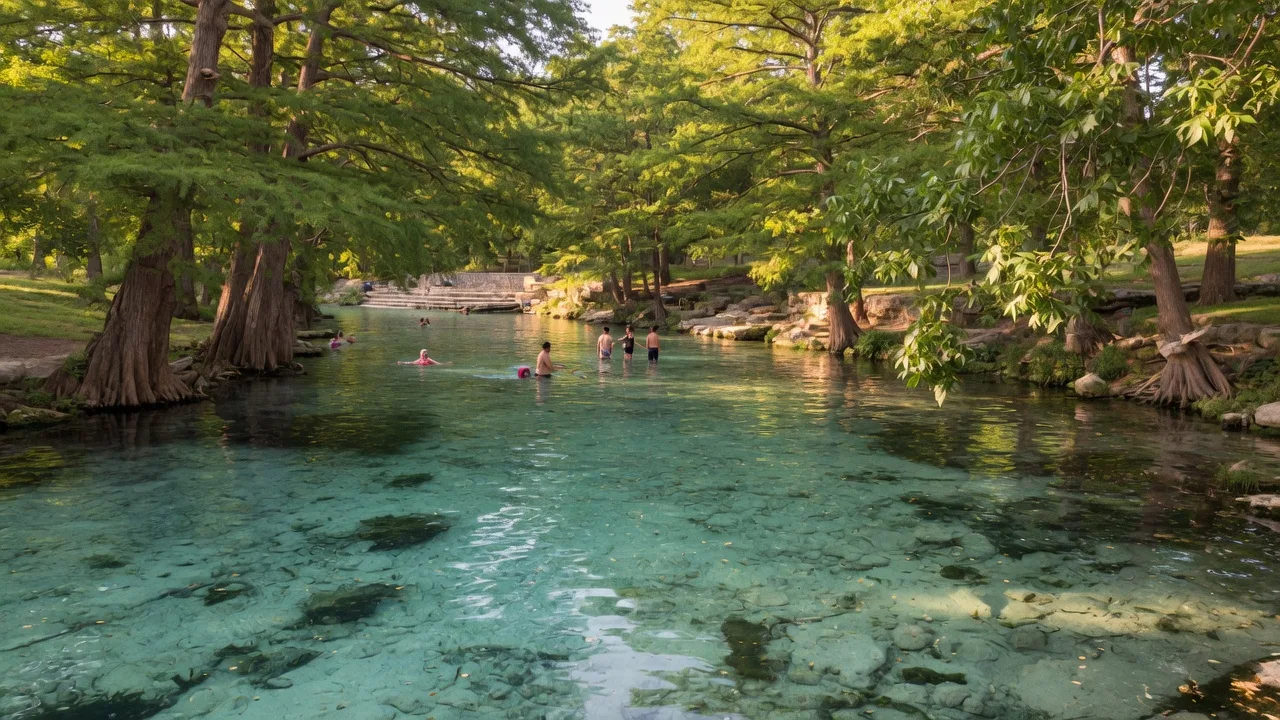
San Marcos occupies a specific place in the Texas Hill Country water system that no other town in the region can replicate. Its identity is inseparable from the San Marcos Springs. The second-largest collection of artesian springs in Texas and one of the most prolific in the world [1][2]. These springs discharge approximately 100 to 200 million gallons of 72-degree water per day from the Edwards Aquifer. They form the headwaters of the San Marcos River on the Texas State University campus [2][3].
What that means for a day trip from Boerne is this: a 60-mile drive east on I-10 and US-281 puts you at one of the most consistently swimmable, ecologically significant, and historically layered river systems in the state. The water temperature never varies more than a few degrees. The clarity is exceptional. And the access is free or very low cost at multiple points along the river [4][5].
For anyone evaluating a move to the Hill Country, San Marcos also offers a useful illustration of how spring-fed water systems work in this region. The springs are part of the Edwards Aquifer system. The same groundwater supply that serves much of Central Texas, and the river that flows from them is a direct expression of aquifer health [3][6]. Understanding the springs helps explain why water is such a central factor in Hill Country property decisions, land use, and local politics.
How to get there from Boerne
The most direct route from Boerne to San Marcos is east on I-10 to the US-281 junction just past Fair Oaks Ranch. Then follow US-281 north through Blanco and Kyle into San Marcos. The total distance is approximately 60 to 68 miles depending on your exact starting point, with a drive time of about 60 to 75 minutes under normal conditions [7][8].
From downtown Boerne, take TX-46 east for roughly 6 miles to the I-10 on-ramp. Head east on I-10 for about 14 miles toward the US-281 exit. Take US-281 north for approximately 40 miles through Blanco and Kyle, then exit at Hopkins Street or Aquarena Springs Drive for downtown or the river access points. The US-281 corridor is a four-lane divided highway for most of the route, with a reduced speed limit through the smaller communities [8].
An alternative route for those wanting a more scenic drive follows a combination of back roads. From Boerne, take US-87 east toward Spring Branch, connect to RM-32 (Fischer Store Road), and follow it east past Canyon Lake into the San Marcos area. This route is longer, approximately 75 miles with a drive time of about 85 to 90 minutes. But it offers consistent Hill Country scenery, river crossings, and a more relaxed pace [7][8].
| Starting Point | Distance | Drive Time | Route |
|---|---|---|---|
| Downtown Boerne | ~60-68 miles | ~60-75 min | I-10 E to US-281 N |
| Fair Oaks Ranch | ~55-62 miles | ~55-65 min | I-10 E to US-281 N |
| San Antonio (north side) | ~45-55 miles | ~45-55 min | I-35 N |
| Austin (south side) | ~30-35 miles | ~30-40 min | I-35 S |
| New Braunfels | ~18 miles | ~20-25 min | I-35 N |
Distances and drive times are approximate and vary by starting point within each community.
What makes San Marcos different from other Hill Country river towns
The Hill Country has several spring-fed rivers, including the Guadalupe, the Frio, the Llano, and the Blanco. But the San Marcos River occupies a distinct position in the regional water system for three reasons [1][2].
First, the flow volume. The San Marcos Springs discharge roughly 100 to 200 million gallons per day. This makes the San Marcos River one of the most consistent spring-fed water bodies in the Southwestern United States [2][3]. The flow varies somewhat with drought conditions but far less dramatically than the springs feeding the Guadalupe or the Blanco. The river runs clear and full even during the driest months of a Texas summer [3][9].
Second, the temperature. The springs emerge at a constant 72 degrees Fahrenheit year-round, drawn from deep within the Edwards Aquifer [2][4]. That means the river is comfortably swimmable in January as well as August. It is one of the most consistent natural swimming experiences you will find anywhere in Texas, and the consistency itself is the point. The river does not depend on seasonal rainfall to be enjoyable.
Third, the ecological significance. The San Marcos River is home to several endangered and threatened species found nowhere else on Earth, including the Texas blind salamander, the San Marcos salamander, the fountain darter, and Texas wild rice [3][6][10]. These species depend on the consistent flow and temperature of the spring system. Their presence makes the river a federally protected habitat under the Edwards Aquifer Habitat Conservation Plan [3][6]. For visitors, what this means is that you are swimming in a living ecosystem that scientists have studied for more than a century. The water clarity you see is a direct result of the spring system's filtering process through the aquifer's limestone geology [9][10].
What to see and do in San Marcos
The San Marcos River and spring-fed swimming
The river is the primary attraction, and the best way to experience it is to pick a park access point and spend time in the water. The river maintains a crystalline clarity that allows you to see the limestone riverbed, submerged vegetation, fish, and turtles clearly from the surface. The water temperature stays at 72 degrees year-round, so the experience is essentially the same in July and December [2][4][5].
Rio Vista Park (555 Cheatham Street) is the most popular river access point and is managed by the City of San Marcos. During the summer managed access period (Memorial Day through Labor Day weekends), out-of-area visitors pay a $5 entry fee per person aged 18 and older. Children under 18 enter free. Local residents living within the San Marcos city limits, the 78666 zip code, or the San Marcos CISD boundary enter free with a digital Rio Vista Park Entry Pass [4][5]. The park features three distinct rapids that create natural swimming areas, shaded picnic tables, and public restrooms. Parking along Rio Vista Park Drive is closed on weekends during the summer managed access period. Visitors park at the Charles S. Cockrum Center on Thorpe Lane and walk approximately 10 minutes to the park [4].
Sewell Park (601 University Drive) sits on the Texas State University campus at the headwaters of the San Marcos River. Admission is free year-round. The park offers river access with wide, clear swimming areas, volleyball courts, and the grassy slope of Tanner's Hill for sunbathing. Parking is available in university lots [11].
City Park and Children's Park offer additional river access with shallower water and gentler current. They are suitable for families with younger children. City Park has picnic shelters and restrooms [5].
For visitors from Boerne making a day trip, the most practical approach is to target Sewell Park or Rio Vista Park as the primary stop, arrive by 9:30 to 10:00 AM to secure parking, and plan for four to five hours on the river. The 72-degree water is cool enough to be refreshing even on 100-degree days. You will want a towel and dry clothes for the drive home.
The Meadows Center and glass-bottom boat tours
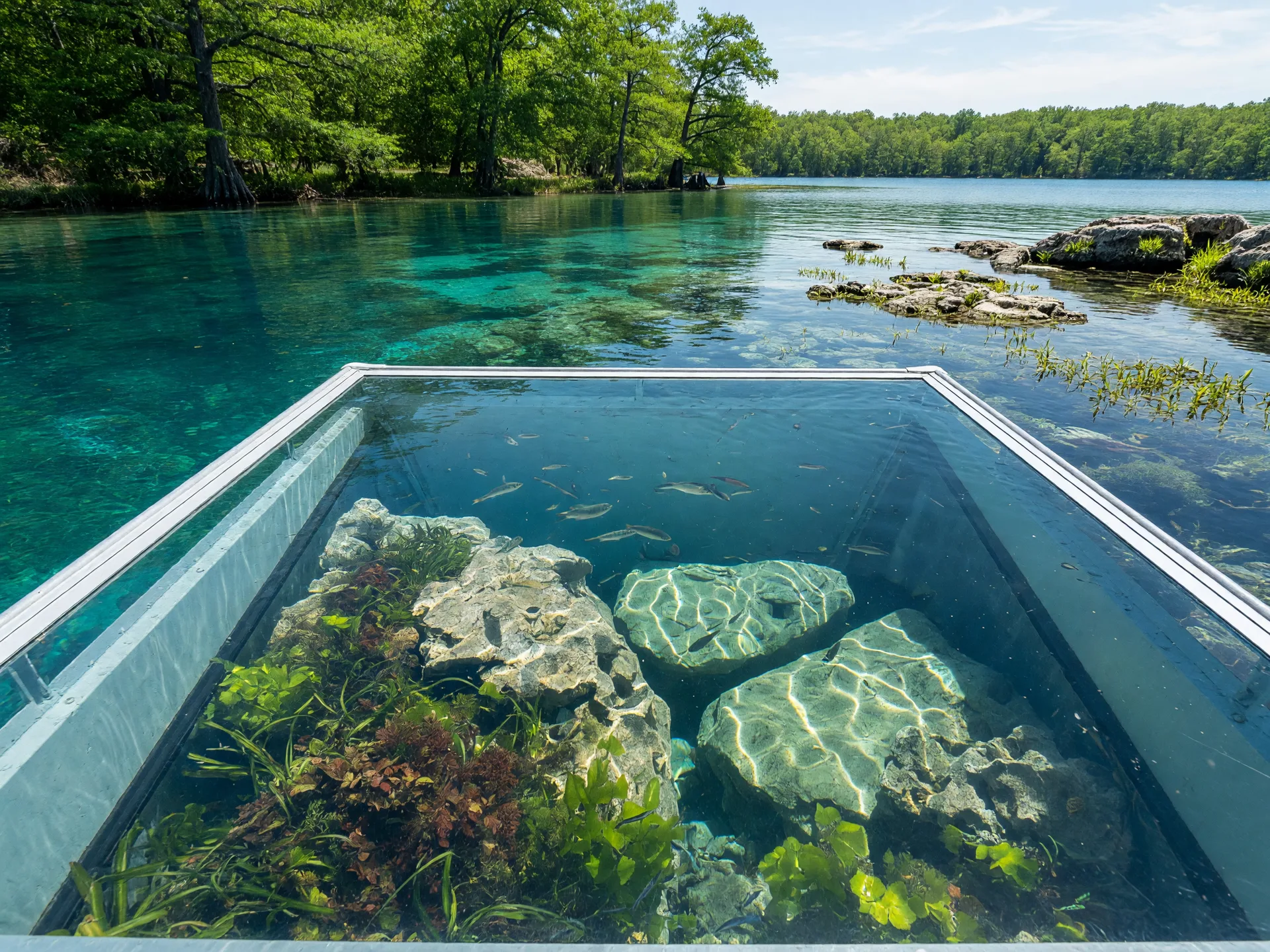
The Meadows Center for Water and the Environment, located at 921 Aquarena Springs Drive on Spring Lake, operates guided glass-bottom boat tours that allow visitors to see the San Marcos Springs up close [12][13]. The lake is actually the preserved headwaters area of the San Marcos River, held behind a small dam that dates to the mid-19th century. The glass-bottom boats, introduced in 1946, provide a window into the spring system. You can see the vents in the lake bed where water rises from the aquifer, the submerged limestone formations, and the aquatic vegetation and fish that live in the spring environment [12][13].
The site has a long history as a tourist attraction. From 1950 to 1996, it operated as Aquarena Springs. A full amusement park with an underwater theater featuring mermaid performances, a swimming pig named Ralph, a submarine theater, and a sky ride over the lake. Texas State University purchased the property in 1994 and transformed it into an educational and research center focused on water resources and conservation [13][14]. The transformation from amusement park to research center is one of the more interesting conservation stories in the Texas Hill Country. It represents a shift from commercial exploitation of the springs to scientific stewardship. The glass-bottom boat tours are the direct link between those two eras [13][14].
Tours run year-round and typically last 30 to 45 minutes. Advance reservations are recommended, especially on weekends. The Meadows Center also offers snorkel tours of Spring Lake during warmer months for visitors who want a more immersive experience of the spring ecosystem [12][13].
Downtown San Marcos and the historic square
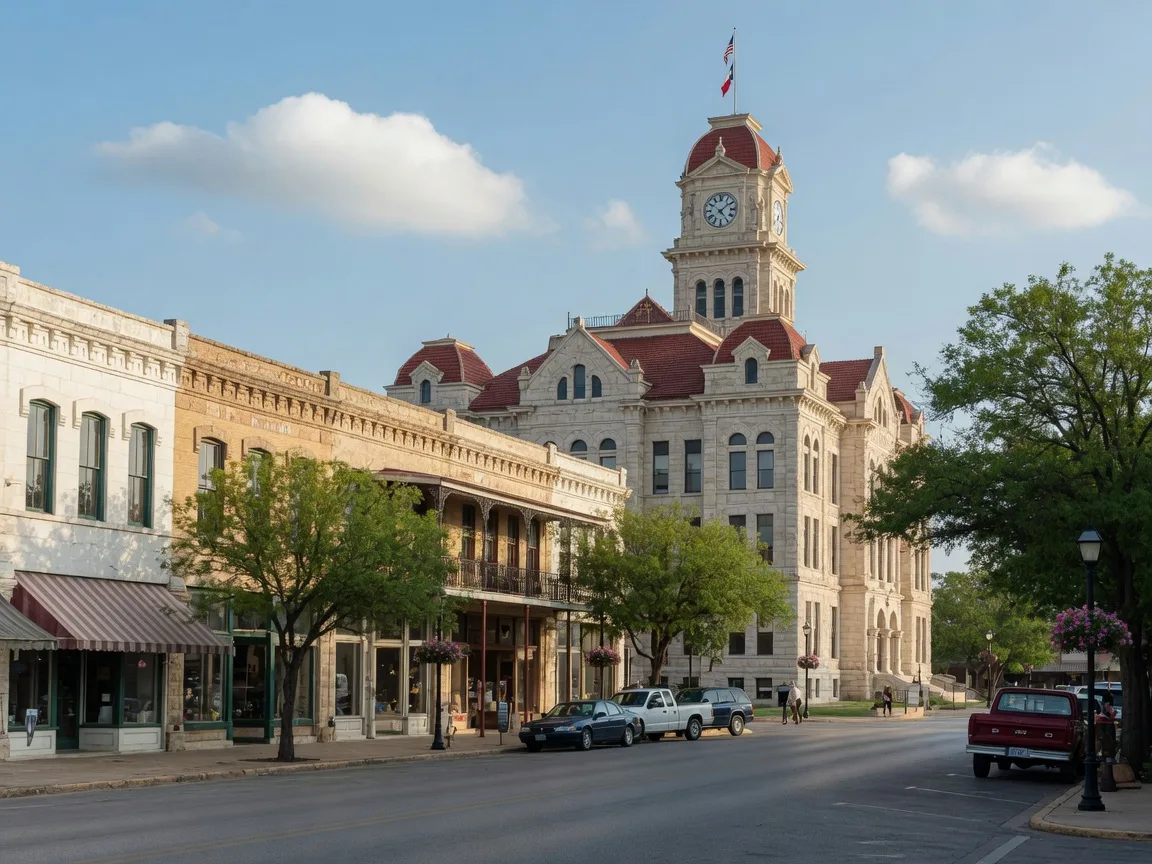
The downtown square is organized around the Hays County Courthouse at 137 N. LBJ Drive. A limestone building constructed in 1909 that anchors a walkable commercial district with a solid collection of independent restaurants, shops, and historic storefronts [15]. The square and its surrounding blocks offer a representation of what a Hill Country downtown can be when a university town's population supports a diverse retail and dining scene.
Palmer's Restaurant Bar and Courtyard on Moore Street has been a downtown anchor for years, offering courtyard dining. Blue Dahlia Bistro on Hopkins Street is worth a stop for lunch if you prefer European-inspired cafe food in a garden setting. The Root Cellar Cafe is another reliable downtown option [16][17].
For barbecue, Black's Barbecue on Hull Street is an outpost of the legendary Lockhart barbecue family. They serve brisket, ribs, and sausage prepared with recipes that made the original Black's in Lockhart a Texas institution since 1932 [16][17].
Rhea's Ice Cream on the square has been a local institution for handmade ice cream. It is a reliable stop for a post-river dessert or afternoon break [17].
Tubing on the San Marcos River
Tubing on the San Marcos River is a different experience from tubing on the Guadalupe River near New Braunfels. The San Marcos is narrower, clearer, and flows through a more compact urban corridor. The experience is less about a long, uninterrupted float and more about short, accessible stretches of river with easy exit points [4][5]. The most popular tubing stretch runs from Rio Vista Park through City Park, a float of roughly 45 minutes to an hour depending on flow conditions [4].
Several local outfitters rent tubes, life jackets, and kayaks near the river access points. The San Marcos River is generally suitable for beginners and families, though the rapids at Rio Vista Park create some conditions that require more attention during higher flow periods [4][5]. Life jackets are recommended for children and weaker swimmers at all times.
Wonder World Cave and Adventure Park
Located at 1000 Prospect Street on the western edge of San Marcos, Wonder World Cave is Texas' first commercial cave, opened to the public in 1903 [18]. The cave was formed by the Balcones Fault. The same geological feature that created the Edwards Aquifer springs, and the tour takes visitors into an underground space where the movement of the earth's crust is visible in the tilted limestone layers [18].
The park also includes a wildlife preserve with native Texas animals, a 75-foot observation tower with views of the surrounding landscape, and a train ride through a tunnel in the hillside. Wonder World Cave is a straightforward add-on to a river-focused day trip. You could do the cave tour in an hour and then spend the rest of the day on the water [18].
Practical tips: hours, fees, and timing
San Marcos works well as a day trip from Boerne because the tight geography of the downtown, river, and university campus means you can cover multiple stops without driving between them. The river access points, downtown square, and the Meadows Center are all within a 1.5-mile radius [4][5][12].
The key decision point for timing is whether you are visiting during the summer managed access period at Rio Vista Park (Memorial Day through Labor Day). During that window, out-of-area visitors pay $5 per person, and the park is most accessible early in the morning. Outside that period, the park is free and parking is less restricted [4].
| Detail | Information |
|---|---|
| Rio Vista Park (summer) | $5/person (18+), free for locals and children |
| Sewell Park | Free, year-round |
| City Park | Free, year-round |
| Meadows Center Boats | $8-$12 per person; reservations recommended |
| Wonder World Cave | $15-$20 per person; hours vary seasonally |
| Tube and gear rental | $10-$20 from local outfitters |
| Best Time to Visit | Spring (Mar-May) and fall (Sep-Nov) |
| Park hours | 6:00 AM to 11:00 PM daily |
Hours, fees, and tour conditions are subject to change. Confirm current details before visiting [4][5][12][18].
Seasonal timing
The best time to visit San Marcos from Boerne is spring (March through May) or fall (September through November). During these windows, the weather is mild, the water is clear, and the crowds are manageable. Summer is the busiest season. The river is at its most popular, the managed access program at Rio Vista Park is in effect, and parking requires early arrival. Winter is the least crowded season, with access to Sewell Park and City Park available year-round and the river maintained at 72 degrees regardless of air temperature [4][5].
Seasonal activity guide
| Season | Best For | Considerations |
|---|---|---|
| Spring (Mar-May) | Swimming, glass-bottom boats, dining | Mild weather; moderate crowds; wildflower season along US-281 |
| Summer (Jun-Aug) | Swimming, tubing, kayaking | Peak crowds; $5 fee at Rio Vista Park; arrive by 9:30 AM |
| Fall (Sep-Nov) | Swimming, boats, downtown festivals | Pleasant weather; reduced crowds; water warm from summer |
| Winter (Dec-Feb) | 72-degree swimming, boats, dining | Cooler air temps; least crowded; river experience unchanged |
The San Marcos River maintains a constant 72-degree temperature year-round regardless of season.
Why San Marcos matters if you are considering the Hill Country
San Marcos offers a concrete illustration of what reliable water access looks like in the Hill Country. The San Marcos Springs have flowed continuously for thousands of years. Their consistency is a direct function of the Edwards Aquifer's storage capacity and recharge dynamics [1][3][6]. Understanding how the aquifer works, how it is recharged, how spring flow responds to drought conditions, and how the legal framework governing water rights plays out in practice, is part of what any informed buyer should know about the Hill Country [6][9].
San Marcos also demonstrates how a university town's presence shapes the character of a Hill Country community differently than a purely residential suburb or a retirement destination does. Texas State University's enrollment of roughly 38,000 students supports a downtown that has more restaurants, more cultural events, and more energy than comparably sized towns without a university anchor [15]. For families considering a move to the Hill Country, the proximity of Texas State University matters for education, employment, and the long-term economic stability of the region.
For Boerne residents specifically, San Marcos represents the closest opportunity for consistent, year-round spring-fed swimming that does not require navigating the crowds of New Braunfels or the limited access of smaller swimming holes. The 60-mile drive is straightforward and the river access is well-maintained. It is a day trip you can make in any season and count on the water being clear, cold, and swimmable.
Pairs well with
- Blanco (Historic Towns and Villages). Located about 25 miles west of San Marcos on US-281, the town of Blanco offers a walkable town square, the Blanco River, and Blanco State Park. It fits naturally on the return leg from Boerne. Stop for lunch or a short walk through town on the way home.
- Canyon Lake (Lakes and Rivers). Located about 30 miles west on RM-32, Canyon Lake offers a very different water experience. Reservoir boating and watersports compared to San Marcos' river swimming. Pairing the two on separate visits gives you a comprehensive view of the region's water infrastructure [1][2].
Frequently asked questions
How far is San Marcos from Boerne?
Approximately 60 to 68 miles east of downtown Boerne via I-10 and US-281. The drive takes roughly 60 to 75 minutes under normal conditions. From Fair Oaks Ranch, the distance is about 55 to 62 miles with a drive time of 55 to 65 minutes [7][8].
Is the San Marcos River clean for swimming?
Yes. The San Marcos River is spring-fed from the Edwards Aquifer and is one of the clearest rivers in Texas. The water is a constant 72 degrees Fahrenheit year-round and supports exceptional visibility to the limestone riverbed. The river is also a federally protected habitat under the Edwards Aquifer Habitat Conservation Plan [2][4][10].
Do you need a reservation to visit San Marcos river parks?
No reservation is needed for day-use access to most parks. However, during the summer managed access period (Memorial Day through Labor Day), out-of-area visitors to Rio Vista Park pay a $5 entry fee per person aged 18 and older, and parking is restricted. Sewell Park and City Park remain free year-round. Glass-bottom boat tours at the Meadows Center do require advance reservations [4][5][12].
Can you swim in the San Marcos River in winter?
Yes. The San Marcos Springs maintain a constant 72-degree temperature year-round, so the river is swimmable even in January. The air temperature may be cool, but the water temperature is the same in winter as it is in summer. Sewell Park and City Park are open year-round and provide river access for winter swimming [2][4][5].
What is the history of Aquarena Springs?
Aquarena Springs was a theme park that operated at Spring Lake from 1950 to 1996, famous for glass-bottom boat tours, underwater mermaid shows, a swimming pig named Ralph, and a sky ride. Texas State University purchased the property in 1994 and transformed it into the Meadows Center for Water and the Environment, which focuses on ecological research and conservation. Glass-bottom boat tours continue to this day [13][14].
Sources
- [1] San Marcos River, Texas Rivers Protection Association. txrivers.org
- [2] San Marcos Springs, Wikipedia. wikipedia.org
- [3] San Marcos, Texas, Wikipedia. wikipedia.org
- [4] Rio Vista Park, City of San Marcos. sanmarcostx.gov
- [5] Rio Vista Park Entry Pass, City of San Marcos. sanmarcostx.gov
- [6] Edwards Aquifer Habitat Conservation Plan. eahcp.org
- [7] Distance from Boerne, TX to San Marcos, TX, Distance Cities. distance-cities.com
- [8] Driving Distance from Boerne to San Marcos, Travelmath. travelmath.com
- [9] San Marcos Springs, Texas State Historical Association. tshaonline.org
- [10] Species of Concern, San Marcos River. fws.gov
- [11] Sewell Park, Texas State University. txst.edu
- [12] Meadows Center Glass-Bottom Boats. txst.edu
- [13] Meadows Center, Wikipedia. wikipedia.org
- [14] The Transformation of Aquarena Springs, Texas Parks and Wildlife. tpwmagazine.com
- [15] San Marcos, TX History, Visit San Marcos. visitsanmarcos.com
- [16] Blacks Barbecue San Marcos. blacksbbq.com
- [17] Top Restaurants in San Marcos, TripAdvisor. tripadvisor.com
- [18] Wonder World Cave and Adventure Park. wonderworldpark.com
- [19] Day Trip Destination: San Marcos, AustinTexas.org. austintexas.org
Published August 24, 2026
Updated August 24, 2026