
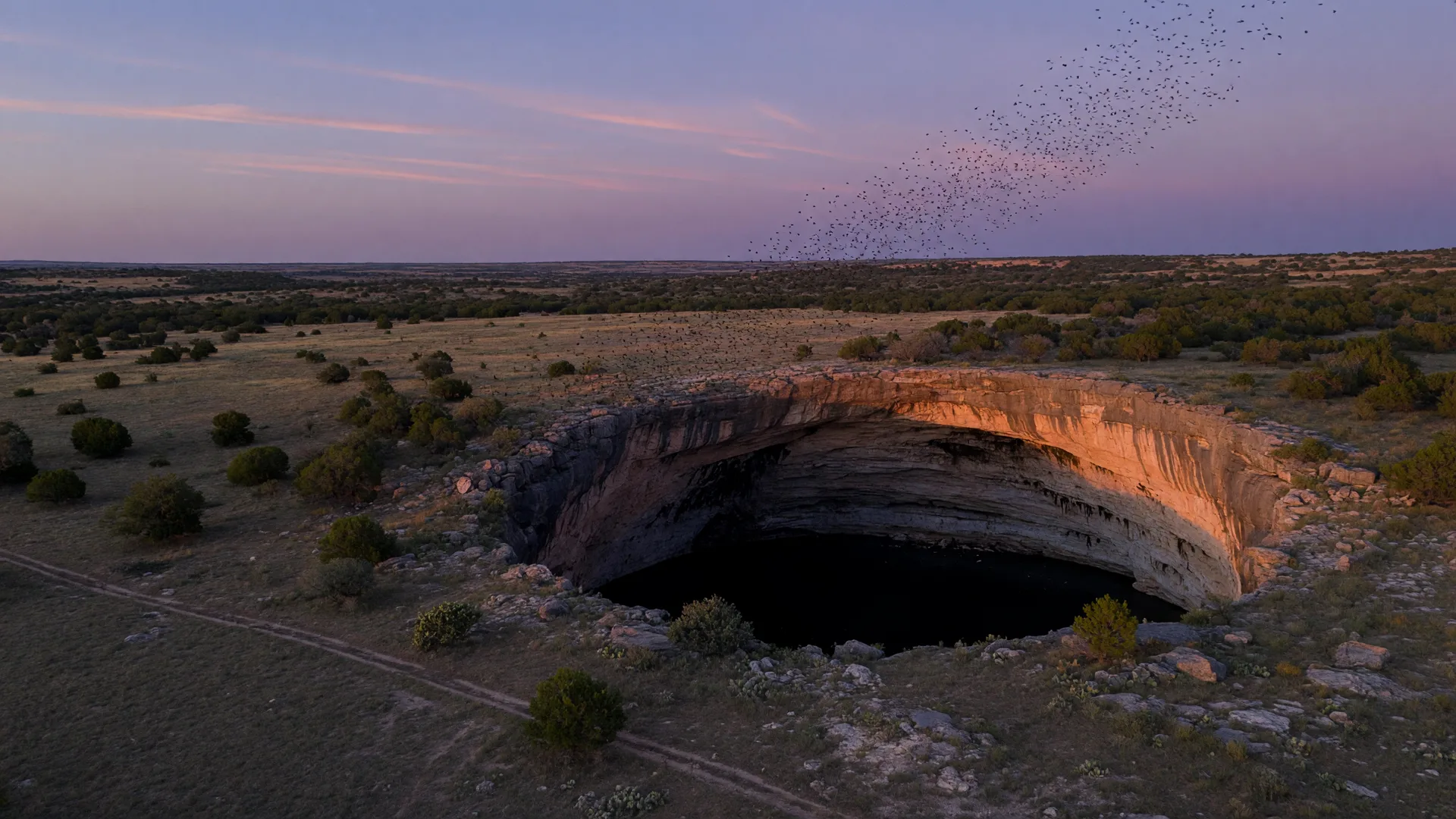
Devil's Sinkhole is the farthest-flung destination in this day-trip series, and it holds the most unusual sight of any of them. It is a 1,859.7-acre state natural area in Edwards County, set about six miles north of the town of Rocksprings on U.S. Highway 377, and it centers on a roughly circular opening in the limestone that drops about 350 feet into the largest single-chambered cave in Texas [1][6][12]. Listed as a National Natural Landmark in 1972, it is one of the biggest vertical chambers in the country, and it is nearly invisible from the surface until you stand on its rim [1][6][12].
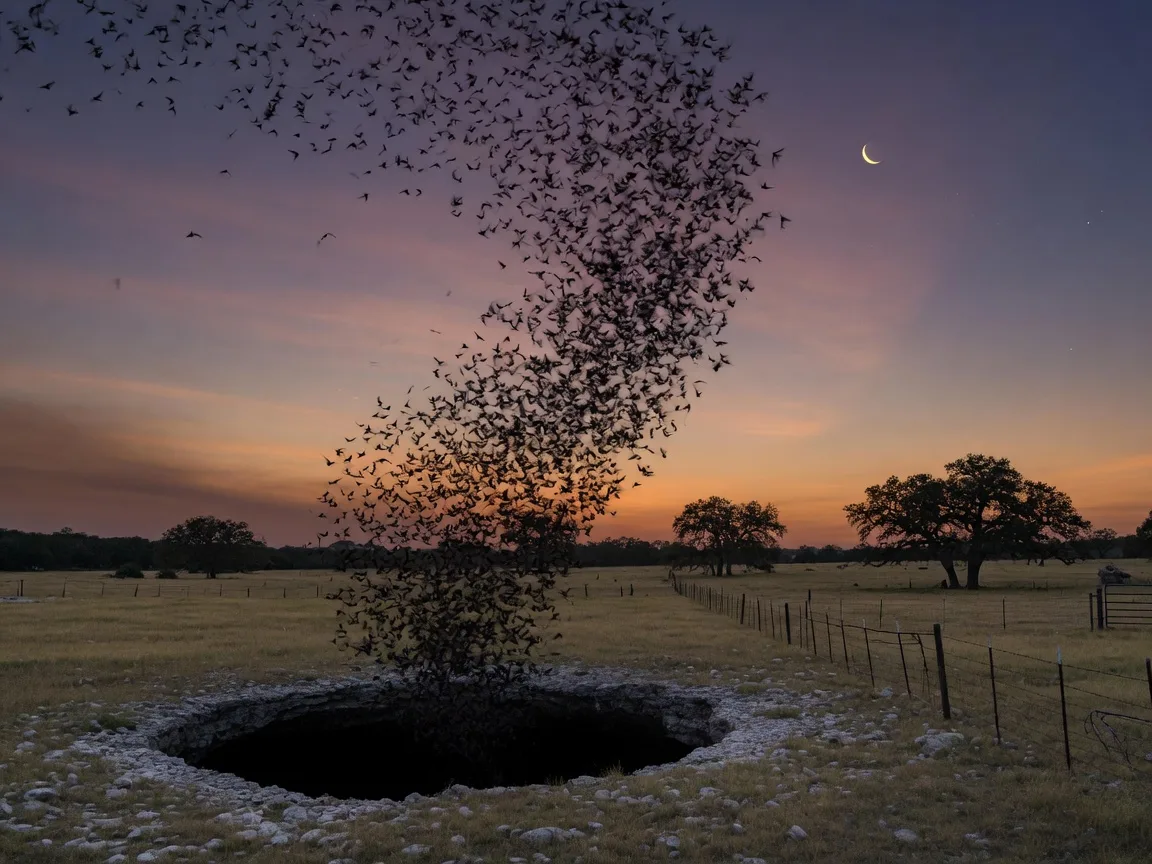
What makes the site famous, though, is what lives inside it. The chamber is the summer roost for one of the world's largest colonies of Mexican free-tailed bats, numbering in the millions, and on warm evenings the bats pour out of the opening at dusk in a dense, spiraling flight that has drawn visitors for decades [1][3]. Because the bat flight happens at sunset, the visit is naturally an evening program: guided tours by reservation only, check-in at the Devil's Sinkhole Visitor Center in Rocksprings, and a short drive out to the rim for the show [1][4].
This is one of the longer trips in the series, roughly 108 miles and two hours and twenty minutes from downtown Boerne, so it rewards treating the drive itself as part of the day [9]. This guide covers the route, how the tours work, what to expect at the rim, the town of Rocksprings worth a wander, and why the far western edge of the Hill Country matters to anyone weighing a move here.
How to get there from Boerne
The drive is deceptively simple on a map and genuinely scenic in person. From downtown Boerne, head west on Interstate 10 past Comfort, take the Mountain Home exit onto Texas State Highway 41, and follow SH 41 west to its junction with U.S. Highway 377 near Rocksprings [10]. Then turn north on U.S. 377 for a short stretch to the sinkhole area, though every tour actually checks in first at the Devil's Sinkhole Visitor Center at 101 N. Sweeten Street on the town square in Rocksprings [1][4][10].
The full run from Boerne to Rocksprings is about 108 miles and typically takes two hours to two hours and twenty minutes, depending on traffic and how many ranch gates you have to slow for on the two-lane stretches [9][10]. The landscape changes character as you go: the improved, populated corridor between Boerne and Comfort gives way to open ranch country west of Mountain Home, and by the time you reach SH 41 you are into true Edwards Plateau territory, where the horizon opens up and towns get noticeably farther apart. There is no reliable fuel on the second half of the route, so fill up in Boerne or Comfort before you leave the interstate corridor [10].
Because the bat-flight tours are timed to sunset and check-in happens in town, plan the drive so you arrive in Rocksprings at least forty-five minutes before your tour start time. That leaves room to park, check in, use the restroom, and caravan to the viewing site without rushing [5]. Return is in the dark, and the two-lane roads are lightly traveled and dark-sky friendly, which is lovely and worth driving carefully.
| Leg | Distance | Drive Time |
|---|---|---|
| Downtown Boerne to Rocksprings | ~108 miles | ~2 hr 15-20 min |
| Rocksprings to Devil's Sinkhole | ~6 miles | ~10-15 min |
| Rocksprings to Kickapoo Cavern State Park | ~31 miles | ~40-45 min |
| Rocksprings to Leakey | ~51 miles | ~1 hr |
| Rocksprings to Garner State Park | ~60 miles | ~1 hr 15 min |
Distances are approximate and based on standard driving routes. Allow extra time on two-lane ranch roads and for the drive home in the dark after the tour.
What to see and do
Stand at the rim of Texas' largest cave chamber
The centerpiece is the hole itself. Visitors are led along a short walk to a fenced viewing area at the rim, where the sheer drop opens beneath you: the opening is up to 60 feet across at the surface, and the cavern below balloons out to a chamber more than 320 feet in diameter [1][6]. Standing there, the scale is hard to process, because nothing at ground level advertises what is underneath. The underlying Edwards Group limestone formed the cavern over millions of years when moving groundwater dissolved the rock, and eventually the roof collapsed to create the opening visitors see today [6][12]. The guides explain that geology and let you absorb the sheer depth before the bats take over the show.
Watch the bat flight at dusk
The evening bat flight is the reason most people come. The chamber is a summer roost for Mexican free-tailed bats, and the colony is among the largest in the world, with TPWD describing numbers that reach into the millions during the warm months [1][3]. Just after sunset, the bats stream up out of the opening in a dense column, the flight often stretching for twenty minutes or more as the colony empties out to feed on insects across the surrounding ranch country. It is a genuinely wild sight, and it happens reliably enough, night after night, that it has supported a public tour program since the 1990s [3][5]. On the plateau, seconds of standing still give way to thousands of wingbeats, and the dark funnel against the fading sky is the kind of thing people drive across the state to see [5].
Take a morning tour or a nature walk
The evening program gets the headlines, but the schedule also includes morning bat-flight tours, when the colony streams back into the chamber to roost, and guided nature hikes on the first and third Saturdays of the month [4][5]. The hikes are an easy way to see the natural area without the sunset timing, and they cover the plateau ecology: juniper and live oak savanna, native grassland, and the karst geology that defines this corner of the state [4][5]. Mornings on the Edwards Plateau are crisp and quiet, and a hike followed by lunch in Rocksprings makes a more relaxed alternative for visitors who cannot make the evening program.
Wander Rocksprings, the county seat
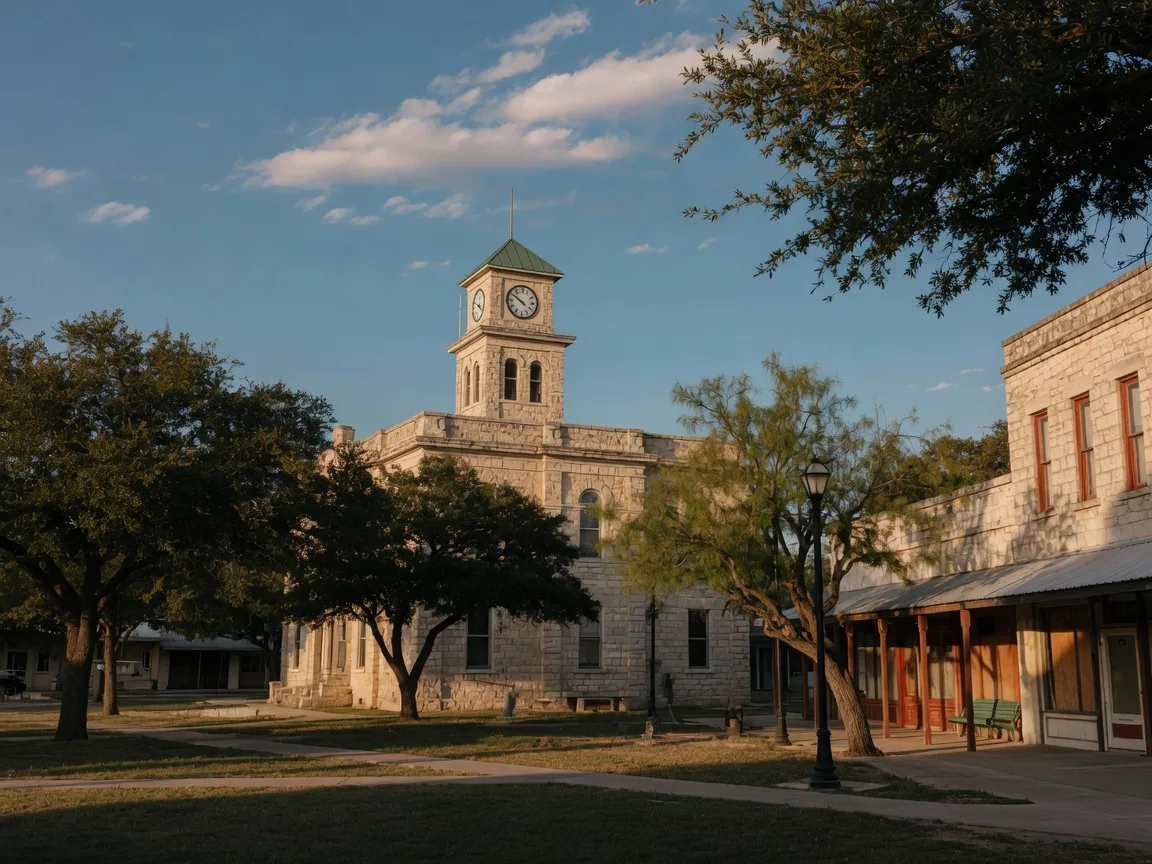
Rocksprings is worth its own half-hour or hour before or after the tour. It is the seat of Edwards County and one of the smallest county seats in Texas, with a 2020 census population of 874 in a county of about 1,400 people [7]. The town square is anchored by a historic stone courthouse complex, and the town is known as the "Top of the Texas Hill Country," sitting at roughly 2,400 feet of elevation on the western fringe of the Edwards Plateau [7][8]. The surrounding ranch country has long been one of Texas' wool and mohair centers, a heritage that still shows in the town's identity and its annual "Top o' the World" festival [7][8]. The name itself comes from natural springs that bubbled out of the rocks along Hackberry Creek when the site was chosen in 1891, later compressed from "Rock Springs" to "Rocksprings" [8]. And ask a local about the 1927 tornado, one of the deadliest in Texas history, which nearly flattened the town and led to its careful rebuilding: the 1916 Rocksprings Hotel is one of the few buildings that survived [7][8].
Use it as a jumping-off point
The far western Hill Country rewards an overnight, and Devil's Sinkhole pairs naturally with the river country to the southwest. Garner State Park on the Frio is about 60 miles from Rocksprings, the canyon country around Leakey is about 51 miles, and Kickapoo Cavern State Park sits about 31 miles southwest, all of them reachable on a long weekend [11]. Even as a straight day trip, the drive out and back through the widest, emptiest part of the Hill Country is itself part of the appeal, and it gives a true sense of how large this region actually is [9][10].
Hours, fees, and tour details
| Detail | Information |
|---|---|
| Access | Guided tour only; reservations required in advance [1][2] |
| Evening Bat Flight tours | May 1 through Oct 31, typically Wed-Sun starting around 7 p.m. [4][5] |
| Morning tours & hikes | Morning bat-flight tours and nature hikes on the first and third Saturdays [4][5] |
| Adult (13+) | $14 per person [2][5] |
| Seniors 65+ | $11 per person [2][5] |
| Kids 4-12 / under 4 | $6 / free [2][5] |
| Check-in & reservations | Devil's Sinkhole Visitor Center, 101 N. Sweeten St., Rocksprings; phone (830) 683-2287 [4] |
Tour dates, start times, and fees are set by TPWD and the Devil's Sinkhole Society and can change by season; always confirm the current schedule before you leave.
Tours are operated by the Devil's Sinkhole Society, a nonprofit friends group, in partnership with TPWD, and they last about an hour and a half including the walk to the rim and the bat watch [4][5]. There is no walk-up entry: every visit is ticketed, and tours sell out on summer weekends, so booking ahead is not optional, it is the whole plan [1][2][4]. The tour bus and viewing area are at the sinkhole itself; the Visitor Center in town is where reservations, check-in, and the caravan get organized [1][4].
Best time to visit and seasonal planning
| Season | What it is like | Best for |
|---|---|---|
| Spring (Mar-May) | Bat colony returning; tours begin May 1; mild evenings and green grassland | First bat flights of the season, nature hikes |
| Summer | Peak colony size and the most dramatic flights; warm nights, later sundown | The classic bat-flight experience |
| Fall (Sep-Oct) | Cooler evenings; colony thinning as bats migrate; tours run through Oct 31 | Milder weather, smaller crowds late in the season |
| Winter (Nov-Apr) | Colony mostly gone; no evening bat flights; a quiet, empty plateau | Solitude, occasional nature hikes, stargazing |
The tour window runs from May 1 through October 31, and summer evenings are the most reliable time to see a full-scale flight, when the colony is at its largest and the dusk emergences are most dramatic [1][4][5]. Spring and fall are milder and less crowded, with slightly smaller flights. Winter is the off-season for tours: the bats migrate south, the evening program goes dormant, and the plateau returns to its quiet ranch-country self, best visited for a nature walk or simply to see the region without the crowds [1][4]. For planning purposes, the bat flight tells the season: book May through October for the show, and treat November through April as a different, quieter trip entirely.
Practical tips for the day
Reserve your tour, then build the day around it. There is no walk-up admission, and summer weekend slots go quickly, so book well ahead and treat the confirmed reservation as the anchor of the plan [1][2][4]. Note the exact start time, which shifts with sunset through the season, and confirm it again a few days out [4][5].
Arrive in town early. Check-in happens at the Visitor Center on the Rocksprings square, not at the sinkhole, so get to town at least forty-five minutes before start time. That leaves room for parking, restrooms, check-in, and the caravan to the site [1][4][5].
Dress for a cool evening and bring a layer. The viewing area sits exposed on the plateau, and a warm summer day can turn crisp once the sun drops and the wind comes up. A light jacket or long sleeve makes the bat watch comfortable instead of shivery [5]. The same exposure means sunscreen and a hat for the walk to the rim in full sun.
Bring insect repellent. It is a warm-weather, outdoor, dusk program in ranch country, and the resident insects know the schedule as well as any visitor. Repellent, long pants, and closed-toe shoes are the sensible uniform [5].
Fuel up and pack for the road. Fill the tank in Boerne or Comfort, because services thin out dramatically west of Mountain Home, and pack water and snacks for the drive [10]. The return leg is dark, two-lane, and occasionally shared with deer and livestock, so give yourself time and watch the road.
Why it matters if you are considering the Hill Country
Devil's Sinkhole matters to anyone weighing a move to the Hill Country for a reason that has little to do with tourism and everything to do with what this region actually is. The far western Edwards Plateau is the Hill Country at its most honest: open ranch land, small county seats, dark skies, and a population density that drops off fast once you leave the Boerne-to-Fredericksburg corridor [7][8]. Driving out here, you see the other end of the region's geography, the scale that the phrase "Hill Country" actually covers, and it changes how you read everything closer to town.
It is also the region's geology made visible in the most literal way possible. The same Edwards Limestone that stores the Edwards Aquifer, that determines well yields, foundation conditions, and karst features across Boerne, Fair Oaks Ranch, and San Antonio, is the rock that collapsed into this chamber [6]. Standing at the rim is a three-dimensional lesson in how water moves through this landscape, and it pairs naturally with what you hear from well drillers, inspectors, and the people who evaluate property out here. The sinkhole is not a curiosity removed from daily life; it is the extreme case of the groundwater behavior every Hill Country landowner lives with [6].
And then there are the bats. A colony of this size is a real piece of the region's ecological infrastructure, a vast natural pest-control operation that hunters and farmers have relied on for generations, and TPWD protects the site specifically for it [1][3]. For a family deciding whether the Hill Country gives them enough to do, the ability to drive a couple of hours and watch one of the largest bat flights in the world rise out of the ground is the kind of experience that cannot be replicated in most of the country. It is a reminder that this region's value is not just in its towns and schools, but in the wild, working landscape that surrounds them.
For a combined Hill Country trip, Devil's Sinkhole pairs well with Leakey, the river-town anchor of the Frio canyon country about an hour from Rocksprings, or with Uvalde, the historic county seat about an hour to the southwest. Both round out the far-western itinerary with food, history, and river access, and with an overnight they turn the longest day trip in this series into one of its best weekends.
Frequently asked questions
How far is Devil's Sinkhole from Boerne?
About 108 miles and roughly two hours and fifteen to twenty minutes one way, via Interstate 10 west and State Highway 41 to U.S. 377 near Rocksprings. Tours check in at the Visitor Center in town before the short drive to the site [9][10].
Can you see Devil's Sinkhole without a tour?
No. The natural area is accessible only by guided tour, and reservations are required, including for the bat-flight viewing at the rim. There is no walk-up access [1][2][6].
When is the best time to see the bats?
Evening bat-flight tours run May 1 through October 31, typically Wednesday through Sunday starting around 7 p.m. Summer evenings, when the colony is largest, offer the most dramatic flights [1][4][5].
How much do Devil's Sinkhole tours cost?
Adults are $14, seniors 65 and older are $11, children 4 through 12 are $6, and children under 4 are free. Tours are by reservation through the Devil's Sinkhole Society [2][5].
Is Devil's Sinkhole suitable for kids?
Yes, it is a family-friendly program with free admission for children under 4 and reduced rates through age 12. Just keep little ones close at the fenced rim, where the drop is roughly 350 feet [1][2][5].
Sources
- [1] Texas Parks and Wildlife Department, Devil's Sinkhole State Natural Area. tpwd.texas.gov/state-parks/devils-sinkhole
- [2] Texas Parks and Wildlife Department, Devil's Sinkhole Entrance Fees. tpwd.texas.gov/state-parks/devils-sinkhole/fees-facilities/entrance-fees
- [3] Texas Parks and Wildlife Department, Bat-Watching Sites of Texas: Devil's Sinkhole. tpwd.texas.gov/huntwild/wild/species/bats
- [4] Reserve America, Devil's Sinkhole State Natural Area Tour Availability. texasstateparks.reserveamerica.com
- [5] Texas Highways, Plan Your Rocksprings Road Trip Now to See the Bats at Devil's Sinkhole. texashighways.com
- [6] Wikipedia, Devil's Sinkhole State Natural Area. en.wikipedia.org/wiki/Devil's_Sinkhole_State_Natural_Area
- [7] Wikipedia, Rocksprings, Texas. en.wikipedia.org/wiki/Rocksprings,_Texas
- [8] Texas State Historical Association, Handbook of Texas: Rocksprings, TX. tshaonline.org/handbook/entries/rocksprings-tx
- [9] Distance-Cities, Distance from Boerne, TX to Rocksprings, TX. distance-cities.com
- [10] Texas Parks and Wildlife Department, Devil's Sinkhole Map and Directions. tpwd.texas.gov/state-parks/devils-sinkhole/map
- [11] Within Hours, Destinations Within 1 Hour of Rocksprings, TX. withinhours.com/1-hour-of-rocksprings-tx
- [12] Texas Time Travel, Devil's Sinkhole State Natural Area. texastimetravel.com/directory/devils-sinkhole-state-natural-area
Published October 1, 2026
Updated October 1, 2026