
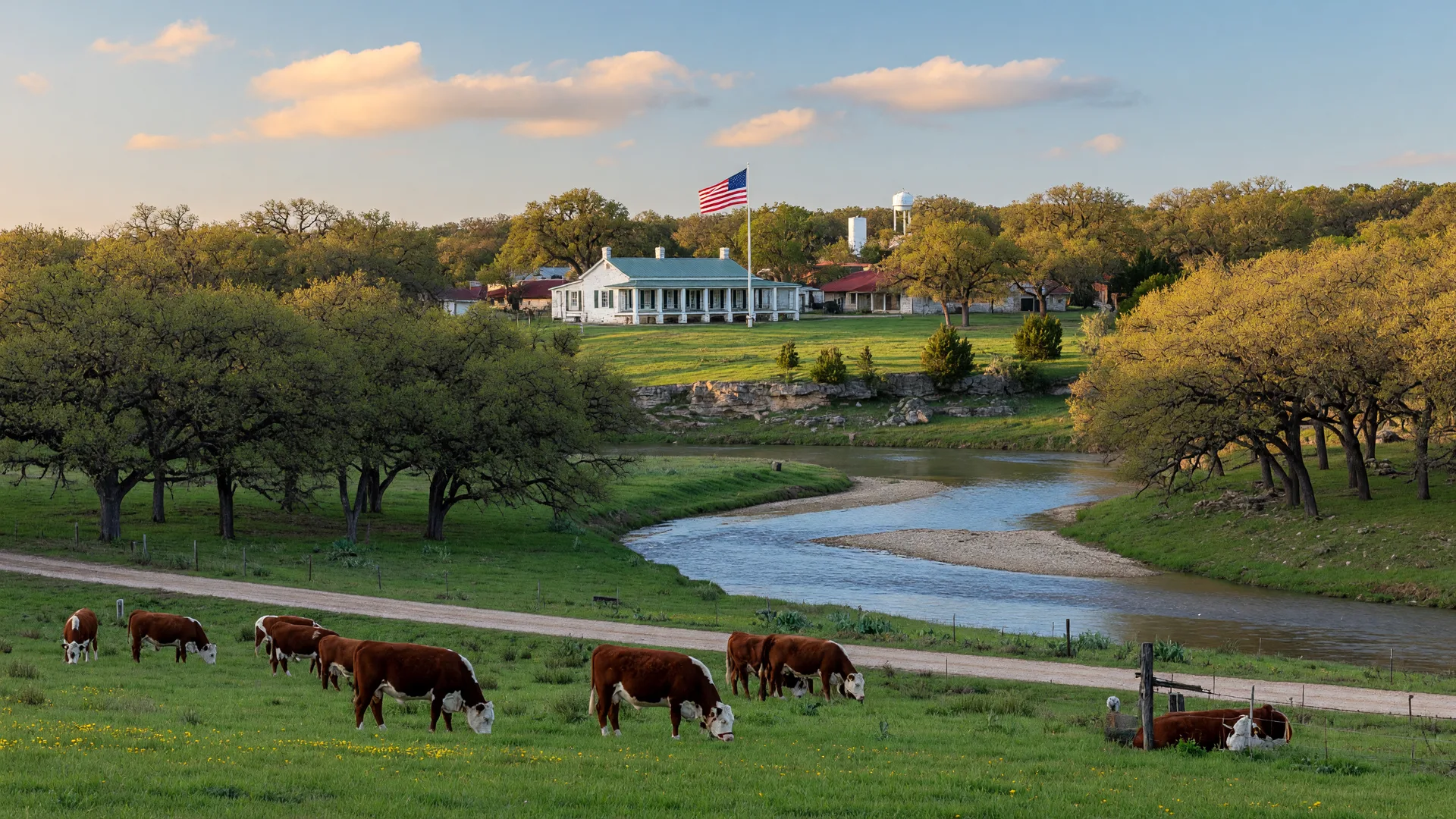
The Lyndon B. Johnson State Park & Historic Site and the adjacent Lyndon B. Johnson National Historical Park form one of the more unusual combinations in the Texas state and national park systems. They sit side by side near Stonewall, Texas, roughly 45 miles northwest of Boerne, and together they preserve not just the political legacy of the 36th president of the United States but also a physical cross-section of Texas Hill Country life across three centuries: an 1860s cattle-driving frontier homestead, a German-Texas farmstead from 1915, and the working cattle ranch where LBJ conducted presidential business from 1963 to 1969 [1][2][3].
The two properties function as a single visitor experience. The state park manages the Sauer-Beckmann Living History Farm, a swimming pool, picnic areas, a visitor center, and the access point for the LBJ Ranch driving tour. The National Historical Park manages the LBJ Ranch itself (the "Texas White House"), which remains a working cattle operation, as well as the LBJ Boyhood Home and Johnson Settlement in Johnson City, 14 miles away [1][2][3].
For anyone evaluating the Hill Country as a place to live, this destination offers something that pure nature parks or historic downtowns do not: a concrete look at how people have made a life in this landscape across three different eras, from frontier subsistence through German-Texan farming through the modern working ranch. That progression tells the story of the Hill Country in a way that is visible, tactile, and free to access [4].
How two parks became one experience
The Lyndon B. Johnson State Park & Historic Site was established by the Texas Legislature and opened in 1972, a year before the president's death [1][4]. On June 6, 1977, the site was renamed, and in 2008, it was officially designated as Lyndon B. Johnson State Park and Historic Site by the Texas Parks and Wildlife Department [4]. The state park covers 733 acres along the Pedernales River and operates under a cooperative agreement with the National Park Service, which manages the adjacent LBJ Ranch [1][2].
The National Historical Park was authorized by Congress and President Richard Nixon in December 1969, a year after LBJ left office. It was formally established in December 1970 to preserve properties associated with Johnson's life and career [2][3]. The park operates in two districts: the Johnson City District (containing the Boyhood Home and Johnson Settlement) and the LBJ Ranch District near Stonewall (containing the Texas White House, the reconstructed birthplace, and the Johnson Family Cemetery) [2][3].
The LBJ Ranch remains a working cattle operation run by the National Park Service, maintaining the Hereford cattle that LBJ himself managed during his years in office and after. It is the only working cattle ranch in the National Park Service system, and the only presidential site where the actual working operations of the president's private business are preserved as part of the historical experience [2][3][5]. The Texas White House itself is currently closed for a major rehabilitation project, with the National Park Service anticipating a reopening in late 2025. During the closure, the grounds are accessible, and the Hangar Visitor Center, which houses exhibits on LBJ's presidency, is also temporarily closed [6]. The self-guided driving tour of the ranch property remains open and includes stops at the reconstructed birthplace, the Johnson Family Cemetery, the Junction School, and the ranch show barn [2][6].
How to get there from Boerne
The drive from downtown Boerne to the LBJ State Park Visitor Center covers approximately 42 to 45 miles and takes roughly 55 to 60 minutes under normal traffic conditions [7]. The most direct route runs west on I-10 from Boerne to Comfort (about 17 miles), then north on US-87 through the rolling ranchland toward Fredericksburg. At the intersection of US-87 and US-290 in Stonewall, you turn east (left) on US-290 for about two miles to Park Road 52, which leads into the state park [1][7].
An alternative route is RR-1376 north from Boerne through Sisterdale and Luckenbach, connecting to US-290 near Stonewall. This route is slightly longer at roughly 48 miles and takes about 65 minutes, but it is one of the more scenic drives in the Hill Country, passing through the Sister Creek valley, the historic Dance Hall Tree in Sisterdale, and the Luckenbach crossroads [7].
From Fair Oaks Ranch, add approximately eight miles and 10 minutes via I-10 West. From San Antonio's northwest side, the drive is roughly 60 miles and about 70 minutes via I-10 to US-87 North [7].
| Starting Point | Distance | Drive Time |
|---|---|---|
| Downtown Boerne | ~44 miles | ~55-60 min |
| Fair Oaks Ranch | ~52 miles | ~65-70 min |
| San Antonio (northwest) | ~60 miles | ~70 min |
| Fredericksburg | ~15 miles | ~20 min |
| Johnson City | ~14 miles | ~18 min |
Distances are approximate and based on standard driving routes via I-10 and US-87.
What to see and do
Sauer-Beckmann Living History Farm
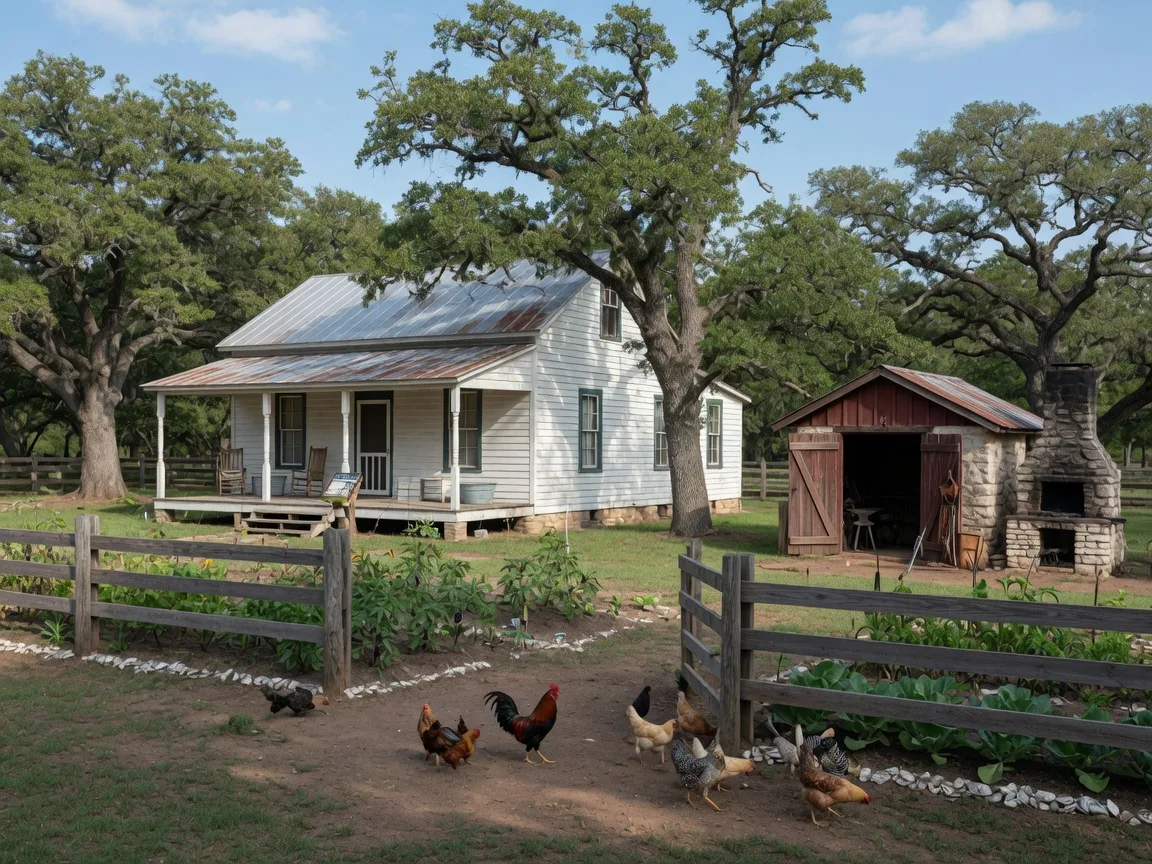
The Sauer-Beckmann Living History Farm is the state park's centerpiece and one of the better living history museums in Texas [1][8]. The farmstead interprets German-Texan rural life as it existed between approximately 1915 and 1918, a period when the Hill Country was still largely a pioneer agricultural landscape. Costumed interpreters perform daily chores using period-appropriate tools and methods: milking cows, gathering eggs from heritage-breed chickens, making butter, cooking meals on wood-burning stoves, canning produce from the garden, and cleaning with homemade lye soap [8][9][10].
The property has a layered history. The original 1869 log cabin on the site was built by German immigrants Johann and Christine Sauer. The Beckmann family acquired the property around 1900 and expanded it with a main house and additional structures. By 1915, the farm represented a typical middle-class German-Texan operation in the Hill Country, blending traditional farming practices with the modest material improvements of the early 20th century [8][9].
Visitors are encouraged to participate in farm activities. This is not a roped-off exhibit. The interpreters actively involve guests in churning butter, feeding animals, shelling corn, and other chores. Children are particularly drawn to the experience, and the farm is structured to accommodate them without being condescending or overly sanitized [8][10].
The farm's hours are seasonal: October through May, it operates from 10:00 AM to 4:00 PM; June through September, it operates from 9:00 AM to 3:00 PM. The farm is closed the last Tuesday of every month, as well as Thanksgiving, Christmas, and New Year's Day [1][8][10].
LBJ Ranch self-guided driving tour
The self-guided driving tour of the LBJ Ranch covers approximately 14 miles and takes visitors through the heart of the president's working Texas Hill Country ranch [2][3][6]. The tour route is a one-way loop that begins at the state park visitor center, where visitors must obtain a free driving permit. Highlights along the route include [2][6]:
- LBJ's reconstructed birthplace: The house where Lyndon Baines Johnson was born on August 27, 1908, in a small farmhouse near the Pedernales River. The original structure had deteriorated by the 1960s, and LBJ himself oversaw its reconstruction in 1964, using historic photographs and his own memories to ensure authenticity. The reconstructed house was built on the original foundation and furnished with period pieces [2][3].
- Johnson Family Cemetery: The burial site of LBJ and Lady Bird Johnson, along with his parents, grandparents, and other family members. LBJ died on January 22, 1973, and is buried beneath a simple limestone marker inscribed with his dates and, notably, his initials rather than the full presidency one might expect. Lady Bird Johnson was buried beside him in 2007. The cemetery is a quiet, shaded spot overlooking the Pedernales River valley [2][3].
- Junction School: The one-room schoolhouse where LBJ began his formal education at age four in 1912, taught by his mother, Rebekah Baines Johnson. The school operated until 1955 and was restored and rededicated in 1965 as a historic site [2][3].
- The Texas White House: The main ranch house where LBJ conducted presidential business during his five years in office. The house is currently closed for a major rehabilitation project, with reopening anticipated in late 2025. During the closure, the grounds remain accessible, and visitors can walk around the exterior. The house played host to world leaders including West German Chancellor Ludwig Erhard, Mexican President Gustavo Diaz Ordaz, and Japanese Prime Minister Eisaku Sato during Johnson's presidency [6][11].
- Ranch show barn and presidential vehicles: A display of vehicles from the Johnson era, including the 1964 Lincoln Continental convertible famously used for "LBJ's Flying Seatbelt" drives around the ranch, and an Amphicar that LBJ reportedly used to play pranks on guests by driving into the Pedernales River. The show barn also exhibits ranch equipment and artifacts from Johnson's farming operation [2][11].
- Hereford cattle and wildlife: The ranch remains a working cattle operation, and Hereford cattle graze the pastures along the driving route. White-tailed deer, wild turkeys, and other Hill Country wildlife are commonly visible from the road [2][5].
The driving tour is open daily from 9:00 AM to 5:00 PM, except Thanksgiving, Christmas, and New Year's Day. The route is suitable for all vehicles, including passenger cars, and takes roughly 45 to 60 minutes to complete without stops, though most visitors spend 90 minutes to two hours with stops at the key sites [2][6].
The LBJ Ranch is also designated as an International Dark Sky Park, making it one of the few presidential historic sites in the country where stargazing is a recommended activity. The park is open until 5:00 PM, so evening stargazing is not accessible during standard hours, but the dark-sky designation reflects the ranch's commitment to preserving the natural nighttime landscape [2][6][12].
Johnson City District: Boyhood Home and Johnson Settlement
While the LBJ Ranch and state park are located near Stonewall, the Lyndon B. Johnson National Historical Park also operates a second district in Johnson City, 14 miles east on US-290 [2][3]. This district contains two additional sites worth visiting for anyone making a full day of the trip.
The LBJ Boyhood Home is a modest Victorian house built around 1886, located at 200 East Elm Street in Johnson City. LBJ's parents purchased the home in 1913 when Lyndon was five years old, and he lived there until his marriage to Claudia Alta Taylor ("Lady Bird") in 1934. It was from the front porch of this house that Johnson delivered his first political speech in 1930, campaigning for state senator Welly K. Hopkins. The home was dedicated as a museum in 1965 and contains original family furnishings donated by Lady Bird Johnson. It is open daily (except Thanksgiving, Christmas, and New Year's Day) from 9:00 AM to 5:00 PM, with free admission [2][3][13].
The Johnson Settlement is located one block west of the Boyhood Home and preserves the original 1860s frontier homestead of LBJ's paternal grandparents, Samuel Ealy Johnson Sr. and Eliza Bunton. Samuel Sr. and his brother Tom ran the largest cattle-driving operation in seven counties, buying cattle on credit in the spring and driving herds north along the Chisholm Trail to Kansas railheads. The restored dogtrot cabin — an open-breezeway log cabin typical of mid-19th-century Texas frontier architecture — served as both their home and business headquarters. The settlement also includes restored barns, a windmill, water tank, and longhorn cattle. A half-mile gravel loop trail winds through the property. Free admission [2][3][14].
Other state park amenities
The state park also offers a swimming pool (open seasonally, generally Wednesday through Sunday from noon to 8:00 PM when in operation), a 1.2-mile nature trail, picnic areas with tables and grills, a playground, and tennis courts [1][4]. The visitor center has exhibits on LBJ's life and the Hill Country environment, a park store, and restrooms. Fishing is permitted in the Pedernales River with a valid Texas fishing license [1].
Hours, fees, and practical details
One of the more attractive aspects of this destination is its cost: admission is free at both the state park and the national historical park [1][2]. There is no entrance fee for either site. The only requirement is picking up a free driving permit at the state park visitor center before entering the LBJ Ranch [2][6].
| Location | Hours | Important Notes |
|---|---|---|
| State Park Visitor Center | 8:30 AM - 4:00 PM daily | Free. Pick up LBJ Ranch driving permit here |
| Sauer-Beckmann Farm (Oct-May) | 10:00 AM - 4:00 PM | Closed last Tuesday of each month |
| Sauer-Beckmann Farm (Jun-Sep) | 9:00 AM - 3:00 PM | Closed last Tuesday of each month |
| LBJ Ranch Driving Tour | 9:00 AM - 5:00 PM daily | Free permit required; ~14-mile loop |
| Boyhood Home (Johnson City) | 9:00 AM - 5:00 PM daily | 14 miles east of Stonewall on US-290 |
| Johnson Settlement | Dawn to dusk | Half-mile gravel loop trail; free |
| Swimming Pool (seasonal) | Wed-Sun, 12:00-8:00 PM | Operated by Texas Parks & Wildlife |
| Holiday Closures | All sites closed | Thanksgiving, Christmas, New Year's Day |
Hours and closures are subject to change. The Texas White House is currently closed for rehabilitation. Confirm current conditions before visiting.
Address for both parks: 199 State Park Road 52, Stonewall, TX 78671. This is the address of the state park visitor center, which serves as the gateway for both the living history farm and the LBJ Ranch driving tour [1].
What to bring: Sunscreen, a hat, and water are essential during warmer months. The driving tour is in an open vehicle (your car), but the Sauer-Beckmann Farm involves walking through outdoor exhibits with limited shade. Comfortable walking shoes are recommended. A camera is useful for the landscape and wildlife along the driving tour. For the swimming pool, bring towels and appropriate gear. The park has no food concessions — pack a picnic lunch or plan to eat in Stonewall, Fredericksburg (15 minutes west), or Johnson City (15 minutes east). Several picnic tables and covered pavilions are available at the state park [1][4].
Pets: Pets are permitted on leashes in the state park but are not allowed inside the Sauer-Beckmann Farm buildings or on the LBJ Ranch driving tour [1][2].
Suggested itinerary: a full day from Boerne
The size and variety of this destination make it worth a full-day trip from Boerne. A practical itinerary might look like this:
- Morning (9:00 AM - 12:00 PM): Depart Boerne and drive to the LBJ State Park Visitor Center. Pick up the free driving permit for the LBJ Ranch. Tour the Sauer-Beckmann Living History Farm, allowing roughly 90 minutes to walk through the grounds, interact with interpreters, and observe the farm operations. The farm is most active in the late morning [1][8].
- Midday (12:00 PM - 1:30 PM): Picnic lunch at the state park's shaded picnic area. Alternatively, drive five minutes west on US-290 to Stonewall for a meal at Hye Market (noted for its kolaches and Hill Country cuisine) or continue to Fredericksburg for a wider selection of restaurants [1][15].
- Afternoon (1:30 PM - 4:00 PM): Take the self-guided LBJ Ranch driving tour. Allow 90 minutes to two hours to complete the loop with stops. Key stops include the reconstructed birthplace, the Johnson Family Cemetery, and the Junction School [2][6].
- Late afternoon (4:00 PM - 5:00 PM): If time and interest allow, drive east 14 miles to Johnson City to visit the LBJ Boyhood Home before it closes at 5:00 PM, or walk the Johnson Settlement trail. This adds roughly 30 minutes of driving [2][3].
- Evening (5:00 PM onward): Return to Boerne via the scenic RR-1376 route through Luckenbach and Sisterdale, stopping for a drink or live music at Luckenbach if the timing works [16].
Seasonal timing: when to go
| Season | Best For | Notes |
|---|---|---|
| Spring (Mar-May) | Living history farm, hiking, wildflowers | Mild weather, bluebonnets along the driving tour. Farm activities in full swing. Best all-around season. |
| Summer (Jun-Aug) | Swimming pool, farm (early hours), driving tour | Farm operates 9 AM-3 PM. Pool open seasonally. Hot for extended outdoor time. Arrive early. |
| Fall (Sep-Nov) | Farm, driving tour, foliage | Cooling temperatures, fewer crowds. Fall color along the Pedernales in October-November. Farm returns to 10 AM-4 PM schedule. |
| Winter (Dec-Feb) | Driving tour, indoor exhibits, solitude | Quietest season. Farm hours continue (Oct-May schedule). Cold days but generally clear. Best time for quiet reflection at the cemetery and driving tour. |
Seasonal conditions vary. Check Texas Parks & Wildlife and National Park Service websites before visiting for current hours and conditions.
Why LBJ State Park and LBJ Ranch matter if you are considering the Hill Country
This is not a conventional day-trip destination in the way a state park or a historic downtown is. It is a destination that tells a story about the Hill Country that most visitors never hear: the story of how the land itself shaped the people who lived on it, from the 1860s cattle drovers to the German immigrants to the 36th president of the United States [4][17].
The LBJ Ranch driving tour is one of the few places in the country where you can see a working cattle operation that was managed by a sitting president. Johnson famously conducted presidential business from his ranch — the phone calls that shaped the Civil Rights Act, the Voting Rights Act, and Medicare were made from a desk overlooking the Pedernales River. The ranch was not a retreat from the presidency; it was a working base of operations, and the landscape informed the decisions made there [17][18].
For someone evaluating a move to the Hill Country, this destination provides something practical: a look at the region's agricultural and political history in a single visit. The Sauer-Beckmann Farm shows how German-Texan settlers built a life on this land without modern infrastructure. The Johnson Settlement shows the cattle-driving economy that preceded the farms. The LBJ Ranch shows how the same landscape that supported frontier settlers and German farmers produced a national figure who changed the country. That progression is rare and worth the drive [4][17].
The combination also matters because it is free. A family can spend an entire day across both parks, visit four distinct historical sites, and pay nothing in admission fees. For anyone relocating to the Hill Country and exploring what the region offers, this makes for an accessible, low-pressure introduction to the area's cultural and historical depth [1][2].
Pairs well with
- Luckenbach (Wine, Food & Culture) — Located about 10 miles south on RR-1376, Luckenbach is a natural stop on the return trip from Stonewall. An afternoon at the LBJ Ranch followed by an evening of live music at Luckenbach's dance hall is one of the better full-day itineraries in the Hill Country [16].
- Fredericksburg (Wine, Food & Culture) — Fifteen miles west of the state park, Fredericksburg's Main Street dining, winery tasting rooms, and the National Museum of the Pacific War make for a practical add-on to a day focused on the LBJ sites. Fredericksburg also has the widest selection of restaurants and lodging in the area [15].
Frequently asked questions
Is admission really free at both parks?
Yes. Both the Lyndon B. Johnson State Park & Historic Site and the Lyndon B. Johnson National Historical Park charge no entrance fees. The only requirement for the LBJ Ranch driving tour is a free driving permit available at the state park visitor center. Parking is also free. This makes the destination one of the more accessible historic sites in the Hill Country from a cost perspective [1][2].
Can I go inside the Texas White House?
The Texas White House is currently closed for a major rehabilitation project, with anticipated reopening in late 2025. During the closure, the grounds are accessible and visitors can view the exterior. The Hangar Visitor Center, which housed exhibits on LBJ's presidency, is also temporarily closed. The self-guided driving tour of the ranch property remains fully open, including the reconstructed birthplace, Johnson Family Cemetery, Junction School, show barn, and other sites [2][6].
How long does it take to visit both parks properly?
Plan for four to six hours to cover the main sites at a comfortable pace. A typical visit includes 60 to 90 minutes at the Sauer-Beckmann Living History Farm, 90 minutes to two hours on the LBJ Ranch driving tour, and 30 to 45 minutes at the visitor center. Adding the Johnson City District (Boyhood Home and Johnson Settlement), which is 14 miles east, adds roughly 90 minutes to two hours including driving time. A full-day trip covering all sites is feasible from Boerne, especially if you bring a picnic lunch [1][2].
Is the Sauer-Beckmann Farm appropriate for young children?
Yes. The living history farm is one of the more child-friendly historical attractions in the Hill Country. Children can participate in farm chores, interact with heritage-breed animals, and experience a working farm from the early 1900s in a hands-on environment. The interpreters are trained to engage visitors of all ages. The farm is not a roped-off exhibit — it is designed for participation, and children are encouraged to touch, ask questions, and help with tasks [8][10].
What is the best time of year to visit?
Spring (March through May) is the best season, with mild temperatures, wildflowers along the driving tour, and full activity at the living history farm. Fall (September through November) is also excellent with cooler weather and fewer crowds. Summer visits are viable but can be hot — the farm shifts to earlier hours (9:00 AM to 3:00 PM), and the swimming pool is a welcome amenity. Winter is the quietest season and offers the most peaceful experience of the driving tour and cemetery, though the farm remains on its regular schedule [1][4].
Sources
- [1] Texas Parks & Wildlife — Lyndon B. Johnson State Park & Historic Site. tpwd.texas.gov/state-parks/lyndon-b-johnson
- [2] National Park Service — Lyndon B. Johnson National Historical Park. nps.gov/lyjo
- [3] Lyndon B. Johnson National Historical Park — Wikipedia. en.wikipedia.org/wiki/Lyndon_B._Johnson_National_Historical_Park
- [4] LBJ State Park & Historic Site Guide — Incredible Texas. incredibletexas.com/lbj-state-park-historic-site-guide/
- [5] LBJ Ranch — Wikipedia. en.wikipedia.org/wiki/LBJ_Ranch
- [6] NPS — Visiting the LBJ Ranch. nps.gov/lyjo/planyourvisit/visitlbjranch.htm
- [7] Distance from Boerne, TX to Stonewall, TX — Distance-Cities.com. distance-cities.com/distance-boerne-tx-to-stonewall-tx
- [8] Sauer-Beckmann Living History Farm — Texas Parks & Wildlife. tpwd.texas.gov/state-parks/lyndon-b-johnson/sauer-beckmann-farm
- [9] Sauer-Beckmann Living History Farm — SAH Archipedia. sah-archipedia.org/buildings/TX-01-NB68.1
- [10] Sauer-Beckmann Living History Farm — Visit Fredericksburg TX. visitfredericksburgtx.com/directory/sauer-beckmann-living-history-farm-at-lyndon-b-johnson-state-park-and-historic-site/
- [11] Texas White House — Wikipedia. en.wikipedia.org/wiki/Texas_White_House
- [12] International Dark-Sky Association — LBJ Ranch Dark Sky Park. darksky.org
- [13] NPS — LBJ Boyhood Home. nps.gov/lyjo/learn/historyculture/boyhoodhome.htm
- [14] NPS — Johnson Settlement. nps.gov/lyjo/learn/historyculture/thejohnsonsettlement.htm
- [15] LBJ State Park & Historic Site — Visit Fredericksburg TX. visitfredericksburgtx.com/directory/lyndon-b-johnson-state-park-and-historic-site/
- [16] Luckenbach, Texas — Hill Country Homesteads. hillcountryhomesteads.com/day-trips/wine-food-culture/luckenbach/
- [17] Lyndon B. Johnson — American Experience. pbs.org/wgbh/americanexperience/features/lbj-ranch/
- [18] LBJ and the Ranch — Miller Center, UVA. millercenter.org/president/lbjohnson/life-after-the-presidency
Published August 10, 2026
Updated August 10, 2026