
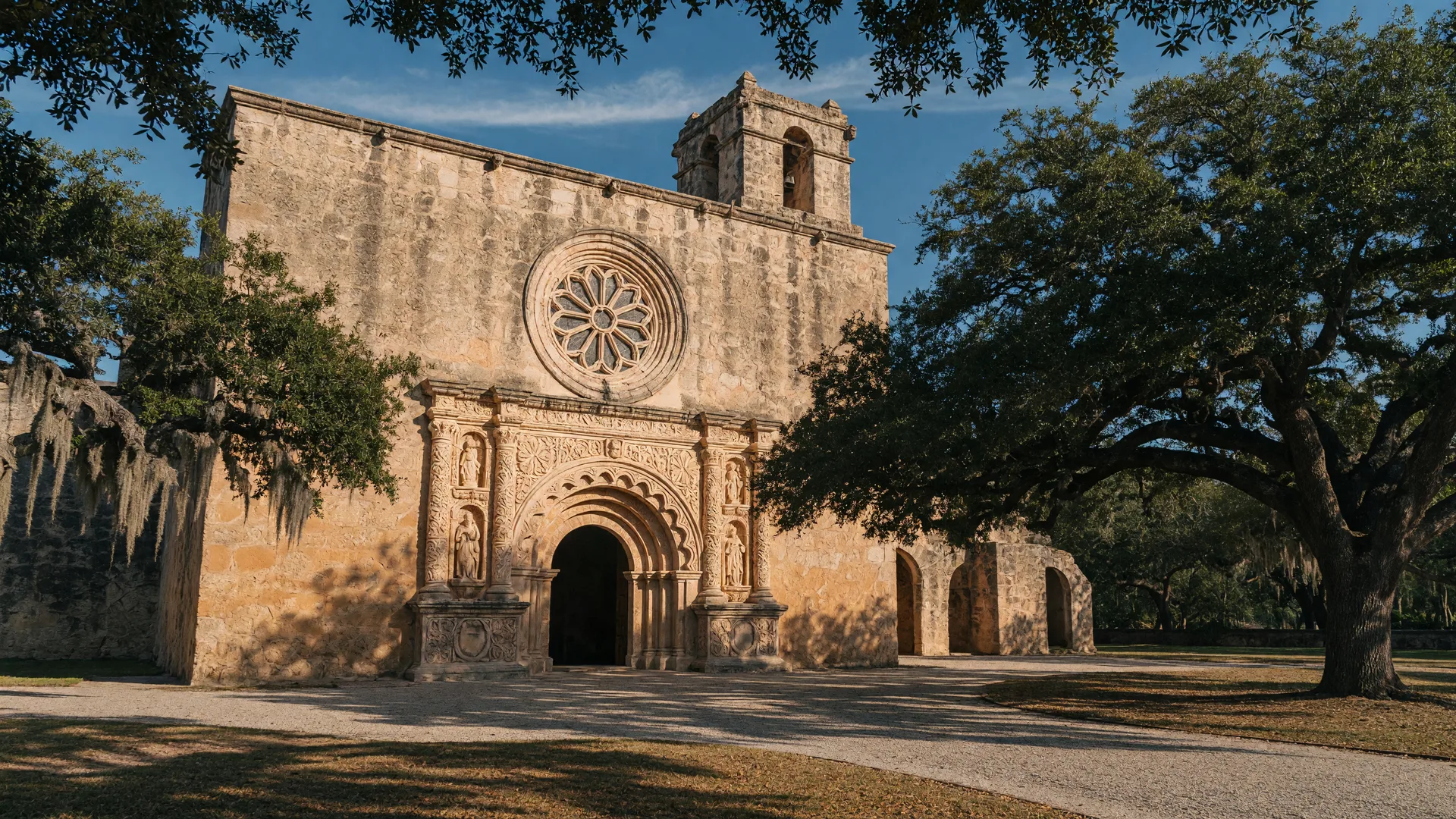
San Antonio Missions National Historical Park is one of the most significant cultural destinations in Texas, and it is less than 45 minutes from Boerne. The park preserves four 18th-century Spanish colonial missions — Concepción, San José, San Juan, and Espada — that together form the largest concentration of Spanish colonial heritage in the United States [1][2]. In 2015, UNESCO designated the San Antonio Missions a World Heritage Site, placing them in the same category as the Grand Canyon, the Statue of Liberty, and Independence Hall [3].
What sets the San Antonio Missions apart from other historic sites in the region is that they are not frozen museum pieces behind velvet ropes. Each mission has an active Catholic parish that still holds regular services. The stone churches, some of which have been in continuous use for over 270 years, function as places of worship, community gathering spaces, and UNESCO-protected cultural landmarks — all at the same time [1][4]. For anyone evaluating a move to the Hill Country, this is a destination that tells you something fundamental about the history, the cultural DNA, and the architectural heritage of the region you are considering.
The park is located roughly 34 miles southeast of downtown Boerne via I-10 East and US-87 South, a drive that takes about 40 to 45 minutes under normal traffic conditions [5]. The visitor center and headquarters are at Mission San José, 6701 San José Drive, San Antonio, TX 78214. Admission to all four missions is completely free. No reservations are required. The park is open daily from 9:00 AM to 5:00 PM, with the mission grounds open from sunrise to sunset [6].
A brief history of the missions
Spain established a network of missions across what is now Texas and the American Southwest during the 17th and 18th centuries as part of a broader strategy to claim and settle the frontier. The missions served multiple purposes: converting indigenous populations to Catholicism, teaching European agricultural and trade skills, establishing Spanish cultural and political authority, and creating self-sustaining communities that could defend the territory against French and later Anglo-American expansion [1][7].
San Antonio became the center of Spanish missionary activity in Texas. Mission San Antonio de Valero (the Alamo) was established in 1718, followed by a chain of missions founded further south along the San Antonio River in the 1720s and 1730s. The four missions preserved in the national historical park were originally established in East Texas near present-day Nacogdoches between 1690 and 1720, then relocated to the San Antonio River in 1731 in a coordinated move that consolidated Spanish missionary resources in the region [1][7][8].
At their peak in the mid-1700s, the missions were thriving agricultural and livestock centers. The Franciscan friars and the indigenous communities built an extensive system of acequias (irrigation canals) from the San Antonio River that watered crops and supported a population of several hundred people at each mission. Mission Espada's acequia system, portions of which still function today, is one of the oldest continually operating irrigation systems in the United States [1][9].
The mission period effectively ended in the early 1800s as Mexico gained independence from Spain, secularization policies disbanded the mission communities, and the land was redistributed. The stone churches remained, however, and the communities that grew around them evolved into the neighborhoods and parishes that exist today. The San Antonio Missions National Historical Park was established by Congress in 1978 and designated a UNESCO World Heritage Site in 2015 [1][2][3].
The four missions: what to see at each one
The four missions of the national historical park are strung along roughly nine miles of the San Antonio River, from south-central San Antonio to the southern edge of Bexar County. The recommended approach is to start at Mission San José (home to the main visitor center), then visit the remaining three in order heading south: Concepción, San Juan, and Espada [6][10].
Mission San José y San Miguel de Aguayo (1720)
Mission San José is the largest and most elaborate of the four missions, often called the "Queen of the Missions" for its size, architectural grandeur, and historical significance [1][4]. Founded in 1720 by Franciscan friar Antonio Margil de Jesús, it was the most successful of the Texas missions. At its peak, approximately 350 Native Americans lived within the mission walls, and over 2,000 were baptized during its operational years [4][11].
The centerpiece of Mission San José is the massive stone church, completed in 1782, with its ornately carved entrance and the famous Rose Window — a circular stone carving on the church's south wall that is considered one of the finest examples of Spanish Colonial Baroque architecture in the United States [4][12]. The exact origin of the Rose Window is debated: some sources credit sculptor Pedro Huizar, while others attribute it to an unknown indigenous artisan working under Franciscan direction. Either way, the detail, symmetry, and preservation of the carving are remarkable [11][12].
The mission compound includes the restored granary, a defensive wall with Native American quarters, the friary building, and the original flour mill that used one of the mission's acequias for power. The visitor center is adjacent to the church and houses exhibits on the history of all four missions, a park film, and the park bookstore. Allow 90 minutes to two hours for San José, more if you plan to join a ranger-led tour [6][10].
Ranger-led tours at San José are offered daily at 10:00 AM, 11:00 AM, and 2:30 PM, weather permitting. Tours last approximately 45 minutes to an hour and depart from the visitor center. They are free and wheelchair accessible. Note that no ranger programs are held on the first Wednesday of each month [10].
Mission Concepción (1731)
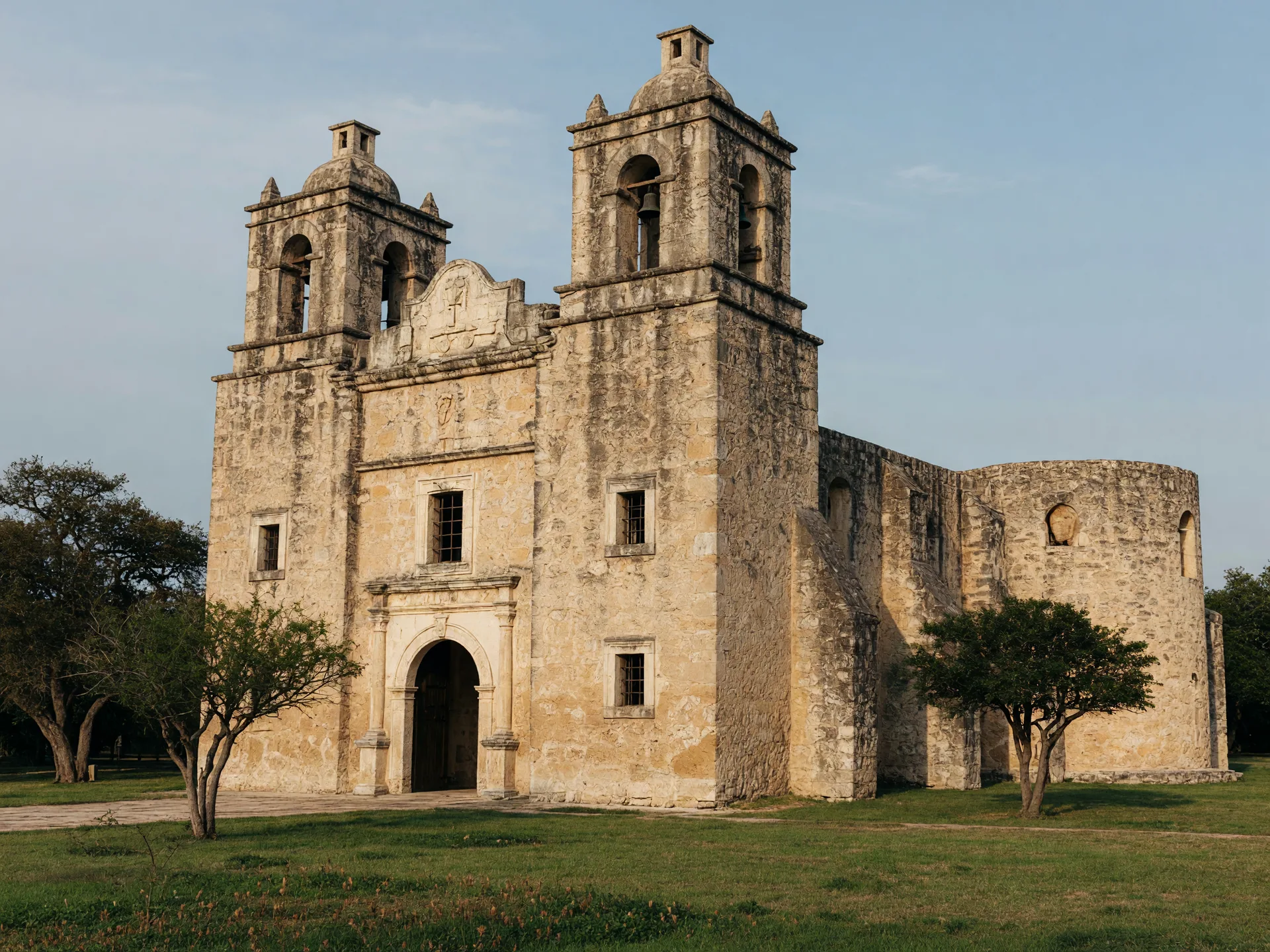
Mission Nuestra Señora de la Purísima Concepción de Acuña, known simply as Mission Concepción, was originally founded in East Texas in 1716 and relocated to its current San Antonio location in 1731 [1][13]. Its stone church, completed and dedicated in 1755, is the oldest unrestored stone church in the United States [13][14]. The "unrestored" designation matters: the church stands today almost exactly as it was built in the mid-18th century, with the same original wall paintings, the same pulpit, and the same rough-hewn limestone surfaces that generations of parishioners have touched.
The interior of the Concepción church retains portions of its original frescoed decoration, including geometric patterns, religious symbols, and architectural details painted directly onto the limestone walls. These frescoes are among the most significant surviving examples of Spanish colonial interior decoration in the United States, and they have survived because the church was never plastered over or extensively renovated [13][14].
Concepción is the closest mission to downtown San Antonio (approximately three miles south) and the most compact of the four, making it a relatively quick stop — roughly 30 to 45 minutes is enough to walk through the church, the cloister, and the grounds. Guided tours are available on weekends at 10:00 AM and 1:30 PM [10][13].
Mission San Juan Capistrano (1731)
Mission San Juan Capistrano was originally established in East Texas in 1716 as La Misión San José de los Nazonis and relocated to the San Antonio River on March 5, 1731 [1][15]. Among the four missions, San Juan sits closest to the river and was notable for its agricultural productivity. The mission's acequia system and its extensive fields and orchards made it the primary food producer for the mission chain, supplying grain, beans, melons, and cotton not only to the other missions but also to the presidio and the growing civilian settlement of San Antonio [15][16].
The church at San Juan is smaller and less ornate than San José or Concepción, but it has a quiet, contemplative character that many visitors find more moving. The bell tower, the thick limestone walls, and the simple wooden altar create a space that feels closer to the mission's original frontier reality than the grander churches to the north. The adjacent friary and the foundations of earlier church buildings are visible in the compound [15][16].
Plan for roughly 30 to 45 minutes at San Juan. The mission is the least visited of the four, which means it offers the most peaceful experience, particularly on weekday mornings [10][15].
Mission San Francisco de la Espada (1731)
Mission Espada, the southernmost of the four missions, was originally founded in East Texas in 1690 — making it the oldest of the mission foundations in the chain — and relocated to its present site in 1731 [1][17]. Espada is distinguished by its unique bell tower and facade, which differ noticeably in style from the other three missions, and by its role in operating the most intact portion of the historic acequia system [9][17].
The Espada acequia, built in the 1740s, carries water from the San Antonio River through a combination of stone-lined channels and a masonry aqueduct that is one of the oldest engineered water structures in the United States. The Espada Dam and Acequia system is a National Historic Civil Engineering Landmark and continues to supply irrigation water to the community to this day [9][17].
Espada's church interior is simple and well-preserved, with exposed limestone walls, a wooden ceiling, and a modest altar. The mission compound includes the restored friary and a small chapel. The surrounding neighborhood, with its winding roads and historic stone houses built by mission families in the 19th century, is one of San Antonio's most distinctive cultural landscapes [16][17].
Allow roughly 30 to 45 minutes at Espada. If you are biking the Mission Reach trail, Espada makes a natural end point — from here, you can either turn around and ride north or arrange a pickup from the Espada parking lot [6][10].
How to get there from Boerne
The San Antonio Missions are approximately 34 miles southeast of downtown Boerne, about a 40- to 45-minute drive under normal traffic conditions [5]. The driving route is straightforward:
Take I-10 East from Boerne toward San Antonio for approximately 25 miles, then take exit 555B to merge onto US-87 South (Roosevelt Avenue) toward downtown San Antonio. Continue south on US-87 for about 6 miles, then follow the signs south toward the missions. The first mission you will encounter driving south on Roosevelt Avenue is Mission Concepción, followed by San José [5][6].
Alternatively, for a more direct route to the main visitor center, take I-10 East to Loop 410 South, then exit at Roosevelt Avenue and head south to Mission San José. This route adds a few miles but can be faster during peak traffic hours [5].
| Starting Point | Distance | Drive Time |
|---|---|---|
| Downtown Boerne | ~34 miles | ~40-45 min |
| Fair Oaks Ranch | ~32 miles | ~35-40 min |
| San Antonio (downtown) | ~6 miles north | ~10-15 min |
| San Antonio Airport | ~16 miles | ~20-30 min |
Distances are approximate. Drive times increase during peak hours, especially on I-10 through the US-281 interchange.
Traffic on I-10 between Boerne and San Antonio is fast — the posted speed limit is 75 mph for most of the stretch — but can slow considerably during morning (7:00–9:00 AM) and evening (4:30–6:30 PM) rush hours. A Friday afternoon departure from Boerne can easily turn a 45-minute drive into 70 minutes. Midday departure, particularly between 10:00 AM and 1:00 PM, offers the most predictable travel time [5][6].
Parking is free and available at each of the four mission sites. Mission San José has the largest lot, which also serves the visitor center. Mission Concepción has a smaller lot that can fill on weekends. Mission San Juan and Mission Espada have moderate-sized lots that rarely fill completely [6][10].
What to see and do
The Mission Reach hike-and-bike trail
The Mission Reach is an 8-mile extension of San Antonio's famous River Walk, completed in 2013, that runs south from downtown along the San Antonio River and connects all four missions of the national historical park [18][19]. The project restored over eight miles of riverbank to native riparian habitat — grasses, wildflowers, and trees that would have lined the river before urban development — while adding over 16 miles of paved shared-use paths, paddling access points, public art installations, and pedestrian bridges [18][19].
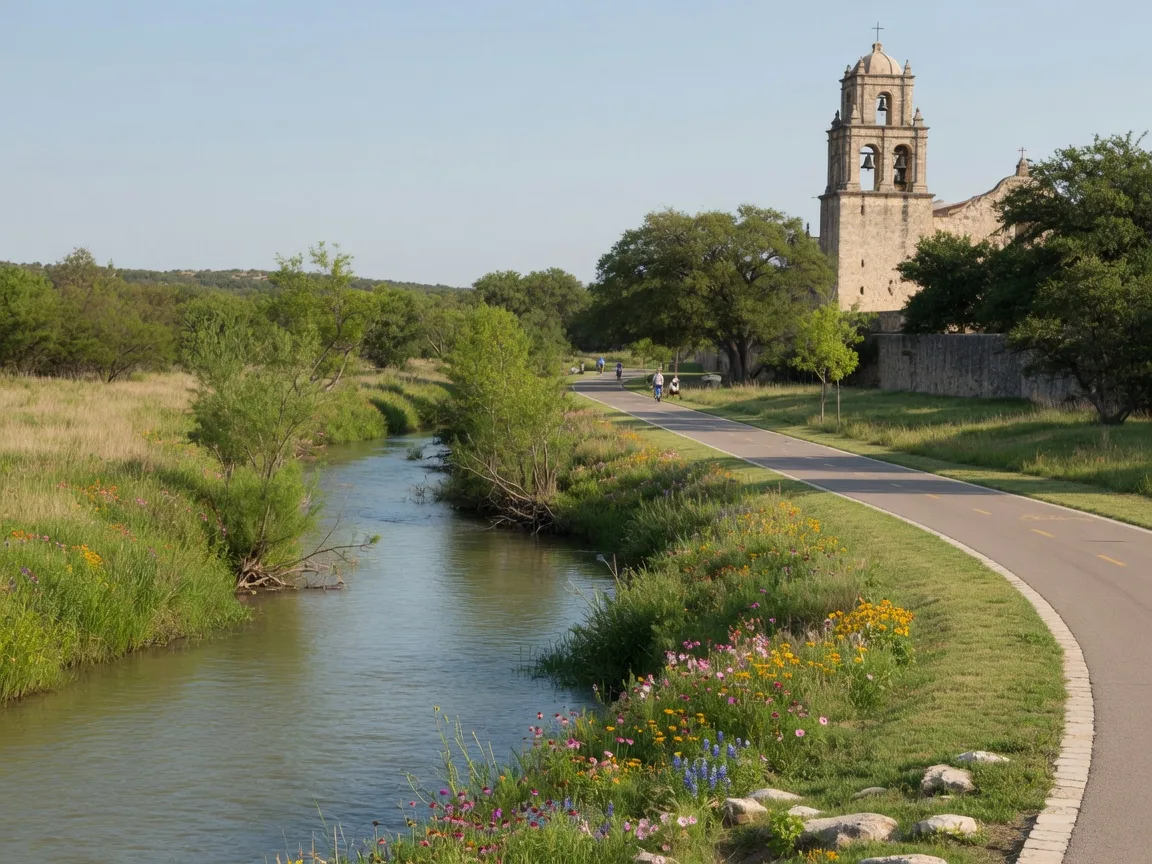
Biking the Mission Reach is the best way to see all four missions in a single visit. The trail is paved, mostly flat, and well-marked. A round trip covering all four missions from the San José visitor center is roughly 10 miles if you go south to Espada and back, or 16 miles if you start from the Blue Star Arts Complex trailhead near downtown and ride the full length of the Mission Reach [18][19]. Bike rentals are available at a few shops near the Blue Star trailhead, though there are no dedicated rental facilities within the park itself. Bikers should note that some short spur paths connecting the main trail to the mission grounds are designated for pedestrians only, and dismounting is required on those sections [19][20].
For visitors who prefer to drive, the standard approach is to drive from mission to mission (a loop of roughly 9 miles), parking at each site's lot and walking the grounds. The drive-and-stop method takes roughly the same total time as biking but with more flexibility for visitors with limited mobility or time constraints [6][10].
The UNESCO World Heritage designation
The San Antonio Missions were inscribed on the UNESCO World Heritage List on July 5, 2015. They are one of only 25 UNESCO World Heritage Sites in the United States, and the only one in Texas [3]. UNESCO's designation criteria recognized the missions as "exceptional examples of the Spanish Crown's efforts to colonize, evangelize, and defend the northern frontier of New Spain" and noted that they "illustrate the interweaving of Spanish and Coahuiltecan cultures through the establishment of communities organized around the Roman Catholic faith" [2][3]. The designation covers the four missions of the national historical park together with the Alamo and Rancho de las Cabras (the off-site livestock ranch associated with Mission Espada, located in nearby Floresville) [2][3].
For residents of the Hill Country, having a UNESCO World Heritage Site within a 45-minute drive is a remarkable advantage. Few metropolitan areas in the United States can claim a World Heritage Site as a day-trip destination, and the combination of cultural significance, free access, and the scenic Mission Reach trail makes the San Antonio Missions a uniquely accessible world-class attraction [3][6].
King William Historic District
Just north of Mission Concepción and directly adjacent to the Mission Reach trailhead near the Blue Star Arts Complex, the King William Historic District offers an additional layer of cultural history worth exploring on the same trip. San Antonio's most prominent historic residential neighborhood, developed primarily by German immigrants in the late 19th century, features restored Victorian mansions, tree-lined streets, and the San Antonio River running along its western edge [21]. The combination of the missions and King William — a UNESCO site and a National Register Historic District within two miles of each other — makes for a remarkably dense cultural itinerary just south of downtown San Antonio [2][21].
Practical tips: hours, fees, and timing
The San Antonio Missions are managed by the National Park Service in cooperation with the Archdiocese of San Antonio, the City of San Antonio, and the San Antonio River Authority. The park is open daily except Thanksgiving, Christmas, and New Year's Day [6][10].
| Detail | Information |
|---|---|
| Admission | Free. No reservations required. |
| Park Hours | 9:00 AM - 5:00 PM daily |
| Grounds Hours | Sunrise to sunset |
| Visitor Center | Mission San José, 6701 San José Dr |
| Ranger Tours | Daily at 10 AM, 11 AM, 2:30 PM (San José); free |
| Best Time to Visit | Weekday mornings, September through May |
| Time Needed | 3-4 hours for all four missions (biking); 2-3 hours driving |
| Parking | Free lots at each mission; largest at San José |
| Closed | Thanksgiving, Christmas, New Year's Day |
Hours and ranger program schedules are subject to change. Check the official NPS website before visiting for the most current information.
Best time to visit: The fall (September through November) and spring (March through May) offer the most comfortable temperatures for walking the mission grounds and biking the Mission Reach. Summer visits are viable — the missions are open, and the Mission Reach is rideable — but temperatures regularly exceed 95°F by midday, and the stone churches and unshaded portions of the trail can be difficult for extended outdoor exposure. Winter is the quietest season and offers a more contemplative experience at each mission, with cooler temperatures that are actually better for walking [6][10].
Weekend crowds: The missions are popular on Saturdays and Sundays, particularly during school breaks and holiday periods. Mission San José sees the highest visitor volume. The quieter southern missions (San Juan and Espada) provide a more peaceable experience even on busy weekends. Weekday mornings, particularly Tuesday through Thursday, offer the lowest crowd levels [6][10].
What to bring: Water is essential, especially for visitors biking the Mission Reach in warmer months. Sunscreen, a hat, and comfortable walking shoes are recommended for all seasons. Bikers should bring their own bike lock and repair kit — there are no rental or repair facilities within the park. Cash is helpful for donations at the mission gift shops, though the NPS bookstore at the San José visitor center accepts cards [6][10].
Accessibility: All four mission sites are wheelchair accessible. The visitor center at Mission San José has accessible parking, restrooms, and exhibits. The Mission Reach trail is paved and flat, making it accessible for wheelchairs and mobility devices. However, some interior areas of the historic church buildings have uneven stone floors and narrow doorways [6][10].
Seasonal comparison
| Season | Best For | Considerations |
|---|---|---|
| Spring (Mar-May) | Biking the Mission Reach, photography, ranger tours | Mild temps 70-85F; wildflowers along river; moderate crowds |
| Summer (Jun-Aug) | Early morning visits, indoor exhibits, river paddling | High temps 90-100F; carry water; plan indoor time at churches |
| Fall (Sep-Nov) | All activities, photography, Mission Reach biking | Best weather window; comfortable 70-85F; lighter crowds weekdays |
| Winter (Dec-Feb) | Quiet contemplation, photography (low-angled light) | 40-65F; lowest crowds; limited hours (closed major holidays) |
Seasonal conditions vary significantly in San Antonio. The missions are open year-round, but summer heat and holiday closures affect the visitor experience.
Why the San Antonio Missions matter if you are considering the Hill Country
The San Antonio Missions offer a more useful perspective for someone evaluating a move to the Hill Country than their tourist reputation suggests. UNESCO World Heritage Sites are not common anywhere in the United States, and having one within a 45-minute drive from Boerne is a distinction that matters for the quality of daily life in the region [3].
But the missions also provide something more specific: they are a window into how the Hill Country and South Texas developed as a cultural landscape. The Spanish colonial mission system was the first European settlement pattern in this part of Texas, and the infrastructure the missions created — the acequias, the stone architecture, the land-use patterns along the San Antonio River — shaped the development of San Antonio and the surrounding region for centuries [1][7]. The acequias at Mission Espada still carry water. The church at Mission Concepción still holds mass. The communities that grew around these mission compounds are still active neighborhoods with distinct identities [4][9].
For out-of-state buyers evaluating San Antonio or the Boerne area, the missions serve as a reminder that this region has a deep, layered history that predates Texas statehood by over a century. The architectural quality of the mission churches, the engineering of the acequia systems, and the survival of these structures through war, secularization, and urban development speak to a level of historical continuity that is increasingly rare in fast-growing Sun Belt metropolitan areas [1][2][3].
The proximity of the missions to Boerne also matters for practical reasons. A family moving to the Hill Country gains not only access to the natural landscape — the rivers, the parks, the Hill Country scenery — but also to cultural assets that most regions of comparable population density do not offer. The missions are free, they are well-maintained by the National Park Service, and they are close enough to be a regular destination rather than a once-a-year special trip [6][10]. For history-minded residents, that is a meaningful quality-of-life advantage.
Pairs well with
- King William Historic District (Wine, Food & Culture) — Located just north of Mission Concepción, San Antonio's 19th-century German heritage neighborhood offers restored Victorian architecture, the San Antonio River, and the Blue Star Arts Complex. A combined cultural tour of the missions and King William covers 300 years of San Antonio history in a single day [21].
- New Braunfels (Historic Towns & Villages) — If you are making a full day of heading east out of Boerne, New Braunfels sits roughly 45 miles east of the missions via I-10 and I-35. The German heritage of New Braunfels — founded by the same Adelsverein that settled Fredericksburg — connects culturally to the German influence visible in the King William District, creating a thematic arc that spans Spanish colonial, German immigrant, and modern Texas culture in a single road trip.
Frequently asked questions
Is the Alamo part of the San Antonio Missions National Historical Park?
Not exactly. The Alamo (Mission San Antonio de Valero) is designated a UNESCO World Heritage Site as part of the same World Heritage designation, but it is managed separately by the Texas General Land Office, not by the National Park Service. The four missions of the national historical park — Concepción, San José, San Juan, and Espada — are managed by the NPS and the Archdiocese of San Antonio. The Alamo is located in downtown San Antonio, about three miles north of Mission Concepción, and requires a separate visit [1][2][3].
How long does it take to visit all four missions?
Plan for three to four hours if you are biking the Mission Reach trail between missions, which includes time at each site and the ride itself. The driving-and-stopping approach takes roughly two to three hours, depending on how much time you spend at each mission. Mission San José requires the most time (90 minutes to two hours for the visitor center, exhibits, ranger tour, and church), while the other three can be seen in 30 to 45 minutes each. A focused visit covering just San José and Concepción can be done in about 90 minutes [6][10].
Do I need a reservation to visit the San Antonio Missions?
No. The park is free and does not require any reservations for general admission. Ranger-led tours at Mission San José are also free and operate on a first-come, first-served basis. Special group tours, educational field trips, and wedding or event permits require advance arrangements through the NPS website, but a standard day trip by an individual or family needs no booking [6][10].
Can I bike the Mission Reach trail with my own bike?
Yes. The Mission Reach trail is a paved, multi-use path open to cyclists. Bikers should bring their own bikes: there are no dedicated bike rental facilities within the park, though rental shops near the Blue Star Arts Complex trailhead (north of the missions) offer options. Note that the paved pathways directly connecting the main trail to some mission grounds are designated for pedestrians only, and cyclists must dismount and walk their bikes on those short spur sections. A round trip from the San José visitor center to Mission Espada and back is roughly 10 miles [18][19][20].
Are the missions still active Catholic parishes?
Yes. All four missions have active Catholic parishes that hold regular mass services. This is one of the unusual aspects of the San Antonio Missions — they are not decommissioned museum buildings but living places of worship that have been in continuous use for over 250 years. Visitors are welcome during mass but should be respectful of worshippers. Photography is generally permitted inside the churches but may be limited during services. Mass schedules vary by mission and are posted at each site [4][6][10].
Sources
- [1] San Antonio Missions National Historical Park — Wikipedia. en.wikipedia.org/wiki/San_Antonio_Missions_National_Historical_Park
- [2] San Antonio Missions (World Heritage Site) — Wikipedia. en.wikipedia.org/wiki/San_Antonio_Missions_(World_Heritage_Site)
- [3] San Antonio Missions — UNESCO World Heritage Centre. whc.unesco.org/en/list/1466
- [4] Mission San José — San Antonio Government. sanantonio.gov/Mission-Trails
- [5] Distance from Boerne, TX to San Antonio, TX — Distance-Cities. distance-cities.com/distance-boerne-tx-to-san-antonio-tx
- [6] Plan Your Visit — San Antonio Missions National Historical Park (NPS). nps.gov/saan/planyourvisit/plan-your-visit.htm
- [7] San Antonio Missions — Texas State Historical Association. tshaonline.org/handbook/entries/san-antonio-missions
- [8] San Antonio Missions National Historical Park — Recreation.gov. recreation.gov/gateways/2911
- [9] Mission Espada Acequia — Texas State Historical Association. tshaonline.org/handbook/entries/espada-acequia
- [10] Guided Programs — San Antonio Missions (NPS). nps.gov/saan/planyourvisit/guided-programs.htm
- [11] Mission San José — Atlas Obscura. atlasobscura.com/places/mission-san-jose
- [12] Rose Window — San Antonio Missions NHP (NPS). nps.gov/saan/learn/historyculture/rose-window.htm
- [13] Mission Concepción — NPS. nps.gov/places/mission-concepcion.htm
- [14] Mission Concepción — TSHA Online. tshaonline.org/handbook/entries/nuestra-senora-de-la-purisima-concepcion-de-acuna-mission
- [15] Mission San Juan Capistrano (Texas) — Wikipedia. en.wikipedia.org/wiki/Mission_San_Juan_Capistrano_(Texas)
- [16] San Antonio Missions — Legends of America. legendsofamerica.com/tx-sanantoniomissions/
- [17] Mission Espada — NPS. nps.gov/places/mission-espada.htm
- [18] Mission Reach — San Antonio River Authority. sariverauthority.org/parks-trails/san-antonio-river-walk-mission-reach/
- [19] Hike & Bike Along the River — NPS. nps.gov/thingstodo/hike-bike-along-the-river.htm
- [20] Mission Reach — TrailLink. traillink.com/trail/mission-reach/
- [21] King William Historic District — San Antonio Government. sanantonio.gov/historic/HistoricDistricts/KingWilliam
Published August 17, 2026
Updated August 17, 2026