
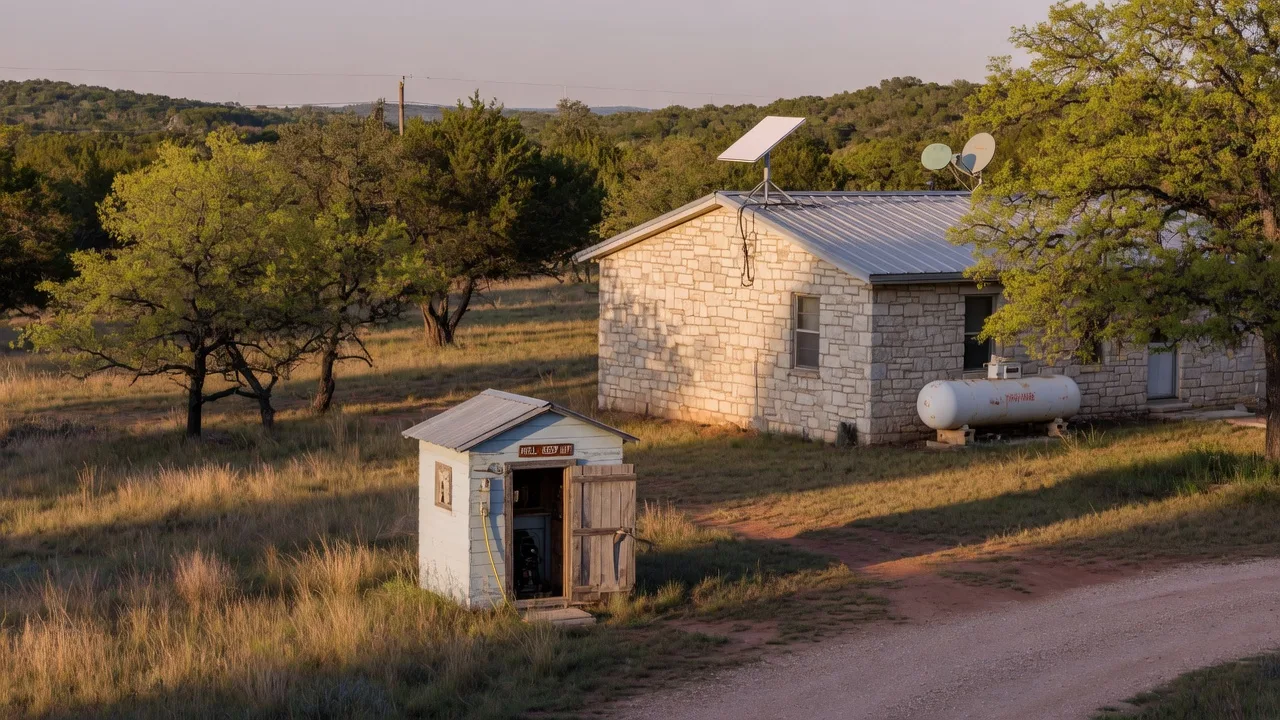
If you are moving to the Texas Hill Country from a suburban community in California, or anywhere with municipal water, sewer, and natural gas, the biggest adjustment you will make has nothing to do with the distance to the nearest grocery store. It has to do with how your home's critical systems work. In the Hill Country, especially outside city limits, you are the utility company. Your well pump is the water tower. Your septic system is the treatment plant. Your propane tank is the gas main. And your internet connection may depend on a clear view of the sky rather than a cable buried in the ground.
I have worked with enough out-of-state buyers to know that some of them discover these realities after they close, when they are standing in their new kitchen and wondering why the tap is sputtering or why the HVAC system is not producing heat despite the thermostat reading 68. That is the wrong time to learn. Here is what the data actually says about living on Hill Country infrastructure, and what it costs to maintain.
Well water: you become the water department
In a suburban home, water arrives at pressure from a municipal system that tests it, treats it, and guarantees supply. You pay a monthly bill and rarely think about it. On a Hill Country property with a private well, the water comes from groundwater beneath your land, delivered through a pump that you own, stored in a pressure tank that you maintain, and treated through equipment that you choose and replace. When something goes wrong, there is no utility to call. There is a well service company, and they charge by the visit.
The average cost of drilling a new well in the Hill Country ranges from $8,000 to $35,000 depending on depth and geology [1]. Deeper wells in limestone-heavy areas run higher. But the cost of drilling is a one-time event, and for most buyers, the initial cost is already baked into the property's value. The ongoing costs are what people underestimate.
Annual well maintenance runs $300 to $500 per year for routine inspection, water quality testing, and pump servicing [2]. Electrical costs to operate the pump add another $100 to $400 per year depending on depth and usage. Water filtration systems, which are common in the Hill Country due to hardness and mineral content, need filter replacements every 6 to 18 months at $50 to $150 per change [1][2]. A full reverse osmosis system under the kitchen sink adds ongoing membrane and filter replacement costs of roughly $100 to $200 per year.
For a family of four using 300 to 400 gallons per day, the total annual cost of owning and operating a private well in the Hill Country comes to roughly $600 to $1,100 per year. That compares to approximately $900 to $1,500 per year for municipal water service in a typical Texas suburb [2]. The well water is often higher quality and better tasting, but it requires your attention.
Well Water vs. Municipal Water: Annual Cost Comparison
| Cost Category | Private Well (4-person household) | Municipal Water (typical suburb) |
|---|---|---|
| Monthly service / electricity | $10-35 (pump electricity) | $50-90 (water bill) |
| Annual maintenance / testing | $300-500 | $0 (utility handles) |
| Filtration / treatment | $150-350/year (filter replacement) | $0-100 (optional fridge filter) |
| Emergency repairs (avg/year) | $0-500 (pump failure, pressure tank) | $0 (utility handles main line) |
| Total annual cost | $600-1,100 | $600-1,180 |
Sources: Texas Southern Drilling well cost analysis (2026), ResearchBuilders.com well ownership guide, Texas Hill Country water infrastructure cost survey. Municipal water estimate based on average San Antonio Water System and Boerne municipal rates for 8,000-10,000 gallons monthly usage.
The one cost that can blindside a new well owner is a pump failure. Submersible pumps in the Hill Country typically last 8 to 15 years. Replacing a pump at 300 feet depth costs $1,500 to $3,000 including the pump, labor, and pulling the drop pipe [1]. If the well casing itself is damaged, replacement costs jump substantially. I advise every well-water buyer to set aside $75 to $100 per month into a home infrastructure reserve fund from month one, so the pump replacement in year nine is an annoyance, not a crisis.
Septic systems: out of sight, but not out of mind
For California buyers accustomed to municipal sewer service, the septic system is the single most misunderstood piece of Hill Country infrastructure. A septic system is not a holding tank that gets pumped every few months. It is a biological treatment system that processes wastewater through a series of natural steps and disperses the treated effluent into the soil. In the Hill Country, most newer homes use aerobic septic systems, which use oxygen to accelerate the treatment process, because the local soils (heavy clay over limestone) do not drain well enough to support conventional systems in many areas [3].
Aerobic system annual cost: $700 to $1,500. The largest ongoing expense is the mandatory maintenance contract required by the Texas Commission on Environmental Quality (TCEQ). Under TCEQ rules (30 TAC Chapter 285), aerobic systems must be operated under a maintenance contract with a licensed service provider who inspects the system quarterly, tests the effluent, and files compliance reports with the county [3]. The contract costs $300 to $500 per year. Electricity to run the aerator pump adds $100 to $300 per year. Scheduled pumping every two to three years adds $250 to $400 per visit. On average, an aerobic septic system costs a Hill Country homeowner $700 to $1,500 per year to operate properly [3][4].
Conventional septic system annual cost: $350 to $850. Older Hill Country properties with conventional septic tanks (anaerobic systems) have lower maintenance costs but require pumping every three to five years at $250 to $400 per visit. The inspection is annual at $100 to $200. But the risk is soil failure: conventional systems in areas with poor drainage can fail catastrophically, costing $5,000 to $20,000 for a new drain field [3]. This is another expense that an infrastructure reserve fund covers without stress.
Here is the practical rule: every buyer purchasing a home on septic should, before closing, confirm that the system was inspected within the last year, verify the maintenance contract is current and transferable, and request the service provider's history report for the property. The TCEQ requires the seller to disclose known septic defects on the Seller's Disclosure Notice (TREC Form OP-H), but the buyer's own inspection is the real protection [3][5].
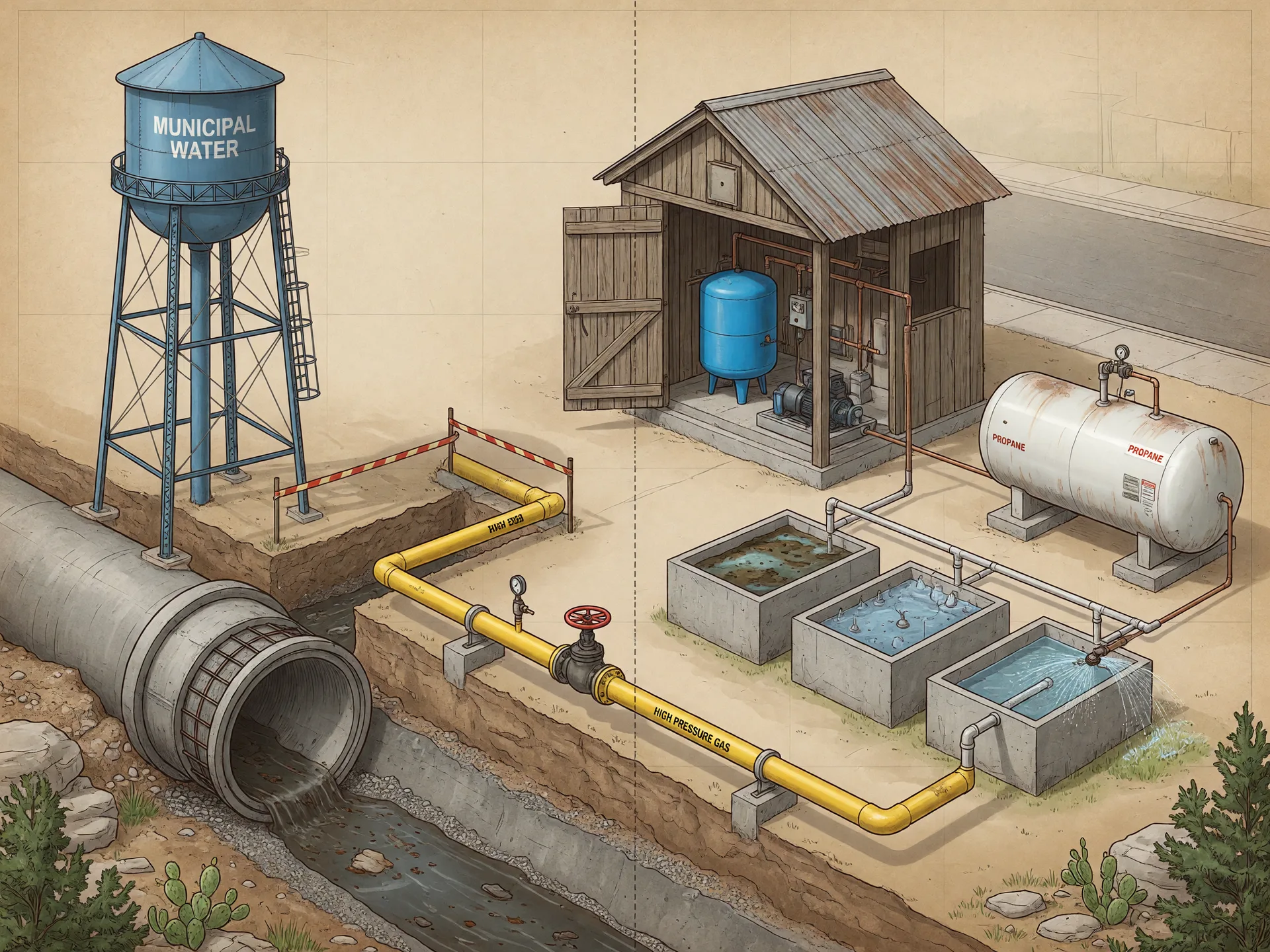
Propane: the hidden utility bill
Natural gas is available in most suburban developments and many city-limit properties in Boerne and Fair Oaks Ranch. But a significant portion of Hill Country acreage homes operate on propane, and the cost difference matters. Propane is delivered by truck to a tank on your property, typically an above-ground 250 to 500 gallon tank that you either own or lease from the supplier.
As of 2026, residential propane in Texas averages $2.60 to $2.99 per gallon [6]. A 1,400 to 2,000 square foot Hill Country home using propane for heating, water heating, cooking, and sometimes clothes drying typically consumes 500 to 800 gallons per year [7]. At $2.80 per gallon, that is $1,400 to $2,240 per year in propane costs alone. A home relying on propane for all major appliances, including furnace, water heater, range, and dryer, can use 800 to 1,200 gallons annually, or $2,240 to $3,360 per year [6][7].
For comparison, natural gas at current Texas rates for the same size home runs roughly $600 to $1,200 per year. The propane premium is real, and it is not reflected in the monthly utility budgets that most buyers compile when comparing properties.
What you can do: Ask the seller for the last 12 months of propane delivery records. The total gallons consumed and the dates of delivery tell you exactly what the heating load looks like for that specific home. Divide by 12 for a monthly cost estimate that you can add directly to your utility budget. If the property has a leased tank, check the lease terms: some suppliers charge monthly tank rental fees of $50 to $100 even when no propane is delivered, and some leases include automatic delivery at a fixed price per gallon, which can be a good deal or a bad one depending on market rates [6].
Hill Country Annual Energy Cost Comparison (1,800 sq ft home)
| Energy Source | Annual Heating Cost | Annual Water Heating Cost | Cooking / Drying | Total Annual |
|---|---|---|---|---|
| Propane (all appliances) | $800-1,400 | $400-600 | $200-300 | $1,400-2,300 |
| Natural gas (suburban) | $400-700 | $200-350 | $100-150 | $700-1,200 |
| Electric heat pump | $500-900 | $350-550 | $150-250 | $1,000-1,700 |
Sources: EIA Texas residential energy prices (2026), Propane Cost Per Gallon Texas residential average, The Propane Guy delivery rates. Costs vary by specific home insulation, appliance efficiency, thermostat settings, and local rates.
Broadband and connectivity: the surprise most California buyers do not expect
This is the item that frustrates more out-of-state buyers than any other single infrastructure issue. In California suburban communities, high-speed internet is a utility as reliable as electricity. In the Hill Country, broadband availability varies dramatically from one property to the next, and the difference between a home with fiber and a home without can be a difference of 80 to 100 megabits per second on a good day. If you work remotely, this is not a nice-to-have. It is a prerequisite.
In Boerne and Fair Oaks Ranch proper, fiber and cable broadband are widely available through Spectrum and GVTC Communications, with speeds up to 1 Gbps [8]. In rural Kendall County and Bandera County, the options narrow significantly. Fixed wireless providers like Rise Broadband and Bee Creek Communications cover portions of the area at 25 to 50 Mbps, but performance depends on line of sight to the provider's tower and degrades in heavy rain or dense tree cover [8]. Satellite internet through Starlink offers 50 to 200 Mbps at $120 per month for the service plus a $600 equipment cost, and it works in the most remote locations as long as you have a clear north-facing view of the sky [9].
For a remote worker or a household that streams heavily, the difference between a home within the GVTC fiber footprint ($80/month for symmetrical gigabit) and a home that requires Starlink ($120/month plus equipment) is $480 per year in service costs and vastly different reliability. Before making an offer on a Hill Country property, check the FCC Broadband Map or the provider's website for the specific address, not just the general area [8]. If the listing says "high-speed internet available" without naming the provider and speed, do not assume it means fiber.
I have seen buyers purchase what they thought was a perfect Hill Country homestead, only to discover after closing that the only internet option was a 15 Mbps DSL connection that could not support a single Zoom call. That is a mistake that does not become less painful over time.
Trash, recycling, and the things you never think about
In suburban developments, trash and recycling pickup is either included in the HOA fee or provided by the city at a modest charge. In unincorporated Hill Country areas, you either contract with a private hauler, haul your own trash to the county transfer station, or both. Hill Country Waste and Texas Disposal Systems serve most of the area, with monthly rates of $25 to $45 per month for weekly pickup [10]. Recycling services are available but may require a separate contract. Some counties offer free recycling drop-off at centralized locations, but that means driving 15 to 25 minutes each way with your recyclables.
It is a small thing, but it adds to the monthly operating cost of a property and it is one of those details that suburban buyers never think to ask about until they have a full week's worth of trash sitting on the porch with no idea where to take it.
The total picture: what the infrastructure cost add-on actually looks like
Here is the bottom line that I prepare for every out-of-state buyer considering a rural Hill Country property. The monthly infrastructure premium for living outside municipal utility service, compared to a comparable suburban home, looks approximately like this:
Monthly Infrastructure Cost: Suburban vs. Rural Hill Country
| Cost Item | Suburban (California/Texas) | Rural Hill Country | Difference |
|---|---|---|---|
| Water | $60-90 | $25-50 (well electricity + maint) | -$10 to -$65 |
| Sewer/septic | $40-70 | $58-125 | +$18 to +$85 |
| Energy (heat + water heat) | $60-100 (nat gas) | $120-190 (propane) | +$60 to +$130 |
| Internet | $65-80 (fiber/cable) | $80-120 (fixed wireless / Starlink) | +$15 to +$55 |
| Trash pickup | $0-20 (included in city/taxes) | $25-45 | +$5 to +$45 |
| Total monthly premium | +$88 to +$250/month |
Estimates based on average costs for a family of four in a 1,800 sq ft Hill Country home. Actual costs vary by property size, system age, appliance efficiency, and specific county/utility rates. Suburban baseline reflects combined California and Texas suburban averages for comparison.
That $88 to $250 per month is not a dealbreaker for most buyers, but it is a real number that should be factored into the monthly housing budget. On a $500,000 home with a 30-year mortgage at 6.5 percent, the principal and interest payment is approximately $3,160 per month. Adding $150 in infrastructure premium moves the effective housing cost to $3,310 per month. That is a 5 percent increase in total monthly housing cost that the listing price and the mortgage calculator do not show.
How to evaluate a property's infrastructure before you buy
When I work with clients considering a Hill Country property outside municipal utility service, I have them run through a checklist before making an offer. Here is that checklist for your reference:
Water: Request the well log, the most recent water quality test, the pump and pressure tank age and specifications, and the last 12 months of any filtration maintenance records. If the well is shared, request the written shared well agreement and confirm it is recorded against the title [1][2]. For more on wells, see our guide on understanding well depths and aquifer levels.
Septic: Request the TCEQ maintenance contract records, the most recent inspection report, the date of last pumping, and confirmation that the system is correctly sized for the number of bedrooms. For aerobic systems sold as-is (no maintenance contract in place), negotiate a credit for a full inspection and one year of service before closing [3].
Propane: Request 12 months of delivery records and the tank lease or ownership agreement. If the tank is leased, ask about buyout options. Owning the tank lets you shop for the best price per gallon annually. Leasing locks you into the supplier's rate [6].
Internet: Verify service availability at the specific address, not the general area. Confirm the provider, technology type (fiber, cable, fixed wireless, satellite), maximum speed, and data cap. If the property is in a fixed wireless dead zone and cannot get Starlink due to tree cover, the property may not be suitable for remote work [8][9].
Backup power: For properties at the end of a long private road or in an area with frequent grid outages (the Hill Country is susceptible to winter weather disruptions as we learned in Winter Storm Uri), ask about generator pre-wiring and backup power capacity. A permanently installed standby generator with automatic transfer switch costs $2,000 to $5,000 installed. For remote workers, this is not optional [11].
For more on how Hill Country geology and infrastructure affect property budgets, see our articles on the hidden cost of caliche and limestone and weather resilience and property preparedness.
Thinking about a Hill Country property with well water and septic?
I help out-of-state buyers evaluate the infrastructure realities of every property they are considering before they make an offer. No scripts, no generic advice, just a straightforward assessment of what the systems are, what they cost, and whether they fit your lifestyle.
Contact Bill Ross | Edwards Aquifer GuideFrequently asked questions
Is well water safe to drink in the Texas Hill Country?
Yes, well water in the Hill Country is generally safe, but it requires regular testing. The EPA recommends testing private wells annually for bacteria, nitrates, and total dissolved solids [12]. In the Hill Country, additional testing for hardness, iron, manganese, and hydrogen sulfide (which produces a rotten egg smell) is common due to the limestone geology. Most homeowners install a whole-house filtration system and a point-of-use reverse osmosis system under the kitchen sink for drinking water. Annual testing through a certified lab costs $50 to $150 [1][2].
How often do I need to pump my septic tank in the Hill Country?
Conventional septic tanks need pumping every 3 to 5 years, depending on household size and usage. Aerobic systems typically need pumping every 2 to 3 years, but the maintenance contractor will monitor sludge levels during quarterly inspections and recommend pumping when needed [3][4]. A family of four with a 1,000-gallon tank can expect pumping every 3 to 4 years at $250 to $400 per visit.
Can I switch from propane to a heat pump to save money?
Yes, and many Hill Country homeowners are doing exactly that. A modern electric heat pump with a high SEER rating can cut heating costs by 30 to 50 percent compared to propane, especially in the Hill Country's relatively mild winters [11]. The upfront cost of a heat pump system, including the indoor air handler and outdoor condenser, runs $4,000 to $8,000 installed. The payback period at current propane prices is typically 3 to 6 years. After that, the savings continue annually. This is one of the most effective infrastructure upgrades a propane-heated home can make.
What internet speed do I need if I work remotely from the Hill Country?
For reliable video conferencing and cloud-based work, you need a minimum of 25 Mbps download and 5 Mbps upload per simultaneous heavy user [8]. For a household of two remote workers and a streaming TV, aim for 100 Mbps or higher. If fiber is not available, Starlink is the most reliable alternative at 50 to 200 Mbps, though latency is higher than fiber. Test the actual connection speed at the property during your visit, not just the advertised speed [9].
Is trash pickup available in rural Kendall County?
Yes, private waste haulers like Hill Country Waste and Texas Disposal Systems provide weekly curbside pickup in most of unincorporated Kendall County for $25 to $45 per month [10]. Some homes in very remote areas may need to haul trash to the Kendall County transfer station on Highway 46, which accepts trash for a per-bag fee. Recycling drop-off is available at the transfer station at no additional charge.
Should I buy a standby generator for a Hill Country home?
If you work from home or have well water that requires electricity to pump, a standby generator is a practical investment. The Hill Country experiences occasional power outages from winter storms, thunderstorms, and ice events. A whole-house generator with automatic transfer switch costs $2,000 to $5,000 installed, depending on the size and fuel type [11]. For well-water homes, the generator must have enough capacity to start the well pump, which draws significant surge current. A 14 to 20 kW generator is typically sufficient for a 2,000 sq ft home with a well pump.
How do I find out if a property has fiber internet before I make an offer?
Check the FCC Broadband Map at broadbandmap.fcc.gov and enter the specific property address. Then confirm availability with the provider directly by calling or using their address lookup tool [8]. Do not rely on the listing agent's general description of internet availability. I have seen listings say "high-speed internet available" based on what is available two miles down the road, not at the specific address. For help evaluating a specific property, reach out through the contact form above.
Sources
- Texas Southern Drilling, Well Drilling Cost Analysis (2026). Average cost ranges for residential well drilling in the Texas Hill Country, including pump installation and casing costs by depth. texassoutherndrilling.com
- ResearchBuilders, Owning a Well in the Texas Hill Country (2026). Annual maintenance costs, water testing requirements, and ongoing operating expenses for private well owners. researchbuilders.com
- Texas Septic Guide, Aerobic Septic System Maintenance Cost in Texas (2026). TCEQ maintenance contract requirements, quarterly inspection costs, pumping schedules, and total annual cost data for aerobic and conventional septic systems. texassepticguide.com
- Texas Commission on Environmental Quality, 30 TAC Chapter 285. On-site sewage facility rules, including maintenance contract requirements for aerobic systems and disposal obligations. tceq.texas.gov
- Texas Real Estate Commission, Seller's Disclosure Notice (TREC Form OP-H). Required disclosure of known septic defects and water quality issues in Texas residential property transactions. trec.texas.gov
- The Propane Guy, Texas Propane Delivery Rates (2026). Current per-gallon propane pricing for the Hill Country region and typical tank lease terms. thepropaneguytx.com
- EIA Texas Residential Energy Prices (2026). Average residential propane, natural gas, and electricity prices by state, used for comparative energy cost modeling. eia.gov
- BroadbandNow, Internet Providers in Boerne and Fair Oaks Ranch (2026). Availability data for fiber, cable, fixed wireless, and DSL internet in Kendall County and surrounding areas. broadbandnow.com
- Starlink, Service Availability and Pricing. Current equipment costs, monthly service fees, and speed ranges for Starlink satellite internet in rural Texas locations. starlink.com
- Hill Country Waste, Residential Service Pricing (2026). Weekly curbside trash pickup rates for Kendall County residential customers. hillcountrywaste.com
- Angi, Generator Installation Costs (2026). National and regional cost data for standby generator installation, including sizing guidance for well-pump equipped homes. angi.com
- EPA, Private Well Water Testing Recommendations. Annual testing requirements for bacteria, nitrates, and total dissolved solids; additional regional testing recommendations for limestone geology areas. epa.gov
Last verified: July 29, 2026. Infrastructure costs, broadband availability, and propane prices are subject to change. Verify current rates and availability with local providers before making financial decisions.
Published: July 29, 2026
Updated July 29, 2026