
If you are buying acreage in the Texas Hill Country, one of the first questions that comes up is how you will get water. For most rural properties, the answer is a well. But a growing number of homeowners are either supplementing their well with a rainwater harvesting system or going entirely off-grid with rainwater as their primary water source. The question I hear most often from buyers moving from out of state is straightforward: does rainwater harvesting actually work here, and what does it cost?
The short answer is yes, it works. The Hill Country receives roughly 30 to 34 inches of rainfall per year, and a properly designed rainwater harvesting system on a typical 2,000 to 3,000 square foot roof can capture 30,000 to 50,000 gallons per year [1][2]. The longer answer involves system design, storage sizing, water treatment, upfront costs, ongoing maintenance, and a clear understanding of when rainwater makes financial sense compared to a drilled well.
I have worked with enough buyers who installed rainwater systems after moving to the Hill Country to know that the ones who are happiest with their systems are the ones who understood the realistic yield, the upfront cost, and the maintenance requirements before they signed the contract. Here is what the data actually says.
How rainwater harvesting works in the Hill Country
Rainwater harvesting in Texas operates on a simple principle: capture rainfall from a roof surface, filter out debris, store the water in a tank, and treat it for the intended use. The systems range from a single rain barrel supplying a garden to a fully integrated potable system that provides all household water [3].
The basic components are the same regardless of system size:
- Catchment surface: Usually a metal or composite roof. The material matters. Metal roofs are the standard because they shed debris easily and do not leach chemicals. Composition shingles work but require more frequent gutter cleaning and produce more sediment. Clay tile, slate, and wood shake roofs are generally not recommended for potable systems [3][4].
- Gutters and downspouts: Standard 5-inch or 6-inch K-style gutters with leaf screens or gutter guards reduce the amount of organic debris entering the system. Downspouts direct water to the storage tank [4].
- First-flush diverter: This device diverts the first several gallons of runoff from each rainfall, which carries the highest concentration of roof debris, bird droppings, and sediment. A first-flush diverter is the single most important component for improving water quality before it reaches the tank [3].
- Storage tank (cistern): The largest and most expensive component. Tanks range from 500-gallon poly barrels to 30,000-gallon above-ground galvanized steel or concrete cisterns. Materials include polyethylene, galvanized steel, stainless steel, fiberglass, and concrete. Above-ground tanks are more common and easier to maintain. Underground tanks require excavation and are significantly more expensive [4][5].
- Pump and pressure tank: Moves stored water from the cistern to household fixtures or irrigation. A variable-speed pump paired with a small pressure tank provides consistent pressure without short-cycling [4].
- Filtration and treatment: For non-potable use (irrigation, livestock), a simple sediment filter may suffice. For potable use, the system requires a multi-stage filtration process: sediment filter, carbon filter, UV sterilization, and in some cases reverse osmosis. Texas regulations require potable rainwater systems to meet the same water quality standards as public water systems [3][4].
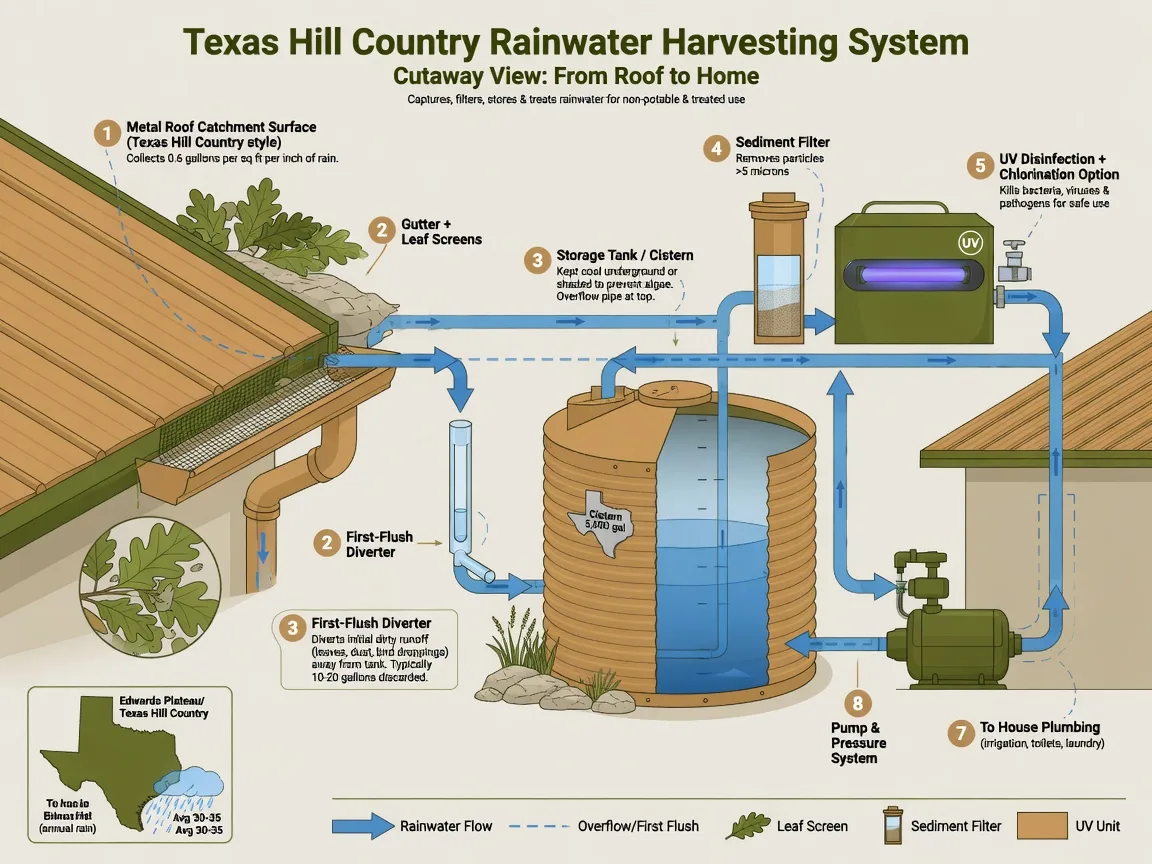
Typical rainwater harvesting system components: roof catchment, gutters, first-flush diverter, cistern tank, filtration, and pump
How much water can you actually collect?
The math is straightforward. For every inch of rain falling on 1,000 square feet of roof area, you can collect approximately 600 gallons of water [1][2]. With the Hill Country averaging 30 to 34 inches of rain per year, a 2,000 square foot roof captures roughly 36,000 to 41,000 gallons annually. A 3,000 square foot roof captures 54,000 to 61,000 gallons [1].
Those are gross figures. Real-world collection efficiency is lower due to first-flush diversion, evaporation losses, and system overflow during heavy rain events. A realistic planning figure is 75 to 80 percent of the gross potential yield, meaning 28,000 to 32,000 gallons per year for a typical 2,000 square foot home [2].
Annual Rainwater Collection Potential by Roof Size (Hill Country, 34 inches/year)
| Roof Area (sq ft) | Gross Collection (gal) | Usable Yield (75-80%) | Daily Equivalent (gal/day) |
|---|---|---|---|
| 1,000 | ~20,400 | ~15,300-16,300 | ~42-45 |
| 1,500 | ~30,600 | ~23,000-24,500 | ~63-67 |
| 2,000 | ~40,800 | ~30,600-32,600 | ~84-89 |
| 2,500 | ~51,000 | ~38,300-40,800 | ~105-112 |
| 3,000 | ~61,200 | ~45,900-49,000 | ~126-134 |
Based on 600 gallons per inch of rain per 1,000 sq ft of roof area. Hill Country average rainfall of 34 inches used (range 30-34 inches). Usable yield accounts for first-flush diversion, evaporation, and system overflow [1][2].
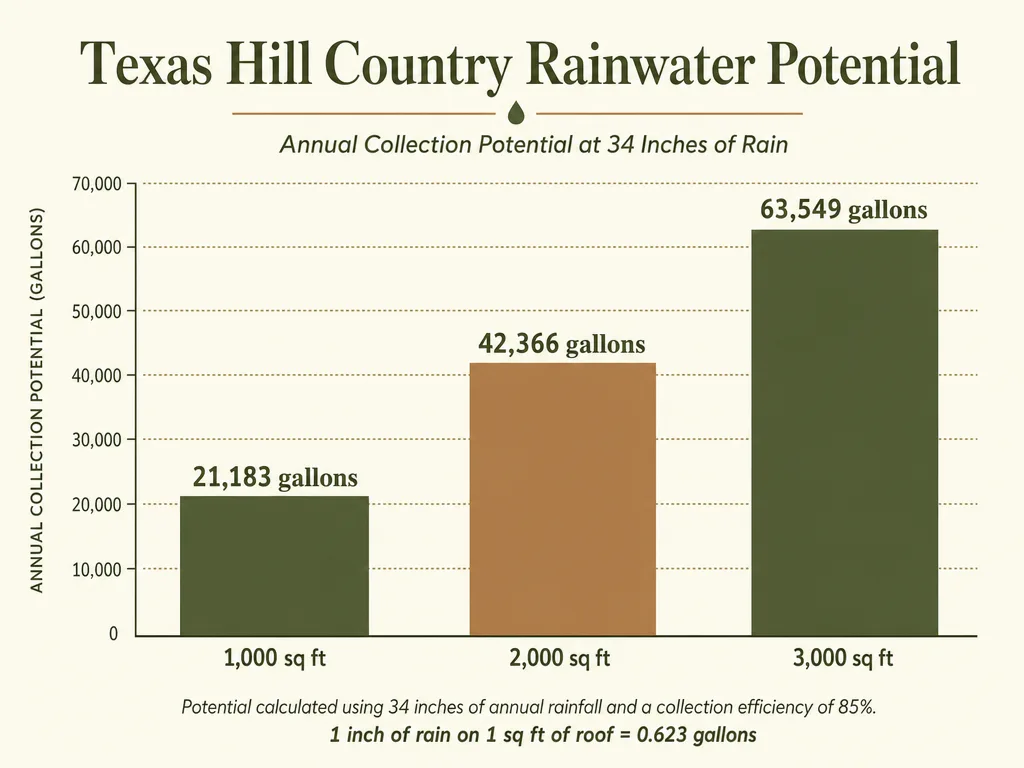
Annual rainwater collection potential by roof size at 34 inches of rain per year
To put those numbers in context, the average Texas household uses approximately 8,000 to 10,000 gallons per month for indoor use alone [2]. A 2,000 square foot roof capturing 31,000 gallons per year provides roughly three to four months of indoor water supply. For a household that also waters landscaping or keeps livestock, the demand increases significantly. Rainwater harvesting as a sole water source requires either a very large storage capacity (10,000 to 30,000 gallons of tank volume) or a supplemental well.
For Hill Country homeowners using municipal water in areas like Fair Oaks Ranch or parts of Boerne, a rainwater harvesting system can offset irrigation costs significantly. A half-acre vegetable garden and lawn area can consume 10,000 to 20,000 gallons per growing season, and capturing that from rainfall eliminates the municipal water bill for outdoor use entirely [2].
What a complete system costs
The cost of a rainwater harvesting system varies dramatically based on three factors: storage tank size, whether the system is potable, and site conditions. Here is the breakdown I see across Hill Country installations [4][5][6]:
Rainwater Harvesting System Cost Ranges (Texas Hill Country, 2026)
| System Type | Storage Size | Typical Cost Range | Best For |
|---|---|---|---|
| Basic rain barrel | 50-100 gal | $100-$500 | Garden irrigation only |
| Non-potable, basic | 500-1,500 gal | $2,000-$5,000 | Landscape irrigation, livestock |
| Non-potable, mid-size | 2,500-5,000 gal | $8,000-$15,000 | Large gardens, partial home supply |
| Potable, residential | 5,000-10,000 gal | $12,500-$30,000 | Primary household water with well backup |
| Potable, large capacity | 15,000-30,000 gal | $35,000-$55,000+ | Sole water source, large households |
Sources: Texas Water Development Board; Hill Country Rainwater; Acer Water Tanks; Fixr. Costs include tank, gutters/gutter guards, first-flush diverter, pump, filtration, plumbing connections, and installation labor. Potable systems require licensed plumber involvement [4][5][6].
The single largest cost driver is storage tank volume. A 5,000-gallon galvanized steel tank costs approximately $3,500 to $5,500, while a 10,000-gallon tank runs $6,000 to $10,000. Polyethylene tanks are slightly cheaper but have a shorter service life in direct Texas sun. Concrete cisterns are the most expensive upfront but can last 50 years or more with proper maintenance [5][6].
The second largest cost driver is trenching and plumbing. Running a pipe from the cistern to the house, installing conduit for electrical to the pump, and integrating with the existing plumbing system can add $3,000 to $8,000 depending on distance and whether the property sits on limestone or caliche. Rock excavation in the Hill Country adds significant labor time and cost [5].
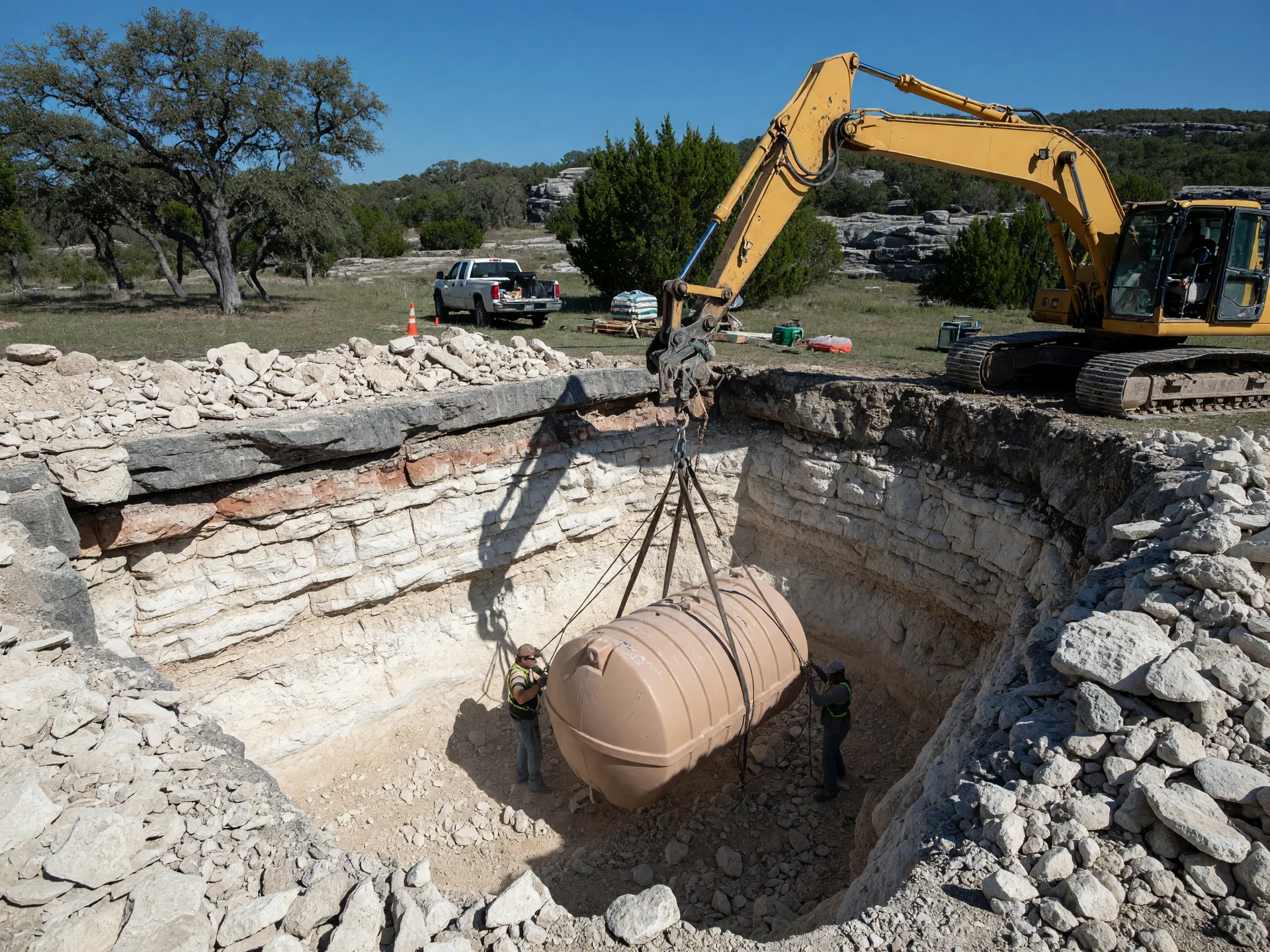
Cistern installation on a Hill Country property. Rock excavation adds significant time and cost to underground tank placement
Texas tax exemptions for rainwater harvesting
Texas is one of the most supportive states in the country for rainwater harvesting, and the tax code reflects that in two distinct ways [7][8]:
Sales tax exemption (Texas Tax Code section 151.355): All rainwater harvesting equipment and supplies are exempt from Texas state sales tax. This includes tanks, gutters, downspouts, diverters, pumps, filters, UV sterilizers, piping, and fittings. The exemption applies at the point of sale. The purchaser must provide the supplier with Texas Comptroller Form 01-339 (Texas Sales and Use Tax Exemption Certificate) at the time of purchase [7]. This is a straightforward, one-time form that any rainwater system installer should be able to process for you.
Property tax exemption (Texas Tax Code section 11.32): Texas law authorizes local taxing units (counties, cities, school districts, and special districts) to exempt part or all of the assessed value of property on which water conservation initiatives, including rainwater harvesting systems, have been implemented [8]. This exemption is not automatic statewide. Each local taxing unit must adopt it by ordinance or resolution. In Kendall County and Bexar County, the exemption has been adopted for qualifying systems. The property owner must apply with the county appraisal district and provide documentation of the system installation, including cost and system specifications [8].
The property tax exemption is worth pursuing. On a $600,000 Hill Country home where a $25,000 rainwater harvesting system qualifies for a 100 percent exemption of the system's added value, the annual property tax savings at the Kendall County combined rate of approximately 1.86 percent is roughly $465 per year. Over the system's expected 30-year lifespan, that compounds to nearly $14,000 in avoided taxes, substantially offsetting the upfront cost [8][9].
Rainwater vs. well: which makes more sense for your property
Every Hill Country acreage buyer asks this question. The answer depends on the specific property, your water usage, your budget, and your tolerance for maintenance. Here is how I think about the decision:
A drilled well costs $15,000 to $30,000 in the Hill Country, with no guarantee of yield. Drilling through limestone and caliche is expensive, and some properties yield as little as 1 to 3 gallons per minute, which is marginal for household use. A well that hits 10 to 20 gallons per minute at 300 to 500 feet is a good outcome, but there is no way to know in advance [10].
A rainwater harvesting system for whole-house potable use costs $12,500 to $30,000 for a 5,000 to 10,000 gallon system. The cost is predictable and does not depend on what lies beneath the surface. The tradeoff is that you are dependent on rainfall patterns. A drought year means you run out of stored water, and you need a backup plan (trucked-in water or a well) [4][5].
In practice, many Hill Country homeowners choose a hybrid approach: a well for primary indoor water and a rainwater harvesting system for irrigation, livestock, and outdoor use. This combination reduces draw on the well during high-demand summer months and provides a backup water source during power outages (rainwater systems with gravity feed or battery backup can operate without grid power) [3][10].
For properties in areas with marginal well yields (under 5 gallons per minute), a larger rainwater harvesting system as the primary water source with a small well as backup is often the most reliable long-term solution. The upfront cost is higher, but the water security is significantly better than relying on a marginal well alone [5][10].
What Texas law says about rainwater collection
Texas has some of the most permissive rainwater harvesting laws in the country. Rainwater harvesting is specifically protected under Texas law, and homeowners' associations cannot prohibit it [11]. The Texas Water Code encourages rainwater harvesting as a water conservation strategy, and municipalities and counties are authorized to provide incentives [12].
Key legal points for Hill Country buyers:
- No permit is required for rainwater harvesting systems for non-potable use (irrigation, livestock). A permit is required if the system will supply potable water to household fixtures, and the system must comply with TCEQ rules for water quality [3][11].
- Texas HOAs cannot ban rainwater harvesting systems. Texas Property Code section 202.007 prohibits deed restrictions or HOA covenants from prohibiting rainwater harvesting. The HOA can impose reasonable aesthetic requirements (tank color, location), but outright prohibition is not allowed [11].
- Rainwater harvesting is recognized as a property right in Texas. The Texas Water Code establishes that landowners have the right to capture rainwater falling on their property [12].
- Texas permits captured rainwater from a properly maintained system to be used as a potable water source, subject to TCEQ testing and treatment requirements [3].
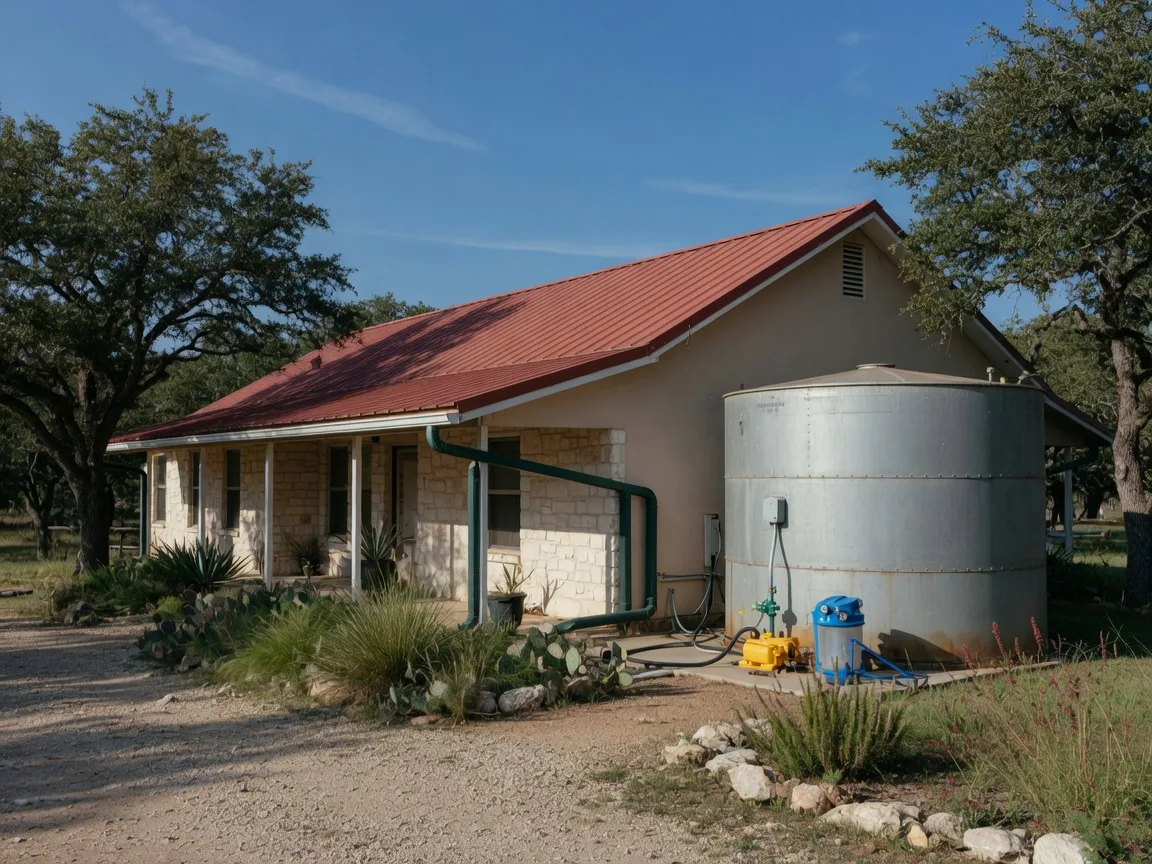
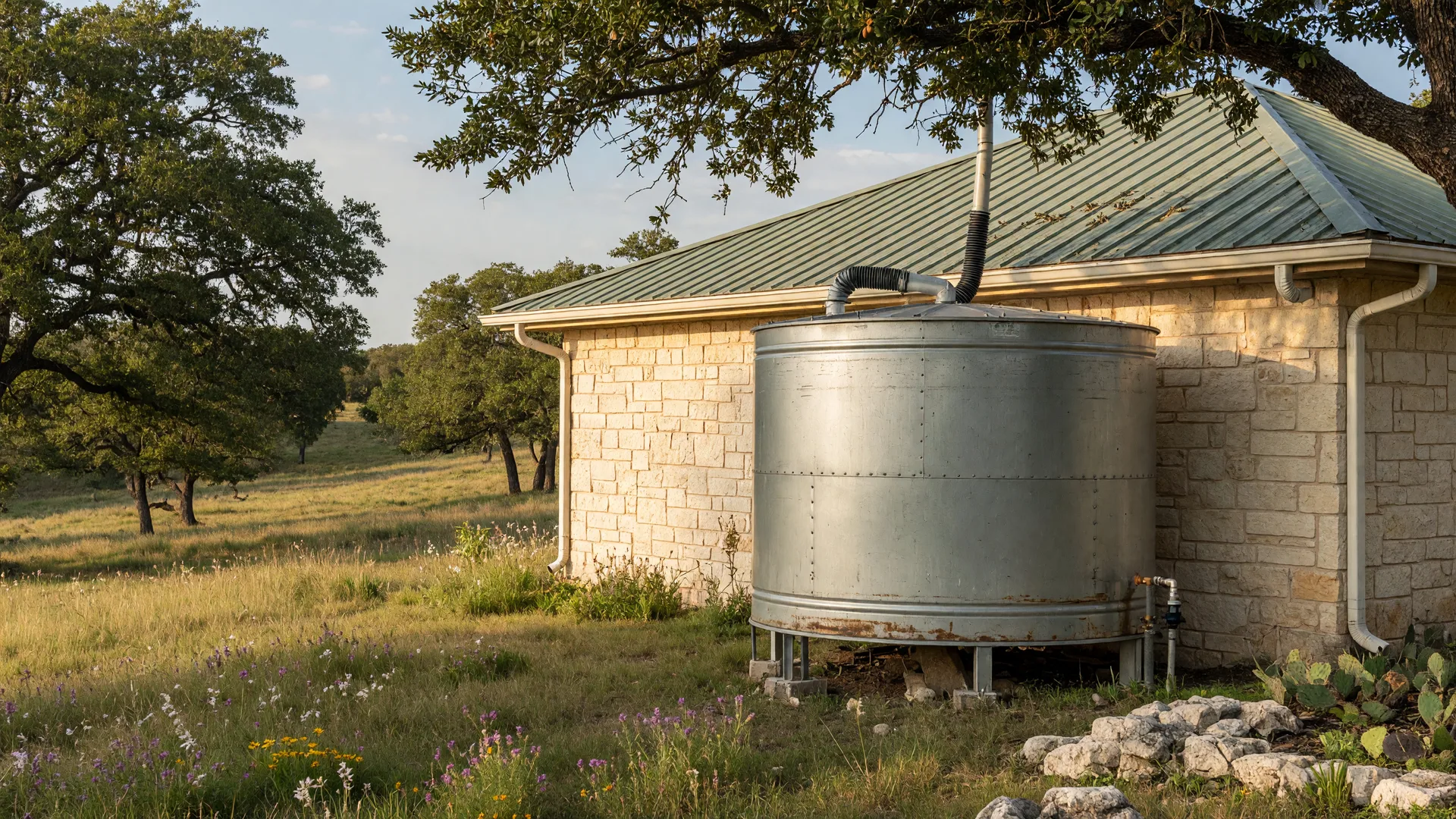
Typical Hill Country home with rainwater harvesting system: metal roof catchment, gutters, and galvanized steel cistern with filtration equipment
Local rebate programs for Hill Country homeowners
Several Texas cities and water districts offer rebates for rainwater harvesting installations. For Hill Country buyers looking at properties near San Antonio, the San Antonio Water System (SAWS) offers rebates of up to $2,000 for rainwater cistern installation [13]. For properties near Austin, the Austin Water Utility offers $0.50 per gallon of storage for non-pressurized systems and $1.00 per gallon for pressurized systems, up to 50 percent of the total system cost [14].
In Bexar County, SAWS customers who install a rainwater harvesting system can receive a rebate that significantly offsets the storage tank cost. The SAWS rebate program is competitive and has annual funding limits, so applying early in the fiscal year improves your chances of approval [13].
For properties in unincorporated areas served by groundwater conservation districts, check with the district for any rebate programs. Several Hill Country groundwater districts offer incentives for rainwater harvesting to reduce demand on the aquifer [14][15].
Maintenance requirements and long-term costs
A rainwater harvesting system is not a set-it-and-forget-it investment. Regular maintenance is required to keep the system functioning and the water safe [3][4]:
- Gutter cleaning: Clean gutters at least twice per year, more often if the property is surrounded by live oaks that drop leaves and pollen extensively. Leaf screens reduce the frequency but do not eliminate the need [4].
- Tank inspection: Inspect the tank annually for sediment buildup, algae growth (in translucent tanks), and structural integrity. Sediment should be pumped out every 3 to 5 years depending on roof debris load [3].
- Filter replacement: Sediment filters need replacement every 3 to 6 months. Carbon filters every 6 to 12 months. UV lamps every 12 months. These are consumable costs that add approximately $200 to $500 per year for a potable system [4].
- Pump maintenance: Well-maintained pumps last 10 to 15 years. Replacement cost is $500 to $1,500 [5].
- Water testing: Potable systems should be tested annually for bacteria, nitrates, and pH levels. Laboratory testing costs $50 to $150 per test [3].
The annual maintenance cost for a potable rainwater harvesting system runs approximately $400 to $800 per year, not including pump replacement. For a non-potable irrigation-only system, the annual cost drops to $100 to $200 per year [4][5].
What buyers should verify before closing on acreage
If you are considering a rainwater harvesting system on a Hill Country property you are buying, here is the due diligence I recommend [10][15]:
- Roof condition and material: Is the roof suitable for rainwater collection? Metal roofs are ideal. If the roof is composition shingles, factor in the cost of additional filtration or eventual roof replacement [3].
- Gutter system: Does the property already have gutters? Adding seamless gutters to a house without them costs $1,000 to $3,000 depending on roofline complexity [5].
- Existing well: If the property has a well, get the well log and flow test results. A well yielding 10+ gallons per minute is a strong water source. A well yielding under 3 GPM is a candidate for supplementing with rainwater [10].
- Site for cistern: Does the property have an appropriate location for a cistern near the house? The tank needs a level, compacted base (concrete pad or crushed stone) and should be located close enough to the house to minimize plumbing trenching costs [5].
- HOA or deed restrictions: Even though Texas prohibits HOAs from banning rainwater harvesting, some older deed restrictions may attempt to restrict cistern placement or visibility. Review the deed restrictions and confirm that your intended system complies [11].
- County permit requirements: Contact the county environmental health department to ask about any permitting requirements for potable systems. Most counties require a TCEQ-compliant system design for indoor plumbed systems [3].
For more on how well water and property infrastructure affect your buying decision, see our guides on well depths and aquifer levels and what well logs actually tell you. The Infrastructure and Land Realities hub covers the full range of water, septic, and land issues that matter for Hill Country acreage buyers.
Frequently asked questions
Do I need a permit to install a rainwater harvesting system in Texas?
No permit is needed for non-potable rainwater harvesting systems used for irrigation or livestock. A permit is required if the system will supply potable water to indoor household fixtures, and the system must comply with TCEQ water quality standards. The permitting process involves submitting a system design plan to the county or authorized local permitting authority [3][11].
How much does a rainwater harvesting system cost in the Texas Hill Country?
A basic non-potable system for landscape irrigation costs $2,000 to $5,000. A mid-size system with 2,500 to 5,000 gallons of storage ranges from $8,000 to $15,000. A complete potable system for a 2,000 to 3,000 square foot home with 5,000 to 10,000 gallons of storage runs $12,500 to $30,000. Large-capacity systems for sole water source use cost $35,000 to $55,000 or more [4][5][6].
Can a rainwater harvesting system replace my well?
Yes, a properly sized rainwater harvesting system can serve as a primary or sole water source. However, given the Hill Country's seasonal rainfall patterns and drought cycles, most homeowners with rainwater as their primary source also maintain a backup well or arrange for trucked-in water delivery during extended dry periods [3][5].
Is rainwater harvesting tax deductible in Texas?
There are two tax benefits in Texas. First, all rainwater harvesting equipment is exempt from Texas sales tax when you purchase it, using Comptroller Form 01-339. Second, the value of the system may be exempt from property tax under Texas Tax Code Section 11.32, if the local county or city has adopted the exemption. The property tax exemption is not automatic and requires filing with the county appraisal district [7][8].
Can my HOA prevent me from installing a rainwater harvesting system?
No. Texas Property Code Section 202.007 prohibits homeowners' associations from banning rainwater harvesting. An HOA may impose reasonable restrictions on the placement or appearance of a cistern, but a complete prohibition is not enforceable [11].
What maintenance does a rainwater harvesting system require?
Gutter cleaning two to four times per year, annual tank inspection, sediment pump-out every 3 to 5 years, filter replacement every 3 to 12 months, and annual water quality testing for potable systems. Annual maintenance costs for a potable system run approximately $400 to $800 [3][4][5].
How much water can I collect from my roof in the Hill Country?
A 2,000 square foot roof on a Hill Country property receiving 34 inches of annual rainfall collects approximately 40,800 gallons gross, with a usable yield of roughly 30,000 to 33,000 gallons after accounting for first-flush diversion, evaporation, and system overflow [1][2].
Does Texas have any rainwater harvesting rebates?
Yes. SAWS offers rebates up to $2,000 for cistern installation in the San Antonio area. Austin offers $0.50 to $1.00 per gallon of storage. Several Hill Country groundwater conservation districts also offer incentive programs. Check with your local water utility or groundwater district before installing [13][14][15].
- Texas Water Development Board, Rainwater Harvesting FAQ. Rainfall collection calculations, storage sizing, and system design guidelines for Texas properties. twdb.texas.gov
- Texas A&M AgriLife Extension, Rainwater Harvesting. Average Texas rainfall data by region, collection formulas, and agricultural rainwater use guidance. agrilifeextension.tamu.edu
- Texas Commission on Environmental Quality, Rainwater Harvesting Guidance. Water quality standards, potable system requirements, and permitting guidance for Texas rainwater harvesting systems. tceq.texas.gov
- Hill Country Rainwater, System Cost and Design Guide. Potable rainwater system design, component costs, and installation pricing specific to the Texas Hill Country. hillcountryrainwater.com
- Acer Water Tanks, Texas Hill Country Rainwater Harvesting. Tank sizing, cost estimates, and pit/excavation considerations for Hill Country installations. acerwatertanks.com
- Fixr, Rainwater Collection System Cost Guide. National and Texas-specific installation cost data for residential rainwater harvesting systems by size and type. fixr.com
- Texas Tax Code Section 151.355, Sales Tax Exemption for Rainwater Harvesting. Statutory provision exempting rainwater harvesting equipment from Texas state sales tax; Comptroller Form 01-339. comptroller.texas.gov
- Texas Tax Code Section 11.32, Water Conservation Exemption. Property tax exemption for water conservation initiatives including rainwater harvesting; local adoption required. law.justia.com
- Kendall County Appraisal District, Property Tax Information. Combined effective tax rates for Kendall County, Bexar County, and Comal County. kendallcad.org
- Texas Water Development Board, Groundwater Well Reports. Well drilling costs, aquifer yields, and well log data for Hill Country counties. twdb.texas.gov
- Texas Property Code Section 202.007, Rainwater Harvesting Covenant Protection. Prohibits HOAs and deed restrictions from banning rainwater harvesting systems. statutes.capitol.texas.gov
- Texas Water Code Section 11.021, Rainwater as a Property Right. Establishes that landowners have the right to capture rainwater falling on their property. statutes.capitol.texas.gov
- San Antonio Water System, Rainwater Rebate Program. Rebates up to $2,000 for rainwater cistern installation for SAWS customers in Bexar County. saws.org
- Harvest Rain, Texas Rainwater Rebates and Tax Benefits. Statewide overview of municipal rebate programs, tax exemptions, and applicable laws for Texas homeowners. harvestrain.com
- WaterCache, Texas Rainwater Laws and Regulations. Comprehensive guide to Texas rainwater harvesting regulations, HOA protections, and local incentive programs. watercache.com
Last verified: July 24, 2026
Published: July 24, 2026
Updated July 24, 2026