
If you are thinking about buying a Hill Country property to use as an Airbnb or Vrbo, or if you already own a home here and are considering renting it out short-term, you need to understand something important: the rules change dramatically depending on which side of a city limit you stand on. Texas does not have a single statewide short-term-rental operating license. Cities frequently regulate short-term rentals through zoning, permitting, registration, occupancy, parking, and safety requirements. Counties have more limited regulatory authority, although county development, floodplain, fire-code, on-site sewage facility, subdivision, and hotel-occupancy-tax requirements may apply where authorized. Special-purpose districts and enforceable private deed restrictions may impose additional obligations. In the Hill Country, those rules range from "register and comply" to "we are still figuring this out." This guide covers the regulations in Boerne, Fair Oaks Ranch, Bandera, Kendall County, and Comal County so you know which agencies, ordinances, tax authorities, and private restrictions to verify before buying or listing a property.
What Texas Law Says (The State-Level Framework)
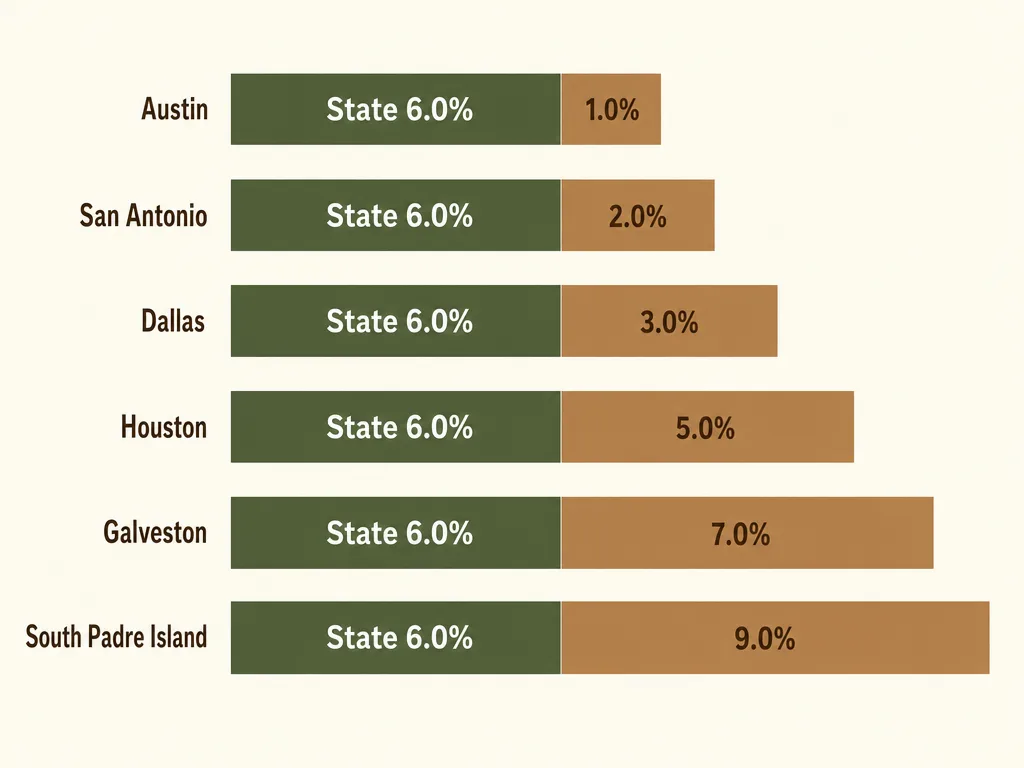
Texas state hotel occupancy tax applies to the rental of all or part of a residential property for 29 days or less. The state rate is 6 percent.
A short-term-rental platform collects and remits the state tax only when it has agreed with the property owner to assume that responsibility. If an owner rents exclusively through a collecting platform, the owner is not required to collect and remit state hotel occupancy tax on those platform bookings. The owner remains responsible for state tax on direct bookings and bookings made through any platform that does not collect the tax on the owner's behalf.
The Texas Comptroller does not issue a printed hotel-tax permit. A business that must report state hotel occupancy tax submits Form AP-102, the Hotel Occupancy Tax Questionnaire. Owners should separately determine whether they must register, file returns, or pay tax to a city, county, or special-purpose district. A platform's collection of state tax does not establish that the platform collects every applicable local tax.
The combined rate varies substantially by address. A property may be subject only to the 6 percent state tax or may also be subject to municipal, county, venue, or special-district charges. Verify each taxing jurisdiction separately.
Important: Airbnb currently states that it collects the 6 percent Texas state hotel occupancy tax on qualifying Texas reservations. Owners using Airbnb, Vrbo, another platform, or direct booking should confirm the taxes that the specific platform collects for the property's exact address. For total cost insights, see the Boerne property tax guide and property tax protest guide on this site.
Boerne: A Detailed STR Ordinance
Boerne has a detailed STR ordinance compared with the other jurisdictions examined in this article. The city council unanimously approved the updated ordinance in August 2023 (Ordinance No. 2023-09), and it applies to any STR within city limits and the extra-territorial jurisdiction (ETJ).
What You Need to Operate
Permit Registration: $200 fee for all STRs in city limits and ETJ. Register with the Boerne Finance Department for city hotel occupancy tax before the STR permit application is approved. The permit expires two years after its effective date. The ordinance allows the renewal application to be submitted beginning 30 days before expiration and requires renewal no later than 30 days after expiration. Delinquent city taxes, fees, or utility charges can prevent registration or renewal. Safety Inspection: Inside the Boerne city limits, the applicant must complete a safety inspection through either a city inspector or a qualifying licensed inspector using the city's STR inspection checklist. The ordinance exempts properties in Boerne's extraterritorial jurisdiction from the inspection requirement. The city inspection fee is $100; an outside inspector may charge a different amount. Insurance: Minimum $500,000 liability coverage per occurrence and $1 million aggregate. Local Contact: Must have a designated local contact person available 24/7. Occupancy Limit: Two people per bedroom plus two additional people. Parking: Boerne requires at least one parking space per rented bedroom. Adjacent on-street parking may count toward the requirement if each counted space abuts the property, is at least 25 feet long, and leaves adequate clearance for a mailbox and trash receptacle. All parking must otherwise comply with the city's stopping, standing, and parking rules. Events: STR occupants are not allowed to host events. Advertising: Every advertisement must include the property's city permit number, occupancy limit, and parking standards. Required Guest Information: The operator must provide the required guest information online and post it visibly inside the rental. The information includes owner/operator and 24-hour representative contact details, parking and noise restrictions, trash and water information, floodplain disclosure when applicable, emergency information, and a floor-plan sketch showing sleeping areas, maximum occupancy, evacuation routes, fire extinguishers, and authorized parking. [4][5].
Location and Zoning Rules
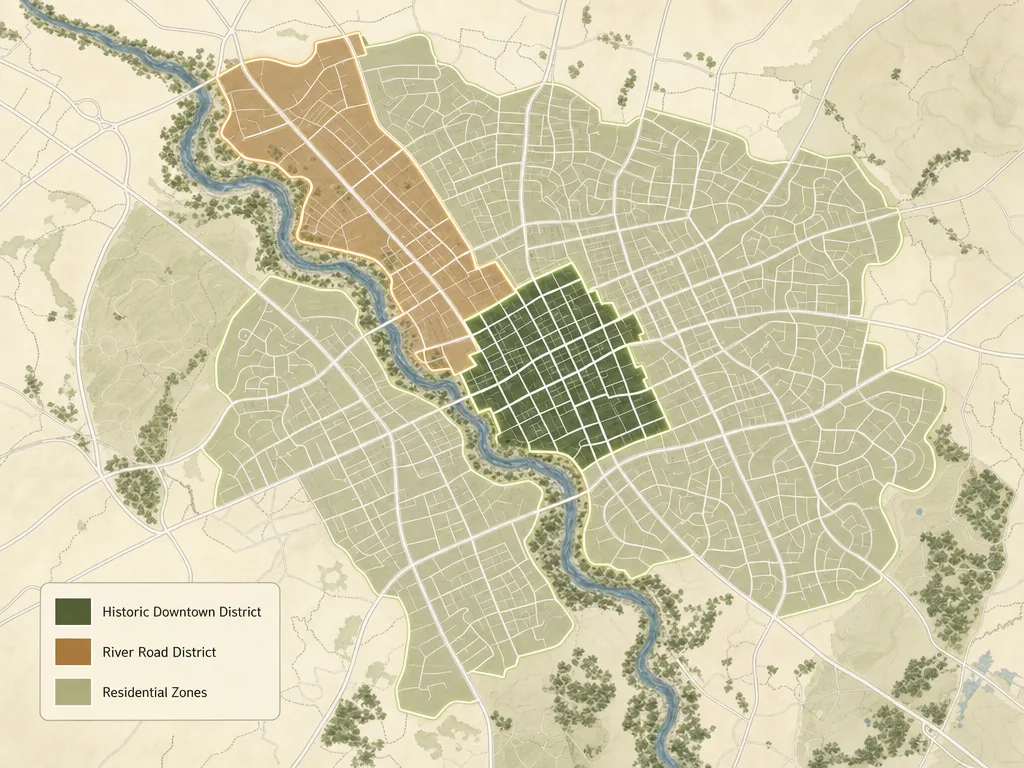
- Residential zones: STRs are permitted but cannot operate within 200 feet of another STR on the same block face (property line to property line measurement)
- One STR per lot: In a residential zoning district, only one short-term rental may operate on a lot, property, or parcel.
- Historic, Downtown, and River Road overlay districts (commercial zones): No separation requirements, STRs are welcome
- Commercial zones outside overlay districts: STRs are NOT permitted
- HOA restrictions: The city is not responsible for enforcing HOA rules, check your HOA separately [4][5]
Special exceptions: A property owner may apply to the Boerne Zoning Board of Adjustment for a special exception from the minimum separation distance or one-per-lot limitation. A special exception is also available from the standard occupancy limit. Approval is discretionary and should not be represented as guaranteed.
What This Means for Investors
The 200-foot separation rule in residential zones is the most significant constraint. If you are buying in a residential neighborhood, you need to verify that no other STR already operates within 200 feet on your block. Commercially zoned properties in the Historic Overlay District, Downtown Overlay District, and River Road Overlay District are not subject to the 200-foot separation requirement. Residentially zoned properties within the overlay districts remain subject to the residential separation rule. For more on living and investing in Boerne, see our Boerne community page.
Fair Oaks Ranch: Current Zoning Framework
Fair Oaks Ranch does not currently identify "short-term rental" as a standalone land-use category in its Unified Development Code. The code does expressly regulate bed-and-breakfast establishments of five or fewer guest rooms.
A bed-and-breakfast use is treated as a conditional use in the city's residential zoning districts. When located in a residential district, the operator must be a full-time resident of the dwelling. The code also imposes guest-register, signage, and parking requirements.
Because the current code does not expressly classify a non-owner-occupied, whole-home short-term rental, an investor should not assume that such a use is permitted by default. Before buying, advertising, or operating, obtain a written zoning determination from Fair Oaks Ranch for the exact property and proposed rental model. Also review all recorded deed restrictions and homeowners-association rules.
Source: Unified Development Code, amended through Ordinance 2025-21, fairoaksranchtx.org. Relevant material: Table 4.2 and the bed-and-breakfast standards in Section 4.10.
Bandera: Current Regulatory Framework
The City of Bandera Code contains a municipal hotel occupancy tax, but the current code reviewed for this article does not establish a standalone STR permit category or expressly classify whole-home STRs by that name. The absence of an STR-specific ordinance should not be treated as affirmative permission.
Before advertising or operating a property inside the City of Bandera, obtain written confirmation from the city regarding the property's zoning, allowable lodging use, certificate-of-occupancy requirements, and any applicable commercial or business permits. County tax requirements and private deed restrictions must be checked separately.
Unincorporated Kendall County, Texas
The official Kendall County, Texas materials reviewed for this article do not establish the Illinois-style STR permit, annual registration, or county zoning program previously described here. Those claims were based on material from Kendall County, Illinois and have been removed.
Properties in unincorporated Kendall County may still be subject to generally applicable county development, subdivision, floodplain, fire-code, building, change-of-occupancy, and on-site sewage facility requirements. The exact requirements depend on the property and proposed use. Recorded subdivision restrictions or other private covenants may independently prohibit or restrict short-term rentals.
Kendall County has considered a possible county hotel occupancy tax for lodging in unincorporated areas. However, no enacted county hotel-occupancy-tax order was located in the official materials reviewed through August 9, 2026. Do not describe the proposal as an existing tax. Recheck the Commissioners Court records before every future update.
Comal County and New Braunfels
The applicable rules depend first on whether the property is inside New Braunfels or another municipality, in unincorporated Comal County, and inside or outside the Water Oriented Recreation District of Comal County.
Unincorporated Comal County
No blanket countywide STR zoning or STR-permit program was verified for unincorporated Comal County. County development, floodplain, fire-code, building, subdivision, and on-site sewage facility requirements may nevertheless apply. Private deed restrictions and homeowners-association rules must be reviewed separately.
City of New Braunfels
Inside the New Braunfels city limits, short-term rentals are not allowed in residential zoning districts. A special use permit is required in nonresidential zoning districts other than C-4, C-4A, and C-4B. STRs are prohibited in the floodway. Operators must obtain a city STR permit, pay city hotel occupancy tax monthly, and complete annual life-safety inspections. This summary is not a substitute for New Braunfels Code Section 144-5.17.
The city's current initial permit and annual fire-inspection fee is $206. The city imposes a 7 percent hotel occupancy tax. Monthly filings and payments are due on the twentieth day of the following month, and a return is required even when no revenue was collected. Beginning February 1, 2026, New Braunfels transitioned its hotel-occupancy-tax processing to RentalScape.
Water Oriented Recreation District of Comal County
Covered lodging inside WORD is subject to a separate 3 percent lodging user fee for stays shorter than 30 days. WORD is a special district; its lodging charge should not be labeled "Comal County hotel occupancy tax."
WORD currently has collection agreements with Airbnb and the HomeAway family of platforms, including Vrbo. Those platforms may collect and remit the WORD lodging fee, but the lodging permit holder must still submit the required account summary or third-party-platform report. The owner must collect and remit the WORD charge on direct bookings and bookings through platforms that do not collect it.
The Tax Breakdown: What You Actually Owe
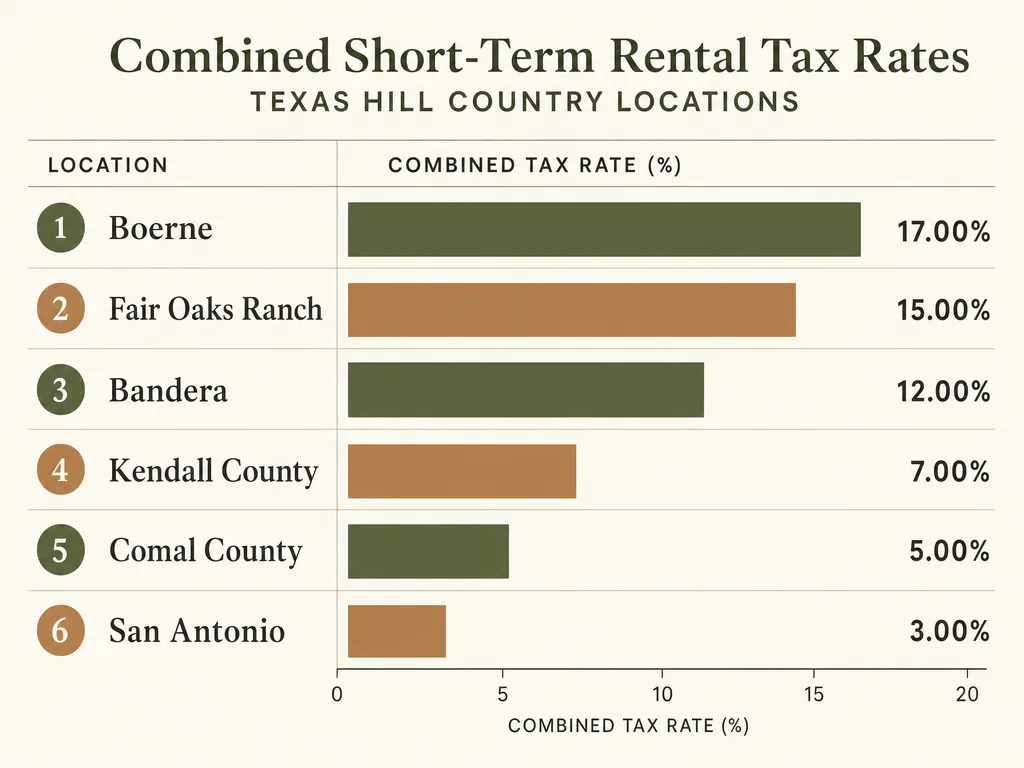
Understanding your total tax burden is essential to building a viable STR business model. Here is how the combined rates stack up across the Hill Country.
| Jurisdiction | State | Local | Combined Stated Rate | Notes |
|---|---|---|---|---|
| Boerne city limits | 6% | Boerne 7% | 13% | Verify which taxes the booking platform collects; local filing duties may remain. |
| Fair Oaks Ranch | 6% | Address-specific; no fixed city HOT rate verified | Do not publish a fixed total | City spans Bexar, Kendall, and Comal counties. Verify the exact address. |
| City of Bandera | 6% | City 3% plus Bandera County 6% | 15% | City and county reports are separate. |
| Unincorporated Bandera County | 6% | Bandera County 6% | 12% | A county report is required even when no tax is due. |
| Unincorporated Kendall County | 6% | No enacted county HOT verified as of August 9, 2026 | 6% | Recheck the county HOT proposal before updating. |
| New Braunfels | 6% | New Braunfels 7% | 13% | If property is also in WORD, add applicable 3% WORD fee after confirming boundaries. |
| Unincorporated Comal County outside WORD | 6% | No countywide Comal HOT verified | 6% | Verify exact address and any applicable municipality or special district. |
| Unincorporated Comal County inside WORD | 6% | WORD 3% | 9% | WORD permitting and reporting requirements apply. |
| San Antonio | 6% | City 9% plus Bexar County 1.75% | 16.75% | Airbnb and Vrbo collect city tax but not county portion. Owner must file monthly and pay county tax. |
Rates and platform agreements can change and must be verified for the exact address.
Fair Oaks Ranch note: Fair Oaks Ranch spans portions of Bexar, Kendall, and Comal counties. Taxing jurisdictions may therefore depend on the property's exact address. Do not assign a fixed local hotel-occupancy-tax rate without written confirmation from the applicable city, county, and special district.
Bandera tax note: The City of Bandera imposes a 3 percent municipal hotel occupancy tax and requires quarterly reporting. Bandera County's current hotel occupancy tax report calculates county tax at 6 percent and states that operators of covered lodging properties in Bandera County must file. Bandera County's tax is authorized to apply within municipalities that impose a city hotel tax. Accordingly, a covered rental inside the City of Bandera is subject to the 6 percent state tax, 3 percent city tax, and 6 percent county tax, for a combined stated rate of 15 percent. A covered rental elsewhere in Bandera County is generally subject to the 6 percent state tax and 6 percent county tax, for a combined stated rate of 12 percent.
Important: Airbnb currently states that it collects the 6 percent Texas state hotel occupancy tax on qualifying Texas reservations. Owners using Airbnb, Vrbo, another platform, or direct booking should confirm the taxes that the specific platform collects for the property's exact address. Local HOT collection varies by platform and jurisdiction, check whether your platform collects local taxes or whether you need to file separately. For more on how property taxes affect your overall cost picture, see our Boerne property tax guide and our property tax protest guide.
HOA Restrictions: The Hidden Dealbreaker
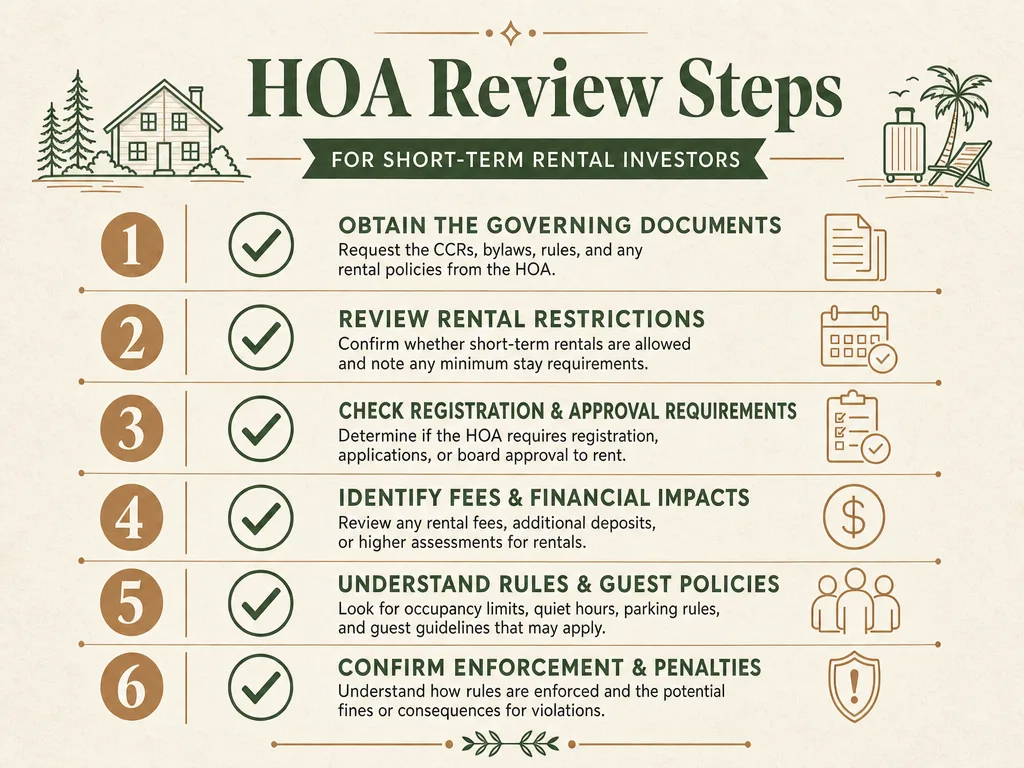
Even if the city or county permits STRs, your HOA may not. This is one of the most common mistakes investors make. Many Hill Country HOAs have covenants that restrict or prohibit short-term rentals. Some HOAs limit rental frequency (minimum 30-day rentals only). Some HOAs require owner approval before renting. The city of Boerne explicitly states it is not responsible for enforcing HOA restrictions [4]. Always review the CC&Rs (Covenants, Conditions, and Restrictions) before purchasing an investment property.
Operating without required governmental permits or registrations, and applicable private deed restrictions or association requirements, carries real financial risk. Several Hill Country-area cities and counties impose per-day fines for unpermitted STR operation, and HOAs can pursue injunctions or litigation against noncompliant owners independent of any city enforcement action. Factor permit and compliance costs into your investment model up front rather than treating them as an afterthought.
Frequently Asked Questions
Do I need a license to operate an Airbnb in Boerne?
Yes. Boerne requires a $200 STR permit registration for any property listed for rent for 30 days or fewer within city limits or the ETJ. The permit is valid for two years and must be renewed. You also need proof of liability insurance ($500,000 per occurrence / $1 million aggregate), a safety inspection, and a designated local contact person available 24/7. [4][5]
Can I operate an STR in a residential neighborhood in Boerne?
Yes, but with restrictions. In residential zones, your STR cannot be within 200 feet of another STR on the same block face. In the Historic, Downtown, and River Road overlay districts (commercial zones), there is no separation requirement. STRs are not permitted in commercial zones outside the overlay districts. [4][5]
What about Fair Oaks Ranch?
Fair Oaks Ranch does not currently classify "short-term rental" as a standalone land use in its UDC. Its residential bed-and-breakfast rules require the operator to be a full-time resident. Do not assume a non-owner-occupied whole-home rental is permitted. Obtain a written zoning determination for the exact property and review all recorded restrictions.
Do Airbnb or Vrbo collect all of my hotel occupancy taxes?
Not necessarily. A platform may collect the 6 percent Texas state tax and selected local taxes for which it has a collection agreement, but that does not mean it collects every city, county, venue, or special-district charge. Owners remain responsible for direct bookings and bookings through non-collecting platforms.
In San Antonio, Airbnb and HomeAway/Vrbo collect the 9 percent city tax, but they do not collect the 1.75 percent Bexar County tax. The owner must file the monthly return, report all covered receipts, and pay county tax on all covered bookings.
In New Braunfels, operators file city returns monthly through RentalScape, including zero returns when required. In WORD, covered permit holders report quarterly and must submit the required platform account summary even when Airbnb or Vrbo collected the WORD charge.
Can I rent my home short-term in unincorporated Kendall County?
No specialized county STR permit or registration program was verified for unincorporated Kendall County, Texas. Generally applicable county development, floodplain, fire-code, building, occupancy, septic, and subdivision requirements may still apply. Private deed restrictions may also control. The county HOT proposal should not be described as enacted without an official Commissioners Court order.
What if my HOA prohibits STRs?
A city or county's allowance of an STR does not override enforceable private deed restrictions. Operating may violate recorded covenants or association rules even when governmental regulations otherwise allow the use. Potential remedies can include an injunction, damages, fines, or attorney's fees, depending on the governing documents and Texas law. Review the current recorded dedicatory instruments, amendments, and association rules with a qualified Texas real-estate attorney or title professional.
Is Bandera good for STR investment?
Bandera should not be described categorically as more STR-friendly. The city code reviewed does not create a standalone STR permit category, but absence of an STR-specific ordinance does not establish that every property or rental model is permitted. Obtain written confirmation of zoning, occupancy, and permit requirements from the city. City and county hotel-occupancy-tax filings are separate.
Related Reading
These resources provide additional context for investors considering Hill Country properties:
- Boerne TX Property Taxes: What Homeowners Need to Know. Understanding the full tax picture is essential before investing in STR properties.
- How to Protest Your Property Tax Appraisal in Bexar, Kendall, Comal, and Bandera Counties. If you are investing in STR properties across multiple counties, understanding the tax protest process in each is important.
- Cost of Living in Boerne TX: What to Expect. Housing costs, insurance, utilities, and other operating expenses that factor into your STR pro forma.
- Moving to Boerne from California: A Complete Relocation Guide. For out-of-state buyers considering Boerne as both a home and an investment.
- The 12-Month California to Hill Country Relocation Timeline. A planning resource for buyers moving to the Hill Country from out of state.
- Boerne Community Page. Schools, amenities, and local context for one of the largest STR markets in the Hill Country.
- Fair Oaks Ranch Community Page. Understanding the master-planned community context and HOA landscape.
- Cordillera Ranch Community Page. Luxury estate and investment property context for the exclusive gated community.
Important: This article provides general educational information about short-term rental regulations in the Texas Hill Country. Local ordinances, tax rates, and HOA rules change. Verify current requirements with the specific city, county, and property HOA before purchasing or operating a short-term rental. This is not legal advice. Consult a qualified real estate attorney for guidance specific to your situation.
Sources
- Unified Development Code, amended through Ordinance 2025-21, City of Fair Oaks Ranch. fairoaksranchtx.org. Relevant material: Table 4.2 and the bed-and-breakfast standards in Section 4.10.
- City of Bandera hotel occupancy tax, including the 3 percent rate. ecode360.com
- City of Bandera forms. banderatx.gov
- Bandera County 6 percent HOT report. banderacounty.gov
- Bandera County non-operation affidavit. banderacounty.gov
- Kendall County forms and permits. co.kendall.tx.us
- Kendall County Commissioners Court. co.kendall.tx.us
- Texas Comptroller of Public Accounts, Hotel Occupancy Tax. comptroller.texas.gov
- Lodgify, "Airbnb and Short-Term Rental Laws in Texas (2026)." lodgify.com
- Awning, "Texas Short-Term Rental Laws: 2026 City-by-City Guide." awning.com
- City of Boerne, "Short-Term Rentals." ci.boerne.tx.us
- City of Boerne, "Boerne City Council Approves Short-Term Rental Ordinance." ci.boerne.tx.us
- STR Profit Map, "Bandera, Texas Short Term Rental Regulations." strprofitmap.com
- Airbnb, "Occupancy Tax Collection and Remittance by Airbnb in Texas." airbnb.com/help/article/2331
- Texas Property Tax Code, Chapter 312, Tax Abatements.
- Kendall County Development Rules. co.kendall.tx.us
- City of New Braunfels and WORD Comal County local tax portals. nbtexas.org, wordcc.com
- City of Boerne Ordinance 2023-09. ci.boerne.tx.us
- City of Boerne STR page. ci.boerne.tx.us
- New Braunfels STR rules and current fees. newbraunfels.gov
- New Braunfels tax information. newbraunfels.gov
- WORD tax types. wordcc.com
- WORD platform agreements and reporting. wordcc.com
- San Antonio HOT. sa.gov
- San Antonio platform-deduction instructions. docsonline.sanantonio.gov
Last verified: August 9, 2026
Published: August 9, 2026
Updated August 9, 2026