
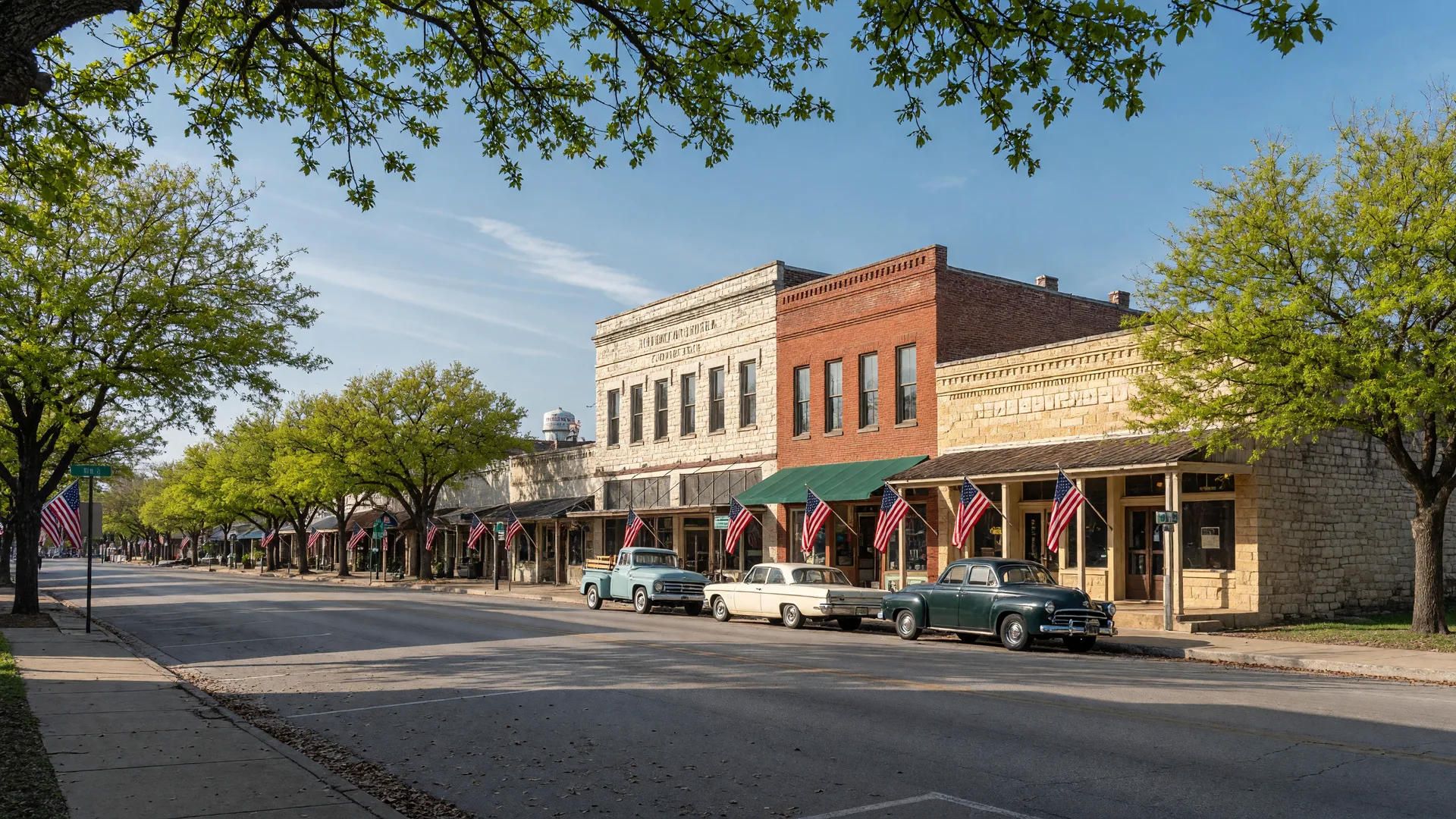
Johnson City sits at the crossroads of US-281 and US-290, roughly 55 miles northwest of Boerne, at the junction where the Hill Country transitions toward the Llano Uplift [1][2]. It is the county seat of Blanco County, population roughly 1,600 to 2,000 depending on the year you count, and it is best known as the hometown of the 36th president of the United States, Lyndon Baines Johnson [1][3]. But Johnson City is not just a presidential footnote. It is a functioning Hill Country town with a walkable downtown, a world-class family science museum housed in a restored 1880s mill, and a pair of National Park Service sites that tell the story of Texas frontier life across two centuries [1][2][4].
The town was founded in 1879 by James Polk Johnson, a former Confederate soldier and cattleman who was a nephew of Sam E. Johnson Sr., making him a distant relative of LBJ. James Polk Johnson donated 320 acres of his land along the Pedernales River for the town plat and actively lobbied to make it the Blanco County seat, a goal achieved in 1891, six years after his death [1][5]. Before the courthouse moved from Blanco to Johnson City, the town was a ranching and agricultural crossroads. It grew organically around cattle driving, cotton, and the regional trade that passed through the crossing of two major highways [1][5].
For visitors from Boerne and the surrounding Hill Country, Johnson City offers a compact, walkable downtown with local restaurants, antique shops, and craft breweries, combined with two of the more interesting museums in Central Texas, all within a few blocks of each other. It makes for a full day trip with a different character than the German-settled towns to the west [2][4].
How to get there from Boerne
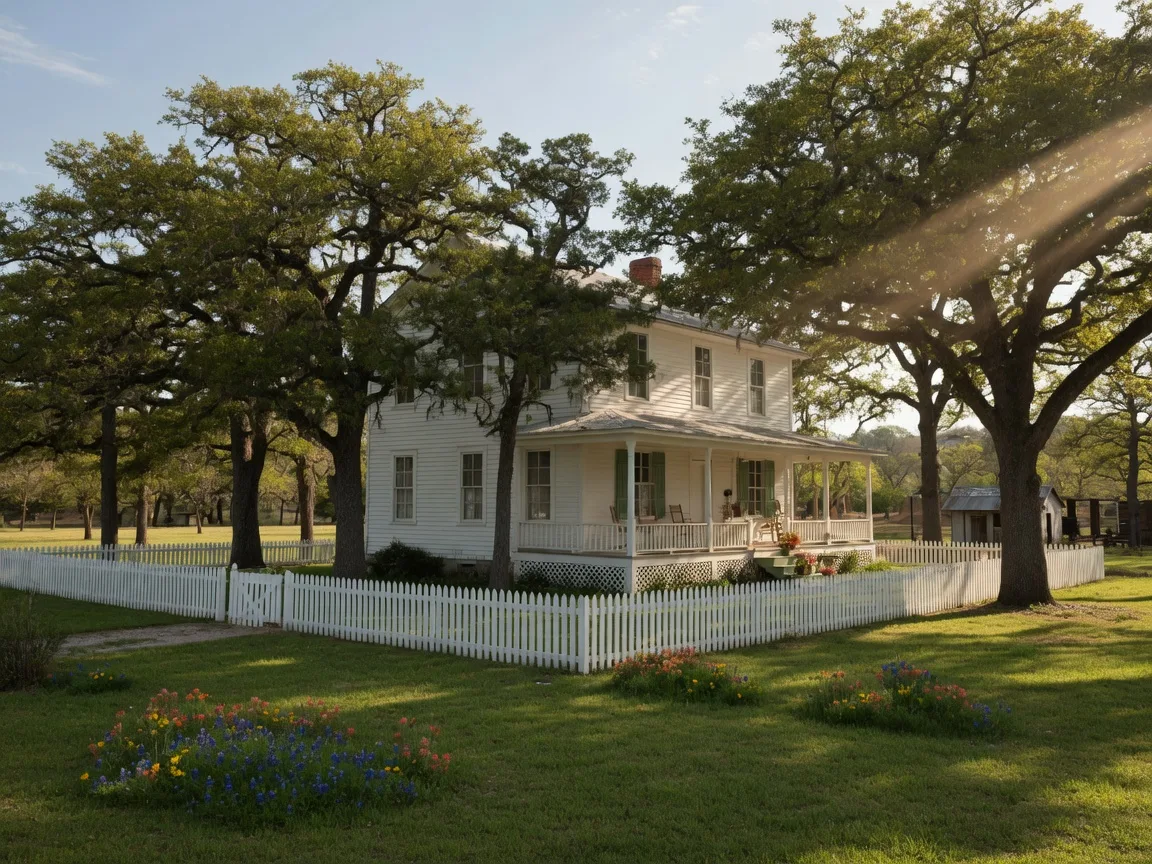
The drive from downtown Boerne to Johnson City covers approximately 52 to 55 miles and takes roughly 55 to 65 minutes under normal traffic conditions, depending on the route chosen [6].
Route via US-281 and RM 473 (recommended): Take US-281 North from the intersection of I-10 and US-281 in Boerne. Continue north through the rural Blanco County landscape for roughly 25 miles. At the intersection with RM 473 near the Blanco River, turn left (west) and continue toward Johnson City. This route runs approximately 52 miles and takes about 55 minutes. RM 473 follows the Blanco River valley through limestone outcroppings, live oak savanna, and open ranchland with crawford grass — a particularly scenic drive [6].
Alternative via Fredericksburg and US-290: A second route goes west from Boerne on I-10 to Comfort (17 miles), then north on US-87 toward Fredericksburg. From Fredericksburg, take US-290 east to Johnson City. This is roughly 60 miles and about 70 minutes, but it offers the option to combine a Johnson City visit with a stop in Fredericksburg, Comfort, or the LBJ Ranch at Stonewall along the way [6].
From San Antonio's northwest side, plan on roughly 85 to 90 miles and about 90 minutes via US-281 North [6]. From Austin, Johnson City is approximately 50 miles west and about 50 minutes via US-290 West [1][6]. Parking in downtown Johnson City is informal and generally available along the main street and around the courthouse square.
| Starting Point | Distance | Drive Time |
|---|---|---|
| Downtown Boerne | ~52-55 miles | ~55-65 min |
| Fair Oaks Ranch | ~60 miles | ~65-75 min |
| San Antonio (northwest) | ~85 miles | ~90 min |
| Fredericksburg | ~30 miles | ~30 min |
| Austin | ~50 miles | ~50 min |
Distances are approximate and based on standard driving routes via US-281 and RM 473.
What to see and do
The Science Mill
The Science Mill is arguably the most compelling reason to visit Johnson City for families. Housed in a restored 1880s mill building at 101 South Lady Bird Lane, this independent science museum operates as a nonprofit and offers over 50 interactive exhibits spanning physics, biology, engineering, and environmental science [7][8]. The building itself is part of the experience: the original three-story limestone mill was built by German stonemasons in the 1880s to grind grain and corn for local farmers and ranchers. It operated as a working mill into the 1920s and later sat empty for decades before being converted into a museum in 2015 [7][8].
The museum's exhibits are designed for a hands-on, high-engagement experience. Highlights include a full-body video game that uses motion tracking to put visitors inside a virtual ecosystem, a bicycle-powered centrifugal force generator, a Tesla coil that produces visible electrical arcs, and a water-play area that demonstrates fluid dynamics principles. Outdoor exhibits include an elevated walkway through the tree canopy, a sound garden, and a kinetic sculpture garden [7][8][9].
Admission pricing is reasonable for families: $11 for adults (ages 18 to 64), $9.50 for youth (ages 3 to 17), $9 for seniors (65 and over), and free for children under 2. Active and retired military receive half-price admission with valid ID. The museum is open Tuesday through Saturday from 10:00 AM to 5:00 PM and Sunday from 12:00 PM to 4:00 PM. It is closed on Mondays and on major holidays [10].
Plan for 90 minutes to two hours inside the Science Mill to engage with the exhibits at a comfortable pace. On weekends and during school breaks, the museum can be busy, particularly in the water-play and motion-tracking areas. Arriving at opening time is a good strategy for a quieter experience [7][10].
The Science Mill also operates an on-site café, the Lady Bird Lane Cafe, which serves coffee, pastries, sandwiches, and kid-friendly options with both indoor and outdoor seating [7].
LBJ Boyhood Home and Johnson Settlement (National Historical Park)
The Lyndon B. Johnson National Historical Park operates two distinct sites in Johnson City, both located a short walk from the downtown square. Together they form the Johnson City District of the park, separate from the LBJ Ranch near Stonewall, which is 14 miles west on US-290 [2][11].
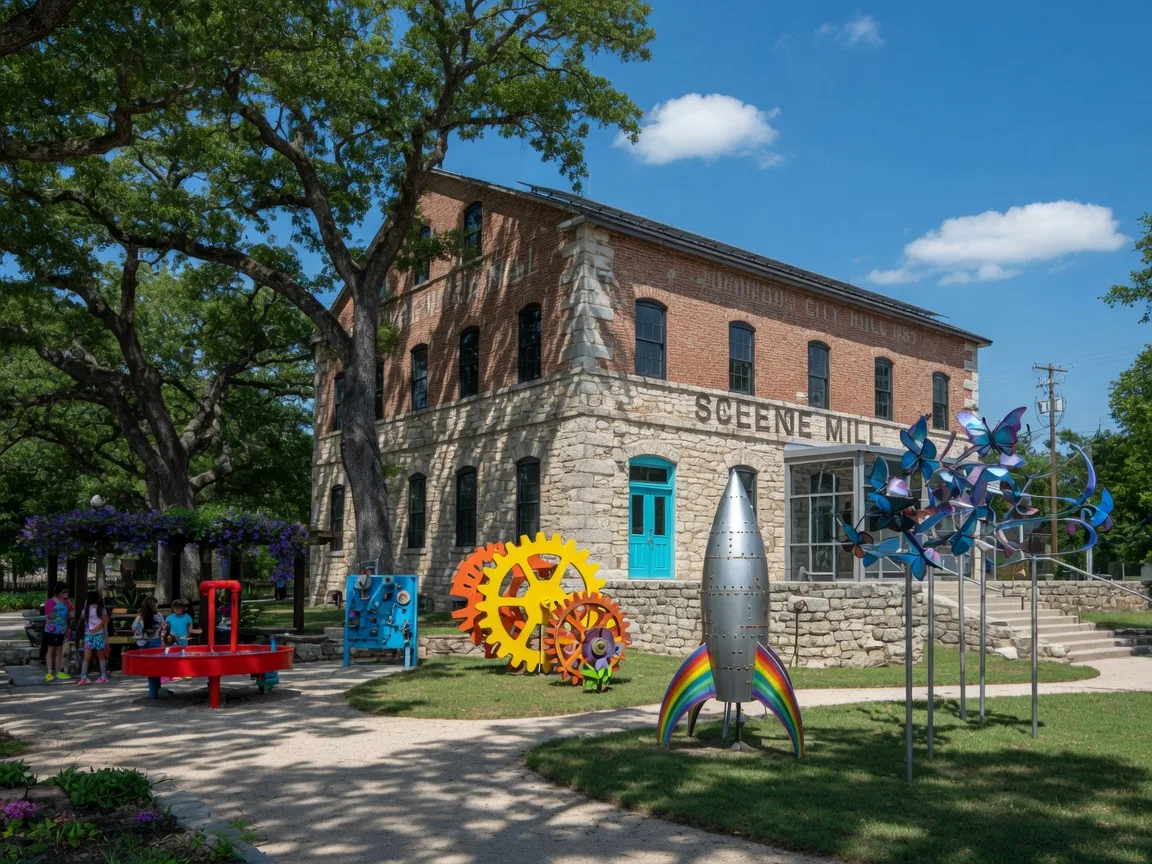
The LBJ Boyhood Home at 200 East Elm Street is a modest Victorian house built around 1886. Lyndon Johnson's parents, Sam Ealy Johnson Jr. and Rebekah Baines Johnson, purchased the home in 1913 when Lyndon was five years old. He lived here until his marriage to Claudia Alta "Lady Bird" Taylor in 1934. The home was dedicated as a museum in 1965 while LBJ was still in office — one of the only presidential birthplace homes to be opened to the public by the president himself. It is furnished with original family belongings donated by Lady Bird Johnson after LBJ's death [2][11][12].
The house is small — a typical late-19th-century Texas town dwelling — and a guided tour takes roughly 30 to 40 minutes. The ranger-led tour covers LBJ's childhood, his family's political involvement, and the 1930 campaign speech he delivered from the front porch that launched his political career. Admission is free. Hours are 9:00 AM to 5:00 PM daily, closed Thanksgiving, Christmas, and New Year's Day [11][12].
The Johnson Settlement is located one block west of the Boyhood Home, a half-mile gravel loop trail winding through an 1860s frontier homestead. This was the original ranch of Samuel Ealy Johnson Sr. and his brother Tom, LBJ's grandfather and great-uncle, who ran one of the largest cattle-driving operations in seven Texas counties in the years after the Civil War. The restored dogtrot cabin — an open-breezeway log cabin typical of mid-19th-century Texas frontier architecture — functioned as both their residence and business headquarters. The property also includes period barns, a windmill, water tank, and longhorn cattle that graze the pasture [2][11][13].
The Johnson Settlement tells the story of the Hill Country cattle-driving economy that preceded the German farming settlements by roughly 20 years. It is a useful companion to the Sauer-Beckmann Living History Farm at the LBJ Ranch near Stonewall — where the German farming tradition is interpreted — because it shows the earlier, rougher, more Anglo-Texas version of how people made a living on this land. The loop trail is open from dawn to dusk with free admission [11][13].
Visitors interested in the full LBJ experience should also plan a stop at the LBJ Ranch near Stonewall, 14 miles west on US-290. The self-guided driving tour there includes LBJ's reconstructed birthplace, the Johnson Family Cemetery, and the Junction School, and it is operated in conjunction with the Lyndon B. Johnson State Park & Historic Site, which hosts the Sauer-Beckmann Living History Farm. Both sites are free. A combined visit to the Johnson City District and the LBJ Ranch makes for a comprehensive full-day presidential history itinerary [2][14].
Texas Vintage Motorcycle Museum
At 100 North Nugent Avenue, just off the courthouse square, the Texas Vintage Motorcycle Museum houses a collection of roughly 30 to 40 vintage motorcycles spanning the 1910s through the 1970s. The collection includes rare American makes such as Indian, Excelsior-Henderson, and early Harley-Davidsons, as well as British and European marques. The building itself is a historic limestone structure that originally served as a Chevrolet dealership [2][4][15].
Admission is free, and the museum is generally open Thursday through Saturday with limited hours. It is a small museum — plan for 30 to 45 minutes — but it fills a niche for motorcycle enthusiasts and anyone interested in the material culture of early 20th-century transportation. The owners are typically on site and happy to talk about the restoration process and the history of each model [2][15].
Downtown: shops, restaurants, and the courthouse square
Johnson City's downtown is arranged around the Blanco County Courthouse, a 1913 brick and limestone building that anchors the town center. The square and the blocks radiating from it hold a mix of local restaurants, antique shops, vintage stores, and a brewery that give the town a self-sufficient feel — it is not a tourist-driven economy in the way Fredericksburg or Gruene are, and that is part of its appeal [4][16].
Restaurants worth noting:
- Pecan Street Brewing — A local brewpub at 117 East Pecan Street serving craft beer brewed on-site alongside a menu of burgers, sandwiches, salads, and tacos. Outdoor seating overlooks the courthouse square, and the brewery serves as something of a community gathering point on weekends [16][17].
- Proof & Cooper's at the Lumberyard — A restaurant and live-music venue on US-290 serving Texas comfort food with dinner service Thursday through Saturday [16].
- Pig Pen BBQ — A straightforward Central Texas barbecue operation with brisket, ribs, and sausage, located on US-290 near the east side of town [16][17].
- Herencia Cuisine — A family-run Mexican restaurant serving traditional interior Mexican dishes alongside Tex-Mex standards [17].
- Bryan's on 290 — A breakfast and lunch spot known for its chicken-fried steak, burgers, and daily specials in a casual diner atmosphere [17].
- Hill Country Cupboard — A local bakery and café offering sandwiches, salads, pastries, and a full coffee bar. Also serves as a gift shop with local artisan products [16].
The antique and vintage shopping scene along Nugent Avenue and the square is active, with half a dozen shops trading in Hill Country farmhouse furniture, vintage textiles, and local art. Unlike the curated retail in Fredericksburg, Johnson City's shops feel more like genuine discovery spaces — you are as likely to find a 1920s branding iron as you are a restored mid-century credenza [4][16].
Practical tips: hours, fees, and timing
Johnson City's attractions are spread over a compact, walkable area, but the three main draws — the Science Mill, the LBJ sites, and the downtown — each have different operating schedules worth planning around [7][11][10].
| Attraction | Hours | Admission |
|---|---|---|
| Science Mill | Tue-Sat 10-5, Sun 12-4; closed Mon | $11 adult, $9.50 youth, $9 senior |
| LBJ Boyhood Home | 9 AM - 5 PM daily | Free |
| Johnson Settlement | Dawn to dusk | Free |
| Texas Vintage Motorcycle Museum | Thu-Sat, limited hours | Free |
| Downtown shops & restaurants | Varies; most open Tue-Sat | Varies |
| Holiday closures | All NPS sites closed | Thanksgiving, Christmas, New Year's |
Hours and pricing may change. Confirm current conditions before visiting, especially for the Science Mill and the motorcycle museum, which have seasonal variations.
Best time to visit: Spring (March through May) and fall (September through November) offer the most comfortable weather for walking between sites. Summers in Johnson City can exceed 100 degrees Fahrenheit, and while the Science Mill and most restaurants are air-conditioned, the Johnson Settlement loop trail and the walk between attractions can be strenuous in peak heat. A weekday visit is recommended to avoid weekend crowds at the Science Mill, which fills up during school breaks [10][11].
Suggested itinerary for a full day from Boerne:
- Morning (9:00 AM - 12:00 PM): Depart Boerne early and drive to Johnson City. Start at the LBJ Boyhood Home for a ranger tour (30 to 40 minutes), then walk one block west to the Johnson Settlement loop trail (30 to 45 minutes). These sites are free and open early, making them a good first stop [2][11].
- Midday (12:00 PM - 1:30 PM): Lunch at the courthouse square — Pecan Street Brewing for a sit-down meal or Hill Country Cupboard for a quicker option [16][17].
- Afternoon (1:30 PM - 4:30 PM): Visit the Science Mill for two hours of interactive exhibits. If time and interest allow, stop at the Texas Vintage Motorcycle Museum afterward if it is open. Browse the antique shops along Nugent Avenue [7][15].
- Late afternoon (4:30 PM): Return to Boerne via the same US-281 or US-290 route, or take the longer scenic drive through Fredericksburg and Comfort for dinner [6].
Annual events in Johnson City
Johnson City hosts several annual events that add an extra dimension to a trip if timing aligns. The Blanco County Fair and Rodeo takes place in August and draws participants from across the region. The Lights Spectacular holiday lighting display in December transforms the courthouse square and surrounding blocks into a Hill Country Christmas scene that draws visitors from as far as San Antonio and Austin. The annual Pig Roast in October marks its 34th year in 2026 and is one of the more genuinely local community events in Blanco County [18][19].
The JCTX Jazz & Art Festival in October and the spring Wildflower Festival provide additional reasons for a return visit. Market Days occur every fourth weekend from spring through fall, featuring local artisans, live music, and food vendors around the courthouse square [18][19].
Why Johnson City matters if you are considering the Hill Country
Johnson City serves a specific purpose for someone evaluating a move to the Hill Country: it shows you what a self-sufficient rural county seat looks like in this region. Unlike towns that are economically dependent on tourism (Fredericksburg), on a single institution (San Marcos with Texas State University), or on commuting to a major metro area (many bedroom communities in Comal and Bexar Counties), Johnson City functions as its own economic center for Blanco County [1][4].
The courthouse, the school district, the local hospital, and the agricultural infrastructure that supports the surrounding ranches and farms give Johnson City a stability that is visible in its downtown. The buildings are occupied. The square is active. The restaurants are patronized by locals, not just weekend visitors [4][16].
For relocating families, the Science Mill is a genuine asset. Museums of this quality — with over 50 interactive exhibits in a nationally unique historic building — are rare in towns of under 2,000 people. It signals an engaged local community and a tax base that supports cultural infrastructure. Combined with the LBJ National Historical Park sites, a family can spend an entire day in Johnson City engaging with science, history, and frontier culture within a few blocks of each other, and pay roughly $11 per adult for the privilege [7][10].
Johnson City's location at the crossroads of US-281 and US-290 also makes it a logistical hub worth understanding. From Boerne, it is roughly an hour north. From Austin, it is 50 minutes west. From Fredericksburg, it is 30 minutes east. That positioning means Johnson City sits at the center of a triangle formed by three of the most significant population and tourism centers in Central Texas, and its real estate market reflects that connectivity. For someone considering a Hill Country relocation who wants proximity to both Austin and the Hill Country wine corridor, Johnson City and the surrounding Blanco County area are worth a serious look [1][6].
Pairs well with
- LBJ State Park & LBJ Ranch (Wine, Food & Culture) — Located 14 miles west on US-290 near Stonewall, the LBJ Ranch and Sauer-Beckmann Living History Farm form the natural companion to the Johnson City District of the National Historical Park. Visiting both in one day creates a full presidential history itinerary [14].
- Blanco (Historic Towns & Villages) — Just 17 miles southeast of Johnson City on US-281, the town of Blanco offers the 1886 limestone courthouse, Blanco State Park with its spring-fed swimming area, and the Buggy Barn Museum. The two towns are easily combined on a single day tour of eastern Blanco County [20].
| Feature | Johnson City | Blanco |
|---|---|---|
| Distance from Boerne | ~55 miles | ~35 miles |
| Population | ~1,600-2,000 | ~1,900-2,200 |
| Primary Attractions | Science Mill, LBJ sites, downtown | Blanco State Park, Buggy Barn, square |
| Walkable Downtown | Yes, courthouse square | Yes, courthouse square |
| Family-Friendly | High — Science Mill for kids | High — state park swimming |
| National Park Site | Yes, LBJ Boyhood Home | No |
| County Seat | Yes, Blanco County | No |
Johnson City and Blanco are the two primary towns in Blanco County. Combined, they offer a full range of Hill Country attractions from history and science to swimming and antique shopping.
Frequently asked questions
Is Johnson City worth visiting if I have already been to the LBJ Ranch?
Yes. The Johnson City District of the Lyndon B. Johnson National Historical Park — the Boyhood Home and Johnson Settlement — is a separate experience from the LBJ Ranch near Stonewall. The Boyhood Home shows LBJ's life as a child and young adult in a way the ranch does not, and the Johnson Settlement tells the cattle-driving frontier story that preceded his family's political rise. Additionally, Johnson City's downtown and the Science Mill are independent attractions with no equivalent at the ranch. Many visitors find that visiting both the Johnson City District and the LBJ Ranch in a single day gives the most complete picture of the Johnson family's place in Hill Country history [2][14].
How long should I plan for a day trip to Johnson City?
Four to six hours is a comfortable range for a focused visit covering the main sites. A typical itinerary includes 60 to 90 minutes at the Science Mill, 30 to 40 minutes at the LBJ Boyhood Home, 30 to 45 minutes at the Johnson Settlement loop trail, and 45 minutes for lunch at the courthouse square. Adding the Texas Vintage Motorcycle Museum and browsing downtown shops extends the visit by 30 to 60 minutes. Combining Johnson City with the LBJ Ranch near Stonewall (14 miles west) makes for a full eight-hour day trip [4][10][11].
What is the best time of year to visit Johnson City?
Spring (March through May) and fall (September through November) are the best seasons for comfortable weather. Summer visits are doable but temperatures often exceed 100 degrees Fahrenheit in July and August, making the walk between outdoor sites less pleasant. The Science Mill and most restaurants are air-conditioned, but the Johnson Settlement trail is exposed. Winter visits offer the quietest experience and can be pleasant on mild days, though the Science Mill closes on Mondays year-round and some shops reduce weekday hours in the off-season. If timing aligns with the October Pig Roast or the December Lights Spectacular, those events add a strong community dimension [10][18][19].
Is Johnson City's downtown walkable?
Yes. The courthouse square, the Science Mill, the LBJ Boyhood Home, and the Johnson Settlement are all within a half-mile of each other. Most visitors park once and walk between sites on foot. Sidewalks are present throughout the downtown core, and the terrain is generally level. The Johnson Settlement loop trail is a maintained gravel path suitable for all ages. The only site that may require a short drive is the Texas Vintage Motorcycle Museum, which is three blocks from the square [2][4][7].
Is the Science Mill appropriate for young children?
Yes. The Science Mill is designed for a broad age range, but it is particularly well-suited for children ages 4 through 14. The exhibits are hands-on and highly interactive, with water-play areas, motion-tracking games, and a bicycle-powered centrifugal force generator that appeal to younger visitors. The museum also offers a designated early childhood area for children under 5. Children under 2 are admitted free. The museum can fill up on weekends and school breaks, so arriving at opening time is recommended for families with young children [7][8][10].
Sources
- [1] Johnson City, Texas — Wikipedia. en.wikipedia.org/wiki/Johnson_City,_Texas
- [2] Lyndon B. Johnson National Historical Park — National Park Service. nps.gov/lyjo
- [3] Johnson City, TX — Census Reporter. censusreporter.org/profiles/16000US4837780-johnson-city-tx/
- [4] Johnson City, Texas: A Historic Corner of the Texas Hill Country — ExploreJCTX. explorejctx.com/johnson-city-texas-a-historic-corner-of-the-texas-hill-country/
- [5] James Polk Johnson Historical Marker — HMDB. hmdb.org/m.asp?m=126760
- [6] Distance from Boerne, TX to Johnson City, TX — Distance-Cities.com. distance-cities.com/distance-boerne-tx-to-johnson-city-tx
- [7] The Science Mill — Official Site. sciencemill.org
- [8] The Science Mill — Wikipedia. en.wikipedia.org/wiki/The_Science_Mill
- [9] The Science Mill — Science Near Me. sciencenearme.org/the-science-mill-1
- [10] Science Mill — FAQ / Hours and Admission. sciencemill.org/faq
- [11] NPS — LBJ Boyhood Home. nps.gov/lyjo/learn/historyculture/boyhoodhome.htm
- [12] Lyndon B. Johnson Boyhood Home — Wikipedia. en.wikipedia.org/wiki/Lyndon_B._Johnson_Boyhood_Home
- [13] NPS — Johnson Settlement. nps.gov/lyjo/learn/historyculture/thejohnsonsettlement.htm
- [14] Hill Country Homesteads — LBJ State Park & LBJ Ranch Guide. hillcountryhomesteads.com/day-trips/wine-food-culture/lbj-state-park/
- [15] Texas Vintage Motorcycle Museum — ExploreJCTX. explorejctx.com/directory/texas-vintage-motorcycle-museum/
- [16] Shop, Dine & Drink in Johnson City — 101 Highland Lakes. 101highlandlakes.com/shop-dine-and-drink-in-johnson-city
- [17] The Essential Guide to Johnson City, Texas — Travel + Leisure. travelandleisure.com/guide-johnson-city-texas-11941423
- [18] Events — Johnson City TX. johnsoncitytx.org/question/city-event-calendar/
- [19] Events — ExploreJCTX. explorejctx.com/events/
- [20] Hill Country Homesteads — Blanco Guide. hillcountryhomesteads.com/day-trips/historic-towns/blanco/
Published August 21, 2026
Updated August 21, 2026