
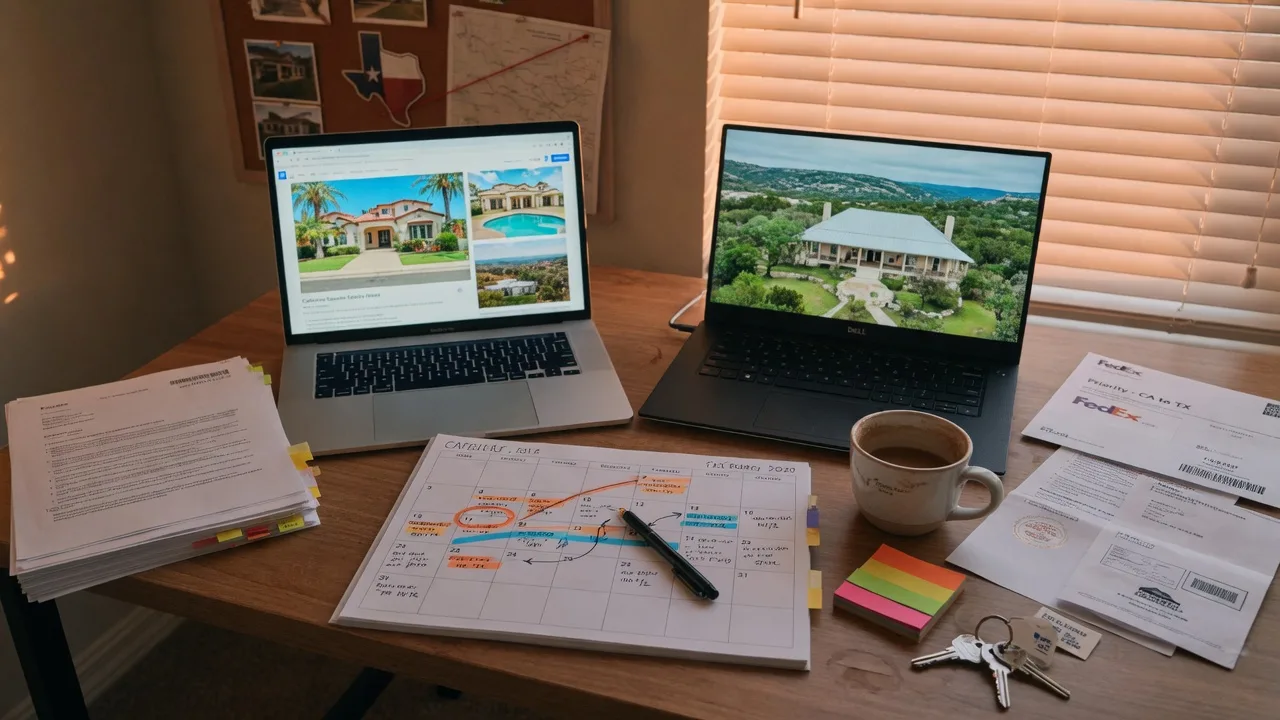
If you are selling a home in California and buying a property in the Texas Hill Country within the same window, you are attempting one of the most logistically complex transactions in residential real estate. I have worked with enough California-to-Texas clients to know that the people who pull this off smoothly are the ones who understand the mechanics before they start, not the ones who figure it out as they go.
The core challenge is timing. California escrow typically runs 30 to 45 days. Texas escrow runs 30 to 60 days depending on financing and the specific contract provisions. Those timelines do not naturally align, and when they overlap in the same calendar window, the margin for error is measured in days, not weeks. Here is how the mechanics actually work [1].
The two fundamental approaches: sequential vs. concurrent
There are two distinct strategies for coordinating a cross-state move, and the choice between them fundamentally changes every other decision in the transaction.
Sequential closing means you close on the California sale first, move your equity into a bank account, then close on the Texas purchase in a separate transaction window. This is the simpler approach logistically. You are never under two contracts at the same time, and your financing picture is straightforward because your down payment funds are already in cash. The trade-off is that you need a place to live between closings, temporary housing, storage for your belongings, and the mental overhead of moving twice [1].
Concurrent closing means both transactions close within days or weeks of each other, often on the same calendar day. This is far more complex but eliminates the gap where you are without a permanent home. The challenge is that your California equity is not available as cash for the Texas down payment until the California sale actually closes. That creates a financing gap that must be bridged by bridge financing, a HELOC, a 401(k) loan, or gift funds [2].
Sequential vs. Concurrent Closing: Tradeoffs at a Glance
| Factor | Sequential | Concurrent |
|---|---|---|
| Logistical complexity | Lower | Higher |
| Financing simplicity | Higher (equity in cash) | Lower (need bridge financing) |
| Gap housing needed | Yes (2 weeks to 3 months) | No |
| Double move cost | Yes | No |
| Risk of being stranded | Lower | Higher if either deal falls through |
Source: California Association of REALTORS and Texas Real Estate Commission standard contract timelines; typical bridge financing product terms.
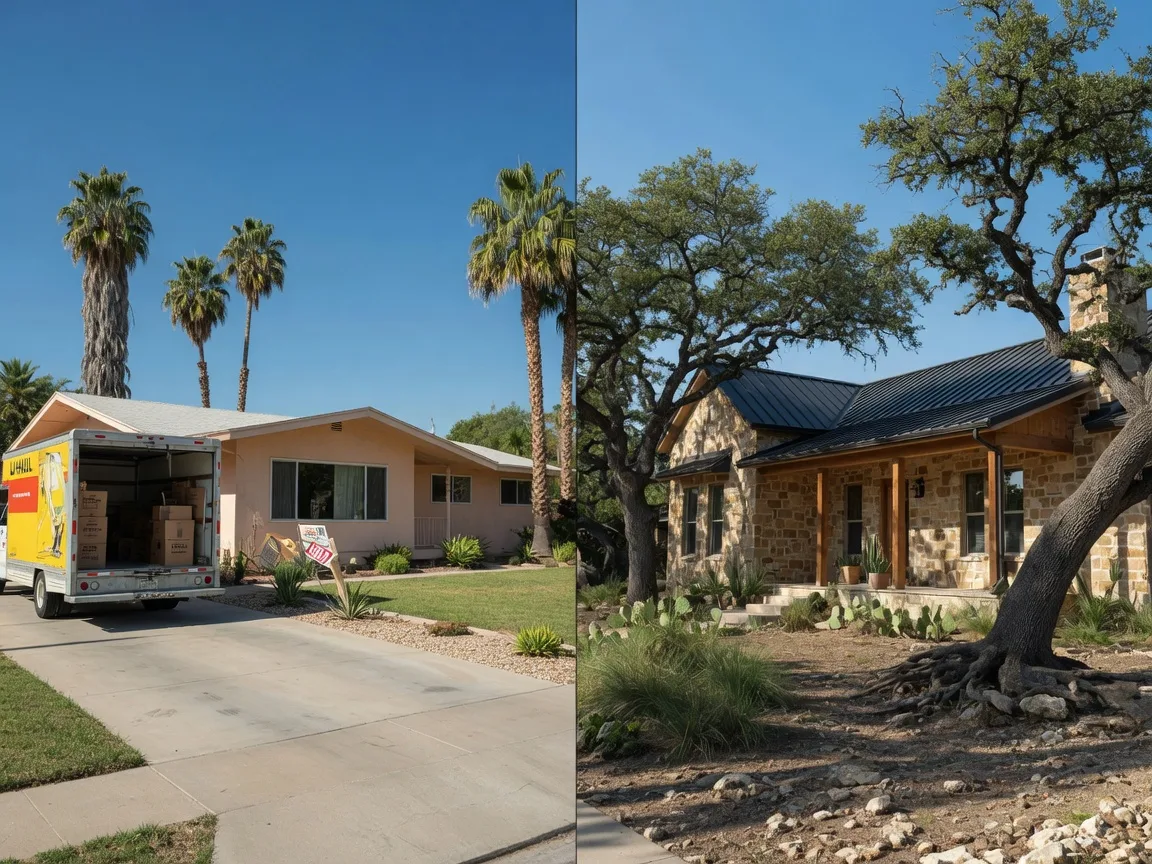
Bridge financing: what it is and what it costs
Bridge financing is the most common solution for the concurrent closing gap, but it is also the most misunderstood by buyers who have never used it. Here is what it actually looks like [2][3].
A bridge loan is a short-term, secured loan that uses your California home's equity as collateral to provide cash for the Texas down payment before the California sale closes. The loan is secured by your California property and is repaid when that property sells. Bridge loans typically run 6 to 12 months, though most are repaid within 60 to 90 days [2].
The cost of bridge financing includes several components: an origination fee (typically 1 to 2 points), an interest rate (typically 2 to 4 percentage points above a conventional mortgage rate), and closing costs that average $2,500 to $5,000 depending on the loan amount [3]. On a $200,000 bridge loan held for 90 days at 10 percent interest, the interest cost alone is approximately $5,000. Combined with origination and closing costs, a bridge loan for a typical California-to-Texas equity transfer runs $8,000 to $15,000 in total cost [2][3].
There are alternatives to bridge financing that may be less expensive depending on your situation. A home equity line of credit (HELOC) on your California property can serve the same purpose at a lower cost, typically prime rate plus 1 to 2 percent with no origination fee. The trade-off is that a HELOC requires your California property to already be free of a first mortgage or have sufficient equity after the first mortgage, and not all lenders will close a HELOC in time for a Texas purchase. Most HELOCs take 30 to 45 days to fund, which is too slow for a transaction that requires closing in 30 days [4].
A 401(k) loan is another option. You can borrow up to $50,000 or 50 percent of your vested balance, whichever is less, with repayment terms of up to 5 years. The interest rate is typically prime rate plus 1 percent, and the interest is paid back to your own account. The risk is that if you leave your job (including being laid off), the loan becomes due in full within 60 days. That is a real risk for retirees who are moving to Texas and leaving their California employment [4].
Bridge Financing Cost Comparison
| Financing Type | Estimated Cost (90 days) | Best For | Time to Fund |
|---|---|---|---|
| Bridge loan | $8,000 to $15,000 | High equity, fast timelines | 7 to 14 days |
| HELOC | $500 to $2,000 (closing) | Low cost, available equity | 30 to 45 days |
| 401(k) loan | $0 to $500 (admin fee) | Small gaps under $50K | 3 to 7 days |
| Gift funds (family) | $0 | Available family resources | Same day (bank transfer) |
| Cash reserves | $0 (opportunity cost) | Buyers with liquid assets | Same day |
Costs are estimates for a $200,000 loan gap over 90 days. Actual costs depend on loan amount, duration, credit profile, and lender terms. Consult a mortgage professional for current rates.
Remote signings: how they actually work across state lines
Both California and Texas allow remote online notarization (RON), but the rules differ in ways that can trip up a cross-state closing. Understanding the difference is essential to avoid a last-minute scramble [5][6].
California permits remote online notarization under Civil Code Section 1189, enacted in 2020. The notary must be physically located in California, and the signer must appear via two-way audio-video communication. The notary verifies the signer's identity through personal knowledge, credible witnesses, or third-party identity verification [5].
Texas permits remote notarization under Texas Civil Practice and Remedies Code Section 121.016, enacted in 2019. The rules are similar to California's, but Texas notaries must register with the Secretary of State and use a TSA-approved identity verification service [6].
The practical challenge for a multi-state closing is that the notary needs to be licensed in the state where the document is being signed, not the state where the property is located. If you are physically in California signing Texas closing documents, you need a California notary. If you are in Texas signing documents for your California sale, you need a Texas notary. The title company coordinating the closing should arrange for licensed notaries on both ends, but that coordination takes time and advance notice [6].
Some title companies can handle hybrid closings where the seller signs remotely in one state and the buyer signs in the other. This is standard practice for cross-state transactions, but it requires both title companies (the one handling your California sale and the one handling your Texas purchase) to communicate clearly about document requirements, signing instructions, and funding releases [1][5].
For sellers who prefer a traditional in-person signing, mobile notaries are available in both states and can travel to your home or a mutually convenient location. Mobile notary fees in California typically run $75 to $150, with additional travel fees for longer distances. Texas mobile notary fees are similar, typically $50 to $100 per signing [5][6].
The timeline: what actually needs to happen and when
Here is the practical timeline I walk through with every client attempting a concurrent California-to-Texas closing. Every date is a real deadline, not a suggestion [1][2].
60 to 90 days before target close. Interview and select a lender who has experience with multi-state transactions. Not all lenders understand the mechanics of bridge financing or concurrent closings. Ask specifically how many cross-state transactions they have closed in the past 12 months, and whether they have a relationship with a title company that handles hybrid closings. Also begin interviewing Texas real estate agents (I know a few) who understand the timeline constraints and can structure your Texas offer to accommodate the California sale.
45 to 60 days before target close. List your California home. The California market timeline varies by region, but a standard listing period is 14 to 30 days before receiving an offer, followed by a 30 to 45 day escrow. In a balanced market, the total timeline from listing to close is 45 to 75 days. In a seller's market, you may find a buyer faster, but the escrow period remains the same [1].
30 to 45 days before target close. Make an offer on your Texas property. Your offer should include an extended closing timeline that aligns with your California escrow. Talk to your agent about structuring the Texas option period to allow for inspection contingencies that can be satisfied even if you are still in California, including remote review of inspection reports and video walkthroughs. The Texas option period guide covers the mechanics of the contract provision that gives you a window to conduct inspections as an out-of-state buyer [7].
14 to 21 days before closing. Finalize bridge financing or alternative funding. Confirm that funds will be available by the Texas closing date. Order moving services with flexible dates that can shift if either closing date moves.
7 to 10 days before closing. Confirm remote notary arrangements for both states. Verify that both title companies have the correct signing instructions, contact information, and document delivery procedures. If you need to be physically present in Texas for the closing, book travel now.
Closing day. Both transactions close. The California sale funds, the bridge loan is repaid from proceeds, and the Texas purchase funds from the remaining equity plus your bridge loan. This is the most complex day of the entire process, and it requires the title companies and lenders on both ends to be in direct communication.
Multi-State Closing Timeline Checklist
| When | What | Who Coordinates |
|---|---|---|
| 60-90 days | Select lender, agent, begin home prep | You + team |
| 45-60 days | List California home | CA agent |
| 30-45 days | Make Texas offer with extended timeline | TX agent |
| 21 days | Finalize bridge financing | Mortgage lender |
| 14 days | Order moving services, book travel | You |
| 7-10 days | Confirm remote notary arrangements | Title companies |
| Closing day | Both closings fund simultaneously | All parties |
Timeline assumes a concurrent closing strategy. Sequential closings follow a different calendar with a gap between the two transactions.

The contingency chain: what happens when one deal slips
This is the most important part of this guide. A concurrent closing works only when both transactions close on schedule. If one slips, the other must adjust or you are left without a home or with two homes. Building contingency provisions into both contracts is not optional [1][7].
On the California sale: Your contract should allow for a flexible closing date that can accommodate the Texas timeline. Your California agent should structure the sale to avoid a rigid closing date that forces the Texas side to match an immovable deadline. If possible, include a provision that allows you to rent back the California property after closing for a defined period (typically 30 to 60 days), which gives you a place to stay while the Texas closing is finalized [1].
On the Texas purchase: Your offer should include a financing contingency that recognizes the bridge financing structure. The Texas contract's standard financing contingency (Paragraph 4 of the TREC One to Four Family Residential Contract) gives you the right to terminate if your loan is not approved, but it requires you to apply for the loan promptly and in good faith. Your lender must understand that the bridge loan is part of the financing picture and must confirm that the contingency language covers it [7].
I have seen concurrent closings fail because the California buyer accepted a contingent offer (the California buyer's sale depended on their own buyer's sale), creating a chain of five or six transactions that all needed to close on the same day. If you have any control over it, avoid accepting a contingent offer on your California home. The chain risk is real, and it multiplies with every link [1].
What about the 1031 exchange?
For California investment property owners who want to roll equity into a Texas property without paying capital gains tax, a 1031 exchange adds another layer of complexity to the timeline. The rules are strict: the replacement property must be identified within 45 days of the relinquished property's closing, and the exchange must close within 180 days. That 180-day window does not extend for Texas closing delays [8].
If you are doing a 1031 exchange into a Hill Country property, the Texas purchase must close within 180 days of the California sale closing, not 180 days from when the California sale went under contract. That means the Texas property must already be under contract and well into the process before the California sale closes. Waiting until after the California closing to start looking for Texas property leaves you with 45 days to identify a replacement and 135 days to close, and 135 days is comfortable for a standard Texas transaction, but only if the property is identified and under contract quickly [8].
The stakes are high. If the 1031 exchange fails, the capital gains tax on a California property that has appreciated significantly can be substantial. Deferring that tax requires precision execution on both the California sale and the Texas purchase. A qualified 1031 exchange accommodator should be engaged before the California sale closes to manage the timeline and paperwork requirements [8].
What the Hill Country specifically requires from out-of-state buyers
For buyers moving to Boerne, Fair Oaks Ranch, or other Hill Country communities, several Texas-specific requirements add to the coordination burden of a multi-state closing [7][9].
Well and septic inspections. If the Texas property has a private well and septic system, the inspections must be scheduled and completed during the option period. For out-of-state buyers who cannot be present, this means coordinating with a local inspector, receiving reports electronically, and making decisions about repairs or termination without seeing the property in person. Well inspections typically cost $200 to $400, and septic inspections run $250 to $500. Both should be ordered as soon as the option period begins [9].
Texas-specific contract provisions. The Texas TREC contract includes provisions that differ from California's standard purchase agreement, including the option period (discussed above), the third-party financing addendum, and the seller's disclosure notice. Understanding these provisions before making an offer is essential for out-of-state buyers who may not be familiar with Texas real estate law. The Texas option period guide covers the key differences [7].
Title insurance and surveys. Texas requires title insurance as a condition of most financed purchases, and title companies in the Hill Country typically require 10 to 14 days to complete the title search and prepare the commitment. For acreage properties, a survey is strongly recommended and may be required by the lender, adding another 7 to 14 days to the timeline. These are not optional steps; they are structural requirements of a Texas real estate closing [7].
Property tax proration. Texas property taxes are paid in arrears, meaning the seller credits the buyer for taxes already paid or the buyer reimburses the seller for the portion of the year before closing. The proration calculation depends on the tax rate, the assessed value, and the closing date. Your title company handles this, but you should understand the numbers before closing [10].
Planning a cross-state move and need someone who understands both sides of the transaction?
I work with California-to-Texas buyers every week. I know the California listing agent side of this process, the bridge financing options, the contract timing constraints, and the Hill Country inspection requirements that out-of-state buyers consistently underestimate. No scripts, just a direct conversation about your specific timeline and property goals.
Contact Bill Ross | Relocation Guide for BoerneFrequently asked questions
Can I close on my Texas purchase before my California sale closes?
Yes, but only if you have sufficient cash or bridge financing to cover the down payment without the proceeds from the California sale. If your down payment depends on California equity, you must close the California sale first (sequential) or on the same day (concurrent). Closing the Texas purchase before the California sale creates a situation where you own two homes simultaneously, which is financially possible but requires carrying both mortgages [1][2].
How much does bridge financing typically cost for a California-to-Texas move?
For a typical California-to-Texas bridge loan of $150,000 to $300,000 held for 60 to 90 days, expect total costs of $8,000 to $15,000 including origination fees (1 to 2 points), interest (2 to 4 points above conventional rates), and closing costs. The exact cost depends on your credit profile, the loan amount, and how long you hold the loan before the California sale funds [2][3].
Do I need to be physically present in Texas to sign closing documents?
No. Both California and Texas allow remote online notarization. You can sign Texas closing documents from California using a California-licensed notary, and you can sign California closing documents from Texas using a Texas-licensed notary. The title companies on both ends should coordinate this process as part of the closing. Some title companies prefer in-person signings and may charge additional fees for remote arrangements [5][6].
What happens if my California sale falls through after I have already made an offer in Texas?
This is the highest-risk scenario in a concurrent closing. If you have already made an offer on a Texas property and your California sale falls through, you have several options: extend the Texas option period (at additional cost) to buy time, use bridge financing or cash reserves to close on the Texas property without the California equity, or terminate the Texas contract under the financing contingency (if your loan approval was contingent on the California sale). The specific remedy depends on your contract language and your lender's policies. This scenario is exactly why I recommend building contingency provisions into both contracts [1][7].
Can I use a 1031 exchange to defer capital gains on my California investment property when buying a Texas primary residence?
A 1031 exchange is only available for investment or business-use properties, not for a primary residence. If you are selling a California investment property and buying a Texas property that will be your primary residence, the 1031 exchange generally does not apply. However, if you are buying a Texas investment property (a rental, a vacation home used as an investment, or a property you intend to rent out for a period before converting to a primary residence), a 1031 exchange may be available under specific conditions. Consult a qualified tax advisor or 1031 exchange accommodator for your specific situation [8].
How long does a typical California-to-Texas concurrent closing take?
A well-coordinated concurrent closing with a standard California escrow (30 to 45 days) and a standard Texas escrow (30 to 45 days) takes approximately 60 to 90 days from listing the California home to closing on the Texas property. This assumes the California home is listed and receives an offer within 14 to 30 days, and the Texas offer is made within 30 to 45 days of the target closing date. The actual timeline varies based on market conditions, property price range, and financing complexity [1][2].
Sources
- California Association of REALTORS, Standard Residential Purchase Agreement. Escrow timeline provisions, closing date mechanics, and contingency rules for California real estate transactions. car.org
- Consumer Financial Protection Bureau, Bridge Loans and Short-Term Financing. Bridge loan product definitions, cost structures, disclosure requirements, and typical terms for residential bridge financing. consumerfinance.gov
- Bankrate, Bridge Loan Costs and Rates. Current bridge loan interest rates, origination fees, and closing cost ranges. bankrate.com
- IRS Publication 575, Pension and Annuity Income; 401(k) Loan Provisions. 401(k) loan limits, repayment terms, and the job-separation acceleration rule under IRC Section 72(p). irs.gov
- California Civil Code Section 1189, Remote Online Notarization. California remote notary requirements, signer identity verification standards, and notary location rules. leginfo.legislature.ca.gov
- Texas Civil Practice and Remedies Code Section 121.016, Remote Online Notarization. Texas remote notary registration, identity verification, and document delivery requirements. statutes.capitol.texas.gov
- Texas Real Estate Commission, One to Four Family Residential Contract (Resale). Standard TREC contract with financing contingency provisions (Paragraph 4), option period (Paragraph 23), and closing timeline requirements. trec.texas.gov
- IRS Section 1031, Like-Kind Exchanges; Revenue Procedure 2005-14. 1031 exchange identification and closing timelines (45/180-day rule), safe harbors, and qualified intermediary requirements. irs.gov
- Texas Commission on Environmental Quality, On-Site Sewage Facility Requirements. Septic system inspection, permitting, and maintenance obligations for Texas residential properties. tceq.texas.gov
- Texas Comptroller of Public Accounts, Property Tax Basics. Tax proration at closing, tax rate determination, and homestead exemption filing procedures. comptroller.texas.gov
Last verified: August 26, 2026
Published: August 26, 2026
Updated August 26, 2026