
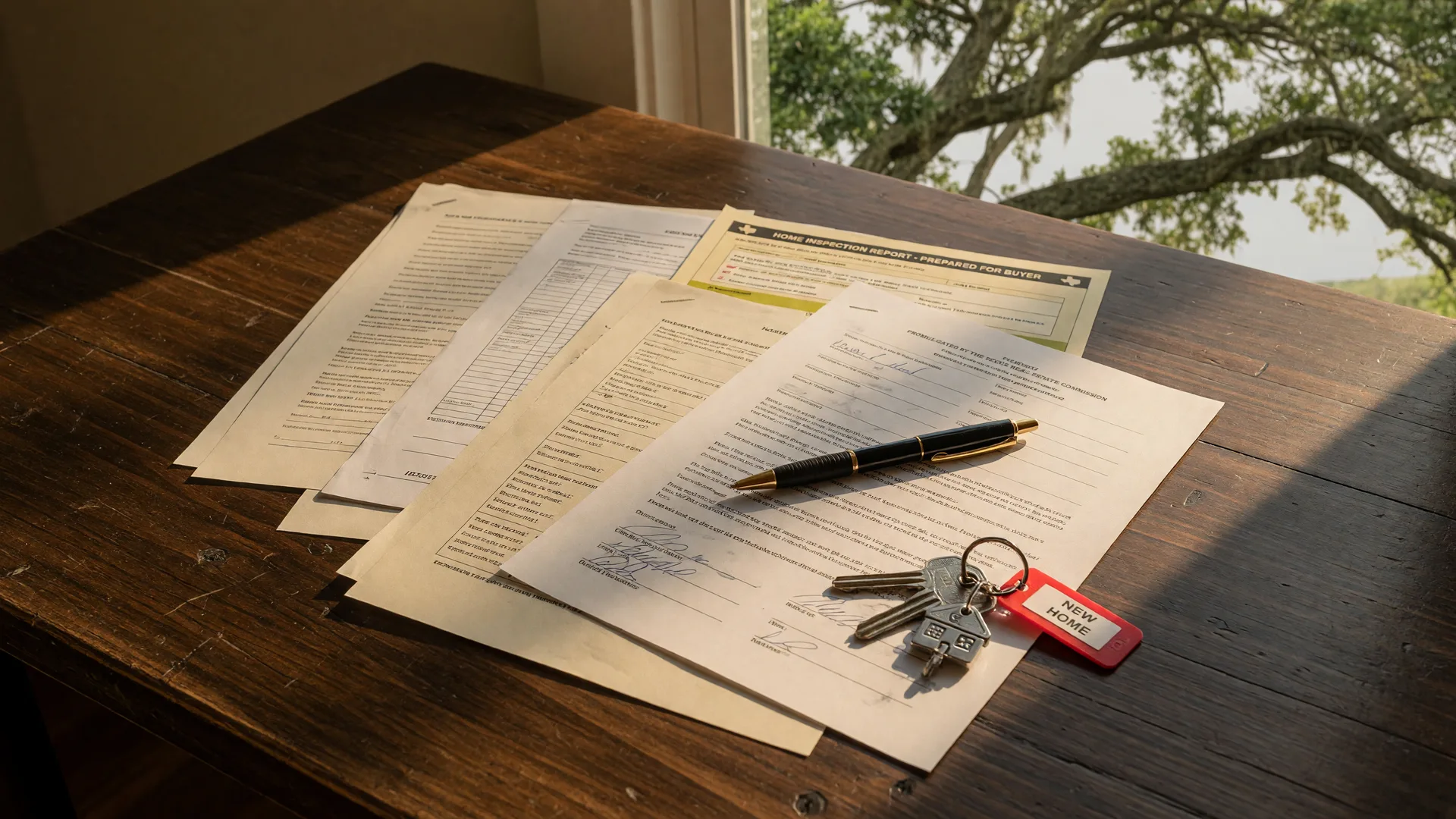
If you are buying a home outside of Texas, the purchase contract in most states works like this: you make an offer, the seller accepts, and you are now under contract with limited ability to back out without losing your earnest money. You typically have a short inspection period, often 10 to 14 days, and outside of those contingencies, getting your deposit back is difficult.
Texas does not work that way. The Texas Real Estate Commission (TREC) promulgated contract forms include a provision called the option period, a defined window during which the buyer can terminate the contract for any reason and receive a full refund of the earnest money. This is not a standard real estate contingency. It is a unilateral right to walk away, no questions asked, built directly into the contract.
For out-of-state buyers relocating to the Texas Hill Country, understanding the option period is one of the most important pieces of the transaction process. This guide explains how it works, what it costs, and how to use it effectively.
What the option period actually is
The option period is a negotiated right that allows the buyer to terminate the contract during a specified number of days in exchange for a nonrefundable fee paid directly to the seller. The option period is governed by paragraph 23 of the TREC One to Four Family Residential Contract (Resale), the standard contract used for most Texas home sales [1].
During the option period, the buyer may terminate the contract for any reason. The buyer does not need to disclose why. The buyer does not need the seller's agreement. The buyer simply delivers a written notice of termination to the seller before the option period expires, and the earnest money is returned in full [1][2].
This is fundamentally different from contingency-based termination rights used in other states. A typical inspection contingency allows you to terminate only if the inspection reveals a defect you are unwilling to accept, and the seller has the opportunity to cure or negotiate. An option period imposes no such limitation. You can terminate because you found a different property, because your financing fell through, because you changed your mind about the neighborhood, or for no stated reason at all [2].
The option period applies exclusively to the buyer. The seller does not have an equivalent right to cancel during the option period, except under specific breach conditions defined in the contract [1].
Option Period vs. Inspection Contingency Comparison
| Feature | Texas Option Period | Inspection Contingency (most states) |
|---|---|---|
| Termination reason | Any reason, no justification needed | Only for specified defects discovered during inspection |
| Cost to buyer | Option fee (negotiated; nonrefundable to seller) | Typically no direct fee beyond inspection costs |
| Earnest money refund | Full refund (minus option fee) | Full refund if contingency not met |
| Seller negotiation right | No; buyer can terminate at will | Typically yes; seller can offer to cure |
| Typical duration | 7 to 10 days | 10 to 14 days |
Source: TREC One to Four Family Residential Contract (Resale), Paragraph 23; Texas Real Estate Commission, Option Period Provisions.
How the option fee works
The option fee is a separate payment from the earnest money. The buyer pays the option fee directly to the seller (or to the title company as escrow agent) in exchange for the exclusive right to terminate during the option period [1].
The fee is nonrefundable. Even if the buyer terminates the contract and receives a full earnest money refund, the option fee stays with the seller. This is the seller's compensation for taking the property off the market during the option period [2].
Option fees are negotiable and typically range from $100 to $500, though higher fees are common on higher-priced properties. On a $600,000 Hill Country home, an option fee of $250 to $500 is standard. The fee is not credited toward the purchase price, it is a separate cost of doing the due diligence [3].
Earnest money, by contrast, is held by the title company or escrow agent and credited to the buyer at closing. If the buyer terminates during the option period, the full earnest money amount is returned. If the buyer terminates after the option period expires without a contractual basis, the earnest money may be forfeited to the seller [1][2].
Option Fee vs. Earnest Money: Key Differences
| Category | Option Fee | Earnest Money |
|---|---|---|
| Purpose | Buyer's right to terminate for any reason | Good-faith deposit showing buyer is serious |
| Amount | Typically $100 to $500 (negotiable) | Typically 1% to 3% of purchase price |
| Refundable? | No | Yes, if buyer terminates during option period |
| Held by | Seller or title company | Title company or escrow agent |
| Applied to purchase? | No | Yes, credited at closing |
Source: TREC contract form, Paragraph 23; Texas Real Estate Commission guidance.
What belongs in the option period
The option period is the time to complete all due diligence that cannot be accomplished before the contract is signed. A standard 7-to-10-day option period should include, at minimum:
General home inspection. A licensed Texas home inspector examines the property's structural, mechanical, electrical, and plumbing systems. For Hill Country homes, the inspection should also cover foundation condition (limestone and clay soils create distinct risks), roof age and condition (hail damage is common), and HVAC age and service history [4]. The Home Inspection Checklist for Boerne covers Hill Country-specific concerns in more detail.
Well water testing. For properties on private wells, a water quality test should be ordered immediately and configured for expedited results. Standard bacteria and mineral panels take 3 to 5 business days. If the property is in an area with known concerns, nitrates from agricultural activity or hydrogen sulfide from natural formation, a comprehensive test is warranted [5].
Septic system inspection. A licensed septic inspector evaluates the aerobic or anaerobic system, including the tank, drip field, spray heads, and control panel. Repairs can range from $500 for a simple pump to $10,000 or more for a full system replacement [6].
Termite / wood-destroying insect (WDI) inspection. Texas lenders typically require a WDI inspection report as a condition of financing. This is separate from the general home inspection and is conducted by a licensed pest control company [7].
Title review. The title company conducts a title search and provides a preliminary title commitment. Buyers or their attorneys should review the commitment for liens, easements, deed restrictions, and other encumbrances that could affect ownership or future property use [8].
Survey review. If a survey is ordered (typically required by the lender or requested by the buyer), the survey identifies boundary lines, easements, encroachments, and improvements. For acreage properties in the Hill Country, the survey is particularly important for confirming property lines across unmarked terrain [8].
Insurance quotes. Texas property insurance rates vary significantly by location, proximity to wildfire zones, and hail exposure. Buyers should secure binding quotes during the option period to confirm insurability and cost. See the Property Insurance in the Texas Hill Country guide for detailed rate information.
The repair negotiation process
After inspections are complete, the buyer typically submits a request for repairs (TREC form notice). The seller may agree to make repairs, offer a credit toward closing costs, or decline the request. If the buyer and seller cannot agree and the option period is still active, the buyer may terminate the contract and receive the earnest money back [1][2].
If the option period has expired and the buyer and seller have not reached a repair agreement, the buyer's options are more limited. The buyer may proceed with the purchase as-is, negotiate under the contract's general provisions (which do not require the seller to agree), or risk losing the earnest money by walking away [2].
This timing dynamic is why experienced buyers in the Texas system often schedule their inspections early in the option period and submit repair requests with several days still remaining. Leaving the repair negotiation until the final day of the option period puts the buyer in a position of having to extend the option period (at additional cost) or accept whatever the seller offers [3].
What happens after the option period expires
Once the option period ends, the buyer's unilateral right to terminate is gone. From that point forward, the buyer may only terminate the contract if the seller has breached a specific provision or if a contingency agreed to in the contract (such as a financing or appraisal contingency) is not satisfied [1].
The standard TREC contract does include a financing contingency (Paragraph 4) and an appraisal contingency (Paragraph 6C), both of which protect the buyer's earnest money if the loan is denied or the property appraises below the contract price [1]. But these contingencies operate differently from the option period. A financing contingency requires the buyer to make a good-faith effort to obtain financing. An appraisal contingency allows the buyer to terminate if the appraised value falls below the contract price, but only if the required addendum is signed [1][9].
For out-of-state buyers, the distinction matters. An option period provides maximum flexibility. Financing and appraisal contingencies provide protection only under specific conditions. The option period covers everything else.
Typical Hill Country Option Period Timeline
| Day | Action Item |
|---|---|
| 1 | Contract executed; option fee paid; order general inspection, WDI, well test, septic inspection |
| 2-3 | Inspection(s) conducted; order survey; review preliminary title commitment; secure insurance quotes |
| 4-5 | Receive inspection reports; review with agent or advisor; discuss findings and priorities |
| 6-7 | Submit repair request to seller; negotiate; if no agreement, decide whether to terminate |
| 8-10 | Extension window if needed; otherwise option period expires, contingencies govern forward |
Typical 7-to-10-day option period. Longer periods (up to 30 days) can be negotiated for complex transactions involving acreage, multiple inspections, or out-of-state buyer logistics.
Can the option period be extended?
Yes. If the buyer needs more time and the seller is willing, the option period can be extended by mutual agreement through a TREC amendment form. The extension typically involves an additional nonrefundable fee paid to the seller. The amount is negotiated separately for each extension [1].
Extensions are common when inspection results arrive late, when repair negotiations require additional time, or when out-of-state buyers need a longer window to complete their due diligence from a distance. Buyers relocating from California or other states should consider requesting a longer initial option period (12 to 14 days) rather than relying on extensions, particularly if they will be conducting inspections while still in their home state [3].
What out-of-state buyers should know about the Texas system
For buyers relocating to Boerne, Fair Oaks Ranch, or other San Antonio area Hill Country communities, several aspects of the Texas option period system differ from what most out-of-state buyers are used to:
Option periods are standard, not unusual. In many states, a purely discretionary termination right is uncommon and may raise seller questions. In Texas, it is the default contract structure for most residential transactions. Sellers expect it, and most accept a standard 7-to-10-day period with a standard option fee [2].
Inspections are the buyer's responsibility to coordinate. Unlike some states where the listing agent or seller arranges inspections, in Texas the buyer is responsible for scheduling every inspection, general, WDI, well, septic, pool, roof, foundation, and paying for each one directly. This means out-of-state buyers need a local point of contact who can manage the inspection schedule [3].
The option fee is not a discount tool. Some out-of-state buyers try to minimize the option fee as a cost-saving measure. This is a mistake. The option fee is one of the best bargains in the Texas real estate contract. It buys the right to walk away from a purchase that could cost hundreds of thousands of dollars. A $300 fee on a $500,000 property is 0.06 percent of the purchase price, an exceptionally low-cost insurance policy [2][3].
Termination is straightforward but must be in writing. The buyer's notice of termination must be in writing and delivered to the seller (or the seller's agent) before 5:00 p.m. Central Time on the final day of the option period, unless the contract specifies a different deadline. Verbal termination is not sufficient under the TREC contract [1].
Evaluating a Hill Country property and want to understand the full contract process?
The Texas option period is one piece of a larger contract system that differs significantly from other states. Understanding how all the provisions interact is essential before making an offer on a Hill Country property.
Schedule a consultation | Relocation GuideFrequently asked questions
Is the option fee refundable if I buy the house?
No. The option fee is nonrefundable regardless of whether the transaction closes. It is the seller's compensation for granting you the exclusive right to terminate. The fee is not credited toward the purchase price at closing [1][2].
Can the seller cancel during the option period?
No. The option period is a unilateral right held exclusively by the buyer. The seller may not terminate the contract during the option period unless the buyer breaches the contract by failing to meet a binding deadline or obligation [1].
How long should my option period be?
Seven to 10 days is standard for a conventional transaction on an existing home. For acreage properties requiring well, septic, and multiple inspections, 10 to 14 days is more appropriate. For out-of-state buyers who need to coordinate travel for inspections, a 12-to-14-day period is recommended [3].
What if I need more time after the option period expires?
If the option period has expired and you need to terminate due to an issue discovered after the deadline, your remedy depends on whether the contract includes other applicable contingencies. Financing and appraisal contingencies provide protection under specific conditions. For issues not covered by contingencies, terminating after the option period may result in forfeiture of earnest money. Extending the option period before it expires is the only reliable way to maintain unrestricted termination rights [1][2].
Does the option period apply to new construction homes?
New construction contracts in Texas often use builder-specific forms rather than the standard TREC resale contract. Builder contracts may not include a standard option period provision. Buyers purchasing new construction in Boerne or Fair Oaks Ranch should review the specific builder contract for termination rights, inspection provisions, and deposit refund terms before signing [3].
Can I do my own inspections, or do I need a professional?
You may walk through the property and observe conditions during the option period. However, a licensed Texas home inspector provides a documented report that may form the basis for a repair request. Lenders and insurers typically require professional certifications for WDI and well/septic inspections. A professional inspection is strongly recommended for out-of-state buyers who cannot personally inspect the property [4].
Sources
- Texas Real Estate Commission, One to Four Family Residential Contract (Resale), Paragraph 23 (Option Period). Standard TREC contract form governing option fee, termination rights, delivery deadlines, and extension procedures. trec.texas.gov
- Texas Real Estate Commission, Option Period Provisions and Contract Addenda. Summary of buyer termination rights, option fee requirements, and interactions with other contract provisions. trec.texas.gov
- Texas REALTORS, Option Period Frequently Asked Questions. Standard option fee ranges, typical period lengths, and guidance for buyers and sellers on negotiating option terms. texasrealtors.com
- Texas Real Estate Commission, Standards of Practice for Home Inspectors. Required inspection categories, structural and mechanical system evaluation, and TREC-required reporting standards. trec.texas.gov
- Texas Department of State Health Services, Private Well Testing. Water quality testing requirements, certified laboratories, and common contaminants by Texas region. dshs.texas.gov
- Texas Commission on Environmental Quality, On-Site Sewage Facilities. Aerobic and anaerobic system requirements, inspection procedures, and maintenance obligations for Texas septic systems. tceq.texas.gov
- Texas Department of Agriculture, Wood-Destroying Insect Inspection Standards. WDI inspection requirements for real estate transactions, Subterranean Termite Treatment Standards, and Form 99 reporting. texasagriculture.gov
- Texas Title Insurance Act (Texas Insurance Code, Title 11). Title search requirements, commitment delivery timelines, survey requirements, and easement/encumbrance disclosure obligations. tdi.texas.gov
- Texas Real Estate Commission, Third Party Financing Addendum and Appraisal Addendum. Financing contingency provisions, appraisal contingency requirements, and buyer termination rights under TREC addenda. trec.texas.gov
Last verified: August 25, 2026
Published: August 25, 2026
Updated August 25, 2026