

High-speed internet is one of the most misunderstood variables in a Texas Hill Country home purchase. Fiber-optic service is widespread across Boerne, but it is not universal, and rural acreage in Kendall, Comal, and Bandera counties often depends on fixed wireless or satellite. City marketing does not equal address coverage, so verifying service at the exact property, not the nearest town, is a standard due-diligence step before closing. This guide explains who serves the region, what each technology actually delivers, and how to check a specific address before you make an offer.
For households moving from coastal metros, the gap between expectation and reality can be substantial. A buyer coming from a city where gigabit fiber is on every street may assume the same speeds wait everywhere. In the Hill Country, the question is not which provider a buyer prefers, but which providers can physically reach a specific house, and at what speed. Those two answers differ from street to street, and sometimes from one side of a canyon to the other.
Why connectivity is now a due-diligence item
Remote work, online schooling, telehealth appointments, smart-home devices, and streaming all pull bandwidth. Reliable broadband has become a functional requirement for a growing share of Hill Country households, and it is the kind of feature that a buyer either verifies or assumes. For buyers, slow or capped service can mean video calls drop, cloud backups stall, and a home office simply does not function. For sellers, a verified fiber connection is a material feature worth documenting, and an unverifiable or weak connection is a risk that an informed buyer will discount.
Connectivity belongs on the same checklist as the physical systems covered elsewhere on this site: the well log, the septic permit, and the roof. Out-of-state buyers can lose an option period asking the wrong questions, or secure real leverage by asking the right ones. This guide covers the provider landscape, the verification sequence, and what to document, the same way the guide to common acreage buying mistakes for out-of-state buyers treats water, and septic as address-specific realities rather than town-level assumptions.
The five ways Hill Country properties get online
Regionally, coverage falls into five technology categories. The right one depends on the exact address, the terrain between the property and the nearest network, and how many people will work or learn from home.
Internet Technology Options in the Boerne and Kendall County Area
| Provider Type | Where It Serves | What to Know |
|---|---|---|
| GVTC Communications | Boerne, Bergheim, Kendalia, Comfort, Spring Branch, and surrounding Kendall County communities | Local fiber cooperative, and the dominant fiber network in the area; symmetric plans commonly start around 500 Mbps, and tiers up to multigigabit speeds are available [1]. |
| AT&T Fiber | Available at select Boerne-area addresses | True fiber where available, with multi-gigabit products at the top end; its footprint in the immediate area is limited, so check the exact address at att.com [2][6]. |
| Spectrum | Broad Boerne-area coverage, including many subdivisions | Cable, and hybrid fiber-coaxial service rather than fiber to the home; consumer tiers commonly range roughlying from100 Mbps to1 Gbps [3][5]. |
| Fixed wireless | Rural stretches across Kendall, Kerr, Gillespie, and surrounding counties | Regional operators including Bee Creek Communications, ZipLink, VGI Technology, and Nexstream bounce signal to a receiver mounted on the property; depends on line-of-sight, and terrain, and some plans offer unlimited data [4][8]. |
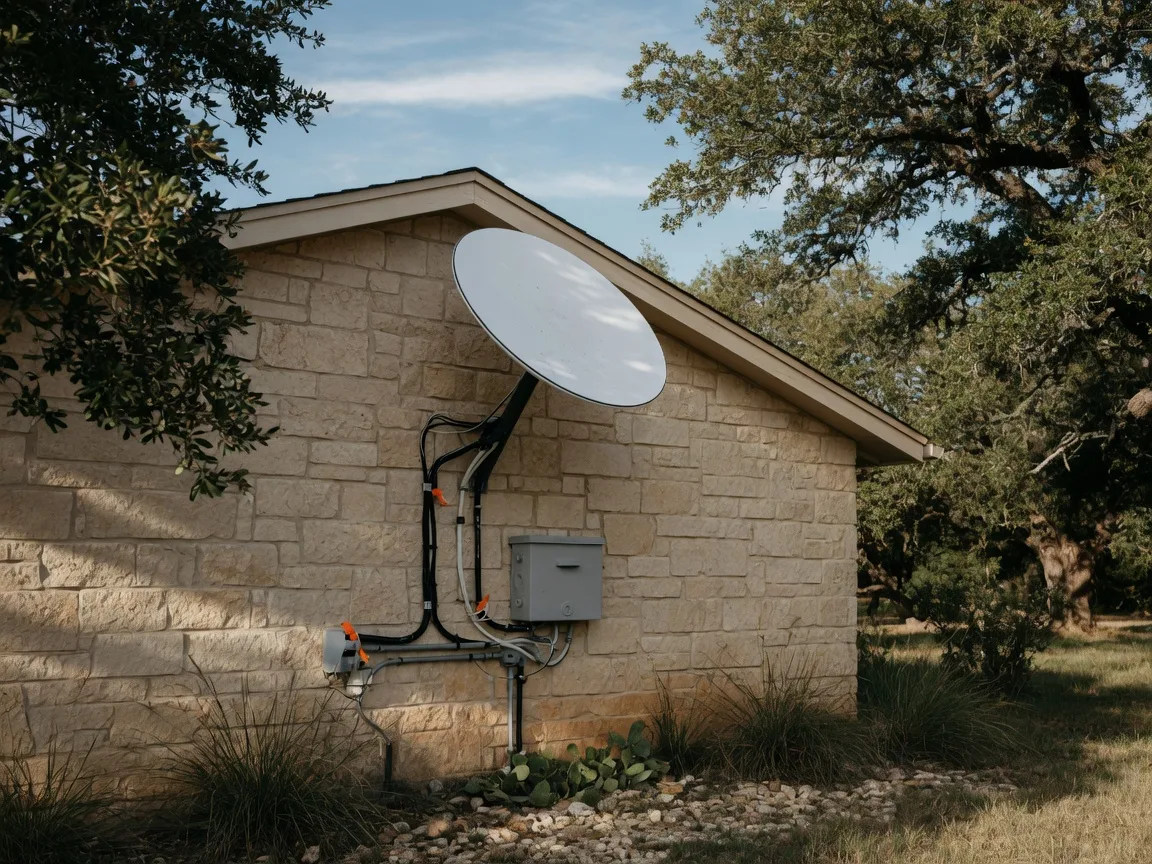
| Satellite | Nearly any addresswith an unobstructed sky view | Starlink's low-Earth-orbit service commonly advertises roughly100 to250 Mbps, and is the usual rural fallback where wired or fixed wireless is absent; geostationary services remain slower, and higher-latency [10][11]. |
Coverage, and availability change rapidly; always verify at the exact address. Third-party coverage estimates vary by neighborhood [1][2][3].
What each technology means for remote work
Download speed alone does not tell a buyer whether a connection will support a home office. Three other variables matter more:
Upload speed. Fiber plans are typically symmetric, with equal download, and upload rates, and that matters for video calls, cloud backups, and large file transfers. Cable uploads run slower than downloads, and fixed wireless, and satellite uploads vary widely by plan [1][3][10].
Latency. Fiber, and cable deliver low round-trip latency, which keeps video calls, and VPN connections stable. Fixed wireless adds modest latency, and geostationary satellite adds heavy latencythat makes real-time video calls, and VPN work painful. Starlink's LEO design cuts that latency well below traditional satellite service[10][11].
Reliability in weather. Fixed wireless needs a clear signal path, and heavy rain, dense tree growth, or new construction between the tower, and the receiver can degrade it. Satellite needs an unobstructed sky view, and snow, ice, or heavy cloud cover can briefly interrupt service. Fiber, and cable are buried or strung on poles, and are generally immune to weather-related signal loss [4][10][11].
Planning for a Working Household
A householdwith two adults on video calls, kids streaming schoolwork, and cloud backups running overnight needs far more than the minimum plan. When fiber is available, choosing a tier well above the entry speed respects the fact that household bandwidth needs grow faster than plans shrink. When the property depends on fixed wireless or satellite, testthe real-world speeds at the time of day you will actually be online, and budget around what the connection delivers, not what the ad copy promises.
How to verify internet at the exact address before you make an offer
The only reliable way to know what a specific Hill Country address can get is to check that address against the official tools, then confirm on the ground. Here is the sequence that works:
- Run the address through the FCC National Broadband Map. Broadbandmap.fcc.gov is the authoritative federal, address-level record of which providers report service there, and at what speeds. It also lets a user file a challenge when a provider's listing is wrong [9][10].
- Check each provider's own lookup tool. GVTC, AT&T at att.com/fiber, Spectrum, Bee Creek at beecreek.net, and Starlink each maintain an address checker that reflects current buildout, and availability[1][2][4][11].
- Drive the property, and look for physical evidence. Fiber to the home requires fiber plant serving the lot, and a finished install shows up as a small box on the exterior wall. Look for utility pedestals along the road, ask neighbors what they actually pay for, and run a speed test on site if the property is occupied [10].
- Test cell coveragewith your actual carrier. Cellular coverage maps overstate real-world signals, especially in canyon country. Stand at the building site, and preferably inside the house, and test your own phone. If the signal is weak indoors, Wi-Fi calling, a signal booster, or a carrier change may become part of the plan [10].
- Do it during the option period, not after closing. The option period is the designed window for due-diligence work. Calling providers, reading the FCC map, and standing on the propertywith your phone are all cheap compared with renegotiating after you own the house.
Address Connectivity Checklist
What to check in the service agreement
Once a buyer knows a provider can serve the address, ther plan terms matter as much as the technology. Read the fine print before locking in a long contract:
- Fiber to the home or fiber to the node? Fiber to the node still covers the last stretch over copper or coax, and upload speeds shrink accordingly. Ask outright whetherthe drop to the house is fiber [1][3].
- Data caps, and deprioritization. Some cable, and fixed-wireless plans throttle or deprioritize heavy users during peak hours, and geostationary satellite plans often carry usage limits. Confirm whetherthe plan has a cap, and what happens when it is hit [3][8][10].
- Contract term, and equipment fees. Confirm the service term, early-termination fees, router or receiver rental costs, and installation charges. Rural installations sometimes require a site visitthat costs extra [4][10].
- Upgrade path. Ask whether fiber buildout is planned for the road, and whether fixed wireless can relocate to a better point on the lot if trees grow into the path [1][4].
What sellers should document
Connectivity is a verifiable feature, and verifiable features carry weight for remote-work buyers. Before listing a Hill Country property, gather the following:
- Pull the FCC National Broadband Map record for the address, and note which providers report service there.
- Run speed tests at different times of day, and write down the real download, upload, and latencythe current plan delivers.
- State the exact provider, and plan name in the listing, along with whether it is fiber, cable, fixed wireless, or satellite.
- Ifthe property sits on fixed wireless or satellite, be upfront about it. Buyerswill verify, and a connectivity surprise at the showing is worse than a disclosed limitation.
A documented high-speed connection helps a property compete for out-of-state buyers, whose relocation math often starts with whether they can keep their jobs online. An unverified connection raises questions either way, and sellers are better served disclosing the real situation than hoping it goes unasked. The broader transition realitiesthat relocating households weigh, from commute to infrastructure, are covered in the guide to the infrastructure, and lifestyle realities of moving to the Hill Country.
Frequently asked questions
Is fiber internet available everywhere in Boerne?
No. GVTC fiber coverage across the Boerne area is broad, but not universal, with third-party coverage trackers variously estimating availability in the high-80s to high-90s percent range for Boerne addresses depending on neighborhood [1][2][3]. AT&T Fiber serves only a subset of Boerne addresses. The only way to know for sure is to run the exact address through each provider's checker [2][6].
What if the property only has satellite internet?
Satellite can work, but treat it as a starting point, not a conclusion. Starlink's low-Earth-orbit service commonly advertises roughly100 to250 Mbps, and is widespread enough that nearly any Hill Country addresswith an unobstructed sky view can order it [11]. Geostationary services remain slower, and higher-latency. Buyers who need upload-heavy remote work should budget for either fiber, a strong fixed-wireless plan, or Starlink before closing, and confirm the sky view from the actual roofline [10][11].
What is the best internet option for a rural acreage property?
It depends on what is physically reachable. Fiber, when available, is the strongest option for remote work. On acreage beyond the fiber footprint, start with fixed wireless from a regional operator, and verify line-of-sight, because plan speed, and reliability vary with the exact terrain [4]. Where fixed wireless does not reach, Starlink is the common choice. Test both where possible, and choose based on real upload speeds, and latency, not just the advertised download number [10][11].
How do I check which providers serve a specific address?
Start with the FCC National Broadband Map at broadbandmap.fcc.gov, which aggregates provider-reported availability at address level. Then confirm with each provider's own address lookup tool, because buildout changes faster than maps are updated. When the maps conflict with what your eyes see at the property, trust the physical evidence: pedestals, boxes, and neighbors' bills [9][10].
Does poor internet hurt a property's resale value?
For a growing share of buyers, broadband is a qualifying feature, like water supply or septic capacity. A property with verified high-speed service appeals to the full buyer pool, while one with weak or unverified service will face questions from any remote-work buyer. Sellersare better served disclosing the real situation than hoping it goes unasked. Every buyer should treat connectivityas an address-specific physical reality, in the same category as the well, the septic, andthe slope of the lot.
Sources
- BroadbandNow, "GVTC Communications." Plan tiers, symmetric fiber speeds, and coverage notes for the Boerne-area fiber cooperative. broadbandnow.com
- ISP Reports, "8 Best Internet Providers in Boerne, TX." Provider footprint estimates, and what each technology offers in Boerne. ispreports.org
- BestNeighborhood, "TV and Internet Providers in Boerne, TX." Coverage comparisons across cable, and fiber providers serving Boerne. bestneighborhood.org
- BestNeighborhood, "Fiber Optic Internet Providers in Kendall County, TX." Fiber buildout coverage across Kendall County communities. bestneighborhood.org
- InMyArea, "Boerne, TX Internet Providers." Technology breakdown, and coverage estimates for Boerne addresses. inmyarea.com
- AT&T, "AT&T Home Internet in Boerne, TX." AT&T Fiber availability, and plan tiers by address. att.com
- AllConnect, "Compare Internet Providers in Boerne, TX." Independent comparison of providers, speeds, and pricing for Boerne. allconnect.com
- Bee Creek Communications, "High-speed Internet, Texas Hill Country." Fixed-wireless provider serving Kendall, Kerr, and Gillespie counties, with line-of-sight requirements. beecreek.net
- FCC, "How to Use the FCC's National Broadband Map." Official guidance on using, and challengingthe address-level broadband map. help.bdc.fcc.gov
- FCC, "National Broadband Map." The authoritative federal, address-level map of reported internet availability. broadbandmap.fcc.gov
- Starlink, "Service Plans, and Coverage." Current residential plan speeds, and availability checks by address. starlink.com
Last verified: September 8,2026
This article is an independent informational resource for buyers, and sellers in Boerne, Fair Oaks Ranch, San Antonio, and the surrounding Texas Hill Country. Service availability, plans, and pricing change frequently; verify every number with the provider at the exact address, at the time of your purchase, and trust physical evidence over marketing materials.
Published: September 8, 2026
Updated September 8, 2026