
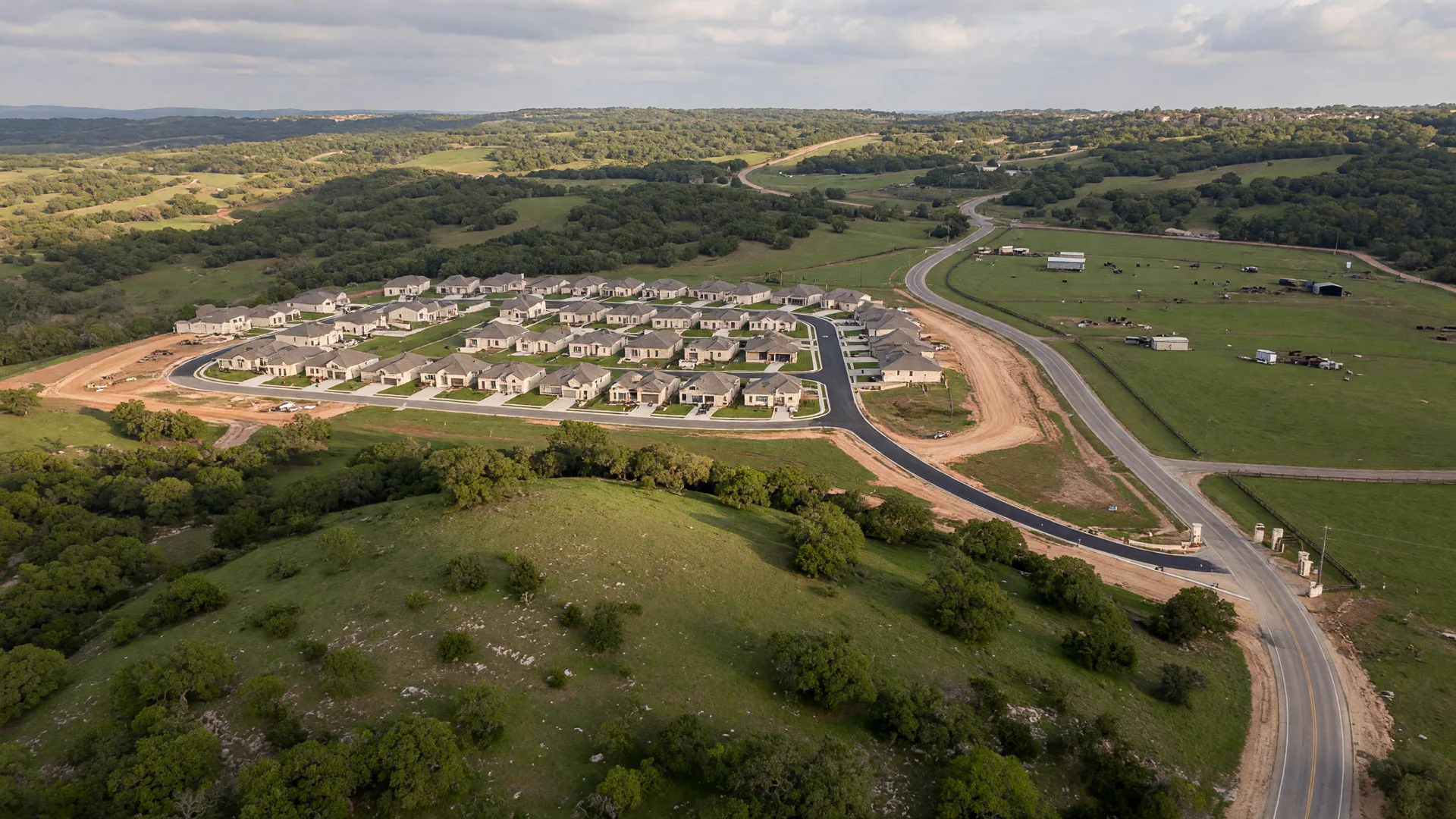
If you follow real estate headlines, you have seen the story repeated so often it has become accepted wisdom: California is emptying out, and Texas is absorbing the exodus. Like most oversimplified narratives, this one contains a kernel of truth surrounded by a lot of noise. The real picture of migration to the Texas Hill Country is more nuanced, more interesting, and far more useful for anyone trying to make a smart buying or selling decision.
I work with relocating families every week, and the questions I hear most often are grounded in those headlines: Are Californians really flooding the market? Is that why prices are up? Am I competing with cash buyers from the coast? The answers vary by community, by price band, and by the specific source of migration. Here is what the actual data shows about who is moving to the Hill Country, where they are coming from, and what it means for the market in 2026.
At a Glance: Key Migration Statistics for the Hill Country
| Metric | Value | Source |
|---|---|---|
| Kendall County population growth (2020-2025) | +31.96% | U.S. Census |
| Kendall County rank among Texas counties | 11th fastest-growing | Texas Demographic Center |
| Boerne population (2025 estimate) | ~23,868 | U.S. Census Bureau |
| Fair Oaks Ranch population (2026 projected) | ~11,066 | Texas Demographics Center |
| Annual CA-to-TX migration (national) | ~100,000 people | IRS Tax Data |
| CA share of TX inbound migration | ~22% of out-of-state | IRS Migration Data |
| Top feeder to TX (all sources) | Other Texas counties | IRS/ACS Data |
Sources: U.S. Census Bureau Vintage 2025 population estimates; IRS county-to-county migration data; Texas Demographic Center; San Antonio Express-News migration analysis. Statewide California-to-Texas migration figure represents net domestic migration and includes all destinations within Texas, not exclusively the Hill Country.
The biggest source of new residents is not California
The most common misconception I encounter is that the Hill Country is being reshaped primarily by a California exodus. The data does not support that framing. According to IRS migration data analyzed by the San Antonio Express-News, the largest source of new residents moving into Hill Country counties is not California or any other out-of-state location. It is other Texas counties [1].
People moving from within Texas account for a significantly larger share of Hill Country inbound migration than any single out-of-state source. Families relocating from the Houston suburbs, San Antonio proper, Dallas-Fort Worth, and Austin are the largest demographic group arriving in Boerne, Fair Oaks Ranch, and surrounding communities [1]. These are Texans choosing a different part of Texas, drawn by the same factors that attract out-of-staters: more space, better schools, a slower pace, and relative affordability compared to the major metro areas they are leaving.
This matters for buyers and sellers because the intra-Texas mover brings a different set of expectations than the California transplant. They already understand property taxes, well and septic systems, the Hill Country climate, and the school landscape. They are not learning the basics from scratch. They are making a calculated move within a system they already know.
California's role: the dominant out-of-state source
While intra-Texas moves dominate the overall numbers, California remains the single largest out-of-state source of new residents to Texas. Approximately 100,000 Californians move to Texas each year, and the flow has held steady through 2025 and 2026 at roughly 262 per day [2]. For the Hill Country specifically, California is the most visible out-of-state feeder state, though Colorado, Florida, and Illinois also contribute meaningful inbound migration flows [1].
The California-to-Texas pipeline has been running for well over a decade, but the composition of the flow has shifted. In the post-pandemic surge of 2021 and 2022, the migration was heavily weighted toward remote workers and tech employees who could relocate without changing jobs. As return-to-office policies have tightened, the mix has shifted toward retirees, pre-retirees, and families making a complete lifestyle transition rather than a work-from-anywhere move [2].
For the Hill Country, this shift works in the region's favor. A remote tech worker might choose East Austin or a downtown San Antonio high-rise. A family with school-age children or a pre-retiree looking for acreage is far more likely to end up in Boerne, Fair Oaks Ranch, or the surrounding communities. The Hill Country's demographic appeal aligns with the current wave of California migration [1][3].

Boerne and Fair Oaks Ranch: where the growth is concentrated
The ZIP code 78015, which covers Boerne and Fair Oaks Ranch, has been one of the fastest-growing ZIP codes in the United States over the past decade [3]. Since 2014, the population in this corridor has more than doubled. The housing inventory has expanded from approximately 3,800 units in 2014 to over 8,400 units in 2025 [3]. That is not incremental growth. That is a community being built at scale.
Boerne itself has grown from 18,087 residents in the 2020 Census to an estimated 23,868 in 2025, a 31.96 percent increase in five years [4]. Kendall County as a whole is the 11th fastest-growing county in Texas, and the pace shows no signs of slowing [4]. In 2025, MoveBuddha ranked Boerne among the top 10 most desirable suburbs in the entire United States [5].
Population Growth: Boerne and Kendall County
| Location | 2020 Census | 2025 Estimate | 5-Year Change |
|---|---|---|---|
| Boerne (city) | 18,087 | ~23,868 | +31.96% |
| Fair Oaks Ranch (projected 2026) | ~9,500 | ~11,066 | ~+16.5% |
| Kendall County | ~44,000 | ~58,000 | ~+32% |
Sources: U.S. Census Bureau 2020 Decennial Census and Vintage 2025 population estimates; Texas Demographics Center; Tami Price Real Estate analysis of ZIP 78015. Fair Oaks Ranch 2020 baseline is approximate as city boundaries have expanded through annexation since the 2020 Census.
Demographics of the new Hill Country resident
Fair Oaks Ranch provides a useful demographic profile of the incoming population because the city is dominated by newer construction and has a well-defined demographic signature. The median age is 46.1 years, the median household income is $174,327, and the population skews married, professional, and college-educated [6]. This is a community of established professionals, many of whom work in San Antonio and commute west, or who have relocated their careers or retirement to the Hill Country.
Boerne presents a slightly broader demographic range. The historic core and the newer subdivisions on the outskirts draw different populations. The downtown area attracts empty-nesters and small-business owners who value walkability. The master-planned communities on the outskirts, like Herff Farms and the subdivisions along Highway 46, attract families with school-age children seeking new construction and Boerne ISD's A-rated schools [7]. The median household income in Boerne is approximately $94,000, and the median age is roughly 42 years [4].
The baby boomer generation is a particularly significant demographic in the current migration wave. As boomers retire or semi-retire, many are selling California and coastal homes worth $800,000 to $1.5 million and purchasing Hill Country properties in the $400,000 to $700,000 range with cash or significant equity. This creates a distinct segment of the market: buyers who are not rate-sensitive, who move on their own timeline, and who prioritize space, privacy, and natural surroundings over proximity to urban amenities [8].
Demographic Profile: Fair Oaks Ranch vs. Boerne
| Metric | Fair Oaks Ranch | Boerne |
|---|---|---|
| Median Age | 46.1 years | ~42 years |
| Median Household Income | $174,327 | ~$94,000 |
| Primary Housing Type | Newer subdivisions (2000s+) | Mix of historic and new construction |
| Dominant Buyer Profile | Professionals, executives, remote workers | Families, retirees, small business owners |
| School District | Boerne ISD or Comal ISD | Boerne ISD |
Sources: Texas Demographics Center (Fair Oaks Ranch); U.S. Census Bureau American Community Survey 5-year estimates (Boerne). Fair Oaks Ranch figures are 2026 projections; Boerne figures are ACS 2023 estimates.
What migrants look for by community
Not all Hill Country communities attract the same demographic profile. The migration data shows distinct patterns by location that are worth understanding if you are choosing where to buy.
Boerne draws the broadest cross-section of migrants. The historic downtown, the Cibolo Creek trail system, the A-rated school district, and the range of housing from Victorian-era homes near Main Street to new construction on the outskirts make it appealing to families, retirees, and professionals alike. The strongest inbound flows are from San Antonio and the Texas urban triangle (Houston, Dallas, Austin), with California and Colorado as the primary out-of-state sources [1][4].
Fair Oaks Ranch attracts a higher-income, more professionally concentrated demographic. The community's newer housing stock, golf course amenities, and location closer to San Antonio make it a natural fit for executives, medical professionals, and remote workers who need regular access to the city. The median income of $174,000 places it among the highest-income communities in the San Antonio metro area [6]. The migration into Fair Oaks Ranch skews heavily toward professional relocations rather than retirement moves.
Bandera attracts a different buyer entirely. The county's lower land prices, more permissive approach to acreage, and the Medina River corridor draw buyers looking for weekend recreational property, horse properties, and off-grid homesteads. The typical Bandera inbound buyer is more price-sensitive and more willing to trade commute time for acreage [1].
Kerrville and Comfort draw a mix of retirees seeking the Hill Country lifestyle at lower price points than Boerne, and second-home buyers from San Antonio and Houston. Kerrville's stronger medical infrastructure makes it particularly attractive to older buyers [1][9].
The housing market impact of sustained migration
The sustained inflow of new residents has reshaped the Hill Country housing market in several measurable ways. The first is inventory pressure: Kendall County's housing stock has more than doubled in the past decade, yet the months of supply has remained tight, indicating that demand has kept pace with or exceeded new construction [3]. This dynamic has supported steady price appreciation in most segments of the market.
The second effect is the compression of price points at the entry and move-up levels. Buyers relocating from higher-cost markets often arrive with significant equity and are willing to pay at or above asking price for properties that meet their criteria. This creates upward pressure on the $350,000 to $600,000 range in particular, which is the sweet spot for many relocating professionals [10].
The third effect is the shift toward cash and high-equity purchases. A significant share of California-to-Texas migrants arrive with cash proceeds from the sale of a California property. For Fair Oaks Ranch and higher-priced Boerne properties, cash transactions have represented an elevated share of closed sales compared to the Texas average [10].
Housing Market Impact by Migration Segment
| Migration Segment | Typical Price Range | Impact on Market |
|---|---|---|
| CA equity migrants (sold CA home) | $450,000 - $800,000 | Cash offers, above-asking bids, short inspection periods |
| Intra-Texas movers (metro to HC) | $350,000 - $600,000 | Financed purchases, contingency sales, rate-sensitive |
| Retirees / baby boomers | $300,000 - $700,000 | All-cash downsizers, priority on one-story layouts and acreage |
| Remote workers | $350,000 - $550,000 | Broadband verification essential; flexible on location |
Sources: San Antonio Board of Realtors MLS data; Tami Price Real Estate market analysis; The Gahm Real Estate Team Boerne market report. Price ranges are approximations based on 2025-2026 closed sale data and vary by specific community and property type.
Where migrants are not moving
The migration patterns also reveal where growth is not happening, and that is equally instructive. While Kendall County and the Boerne/Fair Oaks Ranch corridor are experiencing rapid growth, parts of Bandera County, western Kerr County, and the more remote areas of Comal County are growing more slowly [1]. The reasons vary, but they consistently include limited broadband, longer commutes, and a lack of new housing inventory. Buyers are not avoiding these areas because they are undesirable; they are avoiding them because the practical infrastructure to support a modern remote-work lifestyle is not yet in place. As broadband expands and commuting patterns adjust, these areas may represent the second wave of Hill Country growth.
Longer-term outlook: what the trend lines suggest
The Texas Hill Country Conservation Network projects that the region's population will double in the next 30 years [11]. That projection is consistent with the growth rates Kendall County has posted over the past decade. If the current trajectory holds, Boerne would reach roughly 45,000 to 50,000 residents by 2055, and Kendall County would approach 100,000.
For buyers, this trajectory has two implications. First, the infrastructure improvements that come with population growth, including expanded broadband, improved roads, and additional retail and medical services, will make currently peripheral areas more livable over time. Second, the window for entry at current price levels is finite. As demand continues to outstrip supply in the most desirable communities, price appreciation will continue to narrow the affordability gap between the Hill Country and the Texas metro areas it draws from.
For sellers, the sustained migration trend creates a favorable market for well-priced properties in established communities, particularly those with A-rated schools and reliable broadband. The buyers arriving from out of state and from Texas metro areas both prioritize these two factors above nearly everything else [1][7].
For more on how migration affects specific communities, see our comparisons of Boerne, Bandera, Comfort, Kerrville, and Fair Oaks Ranch and our detailed commute analysis. For help evaluating how the current market conditions affect your specific situation, the contact page connects you directly to Bill Ross.
Frequently asked questions
Are Californians the largest group moving to the Texas Hill Country?
No. The largest source of new residents moving into Hill Country counties is other Texas counties, not California or any other out-of-state location [1]. Families relocating from Houston, Dallas-Fort Worth, Austin, and San Antonio proper make up the largest demographic segment. California is the largest single out-of-state source, representing approximately 22 percent of out-of-state inbound migration, but intra-Texas moves collectively outnumber all out-of-state sources combined [1][2].
How fast is Boerne growing?
Boerne grew from 18,087 residents in the 2020 Census to an estimated 23,868 in 2025, a 31.96 percent increase in five years [4]. Kendall County, where Boerne is the county seat, is the 11th fastest-growing county in Texas [4]. The ZIP code 78015, which covers Boerne and Fair Oaks Ranch, has more than doubled its housing stock since 2014, from approximately 3,800 units to over 8,400 units [3].
What demographic profile do most new Hill Country residents share?
The typical inbound migrant to Kendall County is a married professional between the ages of 35 and 55 with school-age children, though there is a significant and growing retiree segment as well. In Fair Oaks Ranch, the median household income of new residents is $174,000, suggesting a concentration of executives and highly compensated professionals [6]. In Boerne, the income profile is broader, with a median household income of approximately $94,000 [4].
Do most out-of-state buyers pay cash?
A meaningful share of California-to-Texas migrants do pay cash, particularly those selling a California home worth $1 million or more and purchasing a Texas property in the $500,000 to $700,000 range. However, the majority of out-of-state buyers still finance their Hill Country purchases, often with conventional mortgages and significant down payments from their California equity [10]. Cash transactions are most common in the upper third of the market, above approximately $600,000.
Which Hill Country community is growing the fastest?
Kendall County as a whole is the fastest-growing county in the immediate Hill Country region, ranking 11th out of 254 Texas counties for growth rate [4]. Within Kendall County, the Boerne and Fair Oaks Ranch corridor (ZIP 78015) has seen the most concentrated growth, with housing stock more than doubling in the past decade [3]. Bandera County and Kerr County are growing more slowly, constrained by limited broadband infrastructure and longer commute times to major employment centers [1].
Are migration trends expected to continue?
Yes. The Texas Hill Country Conservation Network projects that the region's population will double over the next 30 years [11]. The fundamental drivers, relative affordability compared to California and Texas metro areas, the quality of schools, the availability of land, and the quality of life, remain in place. Economic cycles may slow the rate of growth temporarily, but the long-term trajectory points to sustained population gains in the Hill Country.
How should migration trends affect my buying decision?
If you are considering a Hill Country purchase, the migration data supports buying in communities with established infrastructure, reliable broadband, and strong school districts, as these are the factors that consistently attract the highest-demand buyer pool and support long-term price stability [1][7]. Areas that lack broadband may offer lower entry prices but carry higher uncertainty about future demand and appreciation. For a personalized assessment of how current market conditions affect your situation, reach out directly.
Sources
- San Antonio Express-News, February 2025: You might be surprised at where new Hill Country residents are moving from. IRS migration data analysis showing the largest source of new Hill Country residents is other Texas counties, not California. expressnews.com
- StorageCafe, 2025: California-to-Texas Migration Holds Steady at 100K Annually. Analysis of IRS tax data showing sustained California-to-Texas migration flow of approximately 100,000 people per year through 2025, with demographic shift toward retirees and families. storagecafe.com
- Tami Price Real Estate, 2025: 78015 Ranked One of the Fastest Growing ZIP Codes in America. Analysis of population and housing inventory growth in Boerne and Fair Oaks Ranch (ZIP 78015), documenting a doubling of housing stock since 2014. tamiprice.com
- U.S. Census Bureau, Vintage 2025 Population Estimates: Boerne city, Texas; Kendall County, Texas. Official population estimates showing Boerne at approximately 23,868 and Kendall County as the 11th fastest-growing county in Texas. census.gov
- MoveBuddha, 2025: Boerne Ranked Among Best Suburbs in America. National ranking of Boerne among the top 10 most desirable suburbs in the United States for 2025. tamiprice.com
- Texas Demographics Center, 2026: Fair Oaks Ranch Demographics and Population. Projected population of 11,066 for Fair Oaks Ranch with median age of 46.1 years and median household income of $174,327. texas-demographics.com
- The Gahm Real Estate Team, 2025: Boerne TX Real Estate Market Trends and Lifestyle. Market analysis of Boerne area real estate, including buyer demographics, Boerne ISD A-rating, and price trends. thegahmrealestateteam.com
- Move to Texas Net, 2025-2026: California to Texas Hill Country Relocation Guide. Analysis of California retiree migration patterns to the Hill Country, including equity transfer trends and demographic characteristics. movetotexas.net
- U.S. Census Bureau, American Community Survey 5-Year Estimates (2019-2023): Kerrville, Boerne, Comfort. Demographic and housing data for Hill Country communities. censusreporter.org
- San Antonio Board of Realtors MLS Data, 2025-2026. Closed sale data, cash transaction share, and days-on-market statistics for Kendall County and surrounding areas. Available through SABOR MLS access.
- Texas Hill Country Conservation Network, Regional Population Projections. Projection that the Hill Country region's population will double in the next 30 years. txhillcountryconservation.org
Last verified: August 5, 2026
Published: August 5, 2026
Updated August 5, 2026