
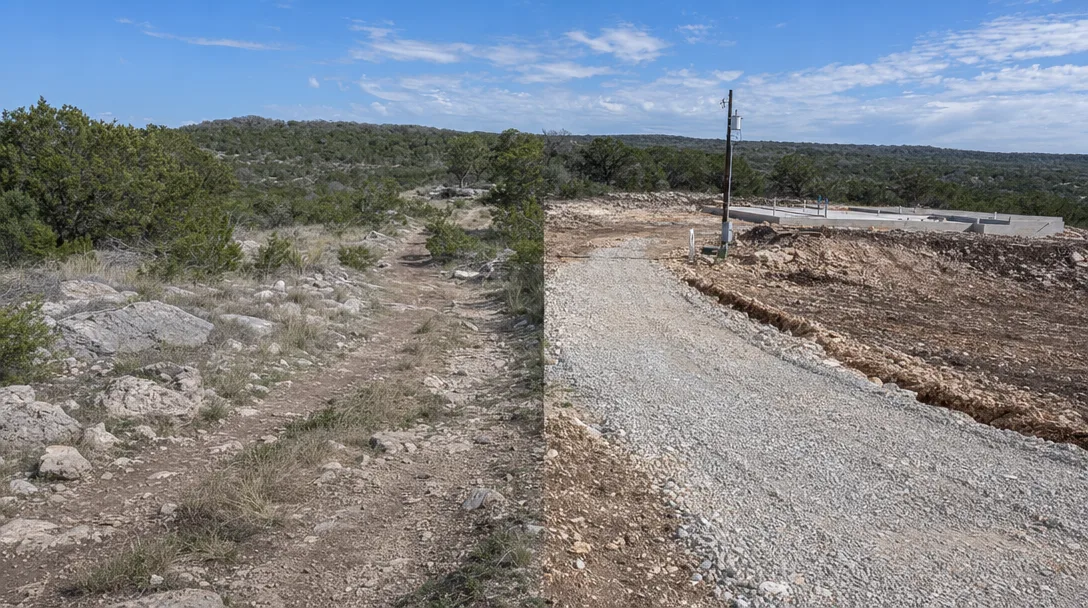
When you search for Hill Country acreage online, the first number that catches your eye is the price per acre. A 10-acre parcel listed at $150,000 works out to $15,000 per acre. That sounds reasonable compared to California land prices, and for a buyer looking to build their dream home in the Texas Hill Country, it can feel like a deal. But here is what I have learned from working with buyers over the years: the price per acre is one of the least informative numbers on the listing sheet. What matters is whether the land is raw or improved, and what it will cost to turn that dirt into a homesite.
What "improved land" actually means in the Hill Country
In real estate terms, "improved" does not necessarily mean a house sits on the property. It means the land has been prepared for development with the essential infrastructure that makes building possible. In the Hill Country, an improved lot typically includes:
Utility access: Electric service run to the property line or to a designated building site. Natural gas, if available in the area, is connected or available for connection. Internet and phone service are established or at least available for installation within a reasonable timeframe [1].
Water supply: Either a drilled well with a documented flow rate, a well permit in place, or connection to a municipal water supply such as Boerne city water or a water supply corporation like Bexar Met Water District or Kendall County Water Supply Corporation [2][3].
Wastewater solution: A septic system permit approved by the county, or connection to a municipal sewer system where available. The permit confirms that the soil can support a conventional or aerobic septic system and specifies the system type required [4].
Access: A legally recorded easement or dedicated road providing ingress and egress, typically with a gravel or caliche driveway already installed from the public road to the building site [5].
Clearing and grading: At minimum, the building envelope has been cleared of brush, trees, and rocks, and the pad area has been graded for construction [1].
A raw land parcel, by contrast, has none of these. It is exactly what the name implies, unimproved, unserviced, and essentially unusable as a homesite until significant work is done.
Raw Land vs. Improved Land: Key Differences
| Feature | Raw Land | Improved Land |
|---|---|---|
| Electricity | Not at site; may need to run from nearest pole | At property line or building pad |
| Water | No well drilled, no municipal connection | Well drilled with GPM test, or municipal hookup |
| Septic | No permit; soil test required | Permit issued, system designed or installed |
| Driveway | None; needs to be built from road | Gravel or caliche driveway installed |
| Clearing | None; brush, trees, rock in place | Building envelope cleared and graded |
| Financing | Land loan or cash only; higher rates | Construction or conventional mortgage possible |
Source: Texas Real Estate Research Center, lender guidelines for raw land vs. improved land financing [1][5].
The real cost of improving raw land: a Hill Country breakdown
This is the section that matters most for buyers, and it is the section most listing agents gloss over. The advertised price per acre does not include what it costs to make the land buildable. Here is a realistic estimate for improving a raw 10-acre parcel in Kendall County or northern Bexar County, based on current contractor pricing and permit fees.
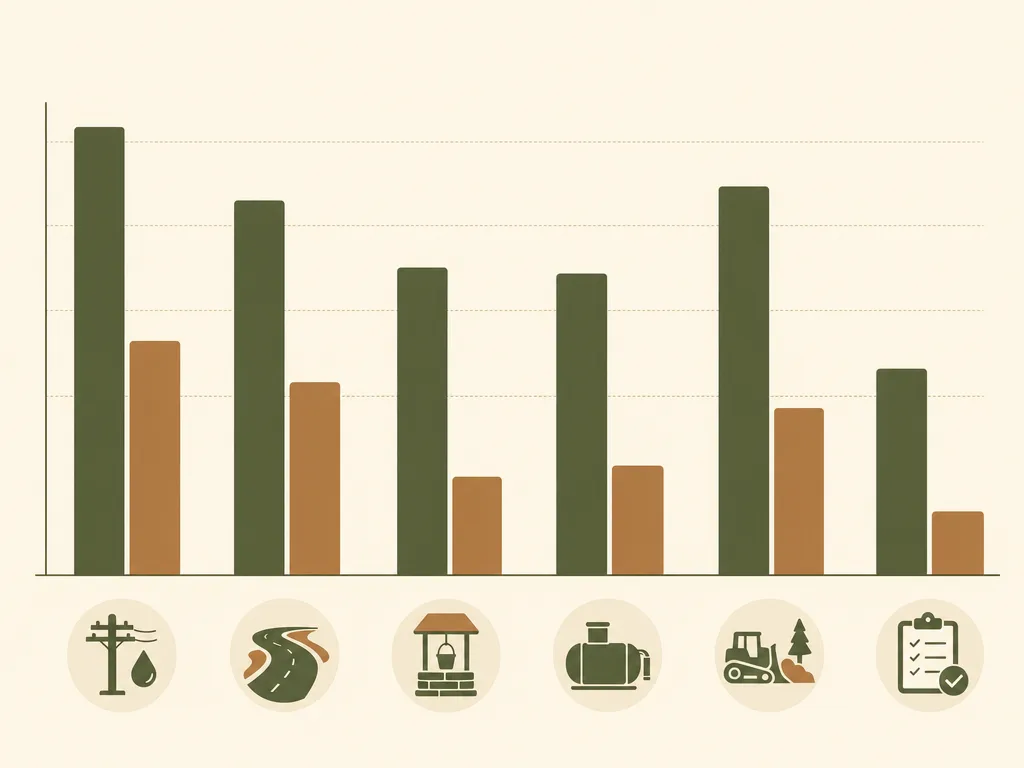
Well drilling: $12,000 to $25,000. Drilling costs in the Hill Country range from $35 to $55 per foot, and residential wells typically need to reach 300 to 800 feet. That is an $18,000 well before you add the pump ($1,500 to $3,500), pressure tank ($400 to $900), and electrical connections ($1,500 to $3,000). A full well installation, drilled, cased, capped, and equipped, runs $20,000 to $35,000 in most Hill Country scenarios [2][3]. And there is no guarantee the first hole finds water, dry holes are a real risk.
Septic system: $8,000 to $20,000. Conventional septic systems in Kendall County start around $8,000 for a standard gravity system on good percolation rates. Aerobic systems, which are required in many Hill Country areas with poor soil or shallow limestone, run $12,000 to $20,000. The permit through the Kendall County Environmental Health Department adds $250 to $500, and the soil percolation test adds $500 to $1,000. If the soil fails the perc test, you may be looking at a more expensive engineered system [4].
Electric service connection: $5,000 to $25,000. If a power line is adjacent to the property, connection through Bandera Electric Cooperative or Pedernales Electric Cooperative may run $5,000 to $10,000. If the power source is half a mile away, expect $15,000 to $30,000 depending on transformer and pole requirements. Underground service adds a premium [1][6].
Driveway and access road: $5,000 to $20,000. A standard gravel driveway from the county road to the building site, 500 to 1,000 feet, runs $8,000 to $12,000. If the terrain requires grading, cut-and-fill, or limestone base material (caliche is the standard in the Hill Country), the cost climbs. A caliche driveway is more durable than gravel but runs $4 to $8 per square yard installed [5].
Land clearing and grading: $3,000 to $15,000. Clearing the building envelope, removing brush, trees, and surface rock, and grading the building pad runs $3,000 to $8,000 for a standard homesite. Heavy brush, dense cedar or juniper, or extensive rock removal pushes it higher. Dozer and excavator rates run $150 to $250 per hour in the Hill Country [1].
Permits and fees: $2,000 to $5,000. Kendall County building permit fees, septic permits, well permits, driveway permits, and impact fees add up. This does not include the cost of a land survey ($1,500 to $3,500) or an environmental assessment if required [5].
Estimated Cost to Improve Raw Land in the Hill Country
| Improvement | Low Estimate | High Estimate | Key Variables |
|---|---|---|---|
| Well drilling & pump | $20,000 | $35,000 | Depth to water, rock hardness, pump size |
| Septic system | $8,000 | $20,000 | Soil perc rate, aerobic vs. conventional |
| Electric service | $5,000 | $25,000 | Distance from nearest pole, underground vs. overhead |
| Driveway | $5,000 | $20,000 | Length, terrain, gravel vs. caliche base |
| Clearing & grading | $3,000 | $15,000 | Brush density, rock removal, pad size |
| Permits & survey | $3,500 | $8,500 | County fees, survey complexity |
| Total estimated range | $44,500 | $123,500 | Before the house foundation is poured |
Estimates based on 2025-2026 contractor pricing for Kendall County and northern Bexar County. Actual costs vary by specific property location, terrain, and contractor availability. Always obtain multiple bids before making an offer on raw land [1][2][4][5][6].
I have worked with buyers from California who saw a 10-acre parcel listed at $12,000 per acre and considered it a bargain. After factoring in $80,000 to $120,000 in improvements, the effective cost of their homesite was closer to $200,000 before they poured a single concrete footer for their house. That is not a bad deal for a finished Hill Country homesite, but it is a different number than the advertised price per acre.
The financing gap: why raw land loans are different
This is where many out-of-state buyers get tripped up. A conventional 30-year mortgage requires an insurable dwelling on the property. Raw land does not qualify. If you are buying raw land, you need a land loan, and land loans have fundamentally different terms [7].
Higher down payment: Land loans typically require 25 to 50 percent down. A buyer purchasing a $150,000 raw land parcel needs $37,500 to $75,000 in cash, compared to 3 to 5 percent for a conventional home loan [7].
Higher interest rates: Land loan rates run 2 to 5 percentage points higher than conventional mortgage rates. If a 30-year fixed mortgage is at 6.5 percent, a land loan for the same borrower may be at 8.5 to 11.5 percent [7].
Shorter terms: Most land loans have terms of 5 to 15 years, not 30. This means significantly higher monthly payments for the same borrowed amount [7].
Balloon payments: Some land loans include a balloon payment after 3 to 5 years, requiring the borrower to refinance or pay off the balance in full [7].
Improved land financing: If the land has utility access, a well, septic permit, and a driveway, it may qualify for a construction-to-permanent loan, which allows a single closing for the land purchase and home construction. This is a much cleaner path than buying raw land first and figuring out construction financing later [7].
For a buyer who wants to build in the Hill Country, the most capital-efficient approach is often to find an improved lot that already has utilities, well, and septic in place, and then use a construction loan to build the home. The total capital required upfront is lower because the improvements are rolled into the loan, not paid out of pocket [7].
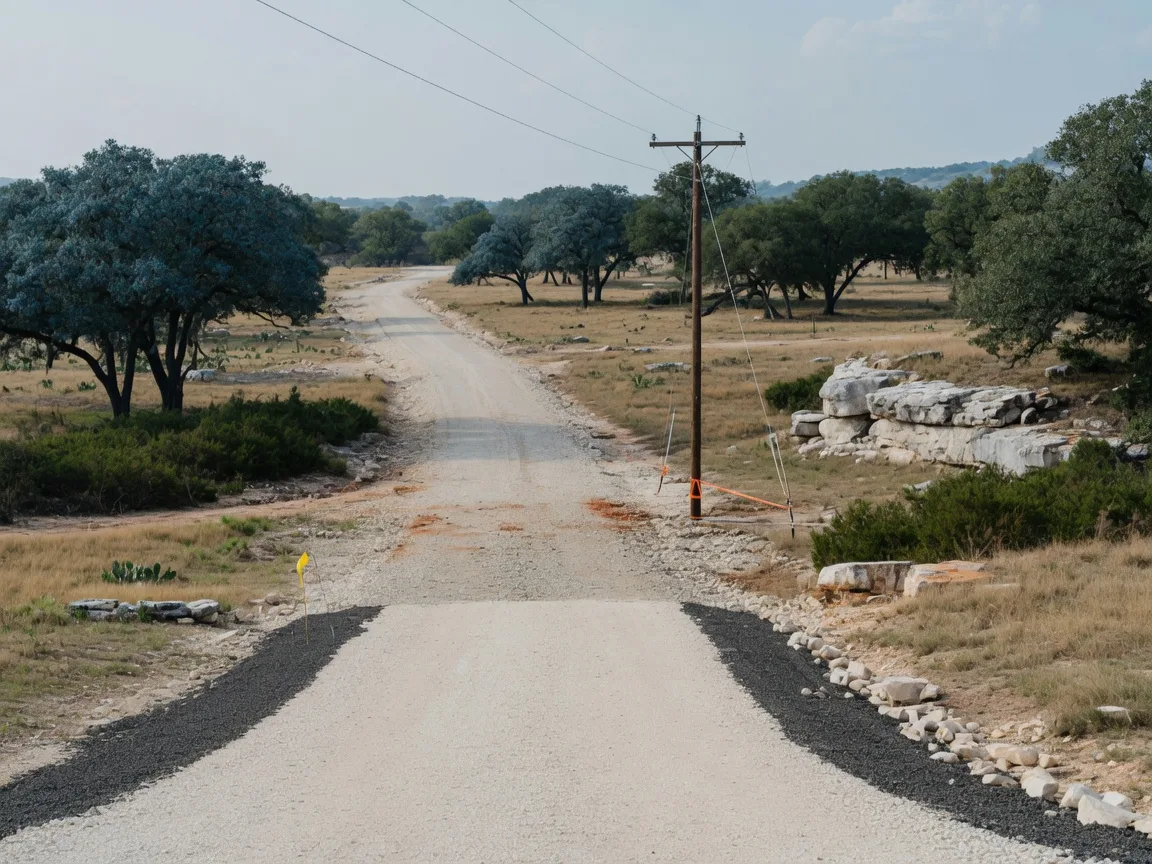
What the price per acre obscures
The price per acre is a useful shorthand for comparing parcels of similar readiness, but it tells you nothing about what the land actually costs to develop. Here are the questions I recommend asking before making any raw land offer.
Where is the nearest power pole, and who is the utility provider? Bandera Electric Cooperative serves most of Kendall County and parts of northern Bexar County. Pedernales Electric serves portions of Comal County and the western Hill Country. The distance from the nearest pole to your proposed building site determines roughly 60 percent of your electric connection cost. Ask the seller for a utility availability letter, or call the co-op yourself [6].
Has a well been drilled on the property? If yes, when was it drilled, what was the flow rate in gallons per minute, and has it been tested during a drought year? If no, check whether neighboring properties have productive wells and at what depth. A well that produces 15 GPM at 400 feet on the neighboring parcel is a good sign. A dry hole on the adjoining property is a warning sign. See our guide to understanding well depths and aquifer levels for more detail [2][3].
Has the septic soil test been done? If the perc test has not been performed, the purchase should be contingent on a satisfactory test. Some Hill Country properties with shallow limestone or heavy clay soils cannot support a standard septic system and require an expensive aerobic or mound system. A perc test costs $500 to $1,000 and can save you $10,000 in surprises [4].
Is there recorded legal access? A property that appears landlocked on the plat map may require a legal easement to reach the public road. If the access crosses another owner's land, the easement needs to be documented and recorded. Texas recognizes prescriptive easements in some cases, but relying on an unrecorded access arrangement is a risk that can block construction financing and complicate resale [5].
What covenants or restrictions are recorded on the deed? Many Hill Country subdivisions have deed restrictions that specify minimum square footage, building materials, roof types, and even whether manufactured homes are allowed. If a deed restriction requires a minimum 3,000-square-foot home and you want to build a 2,000-square-foot weekend cabin, you have a problem. These restrictions are not always apparent on the listing, and they survive all future sales [5].
For more on deed restrictions and what they govern, see our guide to deed restrictions, ETJs, and prohibited uses on Texas acreage.
Considering land in the Hill Country?
I work with buyers evaluating raw and improved land across Boerne, Fair Oaks Ranch, and the surrounding Hill Country. We review well logs, perc test results, utility availability, and recorded deed restrictions before making an offer. No generic advice, just a direct conversation about what a specific property will cost to develop.
Contact Bill Ross | The Real Cost of Owning AcreageA practical framework for evaluating land purchases
After working through land purchases with clients across the Hill Country, I have developed a simple framework that helps buyers evaluate whether a particular parcel is a smart buy or an expensive lesson. It comes down to three variables: readiness, certainty, and total cost of ownership.
Readiness measures how close the land is to being buildable. A parcel with power at the pole, a drilled well producing 15 GPM, an approved septic permit, a caliche driveway, and a cleared building pad is ready. One with none of those is raw, and the difference is $50,000 to $125,000 in improvements [1][2][4][5][6].
Certainty measures how well you understand what it will cost to improve the land. A parcel with a recent well log showing historic drought-year performance provides more certainty than one with no well. A parcel with a perc test provides more certainty than one without. Every unknown variable carries a risk premium, and that premium increases the total effective cost of the property [3][4].
Total cost of ownership combines the purchase price, improvement costs, financing costs, and annual carrying costs (property taxes, insurance, maintenance) into a single number. A raw land parcel listed at $10,000 per acre may have a higher total cost of ownership than an improved parcel listed at $25,000 per acre, because the raw parcel carries $80,000 in improvement costs, higher financing rates, and the risk of cost overruns [1][7].
I have seen buyers overpay for raw land because they only looked at the price per acre and the total acreage. And I have seen buyers pass on improved land because the per-acre price seemed high, not realizing that the improved parcel, with its well, septic, power, and driveway already in place, was actually the cheaper option when measured by total cost to move-in ready.
For a deeper dive into the carrying costs of acreage, including property tax treatments and ag exemptions, read our post on the real cost of owning acreage in the Hill Country.
The specific Hill Country variables that complicate land improvement
The Hill Country is not flat, loamy farmland. It is limestone, caliche, and live oaks over rolling karst topography. These specific geological features add costs that a buyer from California, used to softer soils and more predictable excavation conditions, may not anticipate.
Limestone bedrock: Trenching for utility lines, digging for septic tank installation, and excavating for foundations all require rock excavation in much of the Hill Country. Rock excavation costs $5 to $15 per cubic yard more than standard earth excavation, and in some areas, blasting is required. I have seen buyers budget $5,000 for utility trenching and end up spending $15,000 because a contractor hit a limestone shelf 2 feet below the surface [1][8].
Caliche driveways: Caliche is calcium carbonate-rich rock that compacts into a hard, cement-like surface. It is the standard paving material for Hill Country driveways because it lasts longer than gravel and costs less than asphalt. A caliche driveway runs $4 to $8 per square yard installed, compared to $2 to $4 for standard gravel. For a 1,000-square-foot driveway, the difference is meaningful [5].
Oak wilt and brush management: Live oaks and Spanish oaks cover most Hill Country properties. Oak wilt, a fungal disease that spreads through root systems, is endemic in the Hill Country. If the clearing process damages roots or exposes wounds on oak trees, the disease can destroy the entire tree canopy on the property. Professional oak wilt prevention during construction adds cost. And if the property has heavy cedar or juniper regrowth, brush clearing costs can be significant [1].
Flash flood zones and drainage: Many Hill Country properties have seasonal creeks and drainage channels. FEMA flood maps may not accurately reflect localized flash flooding. Building in a drainage path, even one that is dry 360 days a year, can lead to foundation issues, insurance problems, and lender complications. A drainage study during due diligence costs $1,000 to $3,000 and is worth every dollar [9].
For more on how Hill Country geology affects building costs beyond just the land purchase, see our guide to the hidden cost of caliche and limestone.
Frequently asked questions
What is the difference between raw land and improved land in Texas real estate?
Raw land has no utilities, no water supply, no wastewater system, no road access, and no clearing. Improved land has at least some of these in place, typically electric service at the property line, a drilled well or municipal water connection, an approved septic permit or sewer connection, and a gravel driveway. Improved land qualifies for construction-to-permanent loans; raw land typically requires a separate land loan with higher rates and down payments [1][7].
How much does it cost to improve raw land in the Hill Country?
Based on 2025-2026 contractor pricing in Kendall County and northern Bexar County, improving a raw 10-acre parcel typically costs $44,500 to $123,500. The largest expenses are well drilling ($20,000 to $35,000), electric service ($5,000 to $25,000), and septic system ($8,000 to $20,000). Site-specific factors like distance to power, well depth, soil perc rate, and terrain determine the final cost [1][2][4][5][6].
Can I get a mortgage for raw land?
No. A conventional mortgage requires an insurable dwelling on the property. Raw land with no structure requires a land loan, which typically demands 25 to 50 percent down, carries interest rates 2 to 5 points higher than conventional mortgages, and has terms of 5 to 15 years with possible balloon payments. Improved land with utility access and building permits may qualify for a construction-to-permanent loan, which is a more favorable financing path [7].
What should I verify before buying raw land in the Hill Country?
At minimum, verify: (1) well availability and depth to water in the area, (2) septic soil percolation test results, (3) distance to nearest power pole and electric cooperative availability, (4) recorded legal access through easement or dedicated road, (5) deed restrictions and HOA covenants if any, (6) FEMA flood zone designation, and (7) whether the property lies in the Edwards Aquifer recharge zone, which adds impervious cover restrictions [1][2][5][9].
Is it cheaper to buy improved land or raw land and improve it myself?
That depends on your timeline, capital position, and tolerance for complexity. Improved land is more expensive per acre upfront but has known costs and quicker path to construction. Raw land appears cheaper but carries $50,000 to $125,000 in hidden improvement costs, uncertain variables (well depth, soil perc, utility distance), and higher financing costs. When you add up the total cost of ownership to a move-in ready homesite, a well-improved lot at $30,000 per acre is often cheaper than a raw lot at $10,000 per acre plus $100,000 in improvements and financing premiums [1][7].
How long does it take to improve raw land in the Hill Country?
From contract to ready-to-build, expect 6 to 18 months. Well drilling alone can take 4 to 8 weeks from the time the driller is scheduled. Septic permitting and installation takes 4 to 12 weeks. Electric service connection takes 4 to 12 weeks depending on the cooperative's workload and distance. Clearing and driveway installation takes 2 to 6 weeks. Coordinating these contractors sequentially means most raw land improvements take 8 to 14 months from closing to a buildable homesite [1][6].
What are the property tax implications of owning raw land vs. improved land?
Raw land is taxed based on its market value as unimproved land, which is typically lower than improved land. However, if the raw land qualifies for agricultural or wildlife management use valuation (1-d-1 ag exemption), the taxes are based on productivity value rather than market value, which can dramatically reduce the tax bill. Improved land with a home is taxed as a residence homestead (if the owner lives there) with the standard homestead exemption. For a detailed breakdown, see our guide to ag exemptions and rollback taxes [10].
Sources
- Texas Real Estate Research Center, "Land Development Cost Estimates." Per-acre and per-lot development cost benchmarks for raw land, including clearing, grading, utility extension, and road construction. trerc.tamu.edu
- Texas Water Development Board, "Groundwater Well Costs." Drilling cost per foot, pump installation costs, and well construction standards for private water wells in Texas. twdb.texas.gov
- Edwards Aquifer Authority, "Well Registration and Permitting." Well construction permit requirements, limited production well exemptions, and groundwater withdrawal permitting rules for the Edwards Aquifer region. edwardsaquifer.org
- Kendall County Environmental Health Department, "On-Site Sewage Facility (Septic System) Permitting." Permit fees, soil percolation testing requirements, and system type classifications for residential septic systems in Kendall County. co.kendall.tx.us
- Kendall County Subdivision and Development Guidelines. Driveway permit requirements, access easement standards, road construction specifications, and survey requirements for property development in unincorporated Kendall County. co.kendall.tx.us
- Bandera Electric Cooperative, "New Service Applications and Costs." Electric service connection fees, transformer costs, distance-based pricing, and underground vs. overhead installation rates for residential properties. banderaelectric.com
- Consumer Financial Protection Bureau, "Land Loans vs. Construction Loans." Loan term and rate comparisons between raw land loans, improved land loans, and construction-to-permanent loans. consumerfinance.gov
- Texas Department of Licensing and Regulation, "Rock Excavation Standards." Classification of rock excavation types, typical cost multipliers for limestone vs. earth excavation, and blasting permit requirements. tdlr.texas.gov
- FEMA Flood Map Service Center, "Flood Insurance Rate Maps for Kendall County." FEMA flood zone designations, special flood hazard areas, and base flood elevation data for properties in the Hill Country. msc.fema.gov
- Texas Comptroller, "Agricultural Appraisal (1-d-1) Guidelines." Qualification criteria for ag-use valuation, rollback tax provisions, and wildlife management use alternatives for raw land in Texas. comptroller.texas.gov
Last verified: August 14, 2026
Published: August 14, 2026
Updated August 14, 2026