
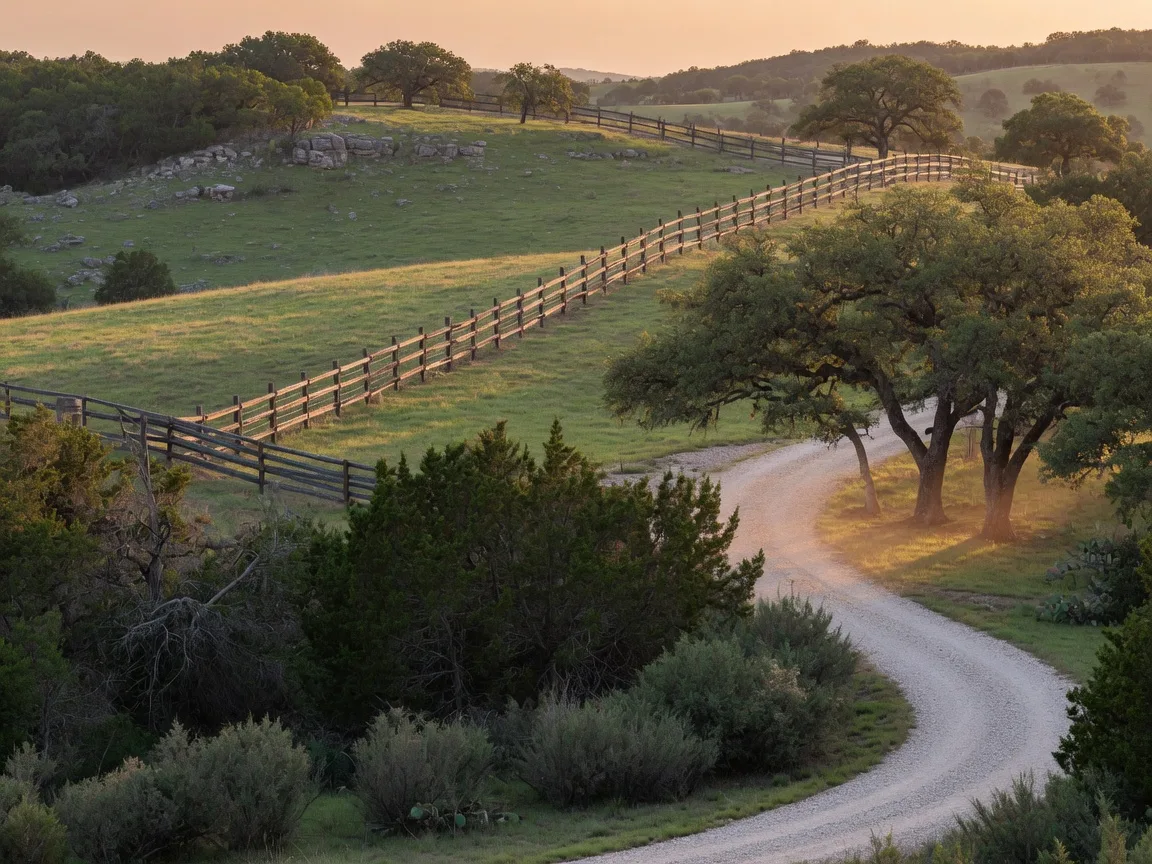
If you are looking at 10, 20, or 50 acres in the Texas Hill Country, the mortgage payment is only part of the picture. The real cost of owning acreage includes property taxes that shift dramatically depending on how the land is classified, fencing that costs more per foot than most California buyers expect, road maintenance that recurs every few years, and brush management that can turn into a six-figure expense if cedar and mesquite are left unchecked for a decade. I have worked with enough buyers who came from suburban subdivisions to know that these costs catch people off guard. Here is what the numbers actually look like.
Property tax: the single biggest variable
The most significant ongoing cost of owning acreage in Texas is property tax, and how much you pay depends entirely on whether your land is classified as agricultural, wildlife-managed, or residential. The difference between these classifications can be thousands of dollars per year on the same piece of property [1].
Texas uses a system called "use-value appraisal" for agricultural and wildlife-managed land. Instead of taxing the land at its market value (what a developer would pay), the county appraises it based on its agricultural productivity value (what a rancher or farmer would earn from it). In Kendall County, an acre of land with a market value of $20,000 to $40,000 may have an agricultural productivity value of $50 to $200 per acre [1]. The difference in tax liability is enormous.
Tax Comparison: 20 Acres in Kendall County
| Land Classification | Taxable Value per Acre | Total Taxable Value | Estimated Annual Tax |
|---|---|---|---|
| Residential (market value) | $25,000 | $500,000 | ~$9,300 |
| Ag-exempt (1-d-1) | $100 | $2,000 | ~$37 |
| Wildlife management | $100 (same as ag) | $2,000 | ~$37 |
| Ag-exempt + Residence Homestead* | $100 (land) + homestead | $2,000 (land) + house | Varies by house value |
*The homesite (typically 1 acre under the house) and the house itself are appraised at market value, minus any applicable homestead exemption. The remaining acreage qualifies for ag-use valuation. Estimates use Kendall County combined rate of ~1.86%.
That difference -- $9,300 per year versus $37 per year -- is why ag-exempt land sells at a premium and why losing the exemption triggers a "rollback tax" that can cost tens of thousands of dollars [1]. If you buy ag-exempt land and do not continue the qualifying agricultural use, the county can recapture up to five years of back taxes at the full market rate, plus interest.
The ag exemption section of our insights library covers the 1-d-1 agricultural appraisal in depth, including what qualifies, how to maintain it, and the rollback tax trap buyers inherit when converting ag land. Understanding this before you buy is critical, because the cost of getting it wrong can be higher than the purchase price of the land itself.
Non-ag land: the tax bill no one warns you about
If the property you buy does not have an active agricultural or wildlife exemption, or if it has a residence with acreage that does not qualify for ag-use valuation, the entire property is taxed at market value. On a 10-acre tract in Kendall County with a $400,000 home, the combined annual tax bill can range from $8,000 to $12,000 depending on the exact location [2].
Many buyers assume that buying acreage means lower taxes. The opposite is often true. A 5-acre lot in a subdivision with a home might carry an effective tax rate similar to a smaller city lot, but with a higher assessed value. A raw 50-acre tract without ag exemption, purchased at market value, produces a property tax bill based on that full market value every year. Without the ag or wildlife exemption, the annual carrying cost of raw land can be prohibitive.
The wildlife management alternative
If you do not want to raise livestock or grow crops, the wildlife management use valuation is the alternative most acreage buyers should understand. Under the Texas Tax Code Section 23.51(7), land that was previously qualified for ag-use valuation can transition to wildlife management use while retaining the same productivity-based tax appraisal [3].
To qualify, you must manage the land for native wild animals -- white-tailed deer, turkey, quail, doves, and other indigenous species -- through at least three of seven approved practices: habitat control, erosion control, predator control, providing supplemental water, providing supplemental food, providing shelter, or making census counts [3]. The minimum acreage requirement is typically 5 acres in Kendall County, though some counties set higher minimums [4].
The wildlife exemption does not require fencing for livestock, barns, or any agricultural infrastructure. What it does require is an active wildlife management plan filed with the county appraisal district. The plan must describe the property, the target species, and the specific practices you will implement. Most county appraisal districts provide templates, and wildlife biologists or Texas Parks and Wildlife biologists can help you draft one [3].
The practical reality: for most acreage owners in the 5-to-100-acre range, the wildlife management option is simpler to maintain than traditional agriculture. You do not need to run cattle, bale hay, or plant crops. But you do need to demonstrate active management each year -- putting out feed or water, conducting surveys, controlling brush -- and keep records. The appraisal district may request documentation of your management activities [4].
Wildlife Management: Approved Practices (Choose at Least Three)
| Practice | What It Involves | Relative Cost |
|---|---|---|
| Habitat control (brush management) | Selective clearing of cedar/brush, prescribed burning | Medium to high |
| Erosion control | Water bars, terraces, reseeding | Low to medium |
| Predator control | Trapping, fencing for ground predators | Low |
| Supplemental water | Wildlife waterers, stock tanks, troughs | Low to medium |
| Supplemental food | Feeders, food plots, mineral blocks | Low |
| Providing shelter | Brush piles, nest boxes, roost structures | Low |
| Census counts | Trail camera surveys, spotlight counts, track surveys | Low |
Source: Texas Parks and Wildlife Department, Wildlife Management Plan Guidelines [3]; Kendall County Appraisal District Wildlife Management FAQ [4]. Cost estimates are approximate and vary by property size and existing conditions.
Fencing: the upfront cost that surprises most buyers
Fencing is the single largest physical improvement cost on Hill Country acreage, and it is almost always more expensive than buyers expect. The limestone and caliche geology that defines the Hill Country makes post-hole digging a heavy equipment operation, not a weekend project. A typical 4-strand barbed-wire fence with steel T-posts runs $4 to $8 per foot installed on relatively flat ground with good soil [5]. On rocky Hill Country terrain, that cost jumps to $8 to $15 per foot. Cedar post fences cost $10 to $20 per foot. Welded-wire or no-climb horse fencing runs $12 to $25 per foot [5].
Fencing Cost Estimates for Hill Country Acreage
| Fence Type | Cost per Linear Foot (Installed) | Cost to Fence 20 Acres (approx.) |
|---|---|---|
| 4-strand barbed wire, T-posts | $4 - $8 (flat) / $8 - $15 (rocky) | $7,000 - $22,000 |
| 4-strand barbed wire, cedar posts | $10 - $20 | $14,000 - $30,000 |
| Welded wire / no-climb horse | $12 - $25 | $18,000 - $38,000 |
| Game fence (8-ft deer fence) | $15 - $20 | $22,000 - $30,000 |
Estimates assume a roughly square 20-acre parcel requiring approximately 1,500 linear feet of perimeter fencing. Actual perimeter depends on property shape, terrain, and existing fencing on adjacent parcels. Sources: Texas A&M AgriLife Extension [5]; local Hill Country fencing contractors (2025-2026 pricing).
If the property is already fenced, the condition of the existing fence matters enormously. Many Hill Country properties have "ranch fence" that was installed 20 or 30 years ago and is rusted, sagging, or broken. A property that needs full replacement fencing adds $10,000 to $40,000 to your upfront costs depending on parcel size and terrain. If you are buying raw land and plan to fence it yourself, budget for equipment rental (post-hole digger, auger, tamping bar) and plan for the caliche layer that will stop a manual digger cold [5].
Road and driveway maintenance
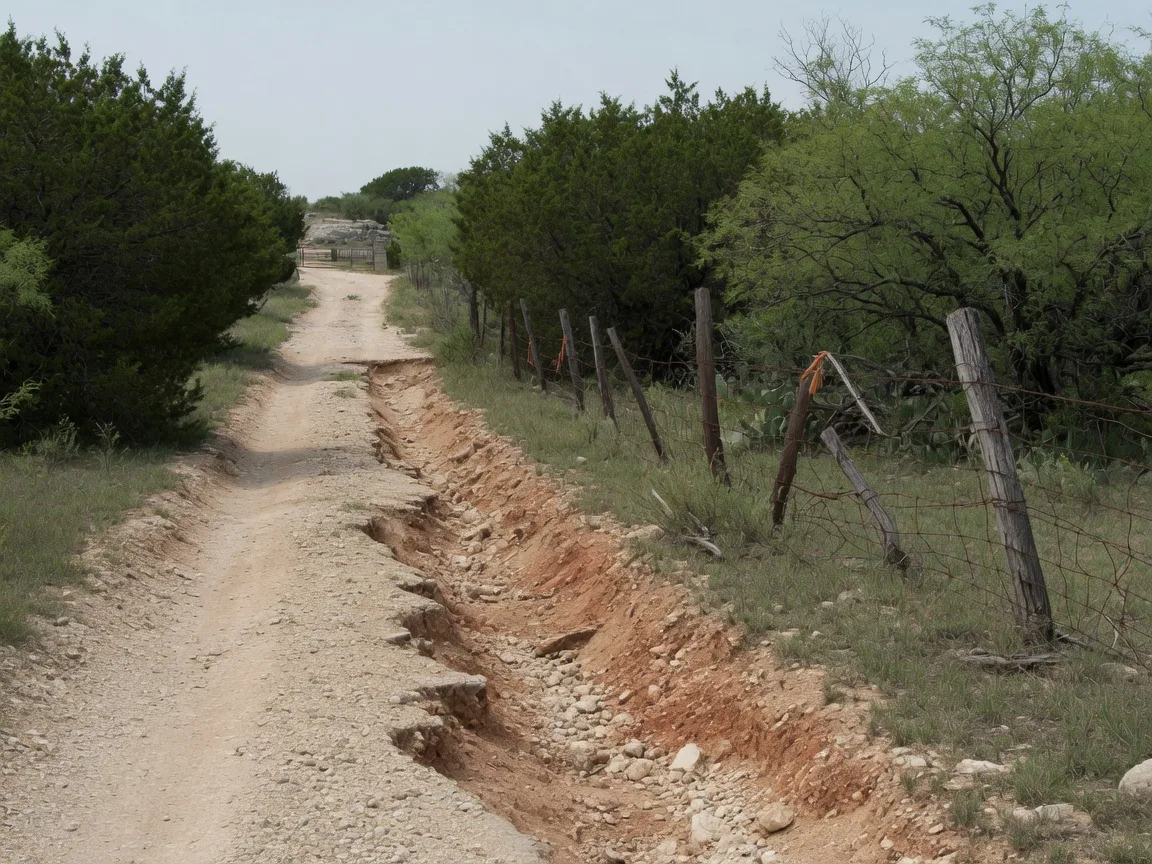
A driveway on Hill Country acreage is not asphalt poured once and forgotten. Most rural properties have gravel or caliche roads that require grading every one to three years, re-graveling every five to ten years, and drainage management after heavy rain events. The limestone and caliche base common in the Hill Country actually provides decent road surface quality when properly compacted, but improper grading or insufficient base depth leads to washboarding, erosion ruts, and impassable sections after storms [6].
Costs vary significantly by driveway length and condition. A standard grading pass on a 500-foot gravel driveway runs $200 to $500 per visit. Re-graveling a 500-foot driveway with 4 to 6 inches of base material costs $2,000 to $5,000. If the driveway requires base repair, culvert installation for drainage, or cut-and-fill work on steep slopes, those costs can run $5,000 to $20,000 [6].
For steep Hill Country properties, the driveway cost is a function of slope and geology. Properties on the edge of the Balcones Escarpment -- areas like the ridges above Comfort or parts of Bandera County -- often require switchback driveways, retaining walls, and significant cut-and-fill grading. A half-mile driveway on a steep property can cost $30,000 to $80,000 to build properly. This is a cost that does not appear on a standard home inspection report, and it is one I flag for every buyer considering a ridge-top or hillside property.
Brush management: an ongoing expense, not a one-time fix
If you are buying acreage in the Hill Country, you are buying brush. Ashe juniper (commonly called cedar), mesquite, prickly pear, and a variety of woody shrubs and invasive species are native to the region and will reclaim any unmanaged land within a few years. The Texas Hill Country has some of the highest brush encroachment rates in the state, and active management is required to maintain pastureland, views, wildfire defensible space, and wildlife habitat [7].
The cost of initial brush clearing -- removing heavy cedar and mesquite from overgrown acreage -- ranges from $250 to $800 per acre depending on density, terrain, and disposal method [7]. Mechanical clearing with a track-mounted mulcher or skid steer is the most common approach. For a 10-acre property with heavy cedar infestation, an initial clearing pass runs $3,000 to $8,000. Follow-up maintenance treatments every three to five years cost $100 to $300 per acre.
Prescribed burning, where local regulations and conditions permit, can be a cost-effective maintenance tool at $50 to $150 per acre, but it requires a burn plan, notification of the Texas A&M Forest Service, and liability insurance [7]. For most acreage owners, mechanical clearing paired with targeted herbicide application (spot spraying for regrowth) is the most practical approach.
Beyond the cost, brush management has a direct impact on property value. Overgrown acreage sells at a 15 to 30 percent discount compared to cleared or managed land of similar size and location. If you are buying raw land with plans to build, budget the clearing cost into your purchase calculation -- it is not optional, and it is not cheap.
Estimated Annual Acreage Maintenance Costs (20 Acres, Hill Country)
| Category | One-Time Cost | Annual / Recurring Cost |
|---|---|---|
| Property tax (ag-exempt) | N/A | ~$37 - $100 (land only) |
| Property tax (non-exempt) | N/A | ~$6,000 - $12,000 |
| Fence installation (new) | $7,000 - $30,000 | $200 - $500 (repairs/year) |
| Gravel road maintenance | $2,000 - $10,000 (initial) | $400 - $1,500 (grading/year) |
| Brush clearing (initial) | $3,000 - $16,000 | $1,000 - $3,000 (maintenance/3-5 yrs) |
| Total (year one, non-exempt) | $12,000+ | $7,500 - $15,000+ |
Costs are estimates based on typical Hill Country conditions. Actual costs vary by property size, location, infrastructure condition, and the specific service providers in the area. Wildlife management plan preparation may add $500 - $2,000 if you hire a consultant.
What California buyers specifically miss
After guiding dozens of California-to-Texas clients through acreage purchases, I can tell you the costs that consistently surprise them. The first is the property tax differential on raw land versus improved land. In California, Proposition 13 keeps property taxes relatively predictable regardless of land use. In Texas, the difference between ag-exempt and non-exempt land is so large that it changes the investment calculus entirely. A 20-acre tract with ag exemption costs roughly $100 per year in land taxes. The same tract without the exemption costs $6,000 to $10,000. That is a $90,000 to $150,000 difference in after-tax carrying cost over a 15-year hold [1][2].
The second surprise is the upfront infrastructure cost. Many California buyers moving from suburban subdivisions assume that acreage comes with a driveway that works, perimeter fencing, and cleared land. In the Hill Country, that is often not the case. A raw 10-acre parcel might need $15,000 to $30,000 in driveway construction, $10,000 to $20,000 in fencing, and $5,000 to $10,000 in brush clearing before it is buildable. Those costs are separate from the well and septic installation covered in our well depth guide and septic overview.
The third surprise is the recurring maintenance burden. Acreage is not a low-maintenance asset. It requires active management of brush, fences, roads, drainage, and wildlife. Even landowners who do not live on the property full-time need a relationship with a local contractor who can check fencing after storms, grade the driveway, and keep cedar from reclaiming the pasture. I recommend budgeting $2,000 to $5,000 per year for ongoing maintenance on properties of 5 to 20 acres, and more for larger tracts.
Building the full cost picture before you buy
Every acreage buyer should walk through a full cost assessment before making an offer. That assessment includes:
Property tax status: Is the land currently ag-exempt or wildlife-managed? When did the exemption transfer last occur? What is the rollback tax exposure if the use changes? Can you qualify to continue the exemption? [1]
Fencing condition and perimeter: Is the existing fence functional? What type and what condition? Does the survey show encroachments or boundary issues that require new fencing? [5]
Access and driveway: Is there an easement for access? What is the condition of the driveway? Does it need grading, re-graveling, drainage work, or complete reconstruction? [6]
Brush density: Walk the property with a local contractor or land manager. How much cedar and mesquite is present? What will initial clearing cost, and what is the ongoing maintenance schedule? [7]
Utility connection costs: Where is the nearest electric pole? What does the electric cooperative charge for new service connection? Does the property have gas, or will you be on propane? These are covered in our infrastructure and lifestyle transition guide.
I run this full cost model with every acreage buyer before we look at properties. It changes the decision-making because it reveals the true cost of ownership -- not just the purchase price and mortgage, but the carrying costs that determine whether a property is a good investment or a financial drain.
Ready to run the numbers on a specific property?
I prepare full cost assessments for every Hill Country acreage property my clients are considering -- including property tax projections, infrastructure improvement costs, and maintenance budgets. No generic estimates, just the actual numbers for the specific parcel.
Contact Bill Ross | More Infrastructure & LandFrequently asked questions
Can I qualify for the wildlife exemption without being a hunter or rancher?
Yes. The wildlife management valuation under Texas Tax Code Section 23.51(7) does not require hunting or the presence of game animals managed for harvest. It requires active management of native wild animals through at least three of seven approved practices. Many landowners qualify through brush management (habitat control), providing supplemental water (installing a wildlife waterer), and conducting annual census counts with trail cameras [3]. You do not need to own livestock, and you do not need to allow hunting on the property.
How much does it cost to clear cedar from a Hill Country property?
Initial mechanical clearing of heavy cedar infestation runs $250 to $800 per acre, depending on tree density, terrain steepness, and whether the contractor mulches on-site or hauls debris away [7]. For a 10-acre property with moderate to heavy cedar, budget $3,000 to $8,000 for an initial clearing pass. Follow-up maintenance treatments every three to five years run $100 to $300 per acre. These costs vary significantly by contractor availability and current diesel prices.
What is the rollback tax, and who pays it?
The rollback tax is the recapture of tax savings when land changes from ag-use valuation to a non-qualifying use. The county appraisal district calculates the difference between the taxes paid under ag valuation and what would have been paid at market value for the previous five years, plus interest [1]. In a sale, the rollback tax liability typically falls on the seller unless the purchase contract specifies otherwise. Buyers should verify the ag exemption status and any pending rollback exposure before closing.
Does a wildlife management exemption transfer to a new owner?
No. The wildlife management plan is specific to the landowner who filed it. When the property sells, the new owner must file their own wildlife management plan with the county appraisal district to continue the exemption [3]. If the new owner does not file a plan within the application window (January 1 to April 30), the land reverts to market-value appraisal for the following tax year. Buyers should plan to file a new plan within 30 days of closing.
Can I put a homestead exemption on acreage with ag/wildlife exemption?
Yes. The homesite (typically the acre under the house plus any reasonable yard area) and the residence itself are appraised at market value. The remaining acreage retains ag or wildlife valuation. You file a homestead exemption (Form 50-114) for the residence and its homesite, and the ag/wildlife exemption continues for the balance of the land [1][3]. The two exemptions coexist on the same property but apply to different portions of the parcel.
How often do I need to re-gravel my driveway?
Most gravel and caliche driveways in the Hill Country need re-graveling every five to ten years, depending on rainfall intensity, usage frequency, and base preparation quality [6]. Annual grading is recommended to maintain the surface and prevent erosion ruts. Driveways on steep slopes or in areas with heavy clay soil may need repairs more frequently. A properly prepared base with 6 to 8 inches of compacted caliche lasts significantly longer than a thin 2-inch gravel topping.
Sources
- Texas Comptroller, Agricultural and Wildlife Use Appraisal. Overview of 1-d-1 agricultural appraisal, productivity valuation methodology, qualification criteria, and rollback tax provisions. comptroller.texas.gov
- Kendall County Appraisal District; Ownwell, Kendall County Property Tax Data. Effective tax rates, median tax bills, and taxable value assessment data for Kendall County. ownwell.com
- Texas Parks and Wildlife Department, Wildlife Management Plan Guidelines. Approved management practices under Tax Code Section 23.51(7), minimum acreage requirements, plan templates, and annual reporting guidelines. tpwd.texas.gov
- Kendall County Appraisal District, Wildlife Management FAQ. Minimum acreage requirements, application procedures, and documentation standards for wildlife management valuation in Kendall County. kendallcad.org
- Texas A&M AgriLife Extension, Fencing Cost Estimates for Texas Landowners. Per-foot cost estimates for barbed wire, welded wire, game fence, and electric fencing on various terrain types in Texas. agrilifeextension.tamu.edu
- Texas A&M AgriLife Extension, Rural Driveway and Road Maintenance. Grading schedules, base material requirements, drainage considerations, and cost estimates for rural gravel and caliche roads in Texas. agrilifeextension.tamu.edu
- Texas A&M Forest Service / Texas A&M AgriLife, Brush Management Cost Guide. Mechanical clearing, prescribed burning, and herbicide treatment cost estimates for Ashe juniper, mesquite, and other brush species common in the Edwards Plateau region. tfsweb.tamu.edu
- Texas Tax Code Section 23.51(7), Wildlife Management Use. Statutory definition of wildlife management use and approved management practices for property tax valuation. statutes.capitol.texas.gov
Last verified: August 3, 2026
Published: August 3, 2026
Updated August 3, 2026