
I sit across from a lot of California families at this exact moment, and the conversation usually starts with a house they have loved for years and a list of reasons it no longer fits. The kids are gone, the stairs are getting harder, the yard is more work than joy, and a good share of the square footage sits empty most of the year. Strategic downsizing is that move done with your eyes open: you understand the tax and financial rules before you list, you time the California sale and the Texas purchase on purpose, and you pick a Hill Country property that fits the life you actually want rather than the one the market expects [1]. This guide walks through the money, the timing, and the emotional side, so moving down in size feels like a gain instead of a loss.
Let me be direct about what this post is and is not. It is not a pitch to sell your California home. It is the framework I use with downsizing clients: how the federal capital gains exclusion works, how California's property tax rules interact with it, what Texas adds on the other side, and how to choose the right-sized property without feeling like you gave something up. Where numbers matter, I cite the source so you can check me [1][3][5].
Separate the financial decision from the emotional one
The biggest mistake I see in downsizing is making both decisions at once and letting one contaminate the other. The financial question is a math problem: how much gain do you have, how much is excluded, what do you owe, and what your ongoing costs look like in Texas. The emotional question is about memory, identity, and family. Both are real, but they need different conversations, and they should never be resolved in the same sentence [1][2].
That separation is the most practical first step. Settle the money first, with a CPA or tax professional who understands both states, then let the emotional work happen separately, with your family and the memories. When you try to do both in one conversation, the math loses, and you keep the bigger house out of guilt rather than out of strategy [1].
The federal capital gains exclusion: the number that decides timing
Under Internal Revenue Code Section 121, when you sell your main home you can exclude a large share of the gain from income: up to $250,000 for a single filer and up to $500,000 for a married couple filing jointly [1]. The gain is the sale price minus your adjusted basis, which is roughly what you paid plus qualifying improvements and minus any depreciation you claimed. For a long-time owner who bought years ago, that exclusion covers a very large portion of the profit, and the IRS explains the full rule in Publication 523 [1].
To qualify for the full exclusion you must have owned the home and used it as your main home for at least two of the five years ending on the sale date, and you cannot have claimed the exclusion on another home within the two years before the sale [1][2]. Most downsizers who have lived in one house for a decade or more meet this easily. The practical point is timing: because the two-of-five window is measured on the sale date, you generally want to sell while the house still counts as your main home, before you have been living in Texas for a long stretch [1].
If you do not meet the two-of-five test, you may still qualify for a partial exclusion when the sale is driven by a change in workplace, a health issue, or an unforeseen circumstance, with the exclusion prorated by the months you owned and used the home [2]. For the typical downsizer the full exclusion is the working assumption, so the planning question becomes how much of your gain sits above that number [1][2].
California's side: what Prop 19 does and does not change
California taxes the gain above the federal exclusion as state income tax at rates up to roughly 13.3 percent, so the part of your profit that exceeds the exclusion is not free [4]. Because California conforms to Section 121, the same $250,000 or $500,000 that is excluded federally is also excluded for California purposes, and only the gain above that line is potentially taxable as capital gain in both [4].
Separately, California Proposition 19 lets homeowners 55 and older transfer the property tax base of their primary residence to a replacement home anywhere in California, usable up to three times, with the base moving in full when the replacement is of equal or lesser value [3]. That rule helps owners who are downsizing but staying in California. If you are moving to Texas, Prop 19 is not your lever, because Texas runs its own property tax system, and you will become a new Texas taxpayer rather than a transferred California one [3][5].
Texas on the other side: no state income tax and a property tax system you should understand
The financial case for many downsizers rests on Texas having no state income tax, so the gain above your federal exclusion is not taxed again by Texas the way it would be in California [5]. But Texas funds itself through property taxes, and you should not move to escape one tax only to be surprised by the other. In Boerne, the combined property tax rate across the city, county, school district, and groundwater district is roughly 1.86 percent of assessed value for a home inside city limits, with Boerne ISD the largest share [5].
Two Texas rules soften that picture. First, a general homestead exemption of $140,000 is subtracted from the appraised value for school district taxes, up from $100,000, effective for the 2026 tax year [6][7]. Second, under Tax Code Section 23.23, the taxable value of a homestead cannot rise more than 10 percent per year, so the bill on the home you keep in Texas grows slowly rather than spiking [6]. The trade-off with California is real but different: you give up state income tax, and you take on a property tax bill that starts at a market-value basis [5][6].
| Consideration | California | Texas Hill Country |
|---|---|---|
| State income tax on the gain above the federal exclusion | Taxed as capital gain, rates up to roughly 13.3 percent [4] | No state income tax, so no Texas tax on that gain [5] |
| Property tax base for downsizers | Prop 19 can transfer the base within California for owners 55+ [3] | New owner starts at market value; $140,000 homestead exemption and 10% cap apply [6][7] |
| Combined property tax rate in Boerne | Depends on county and city; often lower but varied [3] | Roughly 1.86 percent combined for a home inside Boerne city limits [5] |
The two states tax differently more than they tax more or less. Run your own scenario with a CPA before you commit to either side.
A worked scenario: how the numbers actually land
Here is a realistic example I walk through with downsizing clients. A married couple bought a California home years ago with an adjusted basis of $300,000 and now sells it for $800,000, a gain of $500,000. Under Section 121 the full $500,000 is excluded because they are married filing jointly, so no federal or California income tax is owed on the sale [1][4].
Now assume they buy a downsized home in the Hill Country for $650,000 and live in it as their homestead. Under the 2026 rules, $140,000 is exempt from school district taxes, and the taxable value cannot rise more than 10 percent per year [6][7]. At a combined Boerne rate near 1.86 percent, their annual property tax would run roughly $12,000 before exemptions, and the exemption and cap work to keep that from climbing quickly [5][6]. In exchange, they stop paying California state income tax on their retirement income and investment gains for the rest of their lives [5].
The exact numbers depend on your basis, your sale price, your purchase price, and the specific taxing entities where you land. That is why I never promise a single number, only the structure. For the full comparison beyond a single home, see the site's California vs. Texas property tax reality check and the ad valorem tax shock guide, which covers why the tax bill on a newly purchased Texas home can jump in year two [6][7].
Right-sizing in the Hill Country, not just shrinking
Downsizing fails when the goal is only fewer square feet. The better frame is right-sizing: match the home to the life you actually lead. That usually means single-story living, a smaller lot or lock-and-leave maintenance, and proximity to the amenities and medical care that matter as you age [8][9].
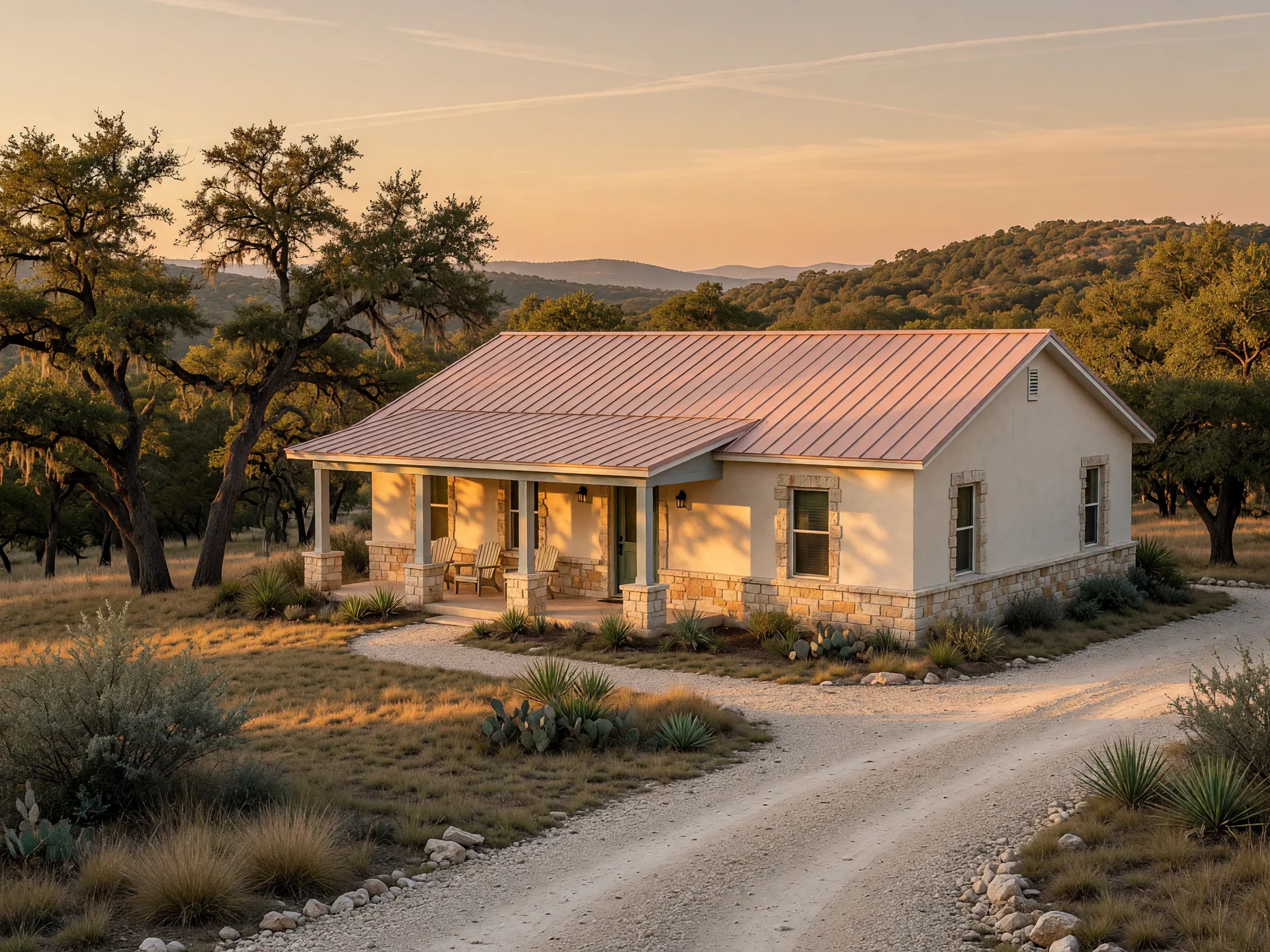
Boerne and Kendall County have real options for this. Esperanza is a large master-planned community that includes Regency at Esperanza, a 55-plus active-adult section by Toll Brothers with resort-style amenities and single-story plans [8]. Balcones Creek Gardens, just off I-10 outside Boerne, is a gated lock-and-leave community of single-story garden homes marketed to active retirees who want minimal upkeep [9]. Older neighborhoods in Boerne and Fair Oaks Ranch also hold single-story homes on manageable lots that never advertise as 55-plus but work beautifully for downsizers [9].
The trade-off to watch is the one every downsizer faces in reverse: a smaller house can still sit on a big lot, and in the Hill Country a big lot often means well water, septic, and real upkeep. If maintenance is the reason you are moving, pair the smaller home with a lot you can actually manage. The site's neighborhood fit framework walks through lot size, HOA appetite, and commute tolerance together, and the HOA vs. no HOA guide explains what deed restrictions govern in an un-HOA'd neighborhood [9].
How to avoid feeling like you gave something up
The honest answer is that you cannot downsize without giving up square footage, so the goal is to give up the parts you no longer use and keep the parts that matter. I ask every downsizing client the same three questions before we look at a single property. What do you actually use in your home every week? What would hurt to lose? And what have you been meaning to do but never had time for because the house consumed it? The answers usually point at a smaller home with a better kitchen for gathering, a yard you can enjoy rather than maintain, and a community where the social life happens outside the front door [8][9].
The families who land this well tend to treat the move as a beginning rather than an ending. They sell on the tax-smart timeline, right-size to a home and lot they can keep, and reinvest the freed-up cash into travel, family, and the things a big house quietly absorbed for years. That is the version of downsizing worth doing, and it is the one I help clients structure [1][8].
Frequently asked questions
How much capital gains can I exclude when I sell my California home?
Under IRS Section 121 you can exclude up to $250,000 of gain as a single filer and up to $500,000 as a married couple filing jointly, provided you owned and used the home as your main home for two of the five years before the sale and have not used the exclusion on another home in the prior two years [1][2].
Do I owe California tax on the sale if I move to Texas?
California conforms to Section 121, so the same excluded amount is also excluded for California purposes. Only the gain above your exclusion is potentially taxable as capital gain by California, at rates up to roughly 13.3 percent [4]. Texas has no state income tax, so it does not add its own tax on that gain [5].
Does Proposition 19 help me if I am moving to Texas?
No. Prop 19 transfers a California property tax base to a replacement home within California for owners 55 and older [3]. Once you move to Texas, Texas determines your property taxes on the new home, so the California base does not follow you.
Will my Texas property taxes be higher than what I pay now?
Possibly, because Texas taxes are based on market value and the rate is meaningful. In Boerne the combined rate is roughly 1.86 percent, with a $140,000 homestead exemption from school district taxes and a 10 percent annual cap on a homestead's taxable value [5][6][7]. The offset is that Texas has no state income tax [5]. Model your own numbers rather than assume one side wins.
What should I look for in a downsized Hill Country home?
Prioritize single-story living, a lot you can maintain (which may mean skipping well-and-septic acreage), and proximity to what you use. Age-targeted options like Regency at Esperanza and lock-and-leave communities like Balcones Creek Gardens exist specifically for this, and older single-story homes in Boerne and Fair Oaks Ranch work well too [8][9].
The bottom line
Strategic downsizing is a financial plan and an emotional transition handled on separate tracks. Understand the federal capital gains exclusion and time the sale to protect it, understand what California and Texas each do to the transaction, and then choose a Hill Country property that fits the life you actually want. Done that way, the move down in size is a gain, not a loss, and it is the kind of transition I help clients structure every week [1][5][8].
Sources
- IRS Publication 523, Selling Your Home. The Section 121 main-home exclusion: $250,000 single and $500,000 married, the two-of-five-year ownership and use test, and how to compute gain and basis. irs.gov/publications/p523
- IRS FAQ: Capital gains, losses, and sale of home. The partial (reduced) exclusion for sales driven by a change in workplace, health, or an unforeseen circumstance, prorated by months of ownership and use. irs.gov
- California Board of Equalization, Proposition 19 fact sheet. How homeowners 55 and older can transfer the property tax base of a primary residence to a replacement home anywhere in California, up to three times, with full transfer on an equal-or-lesser-value replacement. boe.ca.gov
- California Franchise Tax Board, Income from the sale of your home. California's conformity to Section 121 and the treatment of gain above the exclusion as capital gain. ftb.ca.gov
- City of Boerne, Current Tax Rates. The combined property tax rate for a home inside Boerne city limits, roughly 1.86 percent, with Boerne ISD the largest share. ci.boerne.tx.us
- Texas Property Tax Code, Section 23.23 and homestead exemptions. The 10 percent annual cap on a homestead's taxable value and the general homestead exemption framework. comptroller.texas.gov
- Texas Proposition 13 and SB 4 explainer. The 2026 increase in the general school district homestead exemption from $100,000 to $140,000, approved by voters in November 2025. texaspvp.com
- Toll Brothers, Regency at Esperanza. The 55-plus active-adult section within the Esperanza master-planned community in Boerne, with resort amenities and single-story plans. tollbrothers.com
- Sitterle Homes, Balcones Creek Gardens. A gated lock-and-leave community of single-story garden homes near I-10 outside Boerne, marketed to active retirees and downsizers. sitterlehomes.com
This article is general education, not tax, legal, or financial advice. Exclusion amounts, tax rates, and property tax rules change, and your basis, sale price, and chosen property will change the outcome. Confirm the current rules and run your own numbers with a CPA or tax professional before you list a home or commit to a purchase.
Last verified: September 16, 2026
Published: September 16, 2026
Updated September 16, 2026