

If you are buying or selling a home in the Texas Hill Country, closing costs are real, itemized expenses that show up at the settlement table, and they differ from what many buyers expect from other states. In Texas, buyers typically pay between 2% and 5% of the purchase price in closing costs, and sellers pay roughly 6% to 10% once agent commissions are included. Texas has no state or local real estate transfer tax, which keeps one entire category of fees off the table, but title, escrow, recording, and proration line items still add up. This guide breaks down who pays what at a Boerne, Fair Oaks Ranch, or San Antonio closing.
The figures matter most to people moving across state lines, because the line items they are used to (a mortgage tax, a transfer tax, a city deed tax) often do not exist here, while others they rarely see at home (prorated property taxes, an owner's title policy paid by the seller) carry real weight. Understanding the structure in advance is what keeps a settlement from producing surprises at the table.
Texas has no transfer tax, so the line items are different
Many buyers moving from states with a real estate transfer tax expect to see a similar charge in Texas. They will not. Texas has no state or local real estate transfer tax, so no transfer tax appears on the settlement statement. In its place, the county charges recording fees, typically a few hundred dollars, when the deed (and the lender's deed of trust, for financed purchases) is filed with the county clerk after closing. This is a small, predictable charge, and the contract generally specifies whether the buyer or seller pays it [1][7].
That absence of a transfer tax is one reason Texas closings can feel cleaner than in states like New York or Maryland, but it is not the whole story. The large line items in a Texas closing are title insurance, escrow and settlement fees, lender charges, prepaids, and prorated property taxes, and those are where the real money sits.
What buyers pay at a Texas closing
For a financed buyer, total closing costs typically run 2% to 5% of the purchase price. A cash buyer usually pays less, roughly 1% to 3%, because the lender-related charges drop away. The largest buyer line items are lender fees, the lender's title policy, and prepaids for property taxes and homeowners insurance [1][2].
Lender fees cover the cost of originating the loan: origination and underwriting charges, a credit report, and processing. An appraisal, ordered to confirm the home's value for the lender, is also a buyer cost. Then the buyer pays the lender's title insurance policy, which protects the lender against title defects and is priced on a schedule regulated by the Texas Department of Insurance. Finally, the buyer prepays a share of the annual property taxes and the first year of homeowners insurance into an escrow account [1][5][6].
Typical Buyer Closing Costs in Texas
| Line Item | Typical Range | Who Pays |
|---|---|---|
| Lender origination & underwriting | $1,000 - $3,500+ | Buyer |
| Appraisal | $400 - $750 | Buyer |
| Lender's title policy | Roughly $1,000 - $1,500 | Buyer |
| Settlement / escrow fee (share) | $200 - $450 | Often split |
| Prepaid property taxes (escrow) | Varies by closing date | Buyer |
| First-year homeowners insurance | $2,000 - $4,500 | Buyer |
| Recording fees | A few hundred dollars | Per contract |
Ranges are planning estimates, not fixed prices. Actual amounts depend on the loan program, the lender, the purchase price, and the escrow requirements at closing [1][2][5][6].
What sellers pay at a Texas closing
Sellers routinely pay the larger total at closing, typically 6% to 10% of the sale price, because the listing commission is the single biggest line item. In the Hill Country, the combined commission for the listing agent and the buyer's agent usually runs 5% to 6% of the sale price. Beyond commission, the seller customarily pays the owner's title policy, a share of the title and settlement fees, and prorated property taxes credited to the buyer [1][2][4].
Texas also stands out for a distinctive custom around title insurance: by local convention, the seller pays the buyer's owner's title policy while the buyer pays the lender's title policy. This is a custom rather than a statewide legal mandate, and it is negotiable, but it is what standard Texas contracts assume most of the time, so sellers should budget for the owner's policy when they estimate net proceeds [3].
Typical Seller Closing Costs in Texas
| Line Item | Typical Range | Who Pays |
|---|---|---|
| Agent commission (both sides) | 5% - 6% of price | Seller |
| Owner's title policy | ~$1,500 - $3,500 | Seller (custom) |
| Settlement / escrow fee (share) | $400 - $800 | Often split |
| Property tax proration (credit to buyer) | Varies by closing date | Seller |
| HOA dues proration / transfer fee | Varies | Per contract |
| Recording fees | A few hundred dollars | Per contract |
Ranges are planning estimates. Commission is negotiated between the seller and the listing brokerage; the owner's title policy premium follows the Texas Department of Insurance rate schedule [1][2][3][4].
Title insurance in Texas: two policies, two payers
Title insurance is a core part of every Texas closing, and a purchase produces two separate policies. The owner's policy protects the buyer against title defects, liens, and claims that predate the purchase, and it stays in force for as long as the buyer owns the property. The lender's policy protects the lender's interest and is required on any financed purchase [3].
By long-standing local custom, the seller pays the owner's title policy and the buyer pays the lender's policy. That split is a default assumption in standard Texas contracts rather than a legal requirement, and the parties can negotiate otherwise. Title insurance rates in Texas are regulated by the Texas Department of Insurance, and basic premium rates were reduced by 6.2% effective March 1, 2026. On a median-priced Hill Country home, an owner's policy typically runs roughly $1,500 to $3,500, about 0.5% to 0.6% of the purchase price [3][5].
Because the premium follows a regulated schedule, the price of the policy is consistent across approved title companies in Texas. That means shopping between title companies will not change the regulated premium itself. What is still negotiated is which party pays each policy, and that allocation is spelled out in the contract [3][5].
Prorated property taxes and HOA dues
One of the most confusing items on a Texas settlement statement is the proration of property taxes. Texas property taxes are paid in arrears, so at closing the parties split the current year's liability by the day. The seller credits the buyer for the portion of the year before the sale date, so the buyer covers only the days after closing. If a home closes in July, the seller credits roughly half the annual tax bill, and the buyer's cash-to-close reflects that credit rather than a full-year charge [1][6].
Homeowners association dues and special assessments are prorated the same way. HOA dues are split through the closing date so each party pays only for the period they own the home. Special assessments levied before closing are typically governed by the contract, while assessments that arise after closing generally fall to the buyer [7].
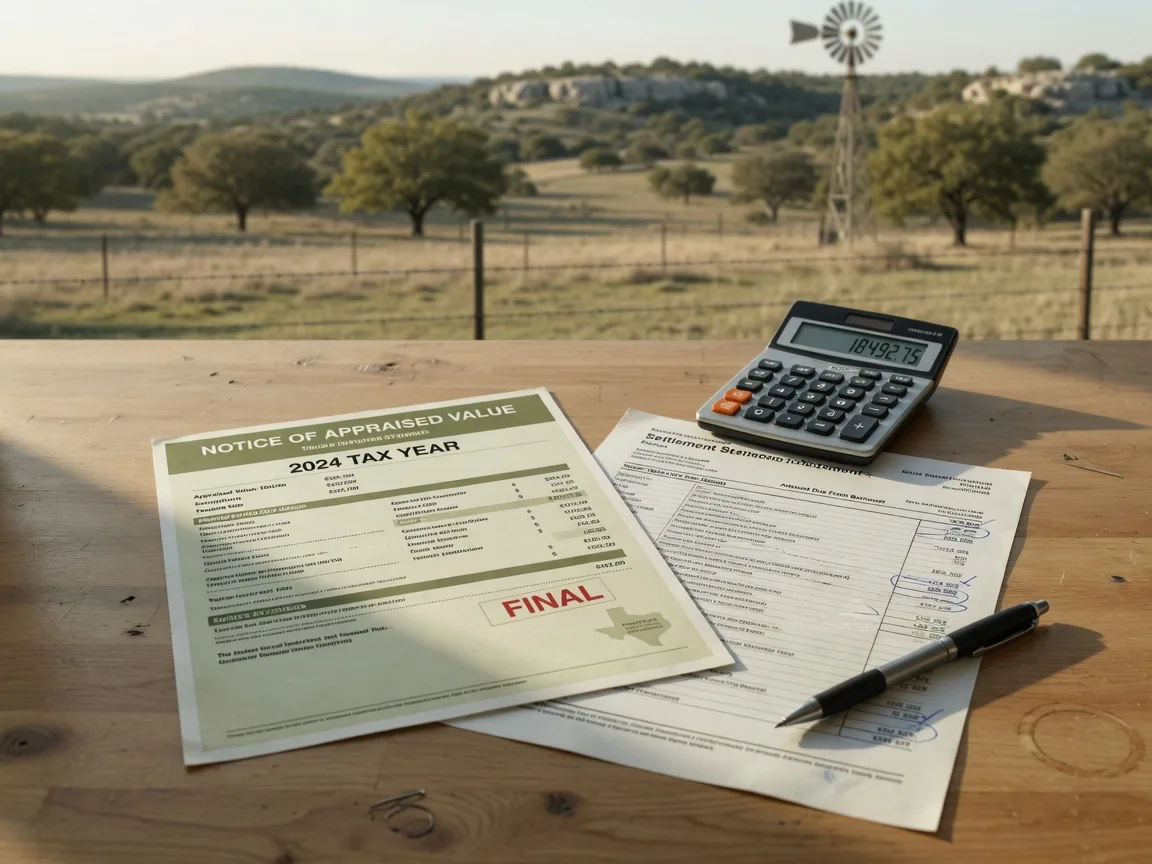
Prorated property taxes are one of the largest credits that move between buyer and seller at the closing table.
The two separate payments buyers often confuse: the option fee and earnest money
Two payments in a Texas transaction are frequently mistaken for closing costs because they happen as part of the same deal. The option fee and earnest money are separate, and they work very differently [8].
The option fee is typically $100 to $500 and is paid within a few days of the contract becoming effective, usually to the title company. It buys the buyer the unrestricted right to terminate the contract for any reason during the negotiated option period, commonly five to ten days. That fee is effectively non-refundable and is paid to the seller even if the buyer walks away [8][9].
Earnest money is a good-faith deposit, usually 1% to 3% of the purchase price, held in escrow by the title company and credited to the buyer at closing toward the down payment and closing costs. If the buyer terminates within the option period, the earnest money is refundable. If the buyer backs out for a reason the contract does not allow, the seller may be entitled to keep it through a negotiated release or the contract's dispute process [8][9].
Neither the option fee nor the earnest money is a settlement-statement closing cost, but both are cash the buyer must have available at specific points in the transaction. They are also two reasons an out-of-state buyer benefits from funds being ready well ahead of the closing date, and why our guide to the Texas option period walks through the timing in detail.
Protecting your wire at closing
Wire transfer fraud is the most serious financial risk in a modern Texas closing, and it does not discriminate by location. Wire fraud losses tied to business email compromise in real estate totaled roughly $446 million in 2023 and $2.7 billion across the United States in 2024, and industry estimates commonly attribute 35% to 50% of all wire fraud to real estate transactions [10][11][12]. Once a wire is sent it is very difficult to recover, and only a small share of incidents are ever reported.
The pattern is consistent. A buyer receives an email that appears to come from the title company or closing agent with "updated" wiring instructions and a sense of urgency, usually with a slightly altered email address. The professional practices that stop it are straightforward [12][13].
- Verify wire instructions by phone. Call the title company or closing attorney using a number from its official website, never a number typed into the email
- Be suspicious of last-minute changes. Instructions that change shortly before closing, especially before a weekend or holiday, deserve extra scrutiny
- Read the sender address closely. Fraudsters rely on an email address that looks almost identical to the legitimate one
- Send wires through secure bank channels and keep records of every request
- Report suspected fraud immediately. Stop all communication, notify the title company, and contact the bank without delay [12][13]

Legitimate title companies rarely change wiring instructions by email close to closing, so a phone-verified number is the buyer's best defense.
What the totals look like for a Hill Country home
Putting the ranges together makes the cash picture concrete. On a $500,000 financed purchase, buyer closing costs of 2% to 5% equate to roughly $10,000 to $25,000 on top of the down payment, made up of lender charges, the lender's title policy, and prepaids. A cash buyer on the same purchase typically pays about $5,000 to $15,000 because the lender line items disappear [1][2].
On the seller's side, a $500,000 sale typically produces 6% to 10% in total costs: $25,000 to $30,000 in commission, an owner's title policy of $1,500 to $3,500, a settlement fee, a property tax proration credit that grows as the closing date moves later in the year, and recording fees. Those figures are planning estimates, not fixed prices, and the final dollar amounts are set by the contract, the closing date, and the specific taxing entities [1][2][4].
Because the parties can negotiate how several fees are allocated, and a seller can grant a credit to cover a portion of the buyer's costs, the same purchase can close with noticeably different totals on each side depending on the offer terms. Reviewing the Closing Disclosure, which Texas lenders must deliver three business days before closing, line by line is the single most reliable way to catch an error before the money moves [6].
For more on how property taxes and exemptions shape a Hill Country purchase, see our Boerne property tax guide, and for lender-related questions start with our mortgage and financing resources.
Frequently asked questions
How much are closing costs for a home buyer in Texas?
Buyers typically pay 2% to 5% of the purchase price in closing costs on a financed purchase, and 1% to 3% on a cash purchase. The main items are lender fees, an appraisal, the lender's title policy, settlement fees, and prepaid property taxes and insurance [1][2].
Do sellers pay closing costs in Texas?
Yes, and sellers usually pay the larger total because the agent commission, typically 5% to 6%, is included. Sellers also customarily pay the owner's title policy, a share of settlement fees, and prorated property taxes. Total seller closing costs typically run 6% to 10% of the sale price [1][2][4].
Who pays for title insurance in Texas?
By local custom, the seller pays the owner's title policy and the buyer pays the lender's title policy. This split is a custom embedded in standard Texas contracts rather than a legal requirement, so it can be negotiated [3].
Is there a real estate transfer tax in Texas?
No. Texas has no state or local real estate transfer tax. Instead, the county charges recording fees, typically a few hundred dollars, when the deed is recorded after closing [1][7].
What is the option period fee in Texas?
The option fee is typically $100 to $500, paid within a few days of the contract becoming effective, and it buys the buyer the right to terminate for any reason during the negotiated option window, commonly five to ten days. It is effectively non-refundable [8][9].
How are property taxes prorated at closing in Texas?
Property taxes are prorated to the day of closing. The seller credits the buyer for taxes covering the portion of the year before the sale date, so the buyer only pays for the period after closing. A mid-year close produces a proportionally larger credit [1][6].
How do I avoid wire fraud when wiring closing funds?
Verify the wiring instructions by phone using a number from the title company's official website, be suspicious of any last-minute changes, check the sender address closely, and send wires only through secure bank channels. Report anything suspicious to the title company and your bank immediately [12][13].
Sources
- Closing Costs in Texas Explained, Neuhaus Real Estate. Buyer (2%-5%) and seller (6%-10%) closing cost ranges and line-item breakdowns. neuhausre.com
- Typical Closing Costs in Texas, Herring Bank. Buyer and seller cost categories including no transfer tax and recording fees. herringbank.com
- Title Insurance in Texas: Who Pays, LRG Realty. Owner's and lender's policies, the seller-pays-owner's-policy custom, and Texas Department of Insurance regulated rates including the 6.2% March 1, 2026 reduction. lrgrealty.com
- Closing Costs When Selling a House in Texas, Alpha Cash Buyers. Seller cost breakdown including commissions and net-to-proceeds. alphacashbuyers.com
- Texas Closing Costs Calculator 2026, CalcDocu. Estimated owner's title policy premiums and escrow sizing by purchase price. calcdocu.com
- Texas Closing Costs for Buyers, Realtor HSU. Lender fees, prepaids, property tax proration, and the Closing Disclosure timeline. realtorhsu.com
- Closing Costs in Texas (2026), Neuhaus Real Estate Guides. Recording fees, HOA dues proration, and special assessment handling. neuhausre.com
- Earnest Money & Option Period in Texas, Neuhaus Real Estate. Option fee range, option window, and earnest money amounts and release. neuhausre.com
- Option Period Basics, Texas A&M Real Estate Center. How the option period and option fee function in the standard TREC contract. trerc.tamu.edu
- Real Estate Wire Fraud Statistics, Closinglock. FBI victim and loss figures and the share of wire fraud tied to real estate. closinglock.com
- Wire Fraud Protection Guide, First American Title. Business email compromise losses and warning signs of fraudulent wiring instructions. firstam.com
- Who Pays Title Insurance in Texas, JVM Lending. Overview of regulated title rates and insurance policy mechanics. jvmlending.com
- Wire Fraud Prevention: Best Practices, Old Republic Title. Phone verification, urgency awareness, and reporting steps. oldrepublictitle.com
This article provides general information about closing costs for Texas home purchases and sales. Rates, figures, and requirements change, and actual settlements depend on the specific contract, lender, and taxing entities involved. Verify current figures with your title company, lender, or a qualified professional before relying on these estimates.
Last verified: September 1, 2026
Published: September 1, 2026
Updated September 1, 2026