
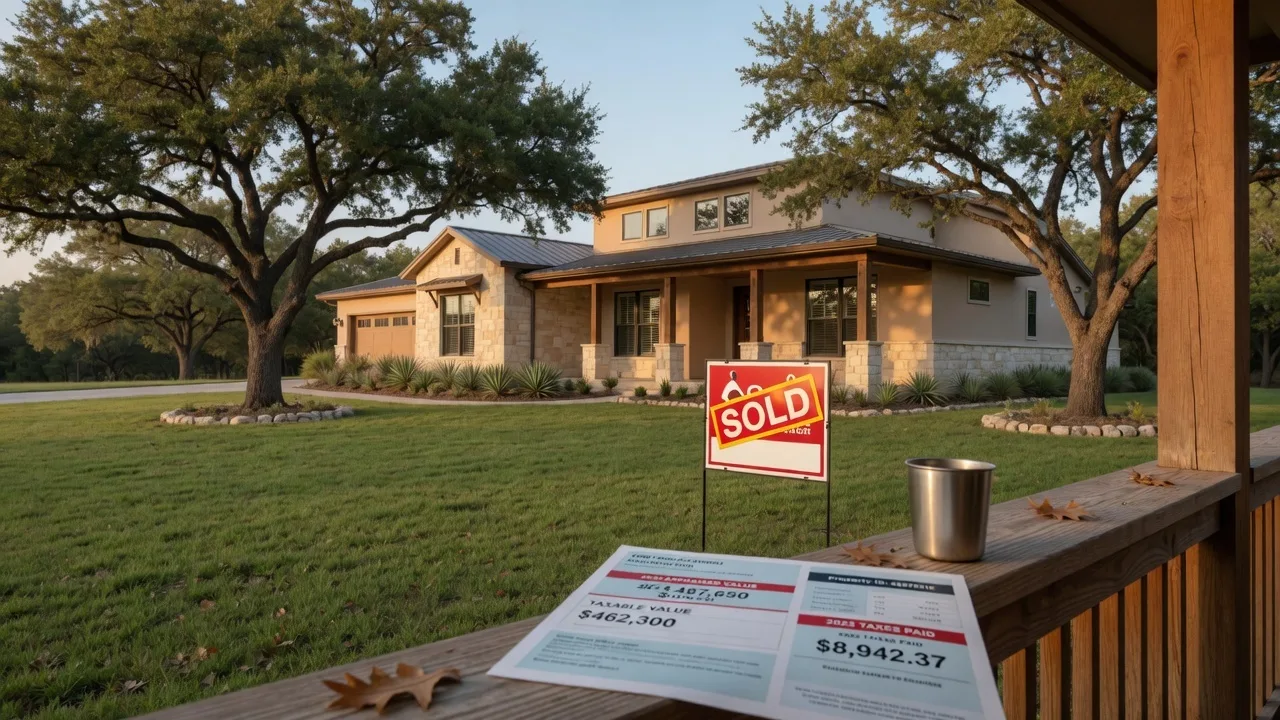
If you are buying a home in the Texas Hill Country, someone along the way — a well-meaning friend, a forum post, maybe even a listing agent — has probably told you that your property taxes will not increase for three years after you close. It sounds reassuring. It is also wrong. The “3-year rule” is one of the most persistent myths in Texas real estate, and believing it can lead to serious budget miscalculations. Here is what actually determines your property tax bill after purchase, how the homestead cap really works, and why the gap between the myth and reality matters most in the Hill Country [1][2].
Where the 3-year myth comes from
The myth has a kernel of truth buried under layers of misunderstanding. Texas Tax Code Section 25.18 requires county appraisal districts to reappraise all properties at least once every three years [1]. That is a minimum — not a maximum, not a guarantee of stability. In practice, most Texas appraisal districts, including the Kendall County Appraisal District (KCAD), the Bexar County Appraisal District (BCAD), and the Comal County Appraisal District, reappraise properties every single year [3][4].
The confusion likely comes from mixing up two different concepts:
- The reappraisal cycle — how often the county physically reviews your property’s value (annually, for most districts).
- The homestead cap — the 10% annual limit on how much your appraised value can increase for a homesteaded property (which starts only after your homestead exemption is in place).
Neither of these gives you a three-year tax freeze. What they do give you is a structured system with specific rules — and understanding those rules is how you avoid surprises.
How the appraisal actually works after you buy
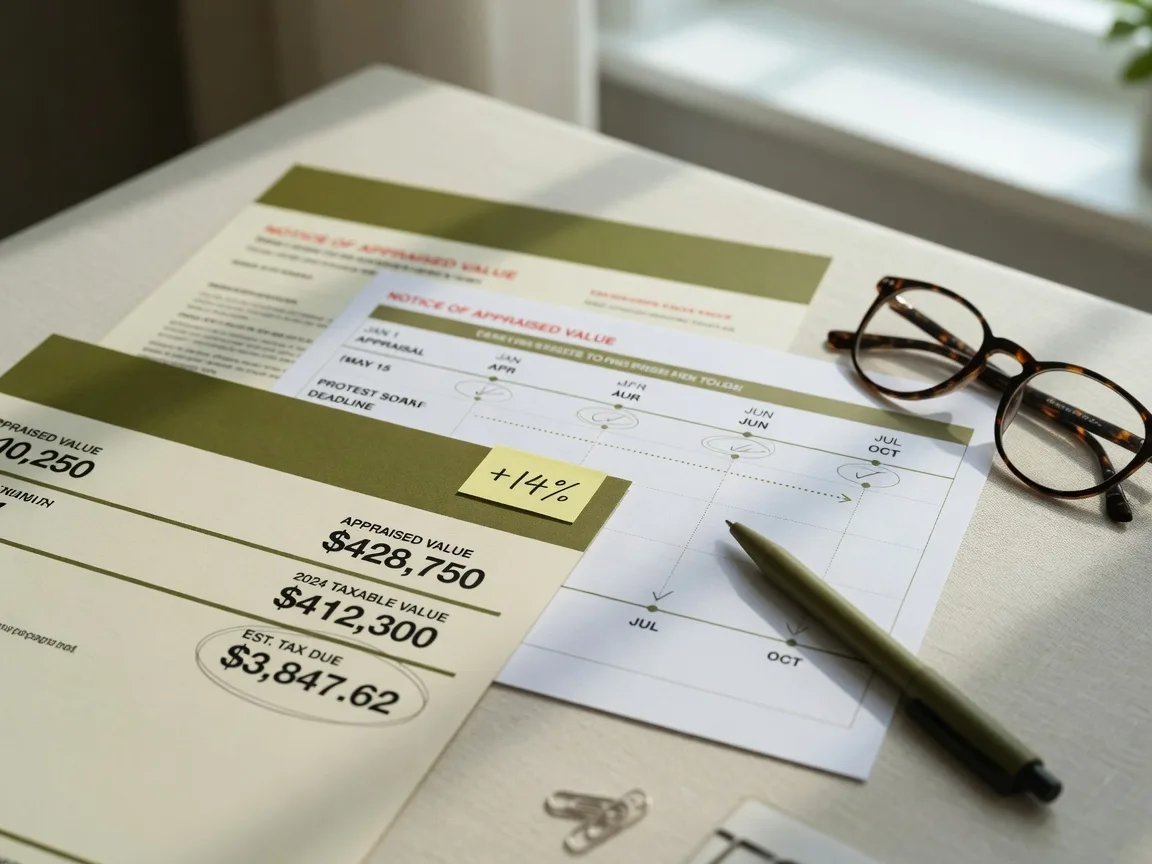
When you purchase a home in Texas, the county appraisal district uses that sale as one of the strongest pieces of evidence for the property’s current market value [2]. Texas Tax Code Section 23.01 requires appraisal districts to appraise property at 100% of its market value as of January 1 of each tax year. Your purchase price — especially if the sale was recent and arms-length — is the most direct market evidence the district has [2].
Here is the typical timeline:
Post-Purchase Appraisal Timeline
| When | What Happens |
|---|---|
| January 1 of Year 1 | Appraisal district values your property as of this date. Your purchase price is key evidence. |
| April – May of Year 1 | Notice of Appraised Value mailed. Your appraised value may equal or approach your purchase price. |
| May 15 (or 30 days after notice) | Deadline to file a formal protest with the appraisal district. |
| January 1 of Year 2 | If homestead exemption is active, the 10% cap now applies — measured from Year 1’s appraised value. |
| January 1 of Year 3+ | 10% cap continues annually, compounding from the previous year’s capped value. |
Source: Texas Tax Code §23.01 (appraisals generally), §23.23 (homestead cap), Kendall County Appraisal District.
The critical point: there is no freeze in Year 1. The appraisal district sets your value based on the current market, and that value becomes the basis for your first tax bill. The 10% cap does not begin until January 1 of the year after you file your homestead exemption and it has been active for the prior January 1 [5][6].
The homestead cap: what it protects and what it does not
The 10% homestead cap under Texas Tax Code Section 23.23 is a real and valuable protection — but it operates differently than most buyers expect [5]. Here is how it actually works:
- It applies to the property, not the owner. When you buy a home, the previous owner’s cap history is wiped clean. The appraised value resets to current market value [5][6].
- It requires an active homestead exemption. You must file your homestead exemption application (Form 50-114) with the county appraisal district between January 1 and April 30. If you miss that window, the cap does not apply for that year [5].
- It starts the second year. If you close in June 2026 and file your homestead exemption, the cap does not protect you until the January 1, 2028 reappraisal — meaning your first full tax year (2026) and potentially your second (2027) are based on the uncapped market value [5][6].
- It compounds. Once active, the cap limits increases to 10% of the previous year’s appraised value, not the original purchase price. Over time, this can still result in significant cumulative increases [5].
Here is what this looks like in practice for a Hill Country buyer:
Cap Timeline: $500K Purchase in Kendall County
| Tax Year | Appraised Value | Cap Active? | Est. Tax Bill* |
|---|---|---|---|
| Year 1 (2026) | $500,000 | No | ~$9,300 |
| Year 2 (2027) | $550,000 (+10%) | Yes (cap limits to 10%) | ~$10,230 |
| Year 3 (2028) | $605,000 (+10%) | Yes | ~$11,253 |
| Year 4 (2029) | $665,500 (+10%) | Yes | ~$12,378 |
| Year 5 (2030) | $732,050 (+10%) | Yes | ~$13,616 |
*Based on Kendall County combined effective rate of ~1.86% on appraised value, before exemptions. Homestead exemption of $140,000 on school taxes is not reflected in this simplified model. Actual results depend on specific taxing entities, exemptions claimed, and market conditions.
Notice what happened: by Year 5, the appraised value has increased from $500,000 to $732,050 — a 46% increase in five years — even with the 10% cap in place. If the market had appreciated faster than 10% in any given year, the cap would have limited the increase, but the value would still be significantly above where it started. And if the market had appreciated more slowly, the district could still appraise at actual market value, which might be below the capped number [5].
The real difference: purchase price as a floor, not a ceiling
One of the most important things to understand about Texas property taxes after a purchase is this: the purchase price typically becomes the new appraisal floor, not a ceiling. [2][7]
When the appraisal district reviews your property after purchase, they see the sale. That sale is the strongest evidence of market value. In most cases, the district will appraise the property at or near the purchase price. If the market continues to appreciate, the appraised value will climb above the purchase price in subsequent years [2][4].
The only scenario where your appraised value stays flat or decreases is if the overall market declines. The appraisal district is not required to hold your value at the purchase price — they are required to appraise at 100% of current market value each year [2].
For buyers coming from California, this can be a difficult adjustment. In many California counties, Proposition 13 limits annual assessed value increases to 2% per year, regardless of market appreciation. Texas has no such limit. The 10% homestead cap is the closest equivalent, and it is significantly more generous to the taxing entities than Prop 13 [3][8].
What this means for Hill Country buyers specifically
The Hill Country market has experienced significant appreciation in recent years. In Kendall County, median home prices have risen steadily, and properties in Boerne and Fair Oaks Ranch frequently close above asking price in competitive segments [4]. When you buy into an appreciating market at a price that reflects current demand, the appraisal district sees that price as the new baseline.
Consider a practical example: you purchase a home in Kendall County for $550,000. The previous owner bought it seven years ago for $380,000 and had been benefiting from the homestead cap, which limited annual increases to 10% of the prior year’s appraised value. When you close, that cap history disappears. The district appraises your home at $550,000 — your purchase price — and that becomes the starting point for your tax bill [5][6].
At the Kendall County combined effective rate of approximately 1.86%, your first-year property tax bill before exemptions would be approximately $10,230 [4]. After applying the standard homestead exemption of $140,000 on school district taxes, the effective bill drops, but the county and special district portions remain based on the full appraised value.
Planning a Hill Country purchase?
Understanding how your property taxes will actually evolve after closing is a critical part of the buy-side equation. I walk every client through the real numbers — purchase price, projected appraisal, exemption impact, and the compounding effect of the 10% cap over time.
Contact Bill Ross | First-Time BuyersWhy the myth persists — and why it is dangerous
The 3-year myth persists because it is easy to remember and feels intuitively protective. Nobody wants to hear that their tax bill might jump 20% or 30% in the first two years after purchase. But the myth is dangerous precisely because it discourages buyers from modeling the real numbers before closing.
Here is what I have seen happen when buyers rely on the 3-year myth:
- Budget shortfall in Year 1. The buyer expects stable taxes and is surprised by a bill based on the full purchase price. On a $500,000 home in Kendall County, that surprise can be $2,000 to $4,000 more than expected if they were modeling against the previous owner’s lower assessed value.
- Escrow adjustment shock. If the buyer has an escrow account through their mortgage servicer, the first escrow analysis after the new tax bill arrives will increase the monthly mortgage payment. This can happen within 12 months of closing.
- Protest deadline missed. Buyers who do not understand the appraisal process often miss the May 15 protest deadline, forfeiting the right to challenge the district’s valuation for that tax year [4].
The right approach is to model the actual numbers before you close. Here is the process I recommend:
Pre-Close Tax Modeling Checklist
| Step | Action |
|---|---|
| 1 | Look up the property’s current appraised value on the county CAD website (KCAD, BCAD, or Comal CAD). |
| 2 | Compare the current appraised value to your expected purchase price. If you are paying above appraised, plan for the higher number. |
| 3 | Identify all taxing entities on the property (county, city, school district, MUD, special districts) and their individual rates. |
| 4 | Calculate the combined effective tax rate. For most Hill Country properties, this ranges from 1.79% to 2.27% [4]. |
| 5 | Apply your expected exemptions (homestead, over-65, disabled veteran) to determine the taxable value. |
| 6 | Project the Year 2 and Year 3 tax bills assuming 10% annual increases if the market appreciates. |
| 7 | Build the projected tax amount into your monthly housing budget — do not rely on the seller’s current tax bill. |
The 10% cap is not a tax freeze
Another variation of the myth is the idea that once your homestead cap is in place, your taxes are essentially locked. They are not. The 10% cap limits annual increases in appraised value, not the tax rate itself [5].
If the taxing entities — the county, the city, the school district, or a municipal utility district (MUD) — raise their tax rates, your bill increases even if your appraised value stays flat. And if your appraised value is still climbing toward the market value (for example, if the district appraised below market in a prior year), the cap allows catch-up increases until the appraised value reaches actual market value [5][6].
In the Hill Country, MUDs are an especially important factor for new construction communities. A MUD tax rate can add 0.25% to 1.0% or more to the combined effective rate, and MUD rates often increase in the early years of a development as infrastructure bonds are paid down [4]. If your property is in a MUD, your tax bill may increase faster than the 10% cap suggests, because the rate itself is changing.
California buyers: the Prop 13 adjustment
If you are relocating from California, the difference between Proposition 13 and the Texas system is one of the most important financial adjustments you will make. Under Prop 13, your assessed value increases by no more than 2% per year, regardless of market appreciation [8]. Over a decade of ownership, this creates a substantial gap between your assessed value and the actual market value.
When you sell that California property and buy in Texas, the new property is appraised at your purchase price — the full market value. There is no carryover of your Prop 13 assessment history. Your Texas tax bill on a $500,000 home may be higher in absolute terms than your California tax bill on a $900,000 home, simply because the Texas assessment starts at market value while the California assessment was artificially suppressed [3][8].
This does not mean Texas is more expensive overall — the absence of state income tax, lower insurance costs, and lower utility bills often offset the property tax difference [3]. But the property tax line item specifically can be a genuine shock if you have not modeled it. That is why I walk every relocating client through a total-cost comparison that accounts for the assessment reset, not just the headline tax rate.
For a deeper comparison of the full financial picture, see our Property Tax Reality Check: California vs. Texas. For first-time buyers navigating these numbers for the first time, our First-Time Buyers guide covers the full cost-of-ownership equation.
Protesting your first appraisal
One of the most valuable steps a new homeowner can take is to protest the appraisal district’s valuation in Year 1 — even if the appraised value is at or near the purchase price [4]. Here is why:
- The district may appraise above the purchase price, especially if comparable sales data is mixed or if the district uses an automated valuation model that overweights certain features.
- Filing a protest establishes a precedent and forces the district to defend their number with evidence.
- The protest deadline is firm: May 15 or 30 days after the notice of appraised value is mailed, whichever is later [4].
You do not need a professional tax consultant to file a protest. The Comptroller’s Office provides a standard form, and many counties offer online filing. Bring your closing documents, your purchase contract, and any evidence that the district’s valuation is above market value. If you are working with me, I provide comparable sales data to support your protest at no additional cost.
Frequently Asked Questions
Do my property taxes really increase every year in Texas?
Yes, the appraisal district reappraises your property annually. However, for homesteaded properties, the annual increase in appraised value is capped at 10% under Texas Tax Code §23.23 [5]. The cap does not apply to non-homesteaded properties (investment homes, second homes). Additionally, tax rates set by individual taxing entities can change independently of your appraised value, so your tax bill may increase even if your appraised value stays flat.
Is there really no 3-year freeze on property taxes after buying a home?
Correct. Texas Tax Code §25.18 requires appraisal districts to reappraise all properties at least once every three years, but most districts reappraise annually [1]. There is no provision in Texas law that freezes or delays reassessment after a property sale. The purchase price becomes the new appraisal baseline immediately.
When does the 10% homestead cap start protecting me?
The cap begins on January 1 of the second year after your homestead exemption is active. If you close in June 2026 and file your homestead exemption, the cap applies starting with the January 1, 2028 reappraisal [5][6]. This means your first tax year (2026) is fully uncapped, and your second year (2027) may also be based on the uncapped market value depending on filing timing.
Can I estimate my post-purchase tax bill before closing?
Yes. Look up the property’s current appraised value on the county appraisal district website, identify the combined effective tax rate for all taxing entities (typically 1.79% to 2.27% in the Hill Country), and apply your expected exemptions [4]. If your purchase price is above the current appraised value, model the tax bill against your purchase price, not the seller’s assessed value.
What happens if I miss the May 15 protest deadline?
You lose the right to protest that year’s appraised value. You must wait until the following year to file a protest. The deadline is 30 days after the notice of appraised value is mailed, or May 15, whichever is later [4]. Mark this date on your calendar immediately after closing.
Does the 10% cap apply to investment properties or second homes?
No. The 10% annual cap under §23.23 applies only to properties with an active homestead exemption [5]. Investment properties, rental homes, and second homes receive no cap protection. The appraisal district can increase the appraised value to full market value in any year.
How do MUD taxes affect my property tax bill?
Municipal Utility Districts (MUDs) levy an additional property tax to fund infrastructure like water, sewer, and roads. If your property is within a MUD, the MUD tax rate is added to the combined effective rate, often increasing it by 0.25% to 1.0% or more [4]. MUD rates are typically highest in the early years of a development and may decrease over time as bonds are retired.
__UNIQUE_SOURCES_MARKER__ class="space-y-3 text-[14px] leading-relaxed list-decimal list-inside">
Written by Bill Ross, Hill Country Homesteads Group, brokered by Keller Williams Boerne. Serving Boerne, Fair Oaks Ranch, San Antonio, and the surrounding Hill Country communities.
If you are buying a Hill Country home and want to understand how your property taxes will actually evolve after closing — not what a forum post or a well-meaning friend told you — reach out. I model the real numbers for every client before we write an offer.
Published: July 10, 2026
Updated July 10, 2026