
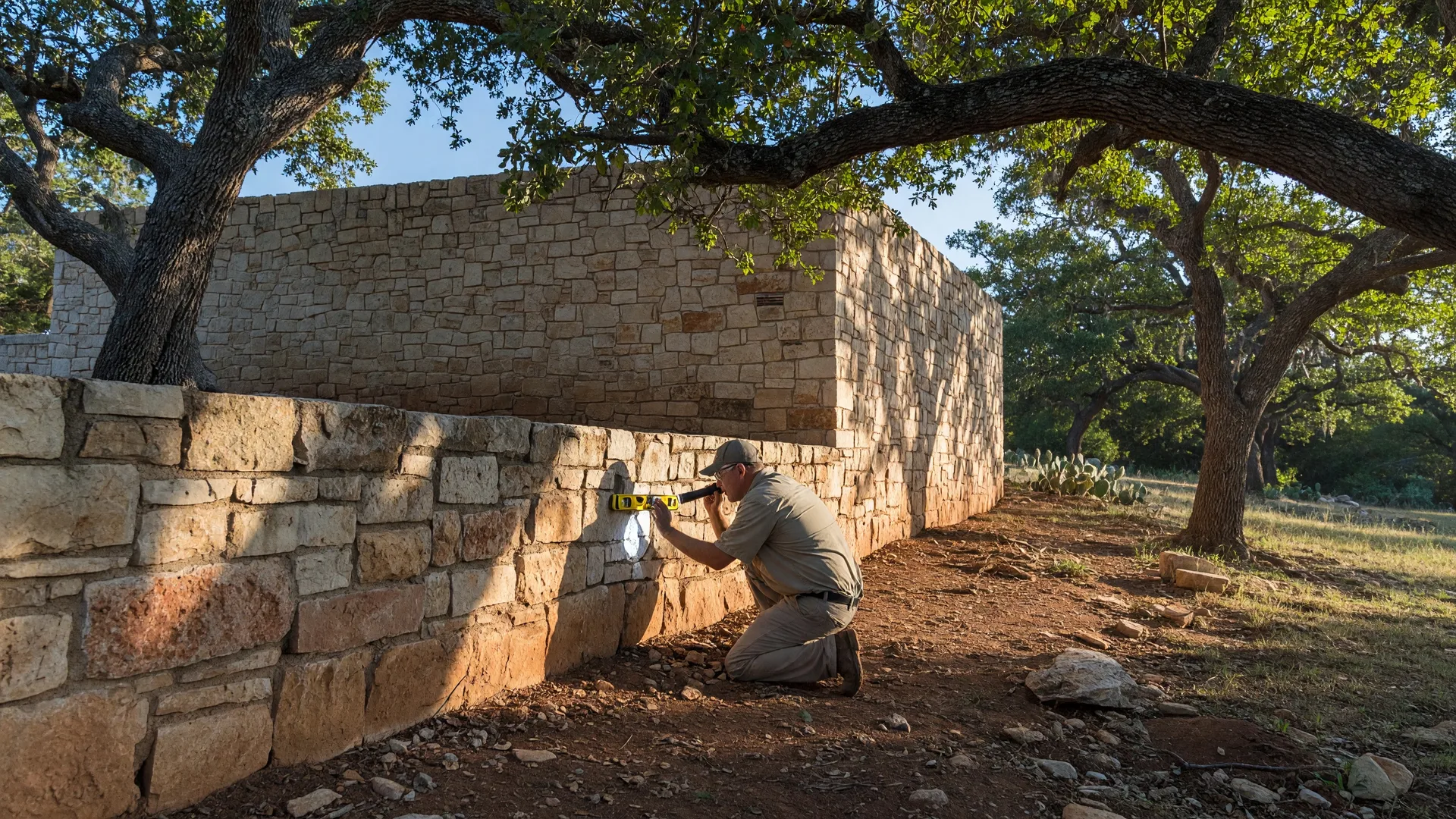
A standard home inspection in the Texas Hill Country covers the same basic systems as any inspection anywhere in the country. The roof, HVAC, electrical panel, plumbing, foundation, and appliances are all evaluated against the same TREC or ASHI standards. But the issues that generate the most expensive repair estimates and the most walked-away deals in Boerne, Fair Oaks Ranch, and the surrounding Kendall County area are the ones specific to the region: foundation movement on karst limestone terrain, well water quality and yield, aerobic septic system maintenance, and drainage patterns that turn a light rain into a foundation repair.
This guide is written for buyers who are new to the Texas Hill Country and need to know what their inspector will be looking for beyond the standard checklist. It covers the six inspection issues that most frequently produce surprises for out-of-state buyers and what each one means for your purchase decision.
1. Foundation movement on limestone terrain
The single most common inspection finding on Hill Country homes is evidence of foundation movement. The underlying cause is the region's karst limestone geology, which creates highly variable soil conditions even across a single lot. In some areas, the limestone bedrock is inches below the surface. In others, it is 20 feet down, with expansive clay soils in between. That variability causes uneven support under the foundation.
Home inspectors look for the same telltale signs: diagonal drywall cracking at door and window corners, crown molding gaps, sloping floors, tile cracks in a stepped pattern, and doors that no longer latch properly. These findings are rarely the result of a single dramatic event. They usually reflect gradual seasonal movement as clay soils expand and contract with rainfall and drought [1][2].
What matters for a buyer is not whether some foundation movement has occurred, but whether the movement is active, whether it has reached a structural concern threshold, and whether the foundation has been stabilized. A pier-and-beam foundation with minor movement is different from a slab with 4 inches of differential settlement and a $25,000 repair estimate [1].
Ask your inspector about the foundation type and whether prior repair work exists. If the house has foundation piers or underpinning, request documentation including the engineering report and warranty details. A repair with no paperwork may offer no recourse [1][2].
2. Well water quality and yield
For properties outside municipal water service, a well inspection is not optional. The two numbers that matter most are gallons per minute (GPM) and water quality. A well that produces 10 GPM or more provides comfortable margin for a four-bedroom home. Below 5 GPM, water conservation becomes a daily consideration. Below 3 GPM, supplemental storage tanks are required [3][4].
Water quality testing should include a standard potability panel and testing for hardness, iron, and hydrogen sulfide. The Edwards and Trinity aquifers produce hard water, typically 10 to 25 grains per gallon, requiring a water softener. Elevated iron levels cause rust staining. Hydrogen sulfide produces the rotten egg odor common in Hill Country well water and requires filtration [3][5].
Well inspections typically cost $300 to $500 and include a current flow test, pressure evaluation, and assessment of the pump and pressure tank [4]. If the well has not been tested in the last 12 months, order a new test during the option period.
For more detail, see the guide to well logs and the Edwards Aquifer buyer guide.
3. Aerobic septic system condition and maintenance history
Rural Hill Country properties rely on private septic systems. Most systems installed since the early 2000s are aerobic treatment units that require mechanical components and regular maintenance [6]. A comprehensive septic inspection by a licensed provider typically costs $350 to $600 [6].
The critical question is whether the system has been properly maintained. TCEQ rules require aerobic systems to be serviced at least annually [6][7]. A neglected system may need $2,000 to $8,000 in component replacement [6]. See the aerobic septic guide for details.
4. Drainage, grading, and water intrusion
Hill Country rainfall comes in intense, short-duration events. A property that looks dry during a showing may have significant grading issues that appear only during the first heavy rain [1][2]. The cumulative cost of regrading, French drains, and gutter improvements typically runs $3,000 to $15,000 [1][2].
5. Roof condition and storm damage history
Texas Hill Country weather subjects roofs to extreme heat, hailstorms, and high winds [8]. For tile roofs, the inspector checks for cracked or displaced tiles. For metal roofs, issues are usually at penetrations. For asphalt shingles, granule loss from UV exposure accelerates deterioration significantly [8].
6. HVAC system sizing and condition
With a cooling season from April through October, HVAC systems in Hill Country homes accumulate significantly more run time than systems in moderate climates. Replacing a 4-ton system costs $7,000 to $12,000. If the inspection reveals R-22 refrigerant, budget for replacement rather than repair [8].
Hill Country Inspection Issues at a Glance
| Issue | Typical Cost to Fix | Priority Level |
|---|---|---|
| Foundation movement (major) | $10,000 - $35,000 | Critical |
| Well replacement / new well drilling | $12,000 - $25,000 | Critical |
| Septic system replacement | $15,000 - $30,000 | Critical |
| Drainage regrading and French drains | $3,000 - $15,000 | High |
| Roof replacement (asphalt) | $8,000 - $18,000 | High |
| HVAC replacement (4-ton) | $7,000 - $12,000 | High |
| Water softener / filtration system | $1,500 - $4,500 | Moderate |
Cost ranges are estimates. Actual costs vary by location, system age, and scope of work.
How to use inspection findings in your offer
In Texas, the option period is when buyers conduct inspections and negotiate repairs or price adjustments. Standard period is 7 to 10 days, though longer is common on acreage properties [10]. A full inspection package on a Hill Country acreage property typically totals $1,500 to $3,500, representing 0.2 to 0.5 percent of the purchase price [2][10].
Evaluating a Hill Country property?
Understanding inspection results in context is part of every Hill Country property evaluation.
Contact Bill Ross | Infrastructure OverviewSources
- L3 Home Inspections, Boerne TX Home Inspection. Common inspection issues specific to Hill Country properties. l3homeinspections.com
- Silver Stone Home Inspections, Boerne TX Home Inspector. Inspection findings on Hill Country properties. silverstonehomeinspections.com
- SATX Inspector, Water Testing Boerne TX. Well water testing protocols and contaminants. satxinspector.com
- Move to Texas, Texas Hill Country Well, Septic and Water Infrastructure Guide. Well performance benchmarks. movetotexas.net
- Texas Water Development Board, Groundwater Data. Aquifer level data for Kendall, Bexar, and Comal counties. twdb.texas.gov
- JLG Septic Services, Boerne TX Septic System Service. Aerobic septic inspection and replacement costs. jlgsepticllc.com
- Texas Commission on Environmental Quality, On-Site Sewage Facilities. Regulatory requirements for aerobic treatment units. tceq.texas.gov
- TLC Home Inspections, Top Home Inspection Issues in Hill Country Homes. Climate-related roof and HVAC wear. tlcinspectors.com
- Texas Department of Agriculture, Wood-Destroying Insect Inspection. Termite inspection requirements. texasagriculture.gov
- Texas Real Estate Commission, Option Period and Inspection Guidelines. Standard TREC contract provisions. trec.texas.gov
Last verified: July 20, 2026.
Published: July 20, 2026
Updated July 20, 2026