
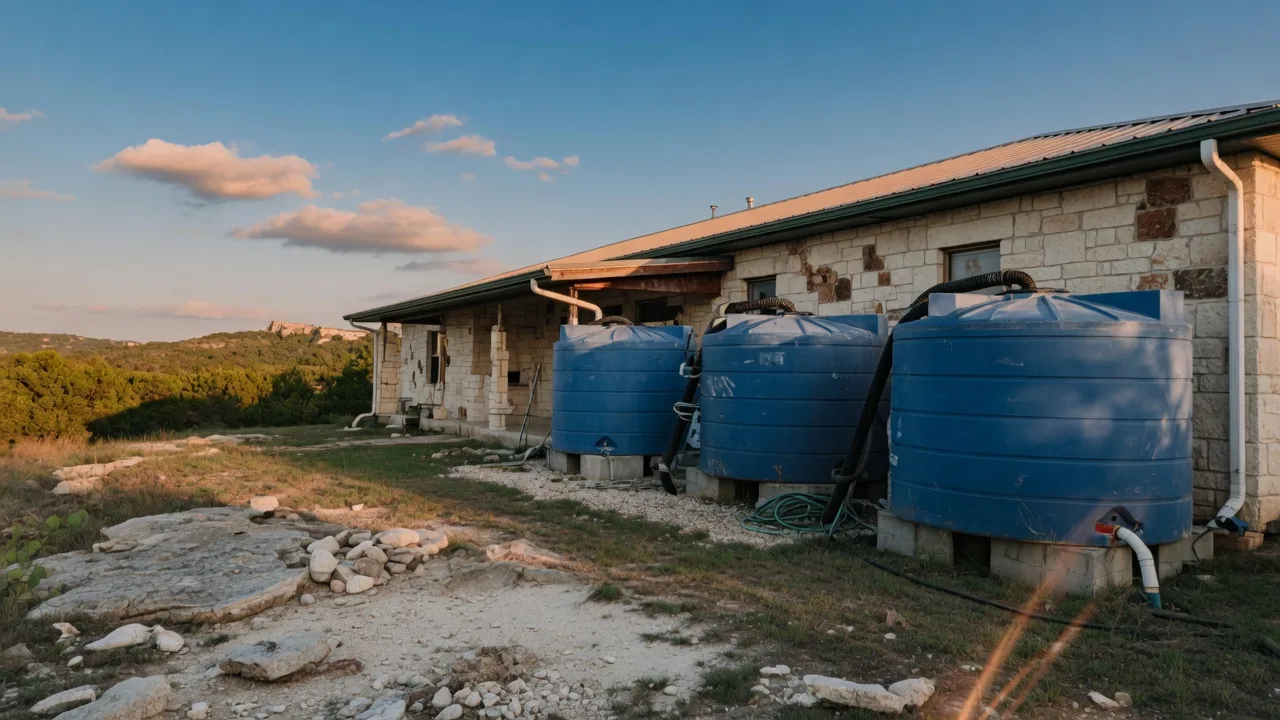
Quick Glossary: Rainwater Harvesting Terms You'll See in This Article
Before you dive in, here are the key terms you'll encounter. Think of this as your cheat sheet.
- Catchment area
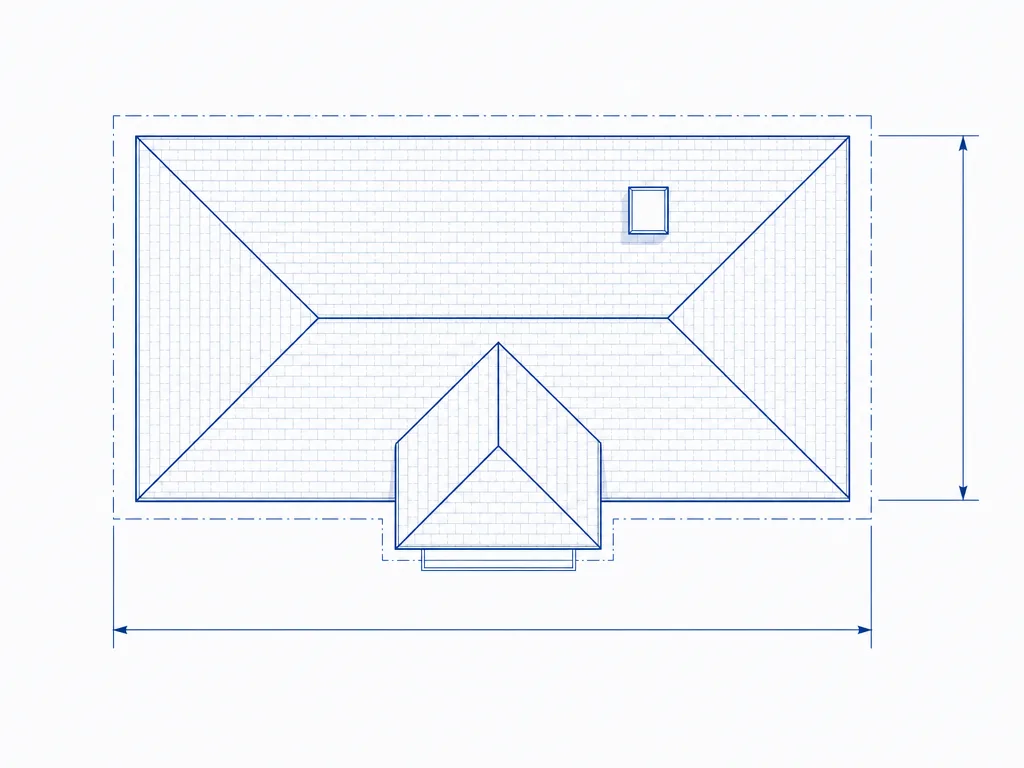
- The horizontal, guttered footprint of your roof that actually collects rain. This is usually smaller than your home's total square footage because it only includes the part with gutters.
- First-flush diverter
- A small device that captures the first bit of runoff from your roof after a dry spell. That initial water carries the most dust, pollen, and debris, so the diverter keeps it out of your tank.
- Collection efficiency
- The percentage of rain that actually makes it into your tank after losses from splashing, evaporation, the first-flush diverter, and any gaps in your gutter system. A good Hill Country system runs about 75 to 90 percent.
- Potable water
- Water safe enough to drink. A potable rainwater system has extra filtration and treatment to meet drinking-water standards.
- Nonpotable water
- Water that's fine for irrigation, toilets, and washing your car, but not safe to drink without further treatment.
- RPZ (Reduced Pressure Zone) backflow preventer
- A plumbing device that keeps rainwater or well water from accidentally flowing back into the public water supply. Required when you connect your system to household plumbing.
- Air gap
- A physical space between your rainwater piping and the public water supply that prevents cross-contamination. Another way to meet the backflow-prevention requirement.
- NSF/ANSI 55 Class A
- The gold standard for UV disinfection units used in potable rainwater systems. It means the unit has been tested and validated to inactivate harmful microorganisms.
- UV disinfection
- A treatment method that uses ultraviolet light to kill or inactivate bacteria, viruses, and other microorganisms in your water. It doesn't remove chemicals -- just living contaminants.
- Ten-inch contractor heuristic
- A rough rule-of-thumb used by some Central Texas contractors: size your tank to hold about ten inches worth of your roof's rainwater yield. Useful for quick comparisons, but not a substitute for a real water-balance analysis.
- Caliche
- A hardened layer of calcium-carbonate-cemented soil common in the Hill Country. Ranges from chalky crust to rock-hard hardpan. It matters because your tank foundation has to work with it, not against it.
- Karst
- A type of landscape formed by dissolved limestone, creating cracks, caves, and underground voids. In the Hill Country, fractured karst limestone can transmit water -- and can create surprises under your tank foundation.
- Water-balance analysis
- A month-by-month calculation that matches your roof's rainwater yield against your household demand, tank storage, and losses. This is the real test of whether a system can keep up with your water needs.
- Customer Service Inspection (CSI)
- An inspection required by your public water utility when new or modified plumbing connects to their system. Common when installing a rainwater system with a municipal backup.
- EAA (Edwards Aquifer Authority)
- The regional agency that manages groundwater pumping from the Edwards Aquifer. When aquifer levels drop, the EAA can restrict how much water permit holders pump -- which is one reason rainwater harvesting is so appealing here.
- GCD (Groundwater Conservation District)
- A local district that manages groundwater in a specific area of Texas. Some GCDs offer rebates or grants for rainwater harvesting; others focus on monitoring and education.
- Form 01-339
- The Texas Sales and Use Tax Exemption Certificate you present to the seller when buying qualifying rainwater harvesting equipment. It saves you the sales tax on eligible items.
Why Rainwater Harvesting Matters in the Texas Hill Country
If you live in the Texas Hill Country, you already know the weather is a study in extremes. NOAA's 1991-2020 Climate Normal for the Boerne station (USC00410902) is 37.52 inches of annual precipitation. Actual rainfall varies by location and from year to year. So to keep things realistic, the calculations in this article use a conservative 33-inch annual-rainfall assumption. You should swap in data from the nearest weather gauge when you're designing your own system. Boerne, Fair Oaks Ranch, and the surrounding communities swing between bone-dry stretches and sudden downpours [1][2]. Water sources vary a lot depending on where you live. SAWS reports that the Edwards Aquifer supplied about 47% of its water in 2025, while other communities in the region may depend on Trinity groundwater, purchased surface water, private wells, or a mix of sources. Recurring drought and population growth put pressure on several regional supplies, not just the Edwards Aquifer [3]. Here's the link for more: saws.org/your-water/management-sources/edwards-aquifer/
Rainwater harvesting lets you capture what falls on your own roof and use it where you need it most: landscape irrigation, gardening, foundation-moisture management, toilet or urinal flushing, and other nonpotable uses allowed under today's state and local rules. And in many cases, drinking water too, as long as you evaluate your catchment, design and install the right treatment system, and keep testing the treated water to make sure it's safe [4][5]. Texas law has several provisions that support rainwater harvesting, but systems still have to follow applicable state rules, local requirements, plumbing restrictions, and water-provider safeguards. Texas Property Code Section 202.007 limits an HOA's ability to ban rainwater harvesting, but it doesn't eliminate architectural-control rules [6]. Several groundwater conservation districts and municipalities in the Hill Country offer rebates that can offset a big chunk of the installation cost [7][8].
Here's what this article covers: how to figure out how much water your roof can produce, how to size a storage tank for the Hill Country's burst-and-drought rainfall pattern, the differences between potable and irrigation-only systems, how to build a foundation that holds on limestone and caliche, and where to find rebates that make the math work.

How Much Water Your Roof Actually Produces
The math is pretty straightforward. Each square foot of horizontal, guttered roof footprint gets you about 0.623 gallons per inch of rainfall, before any losses. Don't use the sloped roof-surface area in this formula [1][9]. So a 2,000-square-foot roof, in a typical one-inch rain, will shed roughly 1,246 gallons of water. Over the course of a year in the Boerne area, that same roof can produce an estimated 30,800 to 37,000 gallons of rainwater at 75-90% efficiency. It all depends on how the rain falls and how much of your roof is guttered [1][9].
Production estimates using a conservative 33-inch assumption
| Efficiency | Estimated Annual Yield |
|---|---|
| Gross theoretical yield | Approximately 41,118 gallons |
| At 75% efficiency | Approximately 30,839 gallons |
| At 85% efficiency | Approximately 34,950 gallons |
| At 90% efficiency | Approximately 37,006 gallons |
All values are modeled estimates, not guaranteed production. Actual yield depends on roof material, condition, guttering coverage, first-flush diversion, overflow, and treatment losses.
How Much Water Actually Makes It Into Your Tank
Not every drop that hits your roof makes it into the tank. A properly designed system typically captures 75 to 90 percent of what falls [9]. The losses come from a few places: the first-flush diverter (which throws away the dirty initial runoff), splash-out during heavy rain, evaporation off warm roof surfaces, and any roof area that doesn't have gutters. Asphalt shingles don't shed water as well as metal roofing. A metal roof in good shape might hit 90 percent efficiency, while an older asphalt-shingle roof might be closer to 75 or 80 percent [9].
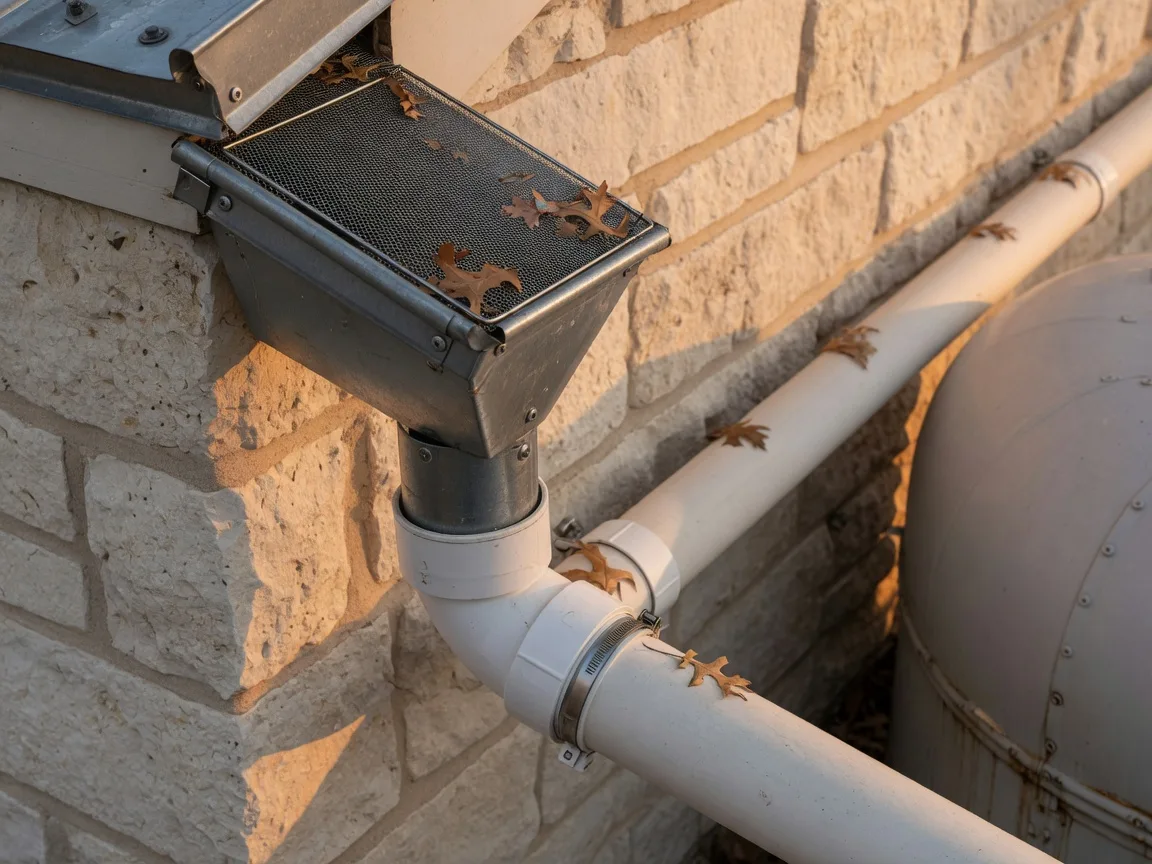
Gutter sizing matters, too. Texas Hill Country rain can come down hard and fast. So gutters, downspouts, and overflow pipes need to be sized for the roof area and local rainfall intensity. A contractor should check current NOAA Atlas 14 data and local building codes instead of just guessing by gutter width. When gutters overflow, that water bypasses your collection system entirely and can cause foundation erosion. Make sure your downspout placement lines up with your tank inlet and first-flush diverter so you capture as much as possible.
The Hill Country Formula
Here's the formula that Hill Country rainwater pros use:
Gallons collected = Roof area (sq ft) x Rainfall (inches) x 0.623 x Collection efficiency (0.75 to 0.90)
Rainwater Collection Formula
Imperial (used throughout this article):
Gallons captured = Horizontal guttered roof footprint (sq ft) x Rainfall (inches) x 0.623 x Collection efficiency
Metric equivalent:
Litres captured = Roof area (m2) x Rainfall (mm) x efficiency
Don't mix the two systems in the same calculation.
Let's look at a real-world example: a 2,500-square-foot roof with metal roofing (90% efficiency) in a 2-inch rain event:
2,500 x 2 x 0.623 x 0.90 = 2,804 gallons
A 2-inch storm on that 2,500-square-foot horizontal catchment produces about 3,115 gallons before losses. At 90% all-in collection efficiency, you could add roughly 2,804 gallons to your tank if there's room. What you actually keep may be lower because of overflow, operating reserve, debris, or other site-specific losses.
Sizing Your Storage Tank for the Hill Country's Rain Pattern
This is where you need to think differently than what the national guides say. The Texas Water Development Board's manual recommends sizing your tank based on your longest dry spell [9]. Don't just pick a drought duration by gut feeling. Model your system against a long enough historical daily or monthly rainfall record from a nearby station, including dry sequences, and test different demand scenarios. But the rain that does come often arrives in intense bursts. A single thunderstorm in May or June can drop two or more inches in an hour.
One Central Texas contractor uses a screening method that gives you storage equal to about ten inches of roof yield. It's useful for rough comparisons, but it's not a substitute for a real water-balance analysis and shouldn't be used by itself to size a potable system. The TWDB method tracks captured water, demand, and remaining storage month by month, including dry periods [9][10].
Monthly Water Balance
Beginning storage + Monthly captured water - Monthly demand - Losses (first flush, overflow, treatment) = Ending storage
This is the fundamental calculation for figuring out whether a rainwater system can meet your household demand. Storage capacity doesn't create water -- it only stores what your roof captures.
Ten-Inch Storage Heuristic - Preliminary Screening Only
| Roof Area (sq ft) | Ten-Inch Heuristic | Gallons per 1" Rain | Annual Yield (33", 75%-90%) |
|---|---|---|---|
| 1,000 | 6,000 gallons | 623 | 15,419 - 18,503 |
| 1,500 | 9,000 gallons | 935 | 23,129 - 27,755 |
| 2,000 | 12,000 gallons | 1,246 | 30,839 - 37,006 |
| 2,500 | 15,000 gallons | 1,558 | 38,548 - 46,258 |
| 3,000 | 18,000 gallons | 1,869 | 46,258 - 55,509 |
| 3,500 | 21,000 gallons | 2,181 | 53,967 - 64,761 |
These figures use: Roof footprint x 33 inches x 0.623 x 75%-90% efficiency.
Don't assume the suggested tank size means your roof can actually refill it or meet your household demand. This contractor screening method approximates the gross yield from about 9.6 inches of rainfall. It doesn't establish the right tank capacity. Your final storage should come from a monthly or daily water balance using site-specific rainfall, your actual demand, tank starting volume, overflow, and the reliability you want (plus a backup plan).
What If You Can't Fit a 12,000-Gallon Tank?
Lots of Hill Country lots, especially in newer subdivisions, don't have room for one giant tank. Here are some practical alternatives:
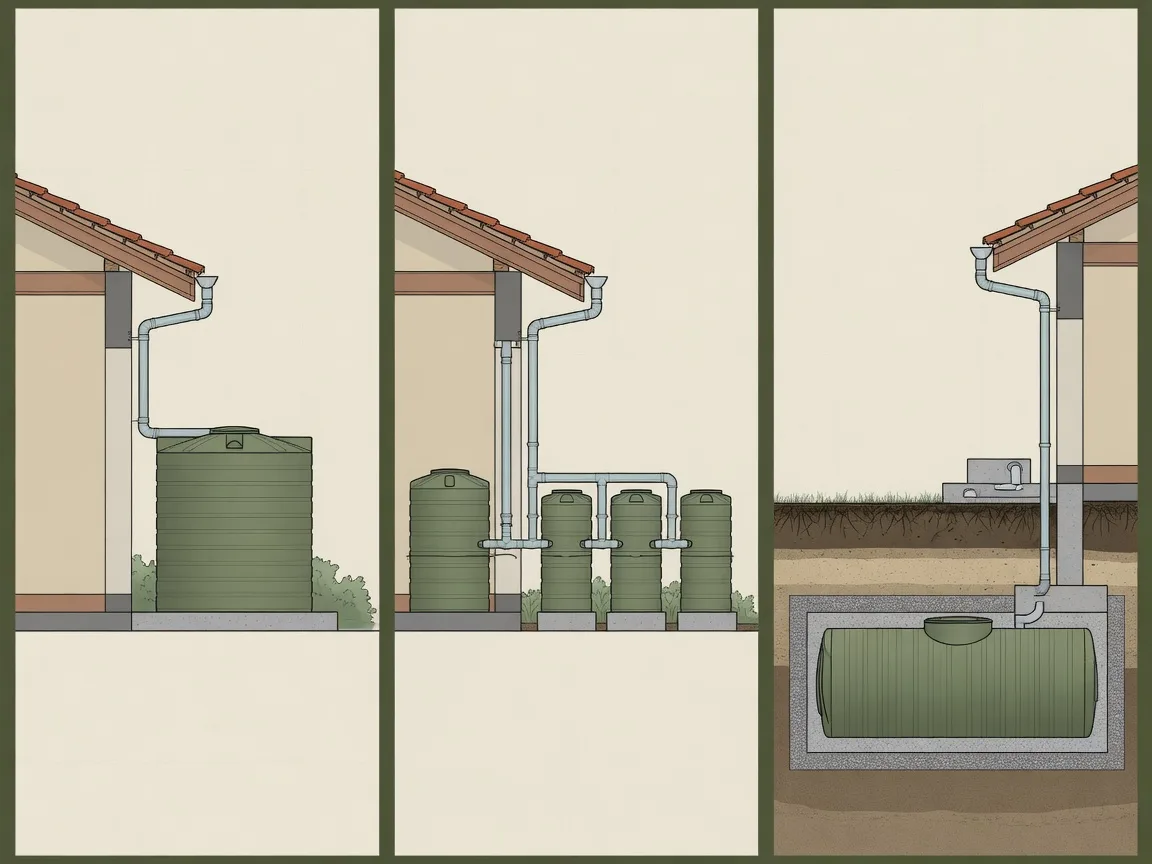
- Multiple smaller tanks: Two linked 6,000-gallon tanks give you more placement flexibility and smaller individual foundation pads, though the combined footprint and number of fittings may equal or exceed one 12,000-gallon tank.
- Underground cisterns: Buried tanks save surface space but cost more to install, require digging into limestone or caliche, and need a pump to deliver water.
- Hybrid approach: A large tank for primary storage paired with a smaller day tank that feeds your household system through a pressure pump.
Potable vs. Irrigation-Only: Choosing Your System
This is the most important decision you'll make about your rainwater system, because it determines the equipment you need, the maintenance you're signing up for, and the cost.
Irrigation-Only (Non-Potable) Systems
An irrigation-only system is the simpler and less expensive option. You use the water for landscape watering, garden beds, filling livestock troughs, and washing vehicles. One thing to know: a cistern doesn't automatically count as an approved fire-protection supply. Fire use requires approval from the authority having jurisdiction and may need dedicated reserve capacity, an approved fire-department connection, proper pump performance, access, signage, and fire-protection engineering. TCEQ classifies rainwater as alternative onsite water. Residential reuse is subject to 30 TAC Chapter 210, Subchapter F, which includes rules to prevent nuisances, health hazards, runoff, and cross-connections. You may not need a separate TCEQ authorization for a compliant residential reuse system, but it still has to follow applicable state rules, local codes, water-provider requirements, and any site-specific approvals. Source: tceq.texas.gov/permitting/wastewater/graywater [5][11].
An irrigation-only system typically includes:
- Gutters and downspouts
- A leaf screen or gutter guard
- A first-flush diverter
- A storage tank with a screened vent
- A gravity-fed or pump-driven outlet to irrigation lines
The filtration is minimal: screens to keep out mosquitoes and debris, and a basic sediment filter if you're running drip irrigation. Maintenance is straightforward: clean the first-flush diverter after each rain event, and check screens every two to three months [12].
Potable (Drinking Water) Systems
A potable rainwater system needs a lot more equipment and maintenance. The water has to be treated to meet health standards for drinking, cooking, and food preparation [5][11]. A typical potable system adds:
- A pre-sediment filter (typically 5-micron or 20-micron cartridge)
- An activated-carbon filter certified for the specific taste, odor, or contaminant-reduction claims you need (carbon filtration doesn't remove every chemical contaminant)
- When ultraviolet treatment is used as the primary disinfection barrier for a potable rainwater system, use an appropriately validated NSF/ANSI 55 Class A unit unless a qualified treatment professional specifies another compliant design. UV performance depends on pretreatment, flow rate, lamp condition, UV transmittance and uninterrupted operation that inactivates microorganisms when the water's flow, turbidity, UV transmittance, pretreatment, lamp output, and maintenance remain within the manufacturer's specifications
- Possibly a reverse-osmosis unit for additional purification
- A pressure tank and on-demand pump
When a privately owned rainwater system with more than 500 gallons of storage also has a public-water hookup, Texas law requires protection by a backflow-prevention assembly or an air gap. The public-water connection may feed the rainwater storage tank, but it can't be cross-connected directly to the structure's rainwater distribution piping. You have to give the public water system written notice. If the public supply is potable, the connection must be installed and maintained by a licensed master or journeyman plumber holding a water-supply-protection-specialist endorsement. Get the water provider's written requirements before you design or install anything [16][17][18].
TCEQ has adopted recommended standards for domestic rainwater use, and while the agency doesn't require a permit for a private household potable system, your plumbing has to comply with locally adopted plumbing code, Texas statutes and administrative rules, Texas State Board of Plumbing Examiners requirements, and water-provider requirements. The system should also be designed to prevent cross-contamination with any municipal or well-water supply [5][11].
Maintenance for a potable system is more involved:
- Replace or service sediment filters according to the manufacturer's instructions, pressure differential, water quality and actual use
- Replace or service carbon filters according to the manufacturer's instructions, pressure differential, water quality and actual use
- Replace or service UV lamps according to the manufacturer's instructions, monitored output and actual use
- Potable systems: get lab testing at least quarterly, or more often if the treatment designer or applicable authority says so. Retest after flooding, suspected contamination, treatment failure, major repairs, extended shutdowns, unusual taste or odor, or any result outside the accepted limit
- Clean the first-flush diverter after every rainfall event [12]
You can't tell if water is safe to drink just by looking at it or by the system components alone. Roof material and condition, animal activity, airborne contamination, storage design, treatment performance, and lab results all matter. Test the untreated and treated water before you drink it, and at least quarterly after that, as the TWDB manual recommends. Retest after roof work, long shutdowns, flooding, contamination events, unusual taste or odor, or treatment failure. Use an accredited laboratory and choose your treatment based on test results. UV disinfection doesn't remove dissolved chemicals, and it depends on electricity and proper pretreatment [9].
System Flow: Potable Rainwater Harvesting
Catchment (roof) → Screening (gutter guards) → First-flush diversion → Conveyance (downspouts) → Storage (tank) → Pump and pressure tank → Treatment (sediment filter, carbon filter, UV) → Distribution (household plumbing) → Overflow (directed away from structures)
Backup water introduction must comply with Texas Health and Safety Code Section 341.042.
Cost Comparison
Prices are planning estimates as of August 2026. Get at least two or three itemized local quotes, because freight, crane access, excavation, foundation work, and site conditions can change the installed cost a lot. These are planning ranges only, not actual bids. Prices vary by site, tank model, delivery access, plumbing scope, treatment requirements, and professional services. Get at least two or three itemized local quotes.
| Component | Irrigation-Only | Potable System |
|---|---|---|
| Gutters and downspouts | $1,500 - $3,000 | $1,500 - $3,000 |
| First-flush diverter | $50 - $200 | $50 - $200 |
| Storage tank (5,000 gal) | $1,500 - $3,500 | $1,500 - $3,500 |
| Filtration | $100 - $300 | $500 - $2,000 |
| UV disinfection | Not required | $300 - $800 |
| Pump and pressure tank | $300 - $800 | $800 - $2,000 |
| Plumbing and installation | $1,000 - $3,000 | $2,000 - $5,000 |
| Frequently omitted costs | Engineering, pad/excavation work, electrical, Customer Service Inspection, backflow equipment and testing, delivery/crane charges, laboratory testing, overflow drainage, permits, and ongoing maintenance | |
| Component subtotal before site-specific and omitted costs | $4,450 - $10,800 | $6,650 - $16,500 |
These are rough ranges for a typical Hill Country residential setup. Actual costs depend on tank size, roof accessibility, distance from tank to point of use, and how much licensed work is needed. A simple detached, nonpotable irrigation system might be fine for owner installation where local rules allow. But potable, fixture-connected, electrical, public-water auxiliary, and backflow work may require licensed professionals and inspections.
Let's Look at a Real-World Example: The Hill Country Acreage Blueprint
To see how this math scales in real life, let's look at a typical custom home built on a caliche hillside in Kendall County (this is an illustrative scenario, not an actual documented installation):
Property Profile: 3,200 square foot metal roof footprint (fully guttered).
Illustrative demand: A three-person household using 240 gallons per day would need about 87,600 gallons per year.
Average-year supply check: Gross annual roof yield: 3,200 x 33 x 0.623 = 65,789 gallons Illustrative annual collection at 90% all-in efficiency: 65,789 x 0.90 = 59,210 gallons The 90% all-in factor already includes an allowance for first-flush and ordinary conveyance losses. You shouldn't subtract a second first-flush deduction. Overflow and treatment reject water, if applicable, should be modeled separately. Against this example's estimated 87,600-gallon annual demand, the illustrative 59,210-gallon supply leaves an annual deficit of at least 28,390 gallons before overflow, treatment reject water, or unusually dry conditions. So the system couldn't support the stated demand as a sole source in an average year. Think of it as a supplemental supply unless you substantially reduce demand or add another catchment or backup source.
Storm yield: Gross yield from a 2.5-inch storm: 3,200 x 2.5 x 0.623 = 4,984 gallons Illustrative retained yield at 90% all-in efficiency: 4,984 x 0.90 = 4,486 gallons, assuming your tank has room. You still need to size and maintain a physical first-flush diverter. But you shouldn't subtract its volume again when the simplified 90% all-in efficiency factor already includes first-flush loss. A detailed design can model each loss individually, but then you leave out the all-in efficiency factor.
Reserve: A full 20,000-gallon tank gives you about 83 days at 240 gallons per day. That describes starting storage, not the system's ability to replenish the annual demand.
Before you count on a rainwater system as a whole-house supply, run a monthly water-balance analysis using historical rainfall, your actual household demand, tank capacity, starting storage, collection efficiency, overflow, treatment losses, and a chosen dry-year reliability target.
This example shows why tank volume alone doesn't give you water security. You have to look at catchment yield, household demand, rainfall timing, overflow, and dry-year performance together.
Building a Foundation That Holds on Limestone and Caliche
This is the part of rainwater harvesting that most national guides gloss over, and it's the part that matters most in the Hill Country. Here's the thing: water weighs about 8.34 lb per gallon. That means 5,000 gallons = roughly 41,700 lb, 10,000 gallons = roughly 83,400 lb, and 12,000 gallons = roughly 100,080 lb. And those figures don't include the tank and equipment weight. Concrete tanks add thousands of pounds of extra dead load compared to poly or metal [13]. That weight has to sit on something solid. And in the Hill Country, "solid" has a specific meaning: fractured limestone, shallow caliche shelves, and thin topsoil over rock.
Understanding What You're Building On
Caliche ranges from weak calcareous soil to strongly cemented hardpan. Its strength, thickness, continuity, and moisture sensitivity depend on your specific site. Just because you see caliche doesn't mean it has uniform bearing capacity or that you don't need to check drainage, settlement, and subsurface irregularities. Limestone in the Hill Country is often fractured (karst) and can transmit water through cracks and voids [14]. Exposed limestone or cemented caliche may look strong, but looks alone don't guarantee adequate or uniform support. Fractures, solution openings, loose seams, variable fill, and uneven contact can create concentrated loading or settlement.
Foundation Design Process
- Tank manufacturer requirements (start here)
- Site and drainage assessment
- Full-load and empty-load analysis (wind, slope)
- Engineered or manufacturer-approved base design
- Inspection and maintenance plan
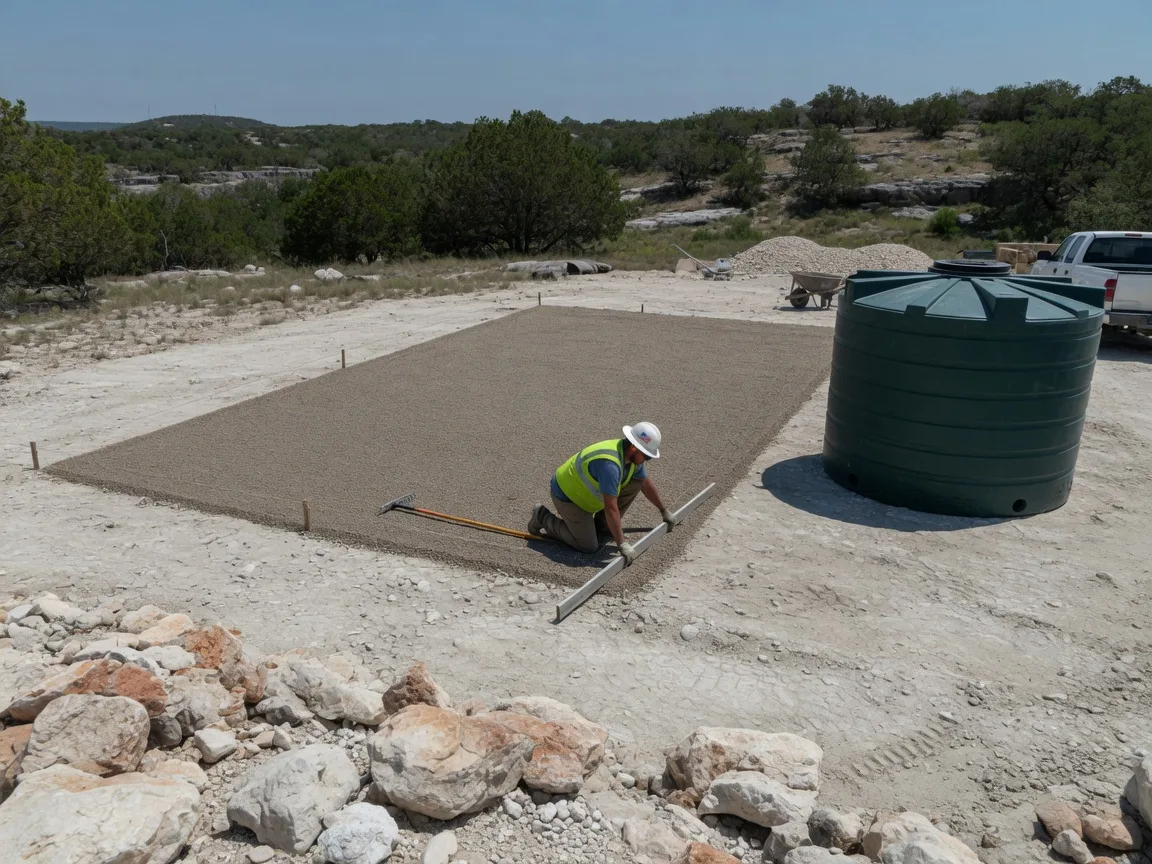
Conceptual illustration only -- not a construction detail. Use the tank manufacturer's specifications and site-specific professional design.
This article is for property-planning purposes and is not a construction drawing, engineering report, water-quality certification, plumbing design, legal opinion, or guarantee of system yield. For site-specific foundation questions, consult a structural or geotechnical engineer. For regulated potable or public-water work, hire a licensed plumber with a Water Supply Protection Specialist (WSPS) endorsement. For potable testing and treatment selection, use an accredited laboratory or qualified water-treatment professional. For utility, municipal, appraisal district, fire marshal, and HOA approvals, contact the respective authority.
Foundation Design Principles
Foundation design must follow the tank manufacturer's requirements and account for tank type and footprint, stored-water weight, empty-tank wind behavior, slope, drainage, fill depth and compaction, expansive or collapsible soil, fractured rock, karst voids, erosion, and seismic or wind loads where applicable. Large tanks and sites with slope, placed fill, uncertain caliche, fractured limestone, or possible voids should be evaluated by a qualified structural or geotechnical professional. Don't go with a thinner footing just because you see rock. Anchors or tie-downs must be approved for the tank model; improvised straps can damage a polyethylene tank or void its warranty [13][14].
Safety warning: Never enter a cistern. Tank entry is a confined-space hazard and should be performed only by properly equipped professionals.
Critical Details for Hill Country Sites
- Level the base in both directions. The completed base must meet the tank manufacturer's tolerances for levelness, flatness and continuous support. Don't use a universal allowable slope because requirements vary by tank design and diameter.
- Don't place a tank directly on bare limestone without fill. Follow the tank manufacturer's base detail. Many polyethylene tanks need smooth, level, continuously supported contact, which may mean removing projections and bridging minor surface irregularities with an approved base material. Don't improvise fill over fractures, depressions, or suspected voids.
- Account for slope and drainage. Grade the surrounding area and provide drainage that carries water away from the foundation without eroding or undermining it. Don't create a berm that traps water against the tank or base unless it's part of a professionally designed drainage system.
- Anchors and tie-downs. Anchors or tie-downs must be approved for the tank model; improvised straps can damage a polyethylene tank or void its warranty.
Foundation design should be based on the tank manufacturer's requirements and actual site conditions, not tank volume alone. Get site-specific professional review when your site has slope, uncontrolled fill, uncertain bearing, drainage concentration, settlement history, karst features or voids, when the tank will be buried, when significant grading or retaining work is required, or when the manufacturer or authority having jurisdiction requires engineered plans.
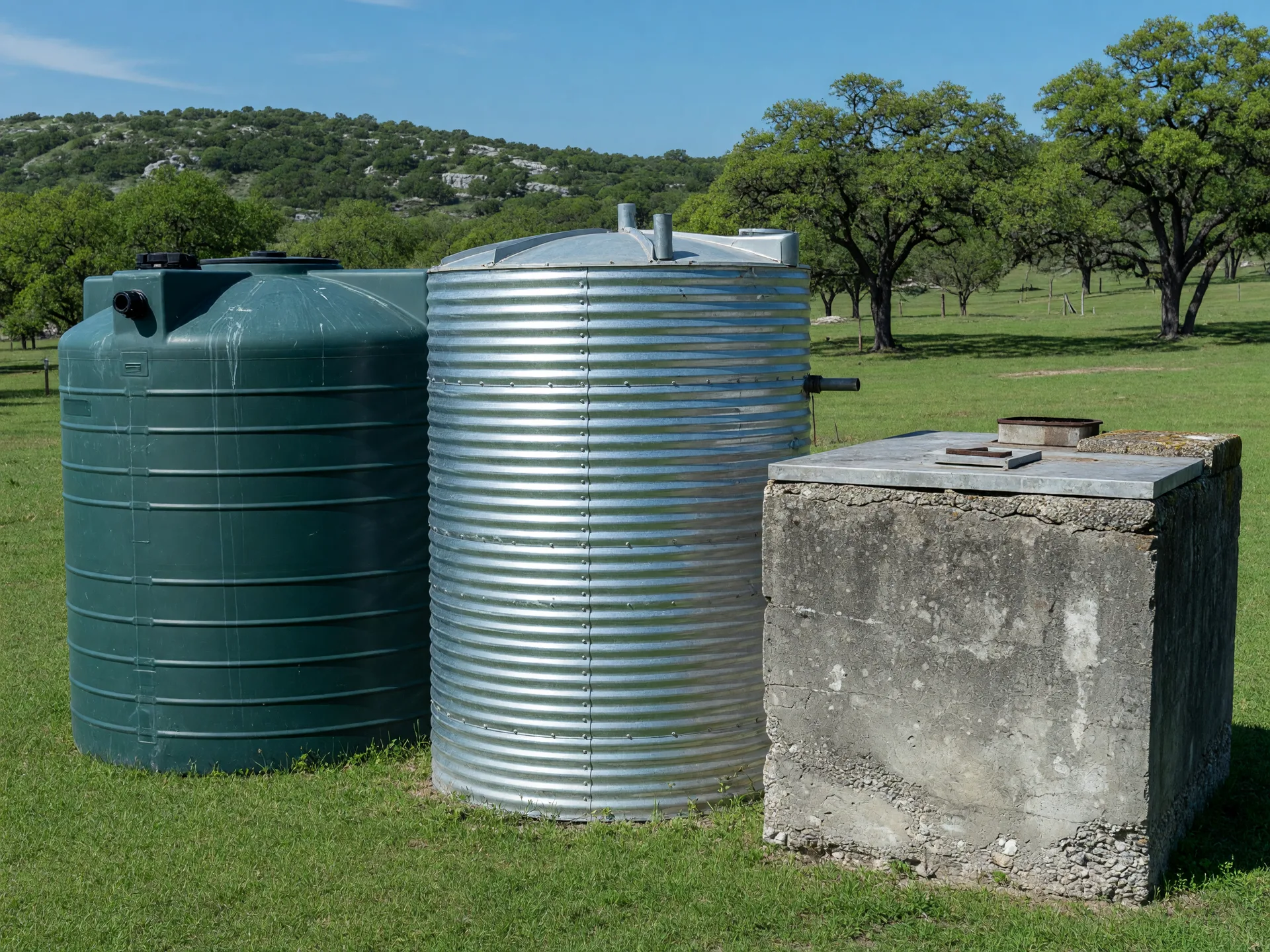
Tank Material Comparison: Polyethylene vs. Galvanized Metal vs. Concrete
Choosing the right tank material is a balance of cost, weight, durability, and how well it handles Hill Country conditions. Here's how the three most common options stack up.
| Factor | Polyethylene (Poly) | Galvanized Metal | Concrete |
|---|---|---|---|
| Cost (5,000 gal) | $1,500 - $3,500 | $2,500 - $5,000 | $4,000 - $8,000 |
| Cost (10,000 gal) | $2,500 - $5,500 | $4,000 - $8,000 | $7,000 - $14,000 |
| Weight (empty) | 300 - 600 lbs | 400 - 900 lbs | 4,000 - 8,000 lbs |
| Weight (full, 10k gal) | Stored water alone: ~83,400 lb. Add empty tank, cover, fittings, and equipment weight. | Stored water alone: ~83,400 lb. Add empty tank, cover, fittings, and equipment weight. | Stored water alone: ~83,400 lb. Add empty tank, cover, fittings, and equipment weight. |
| Foundation requirement | Manufacturer- and site-specific approved foundation | Manufacturer- and site-specific approved foundation | Engineered pad or ring beam; higher dead load |
| UV resistance | Light opacity and UV durability are different properties. An opaque tank helps limit light-driven biological growth, while outdoor durability depends on UV-stabilized resin, wall design, exposure and manufacturer specifications. | Good with proper coating | Excellent |
| Lifespan | 20 - 30 years | 20 - 40 years | 50+ years |
| Lifespan note | Service-life ranges are planning estimates, not guarantees. Confirm the manufacturer's warranty, installation conditions and maintenance requirements. | ||
| Algae risk | Low if dark-colored and sealed | Low if opaque and sealed | Very low (thick walls block light) |
| Widlfe resistance | Requres screened vents/overflows | Requires screened vents/overflows | Naturally resistant; sealed ports recommended |
| Hill Country notes | Lightest option; generally easier to transport and position before filling; still requires a level, smooth, continuously supported, manufacturer-approved base; may need tie-downs on hilltop sites | Modrate weight; check coating annually for corrosion on exposed sites | Heaviest option; may require crane delivery on steep lots; best for permanent installations |
Whch Material Works Best in the Hill Country?
Polyethylene is the most popular choice for Hill Country residential installations. It's the lightest, most affordable, and easiest to transport and place on uneven terrain. Dark-colored poly tanks (green or black) block UV light effectively and resist algae growth. Poly tank durability depends on UV stabilization, proper support, manufacturer warranty terms, impact damage, and installation quality rather than size alone.
Galvanized metal tanks offer a longer lifespan and a distinctive aesthetic that some homeowners prefer. They require proper coating to prevent corrosion, and the metal conducts heat, which can warm stored water in summer. For Hill Country installations, manufacturer-approved, corrosion-compatible fasteners and coatings are recommended; isolate dissimilar metals where specified.
Concrete tanks: A properly designed, installed and maintained concrete cistern can have a long service life. Performance depends on structural design, waterproofing, cracking control, water chemistry, site conditions and maintenance. They are the heaviest and most expensive to install, and are naturally resistant to UV damage and wildlife intrusion. On limestone sites, the foundation load must be evaluated by a structural engineer.
Texas Sales Tax Exemption for Rainwater Harvesting Equipment
Texas Tax Code Section 151.355 exempts rainwater harvesting equipment and supplies from state sales tax [6]. That's a meaningful saving -- at a location where the combined sales-tax rate is 8.25%, the exemption can save you $400 to $1,300 on a typical residential system purchase.
What Qualifies
The exemption covers equipment and supplies used to capture, store, and distribute rainwater, including:
- Storage tanks (polyethylene, metal, or concrete)
- Gutters, downspouts, and fittings
- First-flush diverters
- Filters, screns, and strainers
- Pumps, pressure tanks, and plumbing fittings
- UV disinfection units (for potable systems)
Qualification limits
Texas Tax Code Section 151.355 exempts qualifying rainwater-harvesting equipment and supplies and may also cover qualifying services used solely for water conservation. But don't assume that ever item or ever part of a mixed construction contract is exempt. An item or service qualifies only to the extent it's used solely for the statutory water-conservation purpose. General-purpose gutters, plumbing, electrical work, foundations or site improvements shouldn't be described as automatically exempt without confirming their qualifying use. Ask the vendor to identify qualifying charges and consult the Texas Comptroller when treatment of labor, foundation work, general plumbing, or a lump-sum contract is uncertain. Give the seller a properly completed Texas Sales and Use Tax Exemption Certification, Form 01-339, and keep the invoice and certificate [6].
How to Claim the Exemption
- Obtain Form 01-339 (Texas Sales and Use Tax Exemption Certificate) from the Texas Comptroller of Public Accounts. Downlad it at: comptroller.texas.gov/forms/01-339.pdf
- Complete the form: Fil in your name and address. Complete the Texas Sales and Use Tax Exemption Certification on the back of Form 01-339. Identify the purchaser and seller, describe the qualifying items or services, state the statutory basis -- for example, qualifying rainwater-harvesting equipment, services or supplies under Texas Tax Code Section 151.355 -- and sign and date the form. The form doesn't have a dedicated rainwater-harvesting checkbox.
- Present the form to the supplier at the time of purchase. The supplier needs the completed form before or at the point of sale -- not after. If you don't present the form, you'll be charged sales tax and must request a refund from the supplier.
- Keep a copy for your records. Retain the completed form and all purchase receipts for at least four years in case of a Comptroller audit.
- For online purchases: Whether a seller collects Texas tax doesn't determine whether the purchase is exempt. Keep the exemption certificate and supporting records for a qualifying purchase. If a purchase isn't exempt, Texas use tax may still be due even if the seller didn't collect it. Don't rely on the seller's nexus status as tax advice.
Important Notes
- Texas Tax Code Section 151.355 addresses qualifying equipment, services and supplies used solely for the statutory water-conservation purpose. Mixed-purpose construction, general home improvements and unrelated work are not automatically exempt. Ask the Comptroller or a qualified Texas tax professional about an invoice containing both qualifying and nonqualifying work.
- Present the certificate before purchase whenever possible. If sales tax was paid in error, a purchaser without a Texas sales-tax permit generally must first request a refund from the seller. The seller may refund the tax or issue Form 00-985, Assignment of Right to Refund, allowing the purchaser to file a claim with the Comptroller. Cite the Comptroller's current refund instructions [20]. Refund claims are generally subject to a four-year limitations period.
- The exemption is available to both residential and commercial purchasers.
Groundwater Conservation District Rebates and Incentives
Program terms and regulatory requirements were checked on August 18, 2026, but things can change. Double-check current eligibility and requirements with the administering agency before you buy equipment or start construction. Some utilities and municipalities offer rebates or credits, but programs vary by service area, funding, and application date. A groundwater district's conservation mission doesn't automatically mean it offers a residential cistern rebate. These programs change periodically, so always verify current availability before making purchasing decisions [7][8].
| Program | Amount | Eligibility (as of Aug 18, 2026) | Source |
|---|---|---|---|
| SAWS RainSaver | $1/gal, max $2,000, 500 gal min | Non-drinking use, no existing irrigation, plan approval required | gardenstylesanantonio.com |
| Boerne Utilities | $150 bill credit, 50 gal min | Existing Boerne Utilities customers, proof of purchase required | ci.boerne.tx.us |
| San Marcos | Unverified current amounts | Contact City water-conservation staff | sanmarcostx.gov |
San Antonio Water System (SAWS)
As of August 18, 2026, the SAWS residential cistern rebate is $1 per gallon, with a 500-gallon minimum and a $2,000 maximum. It's meant for non-drinking uses like landscape watering. Current requirements include plan approval, a signed and sealed structural engineer's approval for the base, inspections, registration after installation, a Customer Service Inspection, and possible backflow work depending on the installation. Your property can't have an existing irrigation system, and potable-water backup into the tank isn't allowed. You need to get approval before counting on the rebate [7].
City of San Marcos
An older official guideline describes rainwater-harvesting rebates, but current funding, amounts, eligibility, and application procedures couldn't be verified from a current official program page during this review. Contact the City's water-conservation staff before you buy equipment [8].
Boerne Utilities and Cow Creek Groundwater Conservation District
As of August 18, 2026, existing Boerne Utilities water customers may qualify for a $150 rainwater-harvesting bill credit for an installed tank with at least 50 gallons of storage. You'll need proof of purchase and photo documentation, and the rebate can't exceed the cost of eligible tank and installation or maintenance supplies. Contact Boerne Utilities for current eligibility and application procedures [7].
Cow Creek Groundwater Conservation District manages groundwater resources in Kendall County and publishes conservation information. No current district-funded homeowner rainwater-cistern rebate was verified for this article. Check the district's current website and contact its staff before relying on any program [22].
Edwards Aquifer Authority Grants
As of August 18, 2026, the Edwards Aquifer Authority's 2026 Groundwater Conservation Grant Program is for permit holders proposing qualified projects that improve agricultural irrigation efficiency. It shouldn't be presented as a general residential rainwater-cistern rebate or as funding for exempt-well homeowners [3].
Texas Statewide Incentives
Texas Tax Code Section 11.32 permits -- but doesn't require -- the governing body of an individual taxing unit to exempt part or all of the assessed value tied to an approved water-conservation initiative. This isn't an automatic statewide exemption, and it's not limited to homesteads. Availability can differ among the county, city, school district, and special districts serving the same property. Contact the appraisal district and ask which taxing units have adopted a qualifying exemption, which systems are approved, and what documentation and filing deadline apply [4].
The Rules You Need to Know
| Topic | Requirement |
|---|---|
| Sales tax | Form 01-339 presented at purchase; Section 151.355 |
| Property tax | Per-unit adoption under Section 11.32; not automatic |
| HOA | Section 202.007 limits prohibition but preserves architectural rules |
| Plumbing | applicable plumbing and water-provider requirements |
| Local approvals | Building, electrical, setback, floodplain, drainage, fire, HOA as applicable |
The First-Flush Diverter: Small Device, Big Impact
The Texas Manual on Rainwater Harvesting recommends starting with about 1 to 2 gallons of first-flush diversion for every 100 square feet of contributing roof area. That works out to about 20 to 40 gallons for a 2,000-square-foot catchment. You'll want to adjust that final amount based on your roof material and condition, nearby trees and animals, how long it's been since the last rain, rainfall intensity, and what you plan to use the water for. Potable-system designers may specify a different amount based on testing and site conditions [9].
Here's the thing: that initial runoff carries the highest concentration of contaminants -- dust, pollen, bird and rodent droppings, leaf residue, and any atmospheric pollutants that settled on the roof during the dry spell. In the Hill Country, where dry periods can last weeks, that first-flush load can be significant.
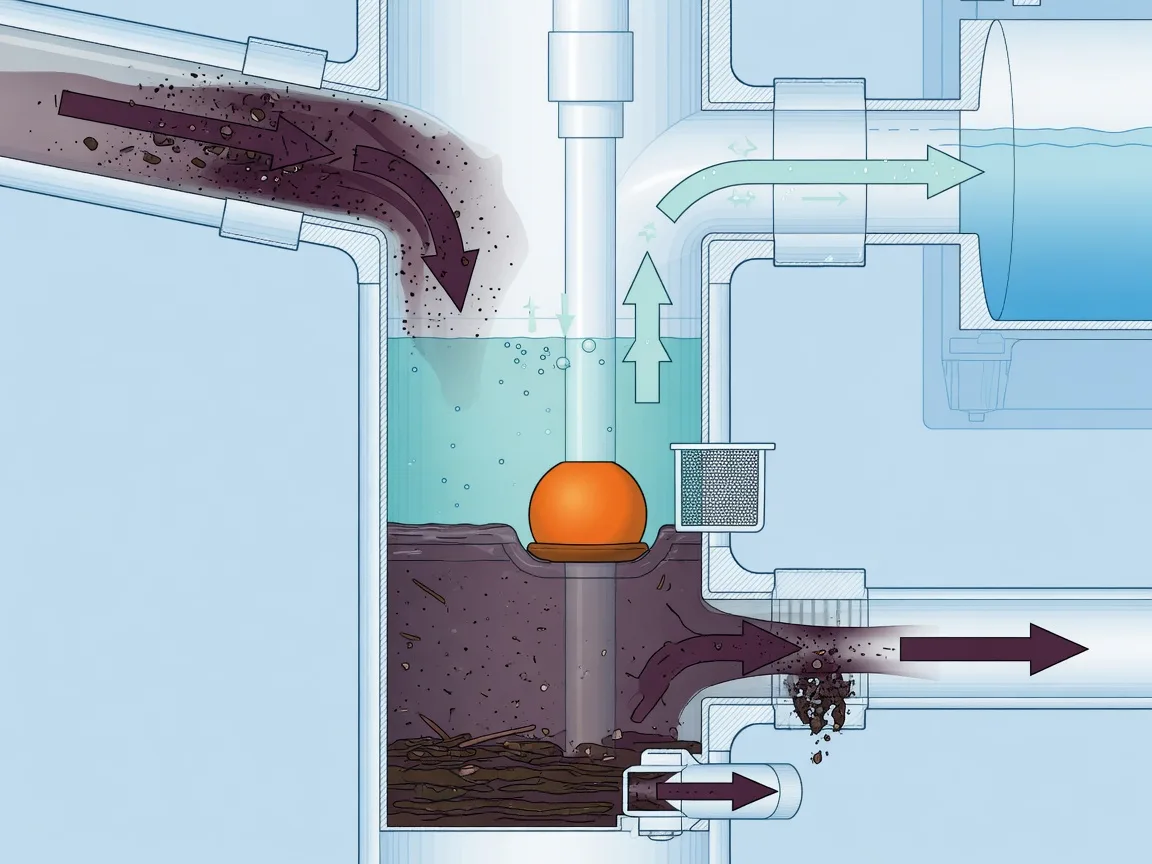
The most common design is a PVC standpipe with a slow-release valve at the bottom. The standpipe captures the dirty initial runoff. Once it fills up, the cleaner runoff that follows continues into your conveyance system and storage tank. The slow-release valve lets the standpipe gradually drain between storms so it's ready for the next event [12].
For a manually drained standpipe diverter, double-check that it drains and resets completely after each rainfall, and clean it when you see sediment or debris. Inspect automatic diverters after big storms and service them at the manufacturer's recommended interval. Check upstream screens and prefilters after substantial rainfall or when flow seems restricted.
Ongoing Maintenance: The Schedule That Keeps Your System Working
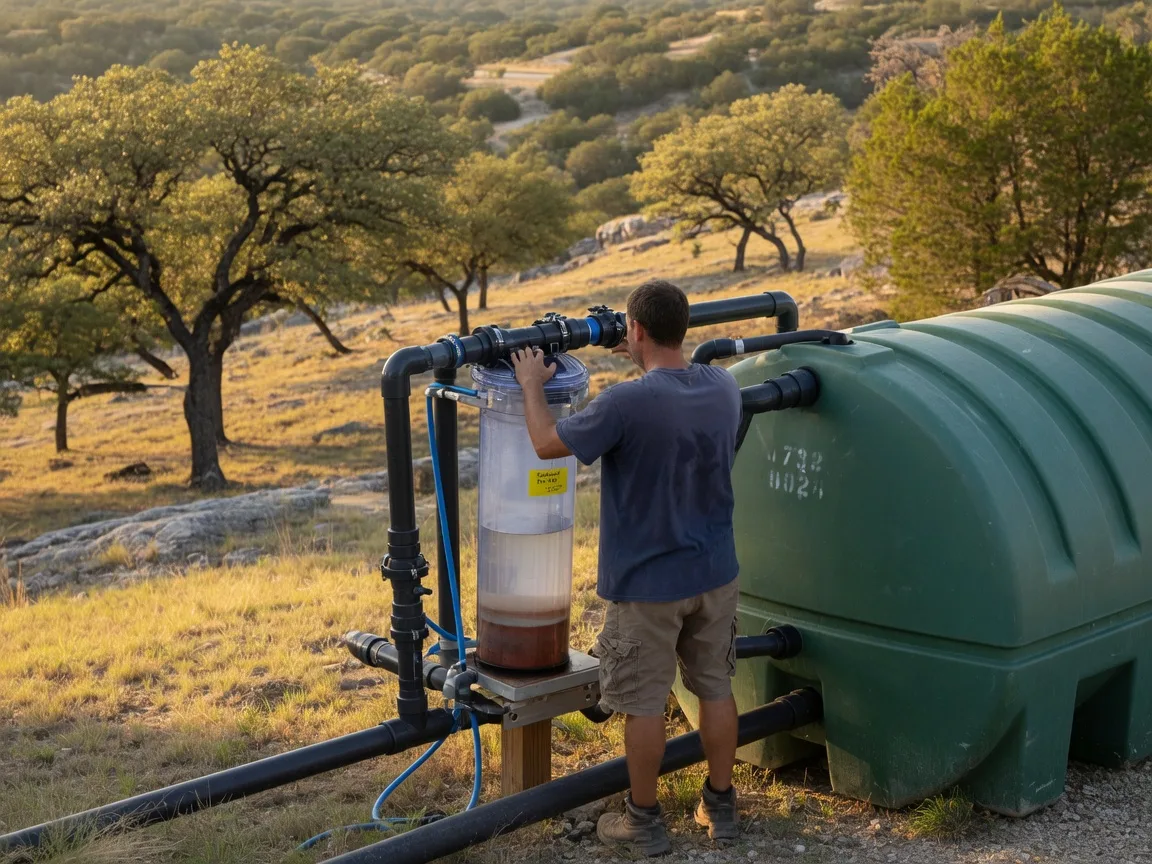
A rainwater system isn't install-and-forget. The Texas Manual on Rainwater Harvesting, published by the Texas Water Development Board, outlines a maintenance schedule that's straightforward but non-negotiable [9][12].
Monthly Tasks
- Inspect gutters and downspouts for debris
- Check first-flush diverter and drain if needed
- Inspect tank screen/vent for insect intrusion
- Check pump operation and pressure
Every 2 to 3 Months
- Replace or service sediment filters according to the manufacturer's instructions, pressure differential, water quality and actual use
- Visually inspect stored water and accessible interior surfaces through a safe inspection port without entering the tank or introducing contamination. Never enter a tank unless confined-space procedures and qualified personnel are used.
- Check all plumbing connections for leaks
Every 6 Months
- Clean gutters and downspouts thoroughly
- Inspect tank exterior for UV damage or structural issues
- Monitor sediment through the inspection port or other manufacturer-approved method. Remove accumulated sediment when inspection findings, water quality or the manufacturer's maintenance criteria indicate that service is needed, using an external drain or qualified tank-service provider.
- Inspect and clean leaf screens and gutter guards
Annually
- Replace or service UV lamps according to the manufacturer's instructions, monitored output and actual use
- Replace or service carbon filters according to the manufacturer's instructions, pressure differential, water quality and actual use
- Arrange professional inspection at the interval established by the system designer, equipment manufacturer and written operation-and-maintenance plan
- Laboratory testing (potable systems -- at least quarterly)
What the Law Says: Your Rights and Protections
Program terms and regulatory requirements were checked on August 18, 2026, but things can change. Double-check current eligibility and requirements with the administering agency before you buy equipment or start construction. Texas law is among the most supportive in the nation for rainwater harvesting [6]:
- No prohibition: Texas Property Code Section 202.007 limits an HOA's ability to ban rainwater harvesting, but it doesn't eliminate architectural-control rules. The statute preserves restrictions involving common or HOA-owned property, certain locations between the home and street, color, screening, visibility, size, type, and materials, subject to statutory limitations. Get and review the declaration and architectural rules, and get written approval where required before ordering a tank [6].
- No universal standalone rainwater-tank permit: Texas doesn't impose one universal standalone permit on every private residential rainwater tank. But that doesn't mean there aren't other approvals you might need. Construction in an Edwards Aquifer Recharge or Contributing Zone may require review under 30 TAC Chapter 213, including a Water Pollution Abatement Plan, Contributing Zone Plan or exception. Locally adopted plumbing, electrical, building and development requirements may also apply. Confirm your property's aquifer-zone status and contact the applicable city, county, TCEQ regional office and water provider before construction.
- Sales-tax exemption: Materials purchased for rainwater harvesting are exempt from Texas sales tax [6].
- Property-tax exemption: Texas Tax Code Section 11.32 permits an individual taxing unit to exempt part or all of the assessed value tied to an approved water-conservation initiative. This isn't an automatic statewide exemption. Check availability and filing requirements with the appraisal district [4].
- Building codes: While no state permit is required, your system must comply with applicable plumbing and water-provider requirements if connected to household plumbing, and local building departments may have setback or placement requirements for large tanks.
Operational Limitations
- Rainwater systems are not drought-proof; drought reduces both groundwater availability and tank replenishment.
- Overflow needs the same engineering attention as tank storage.
- Pumps and UV units stop during power failures unless backup power and safe shutdown controls exist.
- Exposed pipes, filters, valves, and pumps require freeze protection in Hill Country winter conditions.
- Mosquito-proof screening and secure access covers are essential.
- Untreated and nonpotable piping and outlets should be clearly labeled.
- Tanks must never be entered without confined-space procedures and proper equipment.
Before You Buy or Install a Rainwater System
- Define your intended use: irrigation, livestock, nonpotable indoor, potable, or emergency supply.
- Measure only the horizontal footprint of the roof area that will actually be guttered.
- Record roof material, age, coatings, overhanging vegetation, and potential contamination sources.
- Estimate actual monthly demand from water bills or fixture and irrigation calculations.
- Model monthly performance with historical rainfall and at least one dry-year scenario.
- Check tank siting against setbacks, easements, utilities, septic components, floodplain, drainage, access, and HOA rules.
- Get the tank manufacturer's foundation and anchoring requirements.
- Design screened overflow capacity and route overflow away from foundations, septic areas, slopes, neighboring property, and erosion-prone ground.
- Confirm plumbing, electrical, utility-notice, inspection, backflow, labeling, and potable-treatment requirements.
- Get rebate approval before buying equipment.
- Budget for pumps, electricity, filters, laboratory testing, inspections, replacement parts, and eventual tank cleaning -- not only the tank.
- Create a backup-water and power-outage plan.
When Buying a Property With an Existing Cistern
Ask for the tank make, model, capacity, age, warranty, installation invoices, foundation or engineering documents, permits and HOA approval, as-built plumbing diagram, utility notices, Customer Service Inspection and backflow records, treatment-component ages, maintenance log, recent laboratory results, overflow route, backup-water procedure, and pump and electrical records. Check whether the system is potable or nonpotable and whether it's included in the sale. Don't assume it's safe to drink or usable just because the tank is there.

Frequently Asked Questions
How much does a complete rainwater harvesting system cost in the Hill Country?
The table's component subtotals are about $4,450 to $10,800 for an irrigation-oriented system and $6,650 to $16,500 for a potable-oriented system. These aren't guaranteed installed prices. They exclude some or all engineering, foundation or pad work, excavation, drainage, delivery, crane access, electrical work, customer service inspection, backflow protection, laboratory testing, permitting, unusual plumbing modifications, and ongoing maintenance. The final installed price may be significantly higher. Get itemized local quotes that spell out every inclusion and exclusion.
Will a rainwater system provide enough water for my household?
EPA reports that the average American family uses more than 300 gallons per day at home, with roughly 70% used indoors. National averages are only a screening reference. Use your own water bills, occupancy, fixtures, irrigation demand, and conservation plan when sizing a system [4]. Using the article's conservative 33-inch annual assumption, a 2,000-square-foot horizontal catchment produces about 30,839 to 37,006 gallons per year at 75%-90% all-in collection efficiency. That's an annualized average of about 2,570 to 3,084 gallons per month. Actual monthly collection is highly uneven, so don't treat it as a dependable monthly allotment. There's no universal minimum tank size for whole-house rainwater supply. A larger tank can carry stored water through longer gaps between storms, but storage can't fix an annual supply deficit. Size the system with a water-balance model that considers catchment yield, actual household demand, overflow, treatment losses, desired reliability, and your backup-water plan. Irrigation-only use for landscaping and livestock is a far more realistic target for a single rainwater system.
Can I drink rainwater from a harvesting system?
Rainwater may be used for drinking only after you evaluate your catchment suitability, design and commission an appropriate treatment system, and keep testing the treated water to verify quality. A sediment filter, carbon filter, and UV disinfection device don't by themselves guarantee safe water. Treatment performance must be maintained and verified through ongoing testing, including after contamination events, treatment failures, or extended shutdowns.
Do I need a permit to install a rainwater system?
Texas doesn't impose one universal standalone permit for every rainwater tank, and a city or county can't deny a building permit solely because a project includes rainwater harvesting. Still, local building, plumbing, electrical, utility, floodplain, drainage, fire, onsite-sewage, setback, and HOA requirements may apply. Potable connections and public-water auxiliary supplies have additional state and utility requirements. Check requirements with the authority having jurisdiction before construction.
How long do rainwater tanks last?
Polyethylene tanks typically last 20 to 30 years with proper maintenance, metal tanks last 20 to 40 years, and concrete can exceed 50 years. Choose dark-colored tanks (green or black) to block UV light and prevent algae growth -- clear or translucent options let sunlight in and promote blooms. Protect stored-water quality by keeping light, animals, insects, debris, and contaminants out of the tank, and by maintaining screening, first-flush, and treatment components. Tank service life doesn't depend entirely on sediment. It also depends on tank material, UV stabilization, corrosion or coating performance, foundation support, installation quality, water chemistry, temperature, physical damage, maintenance, and manufacturer specifications.
Can I connect my rainwater system to my existing plumbing?
Yes, but the approach depends on your backup water source. Public-water auxiliary supply requires safeguards under Texas Health and Safety Code Section 341.042. Public water systems must require a customer service inspection in circumstances specified by TCEQ, including new construction, material plumbing modifications, and suspected cross-connection hazards. Installing dual-source plumbing will ordinarily require provider review. Confirm the provider's inspection, backflow-testing, and documentation procedures before construction [17]. Private-well backup must comply with the local plumbing authority and well rules.
What happens to my rainwater system during a drought restriction?
Treatment of stored rainwater during drought restrictions varies by municipality, utility, drought stage, system configuration, and labeling or registration requirements. Don't assume an exemption. Verify the current rules with your water provider before irrigating, and distinguish the utility's customer watering schedule from EAA pumping restrictions imposed on permit holders.
Related Reading
- Hill Country Water Guide: Wells, Municipal Supply, and What's Underground
- Boerne Property Tax Guide
- Limestone and Caliche: What It Means for Your Property
- California to Texas Relocation Checklist
- Property Tax Reality Check
- Growth Pressure and Infrastructure Strain
- Who Do I Call? Hill Country Directory
Sources
- Hill Country Alliance -- Rainwater Harvesting. hillcountryalliance.org
- NOAA National Centers for Environmental Information, 1991-2020 U.S. Climate Normals. Source: ncei.noaa.gov
- NOAA, Boerne Station USC00410902, 1991-2020 Annual/Seasonal Normals. ncei.noaa.gov
- Edwards Aquifer Authority -- Current Conditions. edwardsaquifer.org
- Texas Water Development Board -- Rainwater Harvesting FAQ. twdb.texas.gov
- Texas A&M AgriLife Extension -- Rainwater Harvesting, In-Home Use. rainwaterharvesting.tamu.edu
- Texas Property Code Section 202.007 and Texas Tax Code Section 151.355. statutes.capitol.texas.gov (Property Code) and statutes.capitol.texas.gov (Tax Code)
- San Antonio Water System -- RainSaver Rebate Program. Verified/accessed August 18, 2026. gardenstylesanantonio.com
- City of San Marcos -- Rainwater Harvesting (older guideline, unverified current). sanmarcostx.gov
- Texas Water Development Board -- The Texas Manual on Rainwater Harvesting (3rd Edition). twdb.texas.gov
- Symbiosis -- Rainwater Catchment Systems in Central Texas. (Contractor source) symbiosistx.com
- TCEQ RG-445, Rainwater Collection and Treatment for Public Water Systems. tceq.texas.gov
- Texas Water Newsroom -- How to Build a High-Volume Residential System. texaswaternewsroom.org
- Texas Metal Tanks -- Rain Harvesting System Design Overview. (Contractor source) texasmetaltanks.com
- Hill Country Homesteads -- Limestone and Caliche. hillcountryhomesteads.com
- Texas Health and Safety Code Section 341.042. statutes.capitol.texas.gov
- TCEQ -- Cross-Connection Control. tceq.texas.gov
- Texas State Board of Plumbing Examiners. tsbpe.texas.gov
- Texas Water Development Board -- Rainwater Harvesting Calculator. twdb.texas.gov
- Texas Comptroller of Public Accounts -- Sales Tax Exemption for Rainwater Harvesting. comptroller.texas.gov
- Texas Comptroller -- Assignment of Right to Refund (Form 00-985). comptroller.texas.gov
- Cow Creek Groundwater Conservation District. cowcreekgcd.org
- Texas Comptroller -- Form 01-339, Texas Sales and Use Tax Exemption Certification. comptroller.texas.gov
- Texas Tax Code Section 11.32, Property Tax Exemption for Water Conservation. statutes.capitol.texas.gov
This article is for property-planning purposes and is not a construction drawing, engineering report, water-quality certification, plumbing design, legal opinion, or guarantee of system yield. Consult qualified professionals for site-specific decisions.