A note on sourcing: this article is drawn from Texas A&M AgriLife Extension, the Texas A&M Natural Resources Institute, the Texas Department of Agriculture, the Texas Farm Bureau, Texas Parks and Wildlife Department, and county-level reports covering the Central Texas Hill Country. Population and damage figures are state estimates that move year to year, while the control methods, the legal steps, and the buying due-diligence points are current as of November 2026. Each source is cited at the end.
Feral hogs are the most destructive invasive species in the Texas Hill Country, and for anyone buying rural acreage in Boerne, Fair Oaks Ranch, Kendall County, Comal County, or Bandera County, they belong on the due-diligence checklist right alongside the well, the septic system, and the survey. Texas holds at least 3.5 million feral hogs, more than any other state, and their rooting, wallowing, and reproduction damage pastures, water sources, tree roots, and young plantings [1][2]. This article explains what that damage actually costs, how to read a property for hog activity before you make an offer, and which legal, working control methods genuinely reduce a population.
Two realities frame the problem. Feral hogs are not native wildlife; they are an invasive species with no natural predators in this region and an extraordinary reproductive rate, so their range and numbers keep growing across the state [1][2]. And because a sounder forages over hundreds of acres and crosses property lines freely, what happens on the neighbors' land affects what happens on yours [9]. For an acreage buyer, that means the hog question is not simply a lawn-and-garden nuisance, it is a land-management, water-quality, and resale consideration that should be checked before closing.
How much damage feral hogs actually cause
The state-level numbers are the reason this is worth taking seriously. Texas A&M AgriLife Extension has put statewide crop, livestock, and property damage at about $500 million for 2022 [1], and the Texas A&M Natural Resources Institute estimated 2024 agricultural losses above $670 million, with Texas landowners spending more than $130 million a year on mitigation [2]. In the Hill Country those numbers show up as rooted-out pastures, torn-up creek banks and wallows that muddy the water, pecan-grove losses, and lawns that look like they were rototilled overnight [10].
What hog damage looks like on a property
- Rooting / rototilling:
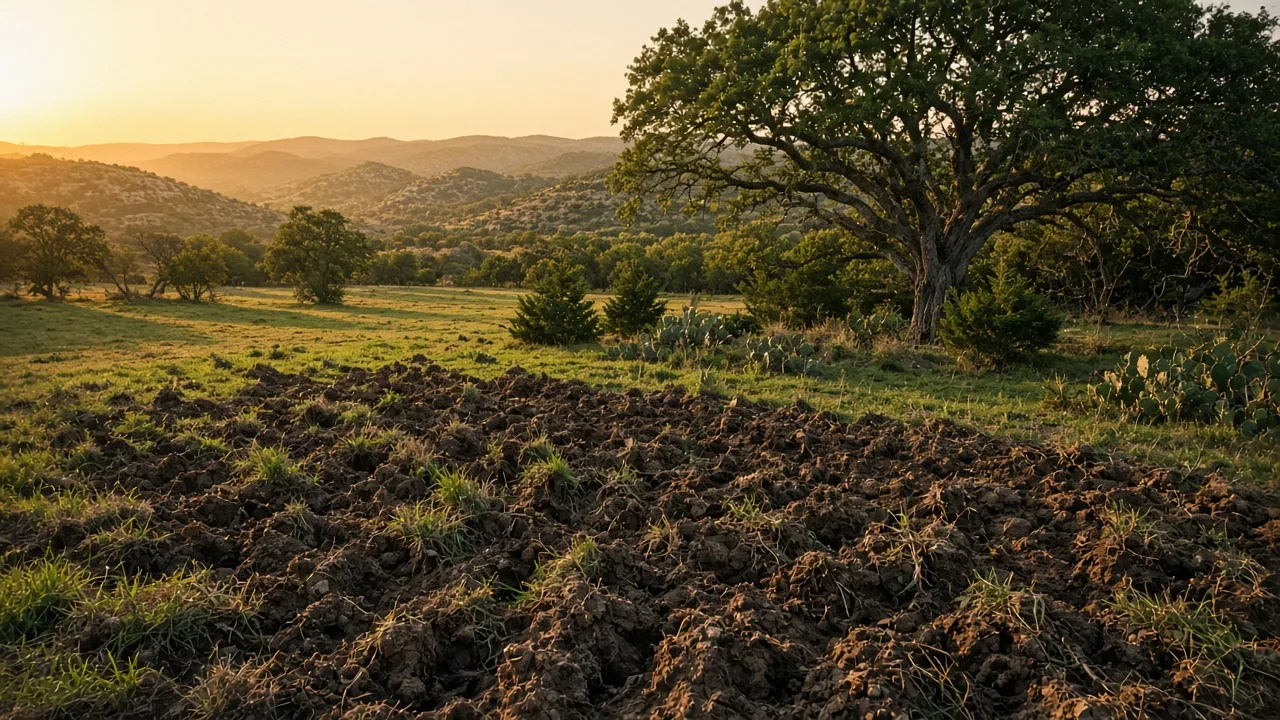
- shallow, torn-up sod in long, straight strips or "typewriter" furrows across pasture, lawn, or garden soil as hogs dig for roots, tubers, and grubs.
- Wallows:
- muddy, water-filled holes made as hogs cool off and coat themselves in mud, usually near creeks, springs, and low wet ground.
- Rubs and mud on trees:
- smoothed bark and caked mud at the base of oaks and fence posts where hogs scratch and mark.
- Tracks and trails:
- blocky, blunt cloven hoofprints wider than a deer's, plus worn game trails linking food, water, and cover.
- Scat and disturbed ground:
- piles of scat and fresh, wet digging at the edges of watered gardens and feed areas are the newest sign to watch.
Beyond the visible mess, hogs degrade water quality. Their wallowing and rooting cause erosion and soil compaction, and they concentrate bacteria in creeks and ponds, problems that matter in a region where water is already the scarcest resource on a Hill Country tract [2][4]. They also destroy tree root systems, damage young plantings and landscaping, and spread invasive plants, which is why the damage is felt not just in the first season but for years after hogs move on [2].
Reading a property for hog activity before you buy
You can check a candidate acreage for hog sign in a short walk, and it is worth doing before you loose an offer. Walk the creek and low ground first, because that is where hogs water, wallow, and travel. Look for torn-up sod, mud holes, rub marks and caked mud on trees, furrows at the edge of any watered garden, and game trails that connect cover to water. Hogs are most active at dusk and through the night, so fresh sign in the morning means the ground was worked recently [3][4].
Ask directly about the neighbors, not just the property line. Because a sounder ranges over many adjoining tracts, the presence of hogs next door is a fact you want to know about even if the tract you are buying looks quiet this week [9]. Ask the seller what hog activity they have seen, whether any control is underway, and whether the property is under any kind of wildlife-management or open-space agricultural tax valuation, because the control work you do will happen on that same ground. The site's guide to ag exemption and rollback tax risks covers the tax side of keeping rural land in its working use, and its raw-versus-improved land comparison walks the rest of the land-buying questions.
Time the check correctly. Hog sign is easiest to read in the cooler months, when hogs forage more and rooting is fresh, and trapping-season guidance also points to fall and winter as the productive window [4]. A dry midsummer walk can make a property look hog-free when the evidence is simply older and drier. If you are serious about a tract, revisit after rain or in the late season, and have a land or ag experienced professional walk it with you before closing.
What actually controls feral hogs
The short answer is that no single method controls a population, and hunting alone on a single tract rarely does [3][6]. Texas A&M and AgriLife recommend an integrated pest management approach that combines trapping, fencing where it pays off, and targeted shooting, applied consistently and ideally across neighboring properties [3][6].
| Control tool | How it works | Notes |
|---|---|---|
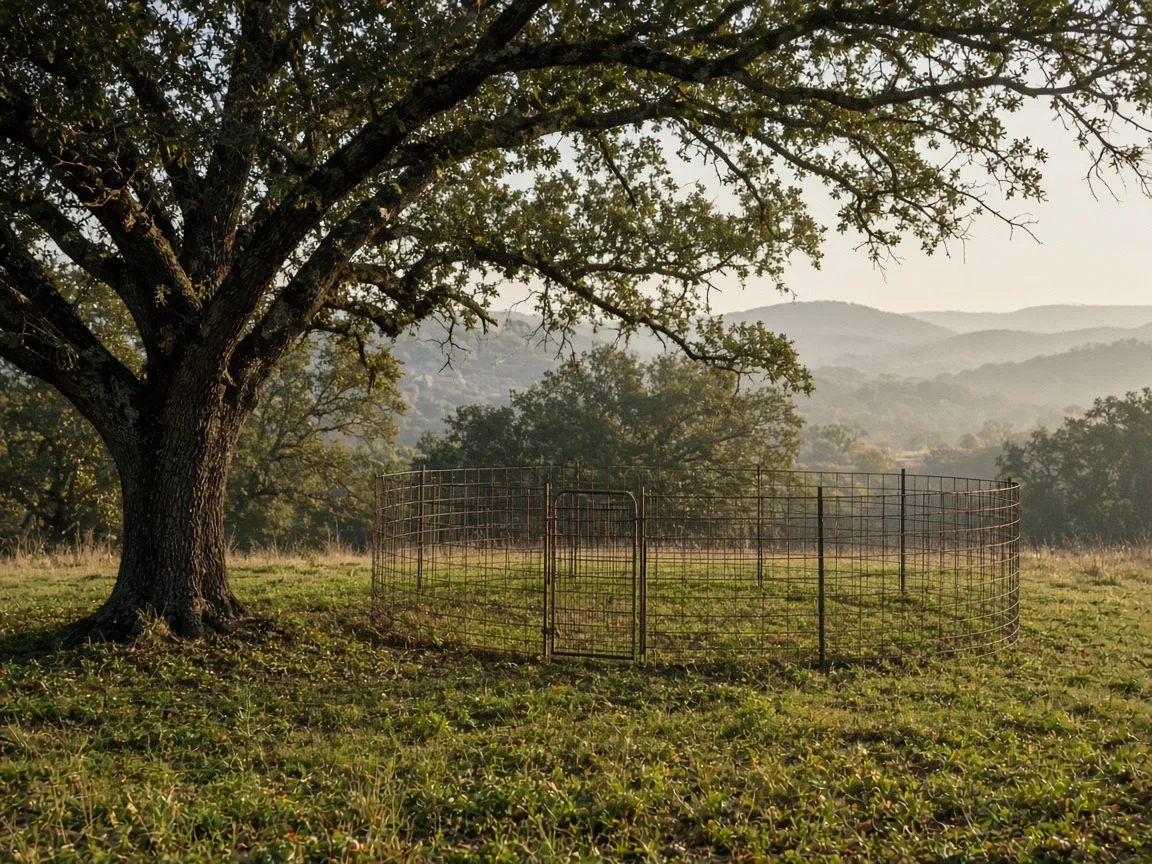
| Corral traps | Large enclosures with a one-way door that capture an entire sounder at once | Roughly four times more effective per capture than small box traps; the cornerstone of population control [4] |
| Drop traps | A panel suspended over a baited site, tripped to fall and trap the group below | Capture whole groups; requires careful placement and condition |
| Box traps | Single-animal cages often used in sensitive or small sites | Catch one or a few hogs at a time; more efficient as a supplement than a primary tool [4] |
| Exclusion fencing | Woven hog proof wire protecting gardens, feed areas, and orchard trees | Worth it only for high-value, small areas; rarely practical across broad pasture |
| Ground and aerial shooting | Removes individuals and sounders under skilled and legal conditions | No license required to take hogs on private land in Texas; hogs may be taken year-round [8] |
| Lethal toxicant bait | A warfarin based bait available since early 2024 | Restricted-use: may only be purchased and applied by a licensed pesticide applicator; not available to the general public [5][7] |
Trap placement, baiting, and timing shape results more than the trap type. Most successful programs pre-bait a site with shelled corn for one to three weeks before setting the trap, position traps on the trails that link food, water, and cover, and trap hardest in the cooler months [4].
Trapping is the most effective single tool, but it takes preparation: pre-baiting for one to three weeks, setting the trap on established hog trails, and leaving panels open until the sounder is coming in confidently before you set the trigger [4]. Because reproduction and immigration repopulate an area quickly, control work generally needs to remove roughly 70 percent of a local population each year just to hold it level [3]. That is a neighbor-wide project, which is why county trap programs, cooperative efforts among adjoining landowners, and community bounty programs produce better results than one isolated landowner [6][9].
There is also a legal convenience worth knowing: hogs may be taken on private land in Texas without a hunting license and year-round, which simplifies the shooting option [8]. But a shooting program alone, without trapping, generally reduces numbers only temporarily because the survivors breed fast [3][6]. The honest conclusion, echoed across every Texas source, is that effective control is trap-first, neighbor-coordinated, and sustained through the year [3][4][6][9].
What this means for a Boerne or Hill Country buyer
For a buyer, hogs should change the offer, not kill it. Hog pressure on a tract is a known, manageable condition in the Hill Country, and it does not need to be a dealbreaker the way an unpermitted septic or an unretirable well might be. What it should do is put a written plan into the purchase: confirm the current extent of activity before closing, understand the neighbors' situation, and budget for fence, trap, or shared-control work as a line item in the land budget the way you would for cedar control or a brush-clearing pass [10].
The practical costs are real. A permanent hog-proof fence around a garden or orchard runs into clear dollars, corral panels and bait run into low four figures depending on scale, and if the tract is large enough to warrant recurring removal, professional trapping or participation in a county program is often the most cost-effective route. Those are operating costs, not necessarily reasons to walk away. On larger rural tracts, hog-control work also lines up with the recurring property-maintenance reality of Hill Country ownership, which the site's guide to land clearing, oak wilt, and caliche costs and its real cost of owning acreage put in context.
Frequently asked questions
Do I need a license to hunt feral hogs on my own Texas land?
No. Feral hogs may be taken on private land in Texas without a hunting license and year-round [8]. Follow local rules on discharge of firearms and on any neighboring or restricted properties, and check any HOA or deed restrictions on the tract before you assume shooting is permitted on your own ground.
Will hogs make my water well or creek unsafe?
Hogs wallow in creeks, ponds, and low ground, which concentrates bacteria and speeds erosion and compaction in those areas [2]. These are surface-water and habitat concerns. Your private well is a separate system, and its safety is governed by the well's casing, depth, and bacteria testing rather than by surface activity. The site's guide to reading well logs and its Edwards Aquifer property guide cover the groundwater side of the question.
Is there a poison I can buy to get rid of hogs on my land?
As of 2024 there is one registered lethal toxicant bait for feral hogs in Texas, and it is a restricted-use product: it may only be purchased and applied by a licensed pesticide applicator, not by the general public, and no other toxicants, repellents, or fertility agents are registered for hogs [5][7]. Do not buy unregistered products; they are illegal and can kill nontarget wildlife.
Can I control hogs on just my five acres?
You can manage your own tract, but because hogs cross property lines freely, isolated efforts rarely reduce numbers for long, and reproduction overwhelms local gains unless control removes roughly 70 percent of the population each year [3]. Coordination with adjoining landowners or a county program is far more effective than working alone [6][9].
Should hog sign kill my offer on a Boerne-area acreage?
Not by itself. Hog pressure is common and manageable in the Hill Country, unlike an unpermitted septic system or a well that cannot produce. Treat it as a documented, budgeted operating condition of rural ownership with a written plan, and have a land-experienced professional confirm the extent before you close.
The bottom line
Feral hogs are a genuine, escalating factor in Hill Country acreage ownership, and they are a due-diligence item, not a mystery. Check for rooting, wallows, and rubs before you buy, ask about the neighbors and any current control effort, time the check for the cooler months when sign is fresh, and go in knowing that controlling hogs is a trap-first, neighbor-coordinated, year-round project rather than a one-week fix [3][4][6][9]. Budget for it the way you would for cedar work, and it becomes a routine part of owning rural land in Texas [10]. The site's rural services directory and its easements and access guide are good companions for any acreage buyer working through the full due-diligence list.
Sources
- Texas A&M AgriLife Extension, Feral Hog Abatement Project. At least 3.5 million feral hogs in Texas and 2022 crop, livestock, and property damage of about $500 million. agecoext.tamu.edu
- Texas A&M Natural Resources Institute, feralhogs.tamu.edu, Impacts. 2024 agricultural losses above $670 million, more than $130 million in annual landowner mitigation spending, and the mechanisms of damage including erosion, water-quality degradation, tree-root damage, and invasive-plant spread. feralhogs.tamu.edu
- Texas A&M Natural Resources Institute, Feral Hog Management. Integrated management, the roughly 70 percent annual removal needed to hold a population, and the limits of hunting alone. feralhogs.tamu.edu
- Texas A&M Natural Resources Institute, Placing and Baiting Feral Hog Traps. Corral traps roughly four times more effective than box traps, one-to-three-week pre-baiting, trap placement on hog trails, and cooler-month timing. nri.tamu.edu
- Texas Department of Agriculture, Feral Hog Pesticide. Restricted-use registration for the warfarin-based feral hog toxicant and the licensed-applicator requirement. texasagriculture.gov
- Texas Farm Bureau, Tools available to help Texans control feral hog population. Corral and drop traps, snares, shooting, and the argument for a group, cooperative approach. texasfarmbureau.org
- Texas Farm Bureau, Toxicant available to help farmers, ranchers control feral hogs. February 2024 availability of the toxicant and its licensed-applicator restriction. texasfarmbureau.org
- Texas Parks and Wildlife Department. Feral hogs may be taken on private land year-round without a hunting license. tpwd.texas.gov
- Texas Association of Counties, Feral hog abatement programs. County trap and bounty programs and why cooperative abatement works where isolated efforts fail. county.org
- Hill Country News, Controlling wild pigs can work if it is a group effort. Ground-level experience of Central Texas landowners with hog damage and control across the region. hillcountrynews.com
This article is general land-buying and land-management education, not pesticide, wildlife, or legal advice. Register and apply any toxicant strictly per Texas Department of Agriculture rules, confirm local firearm rules and deed restrictions on your own tract, and verify current population and county-program details before you act.
Last verified: November 10, 2026
Published: November 10, 2026
Updated November 10, 2026