
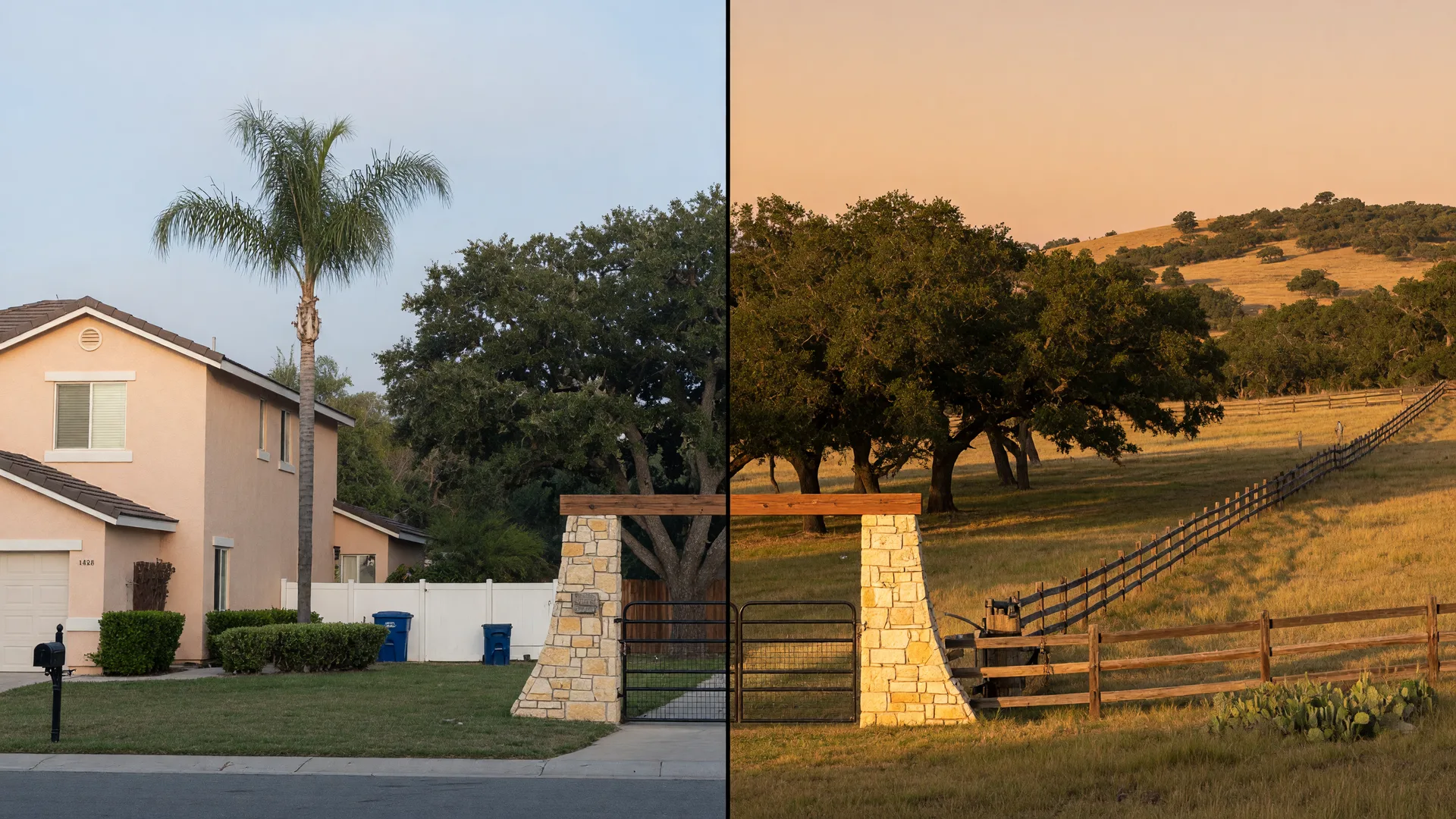
If you own investment property in California and you are thinking about moving your equity into Texas, the 1031 exchange is one of the most powerful tools available for deferring a large capital gains tax bill. Under Section 1031 of the Internal Revenue Code, you can sell investment or business real estate and reinvest the proceeds into like-kind real estate without recognizing the gain at the time of the sale, as long as you follow strict deadlines and work through a qualified intermediary [1]. Because Texas has no state income tax and offers some of the most attractive investment land in the country, the Hill Country is a common destination for this kind of cross-state exchange. Here is how it actually works, what the deadlines are, and what California owners should know before they start.
Let me be direct about the most common misunderstanding: a 1031 exchange defers the tax, it does not erase it. You are rolling your gain forward into a new asset, and the deferred gain comes due when you eventually sell that replacement property without doing another exchange. The power of the tool is that you can keep deferring across a lifetime of properties, and it is especially useful for California owners who hold real estate that has appreciated substantially [1][5].
What qualifies for a 1031 exchange
Since the Tax Cuts and Jobs Act of 2017, only real property qualifies for a 1031 exchange. Personal property such as equipment, vehicles, and business inventory no longer does. Under current law, the exchange must involve real estate held for productive use in a trade or business or for investment [1][3]. That is the key phrase, and it rules out the most important thing people assume: your primary residence does not qualify. A home you live in is handled by the home sale exclusion under Section 121, not by a 1031 exchange [4].
What does qualify includes rental houses and small multifamily buildings, land held for investment, ranch and farmland, commercial property, and even a vacation or short-term rental property, provided it is genuinely held and operated as an investment rather than used personally in a way that makes it a personal residence. The IRS laid out the rules for vacation rentals in Revenue Procedure 2008-16, and the test comes down to how the property is actually used [10][11]. If the property is primarily for your personal use, it will not survive an audit as a 1031 replacement.
In practical terms for California investors looking at Texas, this opens a wide field of Hill Country options: raw acreage held for appreciation, ranch land, a long-term rental house in Boerne or Fair Oaks Ranch, or a short-term rental operated as an investment. Because all real estate in the United States is considered like-kind to other U.S. real estate, the exchange works across state lines. You can sell a California rental and buy Texas land without breaking the like-kind requirement [3][10].

The two deadlines that make or break the exchange
A deferred 1031 exchange runs on two clocks, and they both start on the day your relinquished California property is transferred. They run at the same time, not one after the other, and neither is extended for weekends or holidays [1][2].
The 45-day identification period. Within 45 days of closing on your California property, you must identify in writing the replacement property you intend to acquire. The identification must be a signed document delivered to your qualified intermediary before midnight of the 45th day. You can identify up to three potential replacement properties, or more than three only if their combined value stays under 200 percent of the value of the property you sold, and there is a related 95 percent rule for the exceptions [1][2].
The 180-day exchange period. You must close on the replacement property by the earlier of 180 days after the California sale, or the due date (including extensions) of your federal tax return for the year of the sale. In most cases the 180-day window is what binds, but if your return is due sooner, the earlier date wins [1][2].
1031 Exchange Timeline at a Glance
| Deadline | Clock Starts | What Must Happen |
|---|---|---|
| 45-day identification | Day the California property transfers | Sign and deliver identification of replacement property to the qualified intermediary |
| 180-day completion | Same day (runs concurrently) | Close on the replacement property, by the earlier of 180 days or your tax return due date |
Sources: IRC Section 1031; IPX1031 deadline guidance. The two periods run concurrently from the transfer date and are not extended for weekends or holidays.
Here is the practical consequence for anyone buying in the Hill Country: the Texas property needs to be identified within 45 days, which means you need to know what you want and have it under contract quickly. If you wait until after the California closing to start looking, you are spending your identification window searching. For a first-time 1031 buyer, that is the most common failure point, and it is completely avoidable with early planning [2].
The qualified intermediary is not optional
To defer the gain, you cannot receive the cash from your California sale. The moment you take constructive receipt of the proceeds, the exchange fails and the tax becomes due. This is why the sale proceeds are held by a qualified intermediary (QI), a third party that controls the funds and uses them to complete the purchase of your replacement property [1][2].
You should select the qualified intermediary before your California property closes. The QI receives the identification document, holds the proceeds through the exchange period, and disburses them at the replacement closing. Trying to add a qualified intermediary after the sale closes is too late, because the proceeds have already been handled in a way that breaks the exchange [2].
Boot: why you must reinvest all of it
To defer the entire gain, you generally need to reinvest all of the net sale proceeds and acquire replacement property of equal or greater value, and take on equal or greater debt. Any value you receive that is not like-kind is called boot, and boot is taxable to the extent of your gain [9].
Boot comes in two common forms. Cash boot is any sale proceeds you do not reinvest, including money taken out at closing. Mortgage boot is the amount of debt relief you receive: if your California property had a $200,000 mortgage and your Texas replacement has only a $150,000 loan, the $50,000 difference is treated as boot, even if you never saw a dollar of it [9].
This is where California sellers get surprised. If you have owned a California investment property for many years, it may have substantial equity and a relatively small mortgage. Reinvesting the full proceeds into a Hill Country property of equal or greater value is usually straightforward because Texas land and homes can absorb that equity, but you have to intentionally structure the transaction so no cash and no debt relief slip out [9].

Reverse exchanges and build-to-suit exchanges
Not every California investor wants to sell first and buy second. Two variations handle the other ordering, and both have become more common for people moving into the Texas market.
Reverse exchange. A reverse 1031 exchange lets you acquire the replacement property before you sell the relinquished one, which can be useful if you find the right Hill Country property first. To keep the exchange valid, the replacement property is parked with an exchange accommodation titleholder under the safe harbor of Revenue Procedure 2000-37. The same 45-day and 180-day windows apply, but in a reverse exchange the clock starts when the replacement property is acquired, not when the California sale closes [7].
Build-to-suit (improvement) exchange. A build-to-suit exchange lets you use exchange proceeds to fund construction or improvements on the replacement property, which is relevant if you buy raw Hill Country land and plan to build. The 45-day identification must cover both the land and the planned improvements, and the construction must be completed within the 180-day exchange period for those improvement costs to count toward deferral. Only improvements finished within the window count, and an exchange accommodation titleholder typically holds title during the work [8].
Both of these are more complex and more expensive to execute, and they should be set up with an experienced qualified intermediary and tax counsel before any contract is signed. For most California investors doing a straightforward sale-then-purchase, a standard deferred exchange is the right starting point.
The California clawback rule: what follows your gain to Texas
Moving to Texas does not make your California gain disappear. This is the detail that surprises the most people, so I want to be clear about it.
California conforms to Section 1031, so the gain on your California investment property can be deferred for California purposes as well as federal. But California has a clawback rule: the deferred gain on the relinquished California property remains taxable to California even after you move the investment to Texas, and it can follow you even if you become a Texas resident. You report the exchange on Franchise Tax Board Form 3840 each year until the deferred gain is recognized, and California will tax that deferred gain when the replacement property is eventually sold, unless you keep exchanging or the asset passes through your estate with a stepped-up basis [5][6].
There is also a California withholding requirement. When a California property sells, roughly 3.33 percent of the gross sale price is generally withheld and remitted to the Franchise Tax Board unless an exemption applies. In a 1031 exchange the withholding may still apply at the source and be refunded or credited later, so you should confirm the withholding treatment with your exchange accommodator and tax preparer before closing [6].
The practical takeaway is that a 1031 exchange into Texas is an excellent deferral strategy, but it is not an exit from California tax. That is a decision best made with a qualified tax professional who understands both states, and it should be part of your planning before you commit to the exchange [5][6].
Why the Hill Country, and what Texas adds to the equation
Beyond the straightforward appeal of moving investment capital out of a high-tax state, Texas adds two structural advantages for a 1031 buyer.
First, there is no state income tax in Texas, so once your gain is deferred into a Texas asset, you are not generating California-style income-tax exposure on the ongoing income from that property. Second, Texas has special property tax valuation for land in agricultural use. Under the state's ag-use and open-space valuations, qualifying ranch and farmland is assessed at its agricultural productivity value rather than its full market value, which can lower the property tax bill substantially [12]. The rules are specific, the land must be in genuine agricultural use, and there are rollback tax consequences if you lose the designation, so I wrote a separate deep dive on how ag exemptions and rollback taxes actually work for Hill Country land.
For California owners, this combination is genuinely attractive: defer the California gain, move into a state with no income tax, and potentially hold land under a favorable ag valuation. But none of it happens by accident. It is structured. I have walked California investors through the property tax reality of moving to Texas before, and the same discipline applies here, understand the numbers before you commit.
The practical path for a California-to-Hill-Country exchange
If this sounds like your situation, here is the sequence I recommend, roughly in order:
1. Confirm your California property qualifies. It must be held for investment or business use, not as a primary residence. If it is a vacation rental, review how it has actually been used against Revenue Procedure 2008-16 [4][10].
2. Line up the team before you sell. Select a qualified intermediary, a tax advisor who knows both states, and a Texas real estate professional who understands 1031 timing. Ask the intermediary directly how many cross-state exchanges they have handled and how they manage the 45-day identification clock [2].
3. Know your replacement target early. Because you have only 45 days to identify, you should already know the Hill Country communities and property types you are considering. I cover the fit of specific communities like Boerne and Fair Oaks Ranch, and the difference between raw land and improved land, so you can narrow your list before the clock starts.
4. Plan for the full reinvestment. Make sure the replacement property's value and debt are at least equal to what you sold, so no boot is triggered. If you are buying land and building, understand the build-to-suit rules and the 180-day completion limit [8][9].
5. Execute on the deadlines. Deliver your written identification to the intermediary within 45 days, and close within 180 days. A standard Hill Country transaction can close comfortably inside that window if the property is already identified and under contract [2].
6. Manage the California side. File Form 3840 each year until the deferred gain is recognized, and confirm the withholding treatment at closing so there are no surprises [5][6].
Thinking about a 1031 exchange into Hill Country property?
I work with California investors and relocating families every week, and I understand both the exchange mechanics and the local realities of the land, the wells, the infrastructure, and the communities. No scripts, just a direct conversation about your timeline, your equity, and the property that fits your goals.
Contact Bill Ross | Coordinating a Multi-State ClosingFrequently asked questions
Can I use a 1031 exchange to buy a Texas home that will be my primary residence?
No. A 1031 exchange applies only to property held for investment or business use. If the Texas property will be your primary residence, it does not qualify as a replacement for a 1031 exchange. Your California investment sale may still qualify for an exchange if you acquire a separate Texas investment property, and your eventual primary residence purchase would be a separate transaction using the home sale exclusion under Section 121 where applicable [1][4].
What happens if I miss the 45-day identification deadline?
The exchange fails, and you recognize the gain on the sale of your California property in the year of the sale. The deadlines are strict and are not extended for weekends, holidays, or delays. The only general relief comes through IRS-declared disaster extensions. Missing the identification window is the most common avoidable failure, which is why you should identify your replacement target and have your qualified intermediary in place before your California property closes [1][2].
Does a 1031 exchange work for land in the Texas Hill Country?
Yes. Raw land, ranch land, farmland, and investment real estate all qualify as like-kind replacement property under Section 1031, and real estate anywhere in the United States is like-kind to other U.S. real estate. Land held for appreciation or leased for agricultural use is a legitimate replacement property. If you buy land and plan to build, a build-to-suit exchange can fund the improvements, but the construction must be completed within the 180-day exchange period to count toward deferral [1][8][11].
Is a vacation rental in the Hill Country a valid 1031 replacement property?
It can be, but only if it is genuinely held and operated as an investment under the standards in Revenue Procedure 2008-16. The IRS looks at how the property is actually used, including whether it is rented out at market rates and how much personal use it receives. A property used primarily for personal vacations will not qualify. If you are considering a short-term rental as your replacement, structure it and document it as an investment and review the facts with a tax advisor before committing [10].
If I move to Texas, do I still owe California tax on the deferred gain?
Yes, in most cases. California's clawback rule keeps the deferred gain on your relinquished California property taxable to California even after you move the replacement investment out of state and become a Texas resident. You report the exchange annually on California Form 3840, and California taxes the deferred gain when the replacement property is eventually sold unless you keep exchanging or the asset passes with a stepped-up basis. A 1031 exchange into Texas defers the gain, it does not eliminate California's claim on it, so plan with a tax professional who understands both states [5][6].
What is the difference between a 1031 exchange and a reverse 1031 exchange?
In a standard (forward) exchange, you sell the California property first and acquire the replacement within the 45-day and 180-day windows. In a reverse exchange, you acquire the replacement property first and sell the relinquished property afterward, using an exchange accommodation titleholder to hold the new property under Revenue Procedure 2000-37. The same 45-day and 180-day windows apply, but in a reverse exchange the clock starts when the replacement property is acquired. Reverse exchanges are more complex and cost more to set up [7].
Sources
- Cornell Legal Information Institute, 26 U.S. Code Section 1031, Exchange of real property held for productive use or investment. The statutory basis for like-kind exchanges, including the investment/business-use requirement and the exclusion of personal property since the Tax Cuts and Jobs Act. law.cornell.edu
- IPX1031, Delayed 1031 Exchange: Timelines, Deadlines and Identification Requirements. Details on the concurrent 45-day identification and 180-day exchange periods, the three-property and 200 percent rules, and the qualified intermediary requirement. ipx1031.com
- The Tax Adviser (AICPA), Like-kind exchanges of real estate: Building on the basics. Overview of like-kind exchange rules as they apply to real property after the Tax Cuts and Jobs Act. thetaxadviser.com
- Realized 1031, Can I Do a 1031 Exchange With My Primary Residence? Explanation of why primary residences do not qualify for a 1031 exchange and how the home sale exclusion under Section 121 applies instead. realized1031.com
- California Franchise Tax Board, Reporting Like-Kind Exchanges. How California conforms to Section 1031, the annual Form 3840 reporting requirement, and how deferred gain is tracked for California purposes. ftb.ca.gov
- Peak Exchange, California 1031 Exchange Clawback Rule. Explanation of how California taxes the deferred gain on out-of-state replacement property, including the clawback that follows the gain even for new Texas residents. peakexchange.com
- Atlas 1031, Reverse 1031 Exchange Rules and Timeline. How a reverse exchange works under Revenue Procedure 2000-37, including the exchange accommodation titleholder and the start of the 45-day and 180-day clocks. atlas1031.com
- IPX1031, Build-to-Suit 1031 Exchange: Improvement Exchanges Explained. How a build-to-suit exchange funds improvements, the identification of planned improvements, and the 180-day completion requirement. ipx1031.com
- Deferred.com, 1031 Exchange Boot: Cash Boot, Mortgage Boot, and Taxable Boot. What boot is, how cash boot and mortgage (debt relief) boot trigger recognized gain, and how to avoid it by reinvesting fully. deferred.com
- Leader Bank, 1031 Exchange Services in Texas. How ranch, farmland, and vacation rental properties qualify as replacement property in Texas under Revenue Procedure 2008-16. leaderbank.com
- Realized 1031, Can a 1031 Exchange Be Used for Farmland? How farmland, ranch land, and raw land qualify as like-kind replacement property. realized1031.com
- Austin Central Appraisal District, Texas Ag-Use and Open-Space Valuation Guidelines. How Texas assesses qualifying agricultural land at productivity value rather than market value under the 1-d and 1-d-1 valuations, and the rollback tax consequences. austincad.org
Last verified: September 2, 2026
Published: September 2, 2026
Updated September 2, 2026