

Missing property records can create avoidable friction during the option period, title review, insurance underwriting and loan processing, precisely when the buyer, lender, insurer and title company are working against contractual deadlines. The buyer's title company, lender, inspector, and insurer all ask for records, and a well-organized file does not guarantee a closing or preserve a negotiated price, but it reduces the number of avoidable document questions that arise after contract. Sellers who have to hunt mid-option usually pay for the delay in amendments, price cuts, or a terminated contract. Start on the documents before you set the list price. This is the pre-listing records checklist I use with sellers in Boerne, Fair Oaks Ranch, San Antonio, and the surrounding Hill Country counties, and it is the same list the buyer's team works from.
Many of the underlying records already exist, but some must be requested, updated or created for the current transaction. The goal is to identify what you already have, recover what is missing and flag what needs a fresh report, declaration or test before it becomes a contract issue.
The master checklist: eleven records buyers will request
Not every buyer requests all eleven, and they do not arrive in any fixed order. The list below is the range this market actually asks for, so treat it as the working document for your listing. For each record, the table shows what it proves, where a seller typically finds it, and the gotcha that trips people up on that specific paper.
| Record | What it proves | Where sellers find it | Typical gotcha |
|---|---|---|---|
| Existing Survey + T-47 Affidavit or T-47.1 Declaration | Depicts the surveyed boundary lines and the improvements, fences, easements and other matters shown on the survey. An existing survey may be acceptable to the title company if it accurately depicts the property and satisfies the title company's underwriting requirements. For residential transactions involving area-and-boundary coverage, the title company may rely on a T-47 Residential Real Property Affidavit or the T-47.1 Residential Real Property Declaration in Lieu of Affidavit. T-47.1, effective November 1, 2024, is an unsworn alternative to the notarized T-47 [5]. On Hill Country ranchettes with private roads, the recorded access easement and any road-maintenance agreement is exactly what a title company flags mid-option, the same pattern as the survey gap this row covers. | Locate the prior closing file or contact the title company that handled the purchase. An existing survey is not automatically acceptable for a new transaction. If the current TREC contract calls for the seller to furnish an existing survey, the seller may also be required to provide a T-47 affidavit or T-47.1 declaration. The title company and, when applicable, the lender determine whether the existing survey is acceptable. | |
| Permit and approval history | Documents permits, approvals and recorded inspections that exist for improvements subject to the applicable jurisdiction's requirements | Start with the authority having jurisdiction over the property. Inside an incorporated city, that is typically the municipal permitting or development-services department. In an unincorporated area, relevant records may instead be held by county development, OSSF, floodplain, right-of-way, fire-marshal or other offices. Requirements vary by jurisdiction and improvement. | Missing permits or approvals can create questions for buyers, inspectors, lenders, insurers or title personnel when the work becomes apparent during due diligence. For pools, buyers also ask for the permit, barrier compliance with the fence and gate, and equipment age, and the pool contractors guide on this site covers the builder side. pool contractors guide |
| Roof warranty and roof invoices | The shingle brand, the coverage term, and whether coverage transfers with the house | The roofer's original invoice and the manufacturer's warranty registration | Transferability depends on the manufacturer, warranty tier, installation date and registration history. Some warranties allow only one transfer, but the notification deadline and fee vary substantially. Confirm the exact warranty document before representing transferable coverage to a buyer [21][22][23] |
| Insurance claims history (CLUE) | Property claims filed over the past seven years | Your own CLUE report, free once a year, or your insurer's claims history [12] | Insurers commonly use CLUE information in underwriting. A CLUE report generally contains property claims information from the previous seven years. A prospective buyer generally asks the current owner for the property report, while the buyer's insurer may use CLUE information independently during underwriting. A hail claim from six years ago appears there whether you mention it or not, so pull your own copy first [12] |
| Well log and water tests | Well depth, static water level, yield, and water quality history | The driller's report filed with the state and searchable through TWDB and TCEQ databases, plus any lab results you have [13][14] | A driller's report from decades ago is history, not evidence; limestone-country buyers want current flow data plus bacteria and nitrate tests, and annual testing is the recommended cadence for private wells [15] |
| Septic/OSSF permit and maintenance records | System type (conventional or aerobic), permit status, and service history | County OSSF records and your maintenance provider's service records for aerobic systems | Texas OSSF rules provide for the permit to transfer automatically when the property is sold, but aerobic treatment units and other systems requiring secondary treatment or disinfection have continuing maintenance requirements. The precise service arrangement depends on the system, the initial service-policy period and applicable local rules, and after the initial service-policy period an owner of a single-family residence may in some circumstances maintain the system personally rather than retain a commercial maintenance provider. Verify the current requirements with the local authorized agent [6][7] |
| Propane tank ownership | Whether the tank is owned outright or leased, and which supplier services it | Your propane supplier's account records and the label on the tank itself; leased tanks carry the supplier's marking | A leased tank belongs to the supplier, not to you; some supplier contracts run on auto-renewal or call for the buyer to qualify before closing, and ownership needs to be proven on paper, not assumed from who filled the tank last [18] |
| Ag or wildlife valuation (1-d-1) records | That acreage under a Texas 1-d-1 open-space or wildlife-management valuation is documented, and what a buyer must do to keep the benefit | The county appraisal district's file on the property, the current agricultural or wildlife plan, and your history of qualifying use | The exemption does not follow the new owner automatically; if the qualifying use stops, the district can roll back taxes for prior years plus interest, and that bill can run into five figures, the kind of surprise that lands on the table mid-option |
| HOA Resale Certificate & Bylaws | Legally details your neighborhood rules, assessment fees, and any active property violations. Texas Property Code §207.003 requires a property owners' association to deliver the subdivision information no later than the 10th business day after it receives a valid written request and verifies any required authority. Under Texas Property Code §207.003(c), the association may charge a reasonable and necessary fee, not exceeding $375, to assemble, copy and deliver the subdivision information. An update is capped at $75. Those limits apply to the statutory document-production/update charges; they should not be described as a universal cap on every transfer fee, deposit, assessment or other HOA-related charge that may arise in a sale. Chapter 207 does not govern condominium associations subject to Chapters 81 or 82 [3][4]. | Submit a formal written application directly to your neighborhood Property Owners' Association (POA) board or their contracted management company web portal (e.g., TownSq, HomewiseDocs). | |
| Solar lease or PPA agreement | Whether the panels are owned, leased, or under a power purchase agreement, and who owns the system at closing | The solar contract itself, the installer's records, and the title file | Panels owned free and clear ordinarily convey with the property as part of the transaction, but sellers should verify whether any solar loan, security interest, fixture filing, installer obligation or other financing remains outstanding. Lease and PPA transfer requirements are contract-specific and may include buyer qualification, assumption documents, payoff options or provider approval. Either way the agreement is a disclosure item [19][20] |
| Major repair receipts | The age of major systems, the dates of significant roof work, and whether the work sat under warranty | Contractor invoices, home warranty records, and your closing file | A receipt proves what something cost in the year it was done; it does not buy the buyer a new roof or compressor today, and buyers still inspect and price the age of the equipment on their own terms. On expansive clay soils, a transferable structural repair warranty, the piering and tiebacks, is a document buyers ask about the same way they ask about the roof, and the foundation inspection and repair guide on this site covers what transfers. foundation inspection and repair guide |
The order matters less than completeness. On acreage properties the records that cause the most friction are usually the well, the septic system, and the propane tank, because each involves a third party with registration, transfer, ownership, or maintenance rights you can forget about until closing [13][6][16].

Property records versus statutory and contractual disclosures
This article is a property-records checklist, not an exhaustive list of every disclosure, notice or contract addendum that can apply to a Texas sale. Additional requirements can depend on the property's age, location, utilities, water rights, taxing or assessment districts, HOA/condominium status and other characteristics.
Sort the checklist into three groups. What Texas or federal law actually requires sits in the first group, and it is smaller than most sellers expect. What the contract and its TREC addenda make mandatory sits in the second. The ten records in this checklist are practical transaction records, not an exhaustive catalog of Texas disclosures and notices. Separate statutory, contractual or federally required disclosures can apply depending on the property's age, location, HOA status, utilities, water rights, taxing or assessment districts and other characteristics.
Statutory disclosures: required by Texas or federal law
Texas Property Code §5.008 generally requires a seller of residential real property comprising not more than one dwelling unit to provide the statutory Seller's Disclosure Notice, subject to the statute's exemptions. TREC Form 55-1 is an approved form that may be used to satisfy that requirement [1][2].
One exemption is particularly relevant to estate property: §5.008 does not apply to certain transfers made by a fiduciary in the course of administering a decedent's estate, guardianship, conservatorship or trust. That does not mean every property sold after an owner's death is automatically exempt; the capacity in which the property is being transferred matters [1][2]. The disclosure form covers what you know, and it produces none of the third-party records on this list, which is exactly why the folder matters no matter how carefully the form gets filled out [1][2].
If the parties enter into the contract before the required notice is delivered, §5.008(f) allows the purchaser to terminate the contract for any reason within seven days after receiving the notice [1][2]. Getting the form out early and completely removes the issue before it can form.
Conditional disclosure for pre-1978 homes
For most covered residential property built before 1978, federal law requires the applicable lead-based-paint disclosure and delivery of available lead-related records and reports. TREC Form 56-0 is an approved Texas form that may be used to comply with that federal disclosure requirement [10][11].
When selling a property within a subdivision or master-planned community managed by an association, Texas law places strict obligations on how financial data is shared. Under Texas Property Code § 207.003, once a valid written request is received and any required authority is verified, the association must deliver the complete certificate and all governing documents no later than the 10th business day [3][4].
Texas Property Code §207.003 requires a property owners' association to deliver the subdivision information no later than the 10th business day after it receives a valid written request and verifies any required authority. Under Texas Property Code §207.003(c), the association may charge a reasonable and necessary fee, not exceeding $375, to assemble, copy and deliver the subdivision information. An update is capped at $75. Those limits apply to the statutory document-production/update charges; they should not be described as a universal cap on every transfer fee, deposit, assessment or other HOA-related charge that may arise in a sale. The statute allows a request from an owner or the owner's agent, a purchaser or the purchaser's agent, or a title company or its agent acting on behalf of an owner or purchaser, so the seller is not always the party that orders and pays for the package. In a transaction using TREC's POA addendum, the parties specify who obtains and pays for the subdivision information [3][4].
The resale certificate identifies matters such as regular and special assessments, amounts currently due, transfer fees, violations and certain financial information about the association. The statute also gives legal significance to what the association does, or does not, disclose in the certificate [3][4]. Chapter 207 does not govern condominium associations subject to Chapters 81 or 82.

Contractual and property-specific disclosures
Water paperwork deserves separate attention in the Hill Country. Effective July 1, 2026, TREC added Form 61-0, Seller's Disclosure About Groundwater and Surface Water Rights, to the current contract framework. When an applicable current TREC contract is used, the disclosure is generally required by the contract unless all of the contract's stated exception conditions are satisfied. TREC specifically notes that this disclosure is not independently required by another law. The Residential Condominium Contract is excluded from this requirement [8][9].
An exemption from the Seller's Disclosure Notice under Texas Property Code §5.008 does not automatically exempt the seller from the contractual water-rights disclosure [8][9].
The form addresses matters such as wells, groundwater rights that may have been severed, sold or leased, wells serving or located on other property, watercourses and certain surface-water rights, and it is separate from a well log or laboratory water test [8][9].
Do not confuse a leased or owned individual propane tank with property located in a statutory propane gas system service area. Texas law provides a separate purchaser-notice requirement for property in such a service area, and TREC provides an Addendum for Property in a Propane Gas System Service Area (Form 47-0) [16][17].
Prudent due-diligence records: what a well-prepared seller assembles
Under the state's on-site sewage facility rules, 30 TAC Chapter 285, an existing OSSF permit transfers with the sale automatically by default [6]. Aerobic treatment units and other systems requiring secondary treatment or disinfection have continuing maintenance requirements, but the precise service arrangement depends on the system, the initial service-policy period and applicable local rules. After the initial service-policy period, an owner of a single-family residence may in some circumstances maintain the system personally rather than retain a commercial maintenance provider [7]. Local authorized agents may impose additional or more stringent inspection, reporting, maintenance or administrative requirements, so sellers should confirm county or municipal requirements before listing [6][7]. Sellers should also verify the current requirements with the local authorized agent, and a missing permit record is exactly the kind of gap the buyer's inspection finds [6][7].
Insurers commonly use Comprehensive Loss Underwriting Exchange (CLUE) information in underwriting. A CLUE report generally contains property claims information from the previous seven years [12]. A property owner can obtain a free copy of the report and dispute inaccurate information. A prospective buyer generally asks the current owner for the property report, while the buyer's insurer may use CLUE information independently during underwriting [12].
No statute requires you to hand over a survey, a water test, or a roof warranty with the listing. The buyer's side enforces them anyway: lenders want a survey current enough to underwrite, well inspectors test the water whether or not a test sits in your folder, and a warranty that cannot transfer is marketing copy instead of property value [13][15][21]. In Kendall, Bexar, Comal, and Bandera counties the working assumption is that a prepared seller answers all of it from one folder, and the sellers who can answer those questions quickly remove avoidable uncertainty from the transaction.
On acreage and ranchette properties the well comes up first. The driller's report of depth, casing, and static water level from the day the well was drilled is filed with the state, and it is recoverable years later even when the homeowner's copy went missing [13][14]. For wells drilled in 2003 or later, start with the Texas Water Development Board's Submitted Drillers Reports database. Older records may be in TCEQ's historical Water Well Report Viewer; wells drilled during the transition period can appear in either system. Property location, coordinates, owner information and approximate drilling date can help narrow the search, and a local groundwater conservation district may have additional registration or permit records. The water-quality side of the file is yours to keep current: annual bacteria and nitrate testing is the recommended cadence for private wells, and it is the same guidance the Texas groundwater authorities hand to home buyers, so a recent clean lab panel is worth more to a buyer than any story about how good the water tastes [14][15]. For the layer beneath the records, the aquifer geology, the well depth behavior, and how the Edwards Aquifer shapes Hill Country properties, the Edwards Aquifer buyer guide on this site digs into what the records will not tell you. Edwards Aquifer buyer guide

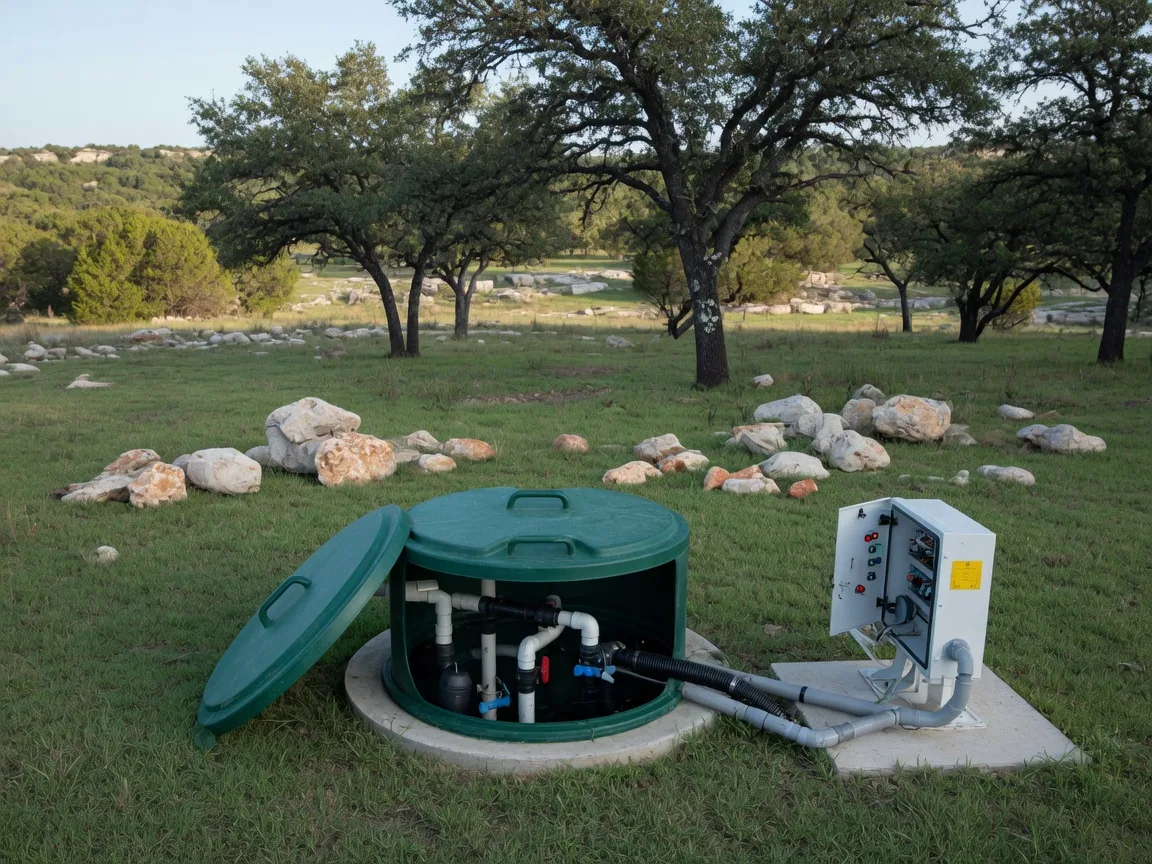
Septic systems sit one step deeper. The OSSF permit transfers to the buyer automatically by operation of the sale under 30 TAC Chapter 285 [6]. For most OSSFs, locate the permit and approval records maintained by the applicable authorized agent. If no permit can be found, do not assume either that the system is illegal or that it is exempt. TCEQ recognizes limited permitting exceptions, including qualifying systems under the 10-acre rule and certain grandfathered systems, so confirm the system's status with the local OSSF authority [6]. Systems requiring secondary treatment, drip irrigation or surface application have continuing maintenance, testing and reporting obligations. During the initial service-policy period, the applicable service policy follows the system. After that period, a qualifying single-family homeowner may maintain certain systems personally where the local authorized agent permits it. Local jurisdictions may impose stricter requirements [6][7]. Both the permit record and the service history belong in the folder, and the aerobic septic guide on this site goes further into the maintenance side of that requirement. aerobic septic guide
Roofs, propane tanks, and solar follow the same pattern with extra paperwork attached to each. A transferable warranty has real dollar value only if the new owner actually completes the transfer, and there is no single uniform rule across shingle manufacturers: transferability depends on the manufacturer, warranty tier, installation date and registration history [21][22][23]. Some warranties allow only one transfer, but the notification deadline and fee vary substantially. For example, the current GAF Shingle & Accessory Limited Warranty allows one transfer and requires the second owner to notify GAF within one year after the property transfer. CertainTeed states that many warranties are transferable once and that its transferability rules depend on the applicable warranty. Owens Corning warranty terms vary by warranty program. Confirm the exact warranty document before representing transferable coverage to a buyer; confirming the specific terms takes one phone call, and it belongs on the pre-listing list. And if you carry a home warranty plan, whether it transfers to the buyer is a cheap, easy credibility point buyers ask about.
Propane tanks come down to ownership. First determine whether the tank is owned or leased and review the applicable contract documents. A leased propane tank may require treatment under the contract's fixture-lease provisions [18]. For an owned tank, verify how the tank is to convey rather than categorically describing every tank as personal property. Supplier contracts differ on auto-renewal and on whether the buyer has to qualify for service before closing, and the ownership question gets resolved by the supplier's records, not by whoever happened to fill the tank last [18].
Solar follows the same pattern with its own paperwork. Panels owned free and clear ordinarily convey with the property as part of the transaction, but sellers should verify whether any solar loan, security interest, fixture filing, installer obligation or other financing remains outstanding. Lease and PPA transfer requirements are contract-specific and may include buyer qualification, assumption documents, payoff options or provider approval, so the lease or PPA agreement is a disclosure item either way, and it belongs in the buyer's hands early [19][20].

What it means for you as the seller
A complete folder rarely raises the price a buyer offers. That is not the point of it. The point is protecting the number you already agreed to at signature. When a buyer discovers during the option period that the roof warranty never transferred or the septic maintenance requirements were not current, the conversation turns into who pays and how much, and the discount usually comes out of the price, not the inspection. When the same facts sit in the folder on day one, the buyer priced the risk into the contract before the inspection ever happened [6][7][21].

Two groups of sellers lean on this checklist harder than any others. Executors and heirs selling an estate usually start with records scattered or lost, and no buyer slows down for the executor's situation, so the folder matters twice as much there; the estate and executor side of that work has a dedicated resource at texasprobatehomes.net. Out-of-state buyers and their agents may place additional value on written documentation because they often have less opportunity to investigate the property in person; the relocation side of this market is covered at movetotexas.net. Hand both groups the same folder and the process stays short and predictable.
There is also a property-tax point worth explaining to buyers. A seller's accumulated 10% homestead appraisal limitation does not simply transfer to the purchaser. Under Texas Tax Code §23.23, the limitation expires on January 1 of the first tax year in which neither the owner for whom the limitation took effect nor that owner's spouse or surviving spouse qualifies for the residence-homestead exemption. The appraisal district continues to determine the property's market value under Texas appraisal law; the new market value is not automatically the purchase price. A buyer should therefore avoid estimating future taxes solely from the seller's current tax bill.
The classic mistakes sellers make
-
Mistake #1: Assuming an Old Survey Is All the Title Company Needs
Finding the old survey is only the first step. The title company decides whether it will accept that survey for the current transaction. Depending on the transaction and requested title coverage, the seller may be asked to complete a T-47 affidavit or T-47.1 declaration identifying changes since the survey. Pools, additions, detached structures, fence relocations, easements or other changes can cause the title company to require a new or updated survey. Survey-cost allocation depends on the contract [5].
- Skipping your own CLUE report. The claims trail follows the property for seven years, you get one free report per year by law, and a hail claim you forgot about is still a data point in the claims history tied to the property [12].
- Assuming the roof warranty transfers itself. Transferability depends on the manufacturer, warranty tier, installation date and registration history: some warranties allow only one transfer, but the notification deadline and fee vary substantially, and consequences for a late filing vary by warranty. One phone call to the manufacturer confirms the terms before you promise them in the listing [21][22][23].
- Treating the propane tank like a utility. A leased tank belongs to the supplier, contracts differ on auto-renewal and buyer qualification, and ownership needs to be proven on paper, not assumed from who filled the tank last [18].
- Forgetting the well has a record somewhere. Driller's reports are filed with the state and recoverable through TWDB and TCEQ databases, but recovery is not guaranteed to be immediate. For wells drilled in 2003 or later, start with the Texas Water Development Board's Submitted Drillers Reports database. Older records may be in TCEQ's historical Water Well Report Viewer; wells drilled during the transition period can appear in either system. The fresh bacteria and nitrate test is the part only you can schedule [13][14][15].
-
Mistake #6: Waiting Too Long — or Ordering Too Early — for the HOA Resale Certificate
Texas Property Code §207.003 generally gives the association until the 10th business day after a valid written request and verification of any required authority to deliver the subdivision information. But the resale certificate included with that information must also be recent: it must have been prepared no earlier than the 60th day before delivery. The practical answer is to gather the HOA contact information and governing documents early, then coordinate the certificate request with the contract timeline rather than treating the listing date as the automatic order date [3][4].
- Describing the solar as included without the paperwork. Panels owned free and clear ordinarily convey with the property as part of the transaction, but sellers should verify whether any solar loan, security interest, fixture filing, installer obligation or other financing remains outstanding. Lease and PPA transfer requirements are contract-specific and may include buyer qualification, assumption documents, payoff options or provider approval, and the agreement is a disclosure item either way [19][20].
- Leaving the land out of the folder. Buyers in this market ask about oak wilt on their own; if you treated live oaks, the arborist invoices and treatment dates belong next to the roof receipts, and the oak wilt guide on this site explains why it matters so much here. oak wilt guide
- Treating the ag or wildlife exemption like it transfers by itself. For acreage under a Texas 1-d-1 open-space or wildlife-management valuation, the exemption does not follow the new owner automatically, and if the qualifying use stops, the appraisal district can roll back taxes with a bill that can run into five figures. A buyer who wants to keep the benefit needs the current plan plus the district's paperwork trail, and for an acreage seller this is a bigger gap than the propane tank, not a footnote to it; the acreage homes guide on this site covers how these valuations work on Hill Country land. acreage homes guide
The pre-listing checklist: what to do before the sign goes up
Most sellers can build the folder in a weekend once they know what to look for. Work it in this order:
- Pull the closing file and find the survey, the deed, and the prior title policy. Check the survey's date against the fence, shop, pool, and any addition built after it.
- Identify the authority having jurisdiction before searching for permits. For property inside a municipality, check municipal permit records. For unincorporated property, check the applicable county development, septic, floodplain, driveway/right-of-way, fire-code and other records. Do not assume every Hill Country county issues a conventional residential building permit for every improvement.
- Find the roof paperwork: the original invoice, the warranty registration, and the transfer form. Confirm the transfer terms with the manufacturer before the warranty gets promised in the listing [21][22][23].
- Request your CLUE report, free once a year, and read it before the listing goes live; a claims item from six years ago is easier to know about first [12].
- Recover the well history by the age of the well. For wells drilled in 2003 or later, start with the Texas Water Development Board's Submitted Drillers Reports database. Older records may be in TCEQ's historical Water Well Report Viewer; wells drilled during the transition period can appear in either system. Property location, coordinates, owner information and approximate drilling date can help narrow the search, and a local groundwater conservation district may have additional registration or permit records. Then dig out the latest lab results; if the last bacteria and nitrate test is more than a year old, schedule a new one [13][14][15].
- If the transaction will use a current TREC contract, determine early whether Form 61-0 will be required and gather the information needed to complete it [8][9].
- Confirm the OSSF's permitting status with the applicable local authorized agent and obtain the permit/approval records if a permit was required, and check the aerobic system's maintenance arrangement against the local authorized agent's current requirements; both are checkable in one phone call [6][7].
- Identify the propane tank in writing: owned or leased, the supplier, and the contract terms. Ask the supplier for the account documents so the file says what the tank is [18].
- Gather the association's governing documents and contact information before listing, but time the resale-certificate request with the anticipated transaction. Texas law requires the resale certificate delivered under Chapter 207 to have been prepared no earlier than the 60th day before delivery. If you order one before a buyer is under contract, calendar the 60-day age of the certificate and confirm whether an update or new certificate will be needed before delivery [3][4].
- Assemble the solar paperwork, where applicable: the purchase or lease/PPA agreement, payoff or transfer information, warranty documents, utility interconnection or permission-to-operate paperwork, and any financing information affecting transfer. Confirm the transfer requirements with the solar company before showings begin [19][20].
- Round up receipts and warranty paperwork for major repairs from the last five years, roof, HVAC, water heater, septic service, well work, and treated oak wilt, and put the whole set in one binder; the home inspection checklist on this site lists what the buyer's inspector will try to verify. home inspection checklist
Keep a complete seller file, but do not post every document publicly with the listing. Before records are uploaded or shared broadly, remove unnecessary account numbers, loan information, signatures, access credentials and other personal information. Full documents can be provided through the appropriate transaction channel when needed.
Frequently asked questions
Am I required by law to give a buyer my survey or water test?
No. Texas Property Code 5.008 generally requires a seller of residential real property comprising not more than one dwelling unit to provide a written Seller's Disclosure Notice, subject to statutory exemptions, and that form covers known condition, not third-party records [1][2]. Surveys, water tests, and CLUE reports are market practice in this market: requested constantly, never required by statute, and worth providing anyway [12][13].
Can I reuse the survey map from when I originally purchased my Hill Country home?
An existing survey may be acceptable to the title company if it accurately depicts the property and satisfies the title company's underwriting requirements. Depending on the transaction and requested title coverage, the seller may be asked to complete a T-47 affidavit or T-47.1 declaration identifying changes since the survey. Pools, additions, detached structures, fence relocations, easements or other changes can cause the title company to require a new or updated survey [5].
How far back does my insurance claims history go, and can I see it?
Insurers commonly use CLUE information in underwriting, and a CLUE report generally contains property claims information from the previous seven years [12]. A property owner can obtain a free copy of the report and dispute inaccurate information, which allows you to identify the claims information associated with the property before it becomes an underwriting issue [12].
Who pays for the HOA resale certificate, and how long does it take?
Texas law provides a default rule: the purchaser pays the fee for issuing the resale certificate unless the purchaser and seller agree otherwise. In a transaction using the current TREC POA addendum, the parties can allocate responsibility for obtaining and paying for the subdivision information differently. The contract therefore controls the transaction, but the statutory default should not be described as automatically placing the fee on the seller [24][4].
Once a valid request and any required authorization are received, the association generally has until the 10th business day to deliver the package. Gather the association's governing documents and contact information before listing, but time the resale-certificate request with the anticipated transaction. Texas law requires the resale certificate delivered under Chapter 207 to have been prepared no earlier than the 60th day before delivery. If you order one before a buyer is under contract, calendar the 60-day age of the certificate and confirm whether an update or new certificate will be needed before delivery [3][4].
Does Texas law limit how much an HOA can charge for a resale certificate?
Yes, with an important limit on what the cap covers. Under Texas Property Code §207.003(c), the association may charge a reasonable and necessary fee, not exceeding $375, to assemble, copy and deliver the subdivision information. An update is capped at $75. Those limits apply to the statutory document-production/update charges; they should not be described as a universal cap on every transfer fee, deposit, assessment or other HOA-related charge that may arise in a sale. Always verify current document and transfer fees directly with your specific HOA management office before listing [3][4].
Do roof warranties transfer when the house sells?
Transferability depends on the manufacturer, warranty tier, installation date and registration history. Some warranties allow only one transfer, but the notification deadline and fee vary substantially. For example, the current GAF Shingle & Accessory Limited Warranty allows one transfer and requires the second owner to notify GAF within one year after the property transfer. CertainTeed states that many warranties are transferable once and that its transferability rules depend on the applicable warranty. Owens Corning warranty terms vary by warranty program. Confirm the exact warranty document with the manufacturer before you market the warranty, and hand the transfer form to the buyer at closing [21][22][23].
What happens to my septic permit when I sell?
Texas OSSF rules, 30 TAC Chapter 285, provide for the permit to transfer automatically when the property is sold, so you typically do not apply for a new one [6]. Aerobic treatment units and other systems requiring secondary treatment or disinfection have continuing maintenance requirements, but the precise service arrangement depends on the system, the initial service-policy period and applicable local rules; after the initial service-policy period, a single-family owner may in some circumstances maintain the system personally rather than retain a commercial maintenance provider [7]. Local authorized agents may impose additional or more stringent inspection, reporting, maintenance or administrative requirements, so confirm the rule with your county or city health department. Keep the service history current, put it in the folder, and the question closes as fast as it opens [6][7].
If my solar panels are leased, can the buyer just keep the payments going?
Not automatically. Lease and PPA transfer requirements are contract-specific and may include buyer qualification, assumption documents, payoff options or provider approval, so the buyer cannot simply inherit the payments [19][20]. Panels owned free and clear ordinarily convey with the property as part of the transaction, but sellers should verify whether any solar loan, security interest, fixture filing, installer obligation or other financing remains outstanding, and either way the agreement belongs in the buyer's hands early [19][20].
I do not have the well log. Where can I find it?
Start with the driller's report filed with the state at drilling time. For wells drilled in 2003 or later, use the Texas Water Development Board's Submitted Drillers Reports database. Older records may be in TCEQ's historical Water Well Report Viewer; wells drilled during the transition period can appear in either system. Property location, coordinates, owner information and approximate drilling date can help narrow the search, and a local groundwater conservation district may have additional registration or permit records [13][14]. Pair the record with a fresh bacteria and nitrate test from a certified lab, annual testing is the recommended cadence, and the two together are the well record a buyer actually wants [15].
None of these records raises the price of an average listing. What a complete folder does is keep small facts from becoming expensive questions. A buyer who can see the permits, the well report, the septic records, and the warranties has fewer open document questions, and a well-documented property gives the parties fewer avoidable issues to resolve between contract and closing. Put the folder together before the sign goes up, and the sources below point to the databases, statutes, and transfer rules cited throughout.
Fees, deadlines, and program rules change with little notice. Confirm anything time-sensitive, the $375 statutory cap on HOA document-production and update charges for resale certificates, a warranty transfer window, septic maintenance requirements, or a solar company's transfer requirements, with the relevant office or company before relying on it. Last verified: September 16, 2026.
Sources
- Texas Property Code §5.008, Seller's Disclosure Notice. Requires a seller of residential real property comprising not more than one dwelling unit to provide the statutory disclosure notice, subject to the statute's exemptions, including certain fiduciary transfers in the course of administering a decedent's estate, guardianship, conservatorship or trust. Under §5.008(f), a purchaser who enters into the contract before the required notice is delivered may terminate the contract for any reason within seven days after receiving the notice. statutes.capitol.texas.gov
- TREC, Seller's Disclosure Notice, Form 55-1 (effective May 28, 2026), under TREC Rule §537.62. The approved form that may be used to satisfy the statutory Seller's Disclosure Notice requirement. trec.texas.gov
- Texas Property Code §§207.002-207.005, Subdivision Information. Requires a property owners' association to deliver the subdivision information no later than the 10th business day after a valid request and verification of required authority; requires the resale certificate delivered with the subdivision information to have been prepared no earlier than the 60th day before delivery under §207.003(a)(3); caps the statutory document-production fee at $375 and an update at $75 under §207.003(c); and excludes condominium associations subject to Chapters 81 or 82. statutes.capitol.texas.gov
- TREC, Addendum for Property Subject to Mandatory Membership in a Property Owners Association, Form 36-11 (effective July 1, 2026). The form through which the parties specify who obtains and pays for the subdivision information and the applicable delivery period. trec.texas.gov
- Texas Department of Insurance, Title Insurance Basic Manual; Forms T-47 and T-47.1. Existing survey acceptance under title underwriting requirements, and the T-47 Residential Real Property Affidavit or T-47.1 Residential Real Property Declaration in Lieu of Affidavit. tdi.texas.gov
- 30 TAC Chapter 285, On-Site Sewage Facilities, particularly §285.20(5). Automatic OSSF permit transfer on sale and the continuing maintenance requirements for systems requiring secondary treatment or disinfection. texreg.sos.state.tx.us
- Texas Commission on Environmental Quality, "Getting a Permit for an OSSF, Such as a Septic System;" and OSSF Maintenance Guidance. OSSF permitting requirements, limited permitting exceptions including the 10-acre rule and certain grandfathered systems, and operation, maintenance and reporting requirements for aerobic treatment units and other on-site sewage facilities. tceq.texas.gov
- TREC, Seller's Disclosure About Groundwater and Surface Water Rights, Form 61-0 (effective July 1, 2026). The state form covering wells, groundwater rights that may have been severed, sold or leased, wells serving or located on other property, watercourses and certain surface-water rights. trec.texas.gov
- TREC, FAQs: Seller's Disclosure About Groundwater and Surface Water Rights (August 14, 2026). Agency guidance on when Form 61-0 applies, its default use in applicable TREC contracts, the exclusion of the Residential Condominium Contract, the note that the disclosure is not independently required by another law, and how groundwater rights may be severed, sold or leased. trec.texas.gov
- EPA and HUD, Lead-Based Paint Disclosure Rule (Section 1018 of Title X). The federal rule requiring disclosure of known lead-based paint and lead-based paint hazards and delivery of available records and reports for most housing built before 1978. epa.gov
- TREC, Addendum for Seller's Disclosure of Information on Lead-Based Paint and Lead-Based Paint Hazards, Form 56-0 (effective May 28, 2026). The TREC-provided addendum used to comply with the federal lead-based-paint disclosure requirement. trec.texas.gov
- Texas Department of Insurance, "How to Get a CLUE About Your Claims History." State regulator guidance on the CLUE database, the seven-year claims trail, and how consumers can check and correct their report for free. tdi.texas.gov
- Texas Water Development Board, Well Report Search. The state database where drillers' submitted well reports for newer wells can be looked up by location, including the Submitted Drillers Report database and Water Data Interactive resources. twdb.texas.gov
- Texas Commission on Environmental Quality, Private Wells. State guidance on private drinking water wells, water quality testing, and historical water-well records. tceq.texas.gov
- Texas Groundwater Protection Committee, "Buying Property with a Private Water Well" (PDF). Buyer-focused guidance recommending annual bacteria and nitrate testing for private wells. tgpc.texas.gov
- Texas Utilities Code Chapter 141, Propane Gas System Service Areas (§141.010, Disclosure to Homeowners). The statutory purchaser-notice requirement for property located in a propane gas system service area. statutes.capitol.texas.gov
- TREC, Addendum for Property in a Propane Gas System Service Area, Form 47-0. The TREC addendum addressing property located in a statutory propane gas system service area. trec.texas.gov
- TREC, One to Four Family Residential Contract (Resale), fixture-lease provisions. The current TREC residential contract's provision that fixtures on the property may be subject to fixture leases, with propane tanks listed as an example, and the contract-specific treatment of leased equipment on a sale. trec.texas.gov
- Solar Panel Exit, "Selling a Home with Solar." Practical explanation of the paperwork and transfer steps for leased, PPA, and owned solar systems. solarpanelexit.com
- HomeLight, "Selling a House with Leased Solar Panels." Practical explanation of solar transfer paperwork and buyer qualification steps on a resale. homelight.com
- GAF, Shingle & Accessory Limited Warranty. Official manufacturer warranty terms, including the one-transfer allowance and the second owner's notification deadline. gaf.com
- Owens Corning, "Roofing Warranty." Official manufacturer roof warranty terms, including transfer deadlines and any fee. owenscorning.com
- CertainTeed, "Roofing Warranty." Official manufacturer roof warranty terms and transfer requirements. certainteed.com
- Texas Property Code §5.012(g), Resale Certificate Fee. The statutory default that the purchaser pays the fee for issuing the resale certificate unless the purchaser and seller agree otherwise, with contractual reallocation permitted. statutes.capitol.texas.gov
Published: September 16, 2026
Updated September 16, 2026