
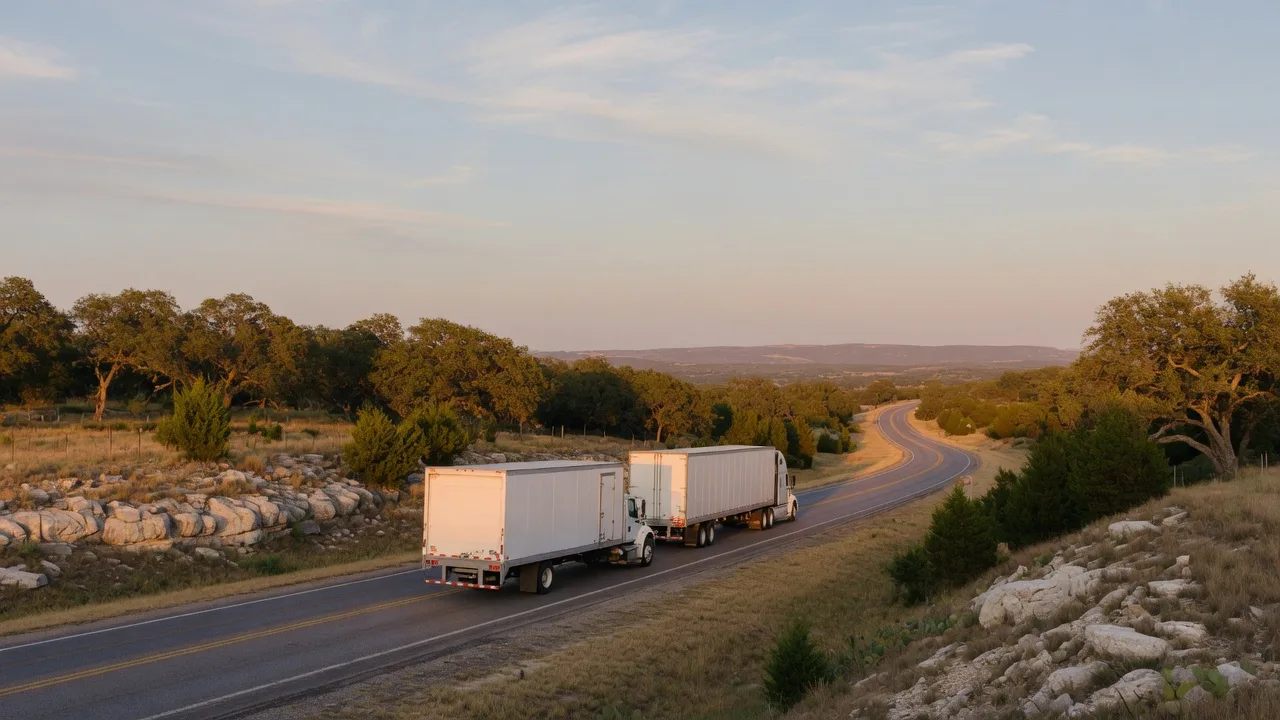
What does it actually cost to move a household from California to the Texas Hill Country? For a typical two-to-three-bedroom home, plan on roughly $3,500 to $8,300 for full-service movers, $2,000 to $6,500 for a container service,and $1,000 to $2,500 plus fuel for a do-it-yourself rental truck [1][3]. That spread exists because three very different services are sold under the same word, move. This guide walks through what each option actually includes, where the extra costs hide,and how to book so the number on your estimate matches the number you actually pay.
The three ways to move a household cross-country
Full-service van lines. A moving company sends a crew that packs your home, loads the truck, drives it cross-country,and unloads at your new house. If you choose full packing, you do little beyond being present for the estimate and overseeing the load. This is the most expensive option, and it is the right one when you need the move done in a tight window or you simply do not want to lift anything yourself [1].
Container services. Companies like PODS and U-Pack drop a container at your door. You pack it on your own schedule, they pick it up, ship it,and deliver it to your Texas address, sometimes holding it in storage for a monthly fee while you close on the new place. Containers generally run below full-service pricing, and they are a strong fit when your move-out and move-in dates do not line up perfectly [2][4].
Do-it-yourself rental trucks. You rent a truck, load it yourself (or hire local loaders at each end(,and drive it roughly 1,400 miles between California and the Hill Country. The base rental is the cheapest way to move by far,and the true cost is the fuel, the nights on the road,and your own time and effort [1][3].

How much each option actually costs
The ranges below apply to a typical two-to-three-bedroom home moving from California to Texas. Your exact number depends on total weight, distance within the state, how much you pack yourself,and the access at both homes [1][9].
California to Texas Move Cost by Method (Two-to-Three-Bedroom Home)
| Method | Typical Range | What You Get |
|---|---|---|
| Full-service van line | $3,500 to $8,300 | Crew packs, loads, drives,and unloads; binding quotes lock the price [1][3][9] |
| Container service | $2,000 to $6,500 | You pack on your schedule; company ships and delivers; storage available between closings [2][4] |
| DIY rental truck | $1,000 to $2,500 plus fuel | You drive about 1,400 miles one way; add near $500 in fuel at about 10 miles per gallon, plus lodging [1][3] |
Ranges reflect published 2025 cross-country moving cost data for the California-to-Texas corridor. Your quote varies with weight, packing, access,and season [1][2][3][4][9].
Where the hidden costs hide
Most legitimate moving surcharges are trigger-based: they appear only when your home or inventory differs from what the mover priced. Knowing them before the estimate means you can ask about each one directly [7][8].
- Fuel surcharges. Many carriers add a percentage of the job on top of the base price, sometimes up to about 10 percent, tied to diesel prices [7].
- Stair fees. Roughly $50 to $100 per flight of stairs above ground level, and the fee stacks per floor [7][8].
- Long-carry fees. When the truck cannot park within about 75 feet of your door, carriers charge $75 to $200 to cover the extra distance [7].
- Shuttle service. If a tractor-trailer cannot reach your street or driveway, goods are transferred to a smaller truck,and you pay an access fee you may never have heard of before [7][8].
- Elevator access fees. Apartment buildings that restrict freight elevators to off-hours or that require a building crew can add a surcharge [8].
- Storage. Containers charge roughly $150 to $300 per month to hold your goods when your closing dates do not align,and some van lines charge storage-in-transit on top of the move [2][7].
- Valuation coverage. The standard liability is minimal, at roughly $0.60 per pound; full-value protection costs extra but covers replacement cost rather than weight [7][8].
The published estimates on hidden moving costs suggest the add-ons can add up to more than $700 on a move, which is exactly why the binding quote you sign matters more than the headline number on the advertisement [7][8].
Binding versus non-binding estimates: what protects you
Federal rules from the Federal Motor Carrier Safety Administration (FMCSA) apply to interstate moves,and they give you more protection than most people realize. A mover must provide a written estimate of all charges before you agree to the service,and you should ask for it in writing every time [5][6].
A binding estimate locks in a fixed price based on the written inventory of your household goods. As long as your inventory and the services do not change, you pay the quoted amount regardless of actual weight. That protection is exactly why I push every family moving out of state to request one [5].
A non-binding estimate is a starting point that can change once your goods are weighed. The rules cap how much a mover can collect at delivery: no more than 110 percent of the non-binding estimate, with any remainder billed within 30 days. That sounds reasonable until you realize what a 10 percent swing means on a $7,000 move [6].
The other protection is FMCSA's constant warning: quotes that run 20 to 30 percent below reputable competitors on the same route often signal a hostage move, where the carrier recovers the difference through fees after your goods are loaded. Compare binding quotes from credible, USDOT-registered movers rather than picking the lowest number [7][13].

The timeline: when to book your move
Booking early is the cheapest thing you can do on this move. For a cross-country relocation, plan to book about 8 to 12 weeks out during peak season, and about 4 to 8 weeks out if you are moving off-peak [10][11]. The carriers on the California-to-Texas corridor fill up weeks in advance, and month-end dates go first, so the more flexible you can be on your exact dates, the more control you have over price [11][12].
Season matters more than most buyers expect. Peak season on this route runs May through September, when roughly 60 percent of American moves happen,and summer dates carry a 10 to 30 percent cost premium. Fall and winter off-peak moves can run 10 to 20 percent cheaper, which is a real line item on a multi-thousand-dollar move [12].

A realistic cost model: what a three-bedroom Hill Country move adds up to
Here is a concrete example built from the published ranges above, not a quote: a three-bedroom home of about 2,000 square feet moving from the Bay Area to Boerne, roughly 1,450 miles. A full-service binding quote near $6,500, a container service near $4,200,and a rental truck around $1,800 plus about $500 in fuel [1][3][9].
Now add the usual details. Full-value valuation coverage,and one flight of stairs, push the full-service scenario toward $7,000 to $7,800 [1][3]. The container scenario stays closer to $4,800 once you add local delivery fees on both ends,and it becomes very competitive if you need a month of storage between closings [2][4]. The DIY number depends mostly on how many nights you spend on the road and whether you hire local loaders at each end, which thousands of families do to split the difference [1][3][9].
Questions to ask every mover before you sign
- Is this estimate binding or non-binding, and will the total be locked once we agree on the inventory? [5]
- Is your pricing based on weight or on cubic footage,and which is better for my inventory? [1][13]
- Which of the trigger fees might apply to my address: stairs, long carry, shuttle, elevator access, or storage? [7][8]
- What is the standard valuation coverage,and what does upgrading to full value cost? [7][8]
- Do you dispatch your own crews, or do you subcontract, and who do I hold accountable if something goes wrong? [7]
- What is your USDOT number,and can you show me your FMCSA registration? [13]
- What is your scheduled pickup and delivery window,and what happens on paper if you miss it? [5][13]
Ways to keep the total down
- Get three to four binding quotes with the same, complete inventory, so you are comparing real numbers rather than ballparks [5][13].
- Pack yourself, or pack everything but the fragile rooms. Removing packing labor can trim a meaningful share of the full-service total [1][8].
- Move off-peak and aim for mid-month dates, when carriers have more capacity and prices run lower [12].
- Slim down before quoting. Furniture you will replace anyway costs you twice: once to ship it,and once to replace it. Most cross-country costs scale with weight and volume [1][3].
- Confirm the truck can reach both driveways before you book, which can avoid a shuttle fee that might cost more than a hundred dollars [7].
- If you are flexible on timing, ask movers about their slower weeks. The carriers fill up at month-end; the week right after the first of the month often has more availability [11][12].
How this fits into the bigger picture
For the families I work with, the moving bill is just one line in a much larger transition. If you are selling in California and buying in the Hill Country within the same window, our guide to coordinating a multi-state closing walks through the bridge financing, remote signings,and timing contingencies that make the two closings work together.
Once you arrive, day-to-day life changes in ways that surprise most California transplants: well water, septic, propane,and drive times all work differently here. Our piece on infrastructure and lifestyle transition explains what actually changes,and the Property Tax Reality Check walks through how Texas property taxes compare to your California tax picture. If you are wondering whether this move is part of a bigger pattern, our data-driven look at migration trends has the numbers,and our first 90 days checklist tells you what to handle first after the truck rolls away.
Every one of these moves has its own details,and the moving quote is just the first number you will see. If you are planning a California-to-Texas moveand want someone who has coordinated this corridor for other families, reach out. I will walk you through what the numbers actually look like on your route,and I will connect you with the local side of the transition. Contact Bill Ross.
Frequently asked questions
Is it cheaper to sell my furniture and ship less?
Usually, for the pieces you do not love or that are cheap to replace. Full-service costs scale strongly with weight,and containers charge by volume, so every piece you sell before the move trims the bill [1][3]. Run the math with replacement costs before you decide: a solid wood dining set that would cost $6,000 to replace is likely worth shipping, while an IKEA bookshelf you will replace anyway probably is not [1].
How accurate are online moving cost calculators?
They are ballparks built from regional averagesand useful for planning a budget, not for signing. The number that matters is the binding quote with a complete written inventory of exactly what you are moving [5][13]. The difference between the two can easily reach thousands of dollars once stairs, access,and services are factored in [7].
Do movers charge by weight or by volume for cross-country moves?
Interstate household movers commonly price by weight with distance tariffs, though some large national carriers quote by cubic foot. Ask which method your mover uses and get it in writing before the estimate walkthrough, because switching methods after your goods are measured changes the number [1][13].
What happens if my Texas closing date lands after my California move-out date?
That gap is exactly where container services shine. They hold your goods for a monthly storage fee, typically around $150 to $300 per month, and you schedule delivery once you control the keys [2][7]. Full-service movers can also store your goods in transit, but it adds cost, so budget for the gap explicitly rather than discovering it at the estimate [7].
Is the lowest quote the best deal?
Often not. The industry regulator and consumer groups warn that quotes 20 to 30 percent below reputable competitors on the same route can signal a plan to recover the difference through fees after your goods are loaded, a practice known as a hostage move [7][13]. Compare binding quotes from credible, USDOT-registered movers, and treat the lowest number with skepticism until you have read the estimate line by line.
Do I need to be present through the whole move?
For full-service, plan to be present for the in-home estimate and at both ends for the load and unload, so you can verify the inventory condition [1]. For containers, you just need the space clear and the truck able to reach the drop spot;you pack on your own schedule, which is part of why they work well for busy families [2][10].
Sources
- moveBuddha, "Moving from California to Texas." Route cost data for full-service, container,and DIY moves on the California-to-Texas corridor, based on 681 real quotes. movebuddha.com
- moveBuddha, "PODS Cost: Cost by Size, Distance, and Season." Container service cost ranges, storage fees,and seasonal price factors. movebuddha.com
- HomeGuide, "How Much Does It Cost to Move Across the Country?" Cross-country full-service and DIY cost ranges by home size. homeguide.com
- move.org, "U-Pack 2026 Review: Pricing and Services." Container shipping cost averages and how U-Pack pricing works. move.org
- U.S. Department of Transportation, Federal Motor Carrier Safety Administration (FMCSA), "What is a binding move estimate?" Federal definition of binding estimates,and what locks in the price. fmcsa.dot.gov
- U.S. DOT FMCSA, "Estimating Charges (Subpart D)." Federal written-estimate rules, including the 110 percent collection cap on non-binding estimates. fmcsa.dot.gov
- FreightWaves, "Hidden Fees Moving Companies Charge." Reports on fuel surcharges, stair fees, long-carry charges, shuttle services,and other add-ons. freightwaves.com
- moveBuddha, "Hidden and Unexpected Moving Costs." Practitioner guide to additional moving costs including storage, valuation,and access fees. movebuddha.com
- National Van Lines, "What Does a California to Texas Move Really Cost?" Mover-published cost breakdown for the route. nationalvanlines.com
- U-Pack, "How Far in Advance Should I Book a Moving Company?" Booking guidance and lead-time expectations for long-distance moves. upack.com
- North American Van Lines, "How Far in Advance Should You Book Movers?" Mover guidance on booking windows for interstate moves. northamerican.com
- moveBuddha, "When Is Peak Moving Season?" Data on when most moves happen,and the cost premium carriers charge during peak months. movebuddha.com
- U.S. DOT FMCSA, "Frequently Asked Questions (Written Estimates." Consumer guidance on written estimates, moving scams,and verification of movers. fmcsa.dot.gov
Last verified: September 7, 2026
Written by Bill Ross, Hill Country Homesteads Group, brokered by Keller Williams Boerne. Serving Boerne, Fair Oaks Ranch, San Antonio,and the surrounding Hill Country communities.
The numbers above come from published cross-country moving cost data;every move is different,and your binding quote with a complete inventory is the only number that should guide your signature. If you are planning this transition, I am happy to walk through the local side of it with you.
Published: September 7, 2026
Updated September 7, 2026