
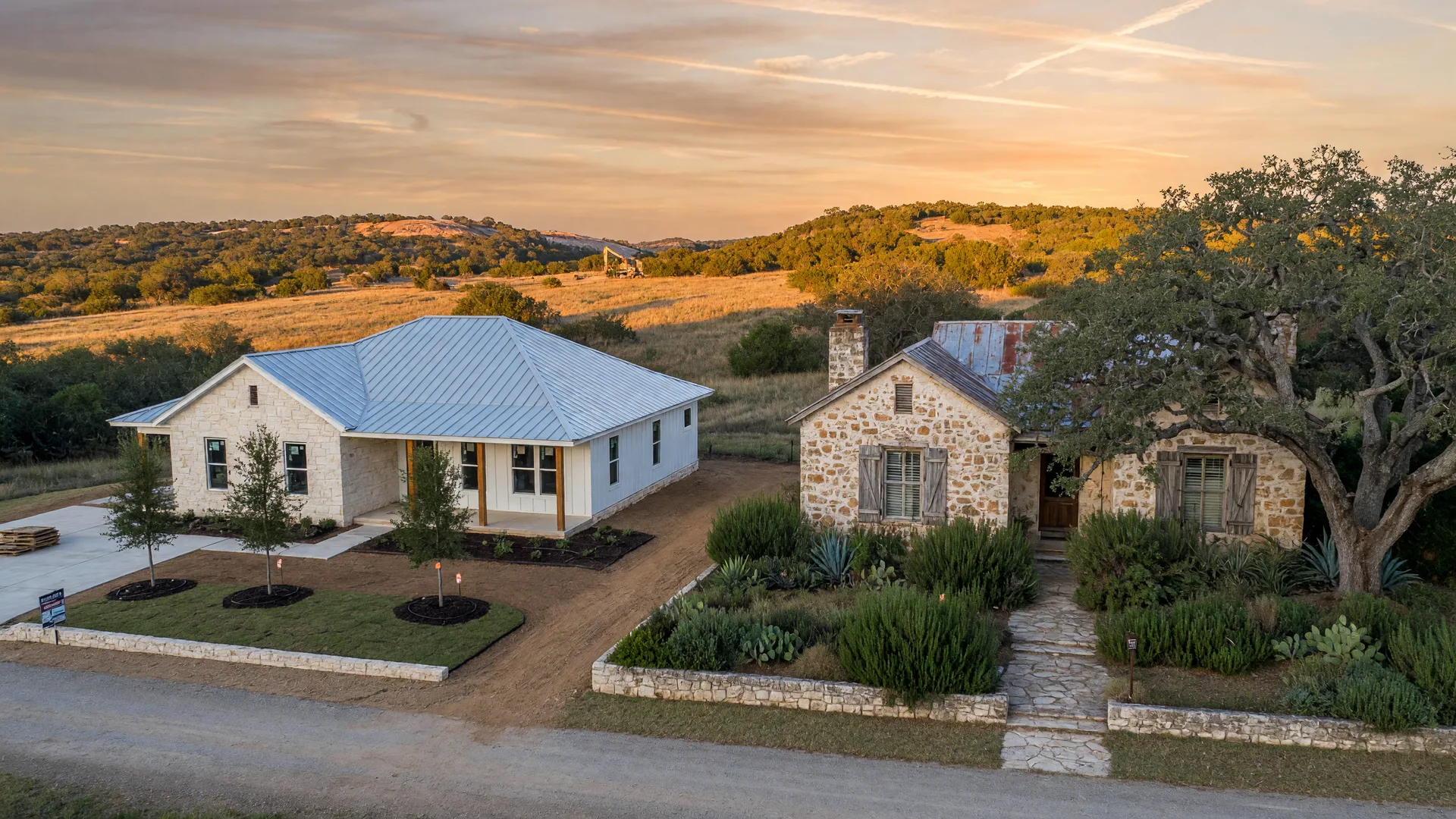
New construction versus resale is the decision I help more buyers work through than any other, especially families relocating from California who expect a new build to be a simple, premium upgrade. In the Hill Country it is usually not that simple. The advertised base price on a new home rarely matches the price you actually pay, and an existing home's list price rarely tells you what it will cost to make it your own. This guide compares the two on the numbers that matter: per-square-foot pricing, lot premiums, upgrade budgets, build timelines, site work on raw land, and warranties, so you can make the call with your eyes open [1][4][8].
I have represented buyers on both sides of this decision in Boerne, Fair Oaks Ranch, and the surrounding communities, and the honest answer is that neither choice is universally better. New construction buys you control; resale buys you certainty. The right answer depends on your timeline, your budget discipline, and how you feel about waiting through a build.
The headline numbers: what the market data actually says
Boerne's market data shows why this comparison matters. The San Antonio Board of Realtors Q4 2025 Kendall County report put the countywide median sale price at roughly $627,900, with an overall price per square foot around $255 [1]. New-construction listings in Boerne averaged closer to $280 per square foot in the same period, so the new-build premium on a square-foot basis is real but not enormous [2]. Through early 2026, the 78006 ZIP code median tracked around $668,000, which tells you how much of Boerne's market now sits above the countywide median [3].
Here is the first thing to understand: the square-foot gap is the least important number in this comparison. The total-cost gap between a new build and a resale is driven by everything attached to the base price: the lot, the upgrades, the landscaping, the carry costs while you wait, and the site work on raw land. Square footage is where the conversation starts, not where it ends.
| Metric | New Construction | Resale |
|---|---|---|
| Price per square foot, Boerne area | ~$280 average for new listings [2] | ~$255 countywide median [1] |
| Median price, Kendall County (Q4 2025) | Skews above $627,900; new product prices higher [1] | $627,900 countywide median, mixed composition [1] |
| Timeline to move in | 4 to 18 months depending on build type [4][5][6] | 30 to 60 days typical after contract |
| Price certainty at contract | Base price plus estimated extras; final number moves [8] | Final price known at contract; inspection may open renegotiation |
Figures are area benchmarks from the cited sources and shift by month, ZIP boundary, and builder. Verify current numbers for the specific property.
What a new build actually costs beyond the base price
Every buyer I have ever taken through a new-construction home center hits the same wall: the price on the sign is the base, and the house on the sign is rarely the base. Builders separate the price into layers, and the layers add up quickly.
Lot premiums. The homesite itself is priced separately. A standard interior lot might carry no premium at all, while a corner, a greenbelt view, a wooded tract, or an acreage lot can add from a few thousand dollars to $50,000 or more [9][10]. In Boerne's master-planned communities, hilltop and view lots sit at the top of that range, and the premium is paid before a single stick of framing goes up.
Upgrades and options. The selection process converts a base house into the house you actually want: flooring, cabinetry, countertops, fixtures, an expanded garage, a covered patio, and all the other choices. Industry guidance puts a typical upgrade spend at 10 to 20 percent of the base price, and 20 to 30 percent when you add landscaping and window treatments [8]. On a $600,000 base, that is $60,000 to $120,000 in selections. Buyers in Boerne's newer communities routinely end up $50,000 to more than $100,000 over the advertised base once selections are made [10].
What is not included. Depending on the builder and the community, the base price may exclude the fence, the backyard landscaping, sod and irrigation, window coverings, and sometimes the driveway approach. These are real line items on a new home, and buyers from California are usually the most surprised, because a ready-to-occupy home there typically includes all of them.
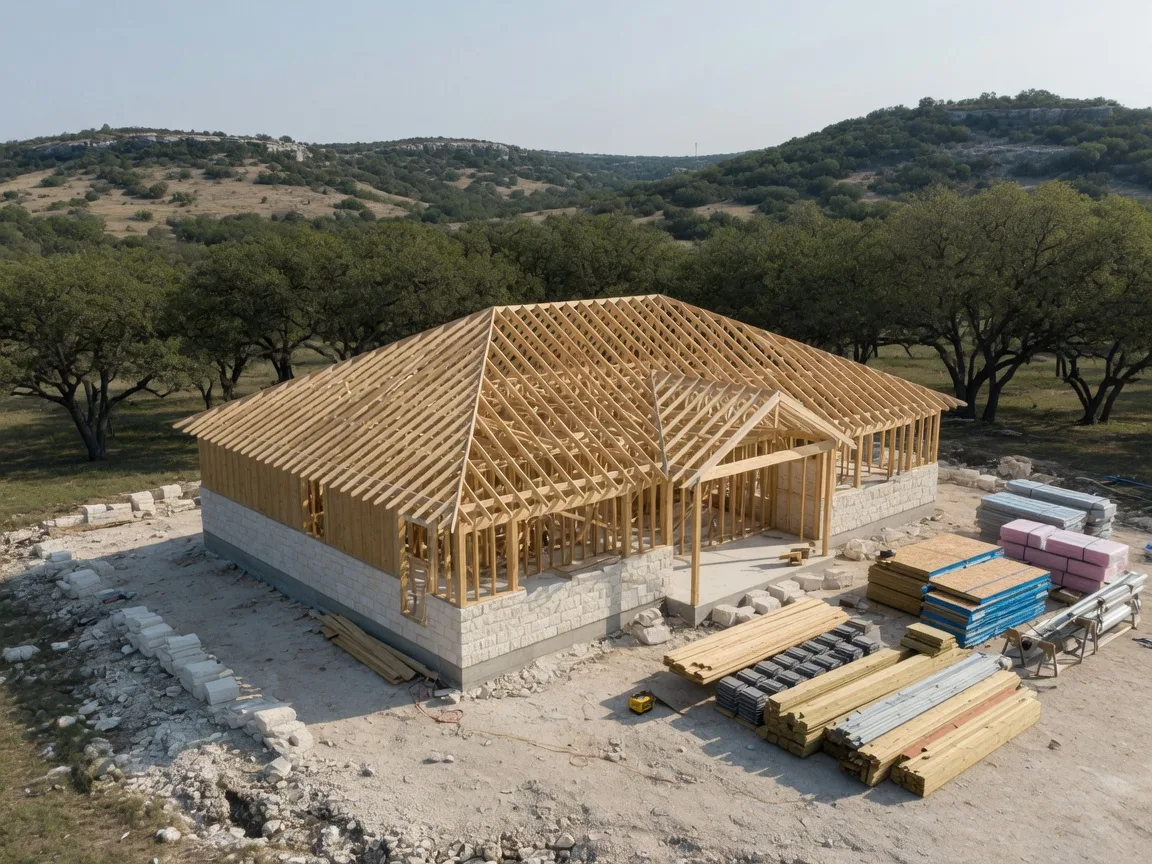
None of this means new construction is a bad deal. It means the comparison has to be done properly: the total finished cost of the new home versus the total occupied cost of the resale, not the base price versus the list price. I walk every new-construction buyer through a line-item budget that includes lot premium, selections, landscaping, and a contingency before they ever make an offer. It is the only honest way to compare [8]. For a tour of the builders and communities on the ground, see the site's Boerne New Construction Guide.
The timeline: what move-in ready actually means in 2026
The second big difference is time. If you are relocating on a fixed schedule, with a house closing in California on a set date, the timeline can decide the question on its own.
Texas-wide and San Antonio-area guidance puts production homes, the ones a volume builder sells off a floor plan, at roughly four to seven months from contract to close, with San Antonio estimates at four to six months for a build that has started and longer if you buy at the foundation stage [4][7]. Semi-custom and build-on-your-own-lot projects run seven to ten months or more [5]. Fully custom homes, the typical route in communities like Cordillera Ranch and on acreage, run twelve to eighteen months, and complex luxury builds can stretch past that [6].
| Build Type | Typical Timeline | Best Fit |
|---|---|---|
| Production home (volume builder) | 4 to 7 months [4][7] | Buyers with some schedule flexibility who want a finished, warrantied home |
| Semi-custom / own lot | 7 to 10+ months [5] | Buyers with land already and some customization appetite |
| Fully custom | 12 to 18+ months [6] | Buyers building a specific home on acreage or in a gated community |
| Resale closing | 30 to 60 days after contract | Buyers with a hard move date, especially out-of-state relocations |
Timelines are benchmarks from Texas builders and San Antonio market guides; Hill Country rock, terrain, permitting, and design time regularly add to the top end [5][6].
The timeline matters twice as much for a coast-to-coast relocation. If you are coordinating the sale of a California home with the purchase of a Texas home, a production build can work inside a single window, but a custom build almost always requires bridge housing. See Coordinating a Multi-State Closing for how that timing logic works, and California vs. Texas: The Real Cost Comparison Model for the full financial framing.
Building on your own lot adds a site-work layer
If the new home is going on raw acreage rather than in a subdivision with utilities at the street, there is a third layer that out-of-state buyers almost never see coming: site work. The house is one project. Getting water, sewer, power, and a driveway to the house is a separate project with its own budget and its own timeline.
Hill Country benchmarks from 2025 and 2026 put the combined cost in rough ranges: a drilled well at $6,000 to $30,000 depending on depth and rock [12], an aerobic septic system at $10,000 to $20,000 because Edwards Aquifer protection rules usually rule out a conventional drain field [11], and electric service runs at $2,500 to $12,500 or more depending on how far the pole is [13]. A gravel or concrete driveway adds thousands more. Together, buyers on raw land commonly budget $35,000 to $75,000 or more for site work before the foundation is poured.
These are exactly the topics covered in depth on this site's infrastructure guides: Understanding Well Depths and Aquifer Levels, Septic Systems: What Hill Country Buyers Must Understand, and Raw Land vs. Improved Land. If your new build sits on raw land, read all three before you price the lot.
Warranties: what the 1-2-10 actually covers
New construction's biggest structural advantage is the warranty, and it is worth understanding precisely, because the marketing is loose but the contract is specific. The standard Texas limited express warranty, commonly called the 1-2-10, covers defects in workmanship and materials for one year, the delivery systems (wiring, piping, and ductwork in the electrical, plumbing, heating, cooling, and ventilation systems) for two years, and major structural defects for ten years [14][15].
Two caveats matter in 2026. First, the old Texas Residential Construction Commission is gone; in Texas today, no builder is legally required to provide any warranty unless it is written into the purchase contract, so the 1-2-10 is a contractual promise you should read, not a state guarantee [14]. Second, a 2023 Texas law lets builders cap their structural exposure at six years with a written warranty and a six-year statute of repose, so newer contracts may say 1-2-6 instead of 1-2-10 [16]. Ask to see the actual warranty document before you sign, and confirm which term applies to your contract [17].
A resale carries no such promise, which is why the inspection contingency is the resale buyer's warranty. A good home inspection, a well and septic evaluation on acreage, and a title review are the existing home's version of the 1-2-10, and they happen before you close instead of after.
Where new construction wins
For the right buyer, the new build is the better value, and it is worth stating plainly where it wins.
- •Control over condition. No deferred maintenance, no aging roof or HVAC, no mystery plumbing. The home starts at zero wear.
- •Modern building standards. New construction in Texas meets current energy codes, which means better insulation, better windows, and real utility savings compared to an older structure [7].
- •Builder financing incentives. Volume builders regularly pair the sale with rate buydowns or lender credits worth real money, though the incentive is priced into the home, so compare it against an equal offer on resale rather than taking it at face value [7].
- •Customization. The finishes, the layout choices, and the lot position are yours from day one, which is worth something real to buyers with strong preferences.
Where resale wins
The existing home has advantages that show up on move-in day, and often in the budget.
- •Immediate occupancy on a hard schedule. A 30 to 60 day close is predictable, which is the whole ballgame for a family with a start date or a school calendar.
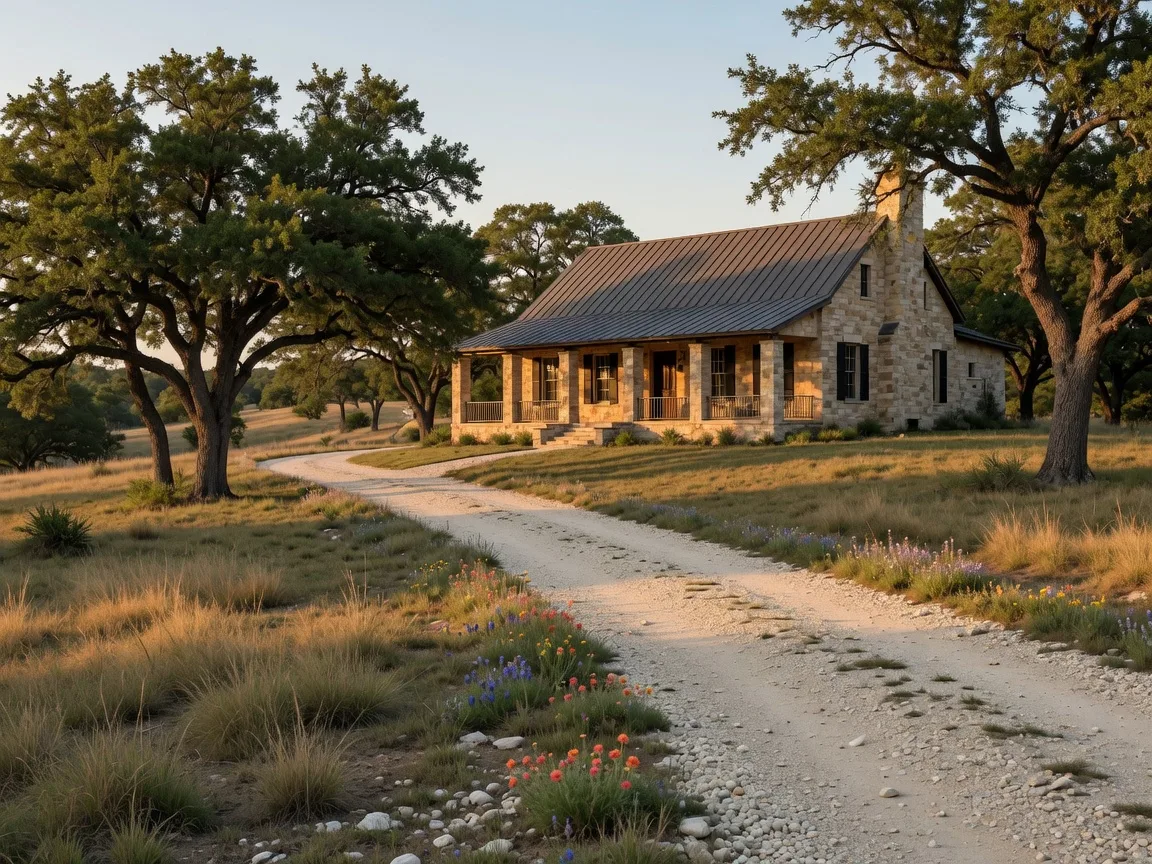
- •Mature landscaping. You cannot buy fifty-year-old live oaks. Established trees, shade, and settled grading come with the existing home.
- •A known neighborhood track record. The HOA's finances, the flood history, the actual drive time, and the school reality are all observable facts rather than projections. See HOA vs. No HOA for what deed restrictions really govern.
- •Price certainty and negotiation room. The agreed price is the price, and an inspection can surface items the seller fixes or credits. There is no upgrade allowance math and no lot premium surprise.
- •No construction risk. No builder delay, no permit stall, no change-order overrun, and no discovery of rock on the site after you have committed.
Honest comparison by price band
Boerne's market is not one market, and the new-versus-resale decision looks different in each band. The table below reflects how the choice actually plays out.
| Price Band | New Construction | Resale |
|---|---|---|
| Under $500,000 | Thin. Most new Hill Country product prices above this band, so options are limited to smaller production plans [1] | The realistic route in Boerne and much of Kendall County; inventory is thin but it exists [1] |
| $500,000 to $800,000 | The volume zone for master-planned product: expect lot premiums and $50,000 or more in selections [8][10] | Strong existing inventory, including homes with mature trees in Fair Oaks Ranch and established Boerne neighborhoods [2] |
| $800,000 to $1.5 million | Custom and semi-custom on view lots; the lot often drives the total as much as the house [9][10] | Gated-community resales with golf, acreage, and established landscaping [2] |
| $1.5 million and up | The estate-build band: 12 to 18+ months and the highest site-work and customization exposure [5][6] | Estates with legacy landscaping and established infrastructure; scarce but choosy |
Bands are approximate and shift with the quarterly market data. For a neighborhood-level view, see Hill Country Micro-Market Trends. For how nearby growth can move an existing home's value in either direction, see Growth Pressure and New Development.
Questions to ask before you choose
Whichever direction you lean, these are the questions that separate a well-informed decision from an expensive surprise.
If you are leaning new construction:
- •What is the total finished cost, including lot premium, selections, landscaping, fence, and window coverings, written as one number?
- •What timeline is in the contract, and what happens if the builder misses it? Is there a penalty, or can the date move freely?
- •What is excluded from the price: driveway, sod, irrigation, fencing, blinds? Get the exclusion list in writing.
- •Is the warranty transferable if you sell before year ten, and does the 1-2-10 or the newer 1-2-6 term apply to your contract [16][17]?
- •Which school district serves the exact lot, not just the marketing ZIP? Boundaries cross ZIP codes, and the details matter for a family.
If you are leaning resale:
- •What are the ages of the roof, HVAC, water heater, and appliances? Ask for dates in writing and verify them on the inspection.
- •On acreage: when was the well drilled, what is the flow, and when was the septic serviced? See the well and septic guides linked above.
- •Has the home flooded, and is it in a mapped floodplain? Resale gives you verifiable history, which is worth more than you might think.
- •What do the HOA or deed restrictions actually govern, and what are the association's financials? See HOA vs. No HOA for what to check.
- •Does the sale price reflect the home as it sits, or will it need real work? Price the needed repairs into your offer before you write it.
Frequently Asked Questions
Is new construction always more expensive per square foot in Boerne?
Generally yes, but the gap is modest. New-construction listings in Boerne averaged around $280 per square foot versus roughly $255 countywide, so the new-build premium is real but not huge [1][2]. The much larger cost difference comes from lot premiums, upgrades, landscaping, and the timeline, not from the per-square-foot rate itself.
How long does a new home actually take to build in 2026?
Plan on four to seven months for a production home, seven to ten months or more for semi-custom or own-lot builds, and twelve to eighteen months for a fully custom home in the Hill Country [4][5][6]. Rock, terrain, and local permitting push custom builds toward the top of those ranges, and raw-land site work adds time before construction even starts.
Are builder financing incentives worth it?
They are worth comparing carefully. A rate buydown from a volume builder can be worth tens of thousands of dollars in interest savings, but the incentive is built into the price of the home [7]. Compare builders who offer credits against builders who do not, and against what sellers are willing to credit on resale, using the same down payment and the same rate. Then the choice is apples to apples.
Do I still need a home inspection on new construction?
Yes. New homes should have a pre-drywall inspection and a final walkthrough inspection, and you should review the warranty claim process before you close [7][17]. The 1-2-10 warranty only helps you if you document the defects and file the claim correctly, and a third-party inspection is the documentation that makes it work.
How do property taxes differ between a new home and a resale?
Both are reappraised after you buy, and both benefit from a homestead exemption filed in your first year. The practical difference is that a new build in a developing community may take a few years for the appraisal district to fully value, while an existing home often resets to its sale price faster. Estimate the post-purchase bill either way; see the site's Ad Valorem Tax Shock guide for how to do that.
The bottom line
New construction in the Hill Country buys control: a home that starts at zero, a modern envelope, and the ability to choose the lot and the finishes. Resale buys certainty: a known closing date, a known price, mature trees, and neighborhood history you can verify. Neither is the objectively better value, because the better value depends on your timeline, your budget discipline, and your tolerance for waiting through a build. Run the total-cost math, not the base-price comparison, and bring the questions above to either table. The right answer is the one you can execute without stress, and my job is to make sure you see the full picture before you choose.
If you are weighing a new build against an existing home in Boerne, Fair Oaks Ranch, or the surrounding communities, I can walk you through the line-item comparison for a specific property. Contact Bill Ross for a direct conversation.
Sources
- San Antonio Board of Realtors, Q4 2025 Kendall County market report, via Summers Real Estate. Countywide median sale price of approximately $627,900 and overall price per square foot around $255. summersre.com
- My Texas Home Resource, "Boerne TX New Construction Homes for Sale." Average price per square foot on new-construction listings in Boerne. mytexashomeresource.com
- HAR.com, ZIP 78006 price trends. 78006 median price trend through early 2026, including the ~$668,000 March 2026 reading. har.com
- InTown Homes, "New Home Build Process in Texas." Production-home timeline benchmarks of roughly four to seven months in Texas. intownhomes.com
- Dunn and Stone Builders, "How Long Does It Take To Build A House In Texas?" Semi-custom and custom timeline ranges, including seven to ten months for semi-custom builds. dunnandstonebuilders.com
- Urban Lux Co, "Custom Home Building Timeline San Antonio." Twelve to eighteen month standard range for custom homes in the San Antonio and Hill Country market. urbanluxco.com
- LRG Realty, "New Construction Homes in San Antonio: 2026 Buyer Guide." Production build timelines, builder incentives, and warranty-plan basics for Texas new construction. lrgrealty.com
- Cypress Mortgage Pro, "The Hidden Costs of New Construction Homes." Upgrade spending guidance of 10 to 20 percent of base price, plus landscaping and window treatment costs. cypressmortgagepro.com
- Red Door Metro, "What Is a Lot Premium on a New Construction Home?" How lot premiums work and the range of premiums by lot desirability. reddoormetro.com
- Weigand Real Estate, "New Home Developments in Boerne, TX: 2026 Buyer Guide." Boerne-area master-planned communities, lot premium behavior, and the $50,000-plus upgrade reality in new communities. weigandrealestate.com
- Texas Septic Guide, "Aerobic Septic System Cost in Texas." Aerobic system cost range of roughly $10,000 to $20,000, typical when Edwards Aquifer protection rules apply. texassepticguide.com
- DrillerDB, "Texas Well Drilling Costs." Drilled well cost range of roughly $6,000 to $30,000 depending on depth, casing, and rock. drillerdb.com
- HomeGuide, "How Much Does It Cost to Get Utilities on Land?" Electric service run cost benchmarks for rural properties. homeguide.com
- The Holmes Firm, "Why Are Residential Builders Still Providing 1, 2, and 10 Year Limited Express Warranties?" How the Texas 1-2-10 warranty works and the post-TRCC contractual reality. theholmesfirm.com
- StrucSure, "1-2-10 Warranty." The standard one-year workmanship, two-year systems, and ten-year structural warranty structure. strucsure.com
- Lexology, "Texas Shortens Cut-Off Date for Suits Against Homebuilders Who Provide a 6-Year Written Warranty." The 2023 Texas law (HB 2023) allowing six-year structural warranties and a six-year statute of repose for newer contracts. lexology.com
- LRG Realty, "New Build Timeline and Warranty Plan in Texas." Practical overview of the new-build timeline and the warranty plan buyers should expect in Texas. lrgrealty.com
Build timelines, lot premiums, and upgrade costs vary by builder, community, and season. The figures cited are area benchmarks from the listed sources, not quotes for a specific home. Verify the current numbers with the builder, the listing, and your agent before you decide.
Last verified: September 10, 2026
Published: September 10, 2026
Updated September 10, 2026